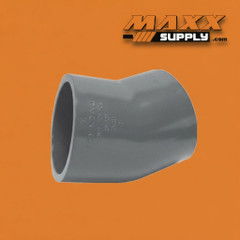


11 1/4 Degree Elbow, Slip x Slip PVC Schedule 80 10" (861-100)
$341.63
The 10" Schedule 80 Gray PVC 11.25 Degree Elbow (861-100, Slip x Slip) is a large-diameter, heavy-wall thermoplastic direction-change fitting manufactured to ASTM D2467 in Schedule 80 gray PVC — a two-port fitting in which both connections are 10" IPS slip socket ends, providing a single-body Schedule 80 PVC solution for changing the direction of a 10" Schedule 80 PVC primary main by exactly 11.25 degrees at a primary main layout direction-change location, without a mitered field fabrication joint, without transitioning out of Schedule 80 gray PVC construction at the direction-change point, and without changing the primary main's pipe size or dividing its flow at the bend location. The 861-100 is the correct fitting wherever a 10" Schedule 80 PVC primary main must change direction by 11.25 degrees — where the upstream 10" IPS pipe end enters the elbow's inlet socket in the primary main's upstream routing direction, the fitting body turns the flow axis by exactly 11.25 degrees through the manufactured elbow geometry, and the downstream 10" IPS pipe exits the elbow's outlet socket in the primary main's new downstream routing direction offset by 11.25 degrees from the upstream axis — and it is equally the component fitting of choice wherever two 861-100 elbows achieve a distributed 22.5-degree direction change, wherever four 861-100 elbows achieve a distributed 45-degree direction change, or wherever eight 861-100 elbows installed in sequence with connecting pipe sections between them achieve the absolute lowest-minor-loss distributed 90-degree direction change configuration available in the 10" Schedule 80 PVC socket fitting ecosystem. As the gentlest standard direction-change fitting of the 10" Schedule 80 PVC socket fitting ecosystem — producing the smallest resultant angular thrust force per fitting body (~0.196 × P × A) and the lowest hydraulic minor loss coefficient per fitting body of any standard elbow angle documented in this catalog at the 10" primary main service level — the 861-100 represents the hydraulic efficiency and thrust restraint reduction frontier of the 10" Schedule 80 PVC primary main direction-change fitting range, serving the most hydraulically demanding and most thrust-restraint-sensitive direction-change specifications on 10" Schedule 80 primary transmission and distribution mains where the absolute maximum achievable minor loss reduction per fitting body governs the elbow angle selection.
The 861-100's commercial identity is defined by the same direction-change function as the 856-100, 857-100, and 865-100 — executing a change in the primary main's flow direction at a manufactured fitting body without altering the pipe size, dividing the flow into a branch, or adapting another fitting's socket — distinguished from all three previously documented elbow angles by the minimum magnitude of the direction change and all hydraulic and civil engineering consequences that flow from that minimum magnitude. The 861-100 does not reduce the pipe size, divide the primary main's flow into a branch, or adapt another fitting's socket: it is an independent fitting body in the primary main pipe run whose sole function is to change the direction of the primary main's flow axis by exactly 11.25 degrees at the fitting body, in any of the four application configurations — single-body, two-fitting, four-fitting, or eight-fitting — that define its complete commercial role at the 10" Schedule 80 PVC primary main service level.
The 11.25-degree direction change that the 861-100 executes has a defining hydraulic and structural consequence — the angular thrust force at the bend — that is quantitatively the smallest of any standard elbow angle in the 10" Schedule 80 PVC primary main fitting ecosystem, and whose magnitude and direction together establish the 861-100 at the most extreme end of the thrust force reduction progression documented across the 856-100, 857-100, and 865-100 elbow pages in this catalog. At a 11.25-degree bend, the resultant angular thrust force formula — 2 × P × A × sin(θ/2) — produces 2 × P × A × sin(5.625°) ≈ 0.196 × P × A, directed at 5.625 degrees outward from the bend corner in the plane of the bend, bisecting the 11.25-degree angle between the upstream and downstream pipe axes. The 861-100's resultant thrust force at 5.625 degrees from both pipe axes is so nearly aligned with the primary main's routing axis that the thrust block bearing surface — which must be oriented perpendicular to this nearly-inline resultant — approaches the orientation of a trench cross-section face perpendicular to the primary main's routing axis, bearing primarily in the nearly-inline pipe axis direction against undisturbed soil ahead of the fitting in the routing direction. This nearly-exactly-inline bearing geometry is the most extreme version of the nearly-inline bearing characteristic documented at the 865-100's 11.25-degree resultant, and demands the same explicit confirmation that undisturbed soil is available in the 5.625-degree bearing direction at each buried 861-100 installation — with the critical additional recognition that the 5.625-degree resultant's bearing vector is so closely aligned with the pipe axis that a shallow trench without adequate undisturbed soil ahead of the fitting in the pipe routing direction may not provide sufficient bearing resistance without restrained joint pipe or deadman block construction in the nearly-inline direction.
The complete thrust force comparison across all documented standard elbow angles in this catalog at the same 10" IPS pipe size and same operating pressure establishes the 861-100's position at the absolute minimum-thrust end of the standard elbow angle progression: the 861-100 at 11.25 degrees produces ~0.196 × P × A — approximately 14% of the 856-100's ~1.414 × P × A at 90 degrees, approximately 26% of the 857-100's ~0.765 × P × A at 45 degrees, and approximately 50% of the 865-100's ~0.390 × P × A at 22.5 degrees. At the 10" primary main service level with a full Schedule 80 system operating pressure, the 861-100's ~0.196 × P × A resultant thrust force is still a meaningful civil engineering load at the 10" IPS cross-sectional area — requiring engineered concrete thrust block construction or approved mechanical joint restraint at every buried 861-100 installation without exception — but its reduced absolute magnitude and nearly-inline direction produce the smallest individual thrust block bearing area of any standard elbow angle in the 10" Schedule 80 PVC socket fitting ecosystem, and the distribution of the total 90-degree direction change across eight individual 861-100 bend events produces eight modest civil thrust restraint engineering elements — each engineered independently from a ~0.196 × P × A load in a sequentially different nearly-inline bearing direction — rather than one large thrust restraint event at a single 90-degree fitting body. The civil scope advantage of this eight-event distribution over the single 856-100 thrust block event is the most practically significant infrastructure construction advantage of the eight-fitting 11.25-degree distributed 90-degree configuration over all simpler direction-change configurations at the same routing location, and must be weighed by the primary system engineer alongside the hydraulic efficiency advantage in evaluating the eight-fitting configuration's total project benefit relative to the simpler single-body or two-fitting or four-fitting alternatives at each specific 90-degree bend location.
The eight-fitting distributed 90-degree configuration of the 861-100 requires extended treatment as the fitting's most commercially distinctive and technically complex application context — the configuration that represents the absolute frontier of hydraulic efficiency and thrust restraint reduction in the 10" Schedule 80 PVC primary main direction-change fitting ecosystem and that governs the 861-100's specification at the most hydraulically demanding large-diameter primary transmission main routing change locations. When eight 861-100 elbows are installed in sequence with connecting 10" IPS pipe sections between each adjacent pair — the first 861-100 turning the primary main by 11.25 degrees, the first connecting pipe section extending the routing in the new 11.25-degree-offset direction for the minimum reestablishment length, the second 861-100 adding another 11.25 degrees to reach 22.5 degrees cumulative, the second connecting pipe section, the third 861-100 reaching 33.75 degrees, the third connecting pipe section, the fourth reaching 45 degrees, the fourth connecting section, the fifth reaching 56.25 degrees, the fifth connecting section, the sixth reaching 67.5 degrees, the sixth connecting section, the seventh reaching 78.75 degrees, the seventh connecting section, and the eighth 861-100 completing the total 90-degree direction change — the resulting eight-sequential-bend distributed geometry produces the lowest achievable combined hydraulic minor loss coefficient of any standard configuration for accomplishing a 90-degree direction change in the 10" Schedule 80 PVC socket fitting ecosystem. Each of the eight 11.25-degree individual bends is the gentlest available standard single-body direction change, producing the minimum flow separation, turbulence generation, and secondary flow energy dissipation per bend body of any standard fitting angle, and the seven connecting pipe sections between sequential bends allow progressive flow profile reestablishment between each sequential bend pair — the overall accumulated flow disturbance across the eight-bend sequence being the minimum achievable through any standard 90-degree direction change assembled from manufactured Schedule 80 PVC socket elbows. At the 10" primary main service level — where the primary transmission main carries the largest flow volumes in the 10" Schedule 80 distribution system and where the absolute hydraulic minor loss per direction-change fitting event at primary transmission main design flows is largest in absolute magnitude — the minor loss reduction from the eight-fitting 11.25-degree distributed configuration represents the maximum achievable hydraulic head recovery relative to any simpler direction-change configuration, and on 10" primary transmission mains serving large distribution areas over long transmission distances where every available foot of hydraulic head is budgeted to maintain required delivery pressure at remote service points, this maximum hydraulic efficiency configuration may be warranted at the most hydraulically critical 90-degree routing turns even at the cost of the configuration's substantially extended routing footprint and complex multi-fitting assembly planning.
The total routing corridor footprint requirement of the eight-fitting 90-degree configuration is the dominant practical constraint governing its feasibility at specific bend locations and must be evaluated before the configuration is specified at any 90-degree routing change. Each connecting pipe section between two sequential 861-100 elbows must be long enough — minimum approximately five to ten pipe diameters, or approximately four to eight feet at the 10" IPS nominal size — to allow the flow profile to substantially reestablish between sequential bends. The eight-fitting 90-degree assembly therefore requires a total corridor length through the direction-change zone of approximately eight 861-100 fitting body face-to-face dimensions plus seven minimum connecting pipe section lengths — a total assembly footprint of minimum approximately twenty-eight to fifty-six feet at the 10" IPS scale between the inlet socket of the first 861-100 and the outlet socket of the eighth 861-100, with longer connecting sections increasing flow reestablishment quality and extending the total footprint proportionally. This minimum twenty-eight to fifty-six-foot extended footprint — substantially longer than the 865-100's four-fitting 90-degree configuration's fifteen-to-thirty-foot minimum footprint and far longer than the 857-100's two-fitting 90-degree configuration or the 856-100's single-body footprint — constrains the eight-fitting configuration to routing locations where the primary main's available corridor provides this extended straight-run length through the direction-change zone: open-terrain primary transmission main routes through agricultural land, large-parcel commercial or industrial properties, and regional water system transmission corridors where the routing right-of-way provides extended unobstructed corridor length at 90-degree routing turns; water treatment plant primary header routes through extended gallery structures with adequate gallery run length through the direction-change zone; pump station primary header routes through extended header bay structures with adequate bay depth; and large commercial campus primary distribution main routes where underground routing corridors of adequate length exist at 90-degree campus layout turns. At routing locations where the available corridor cannot accommodate the eight-fitting footprint — which includes the majority of urban and suburban confined right-of-way environments, most pump station vault dimensions, most treatment plant gallery direction-change zones, and most campus infrastructure corridor routing turns — the four-fitting 865-100 configuration, the two-fitting 857-100 configuration, or the single-body 856-100 is the only spatially viable option, and the 861-100's eight-fitting configuration should not be specified without corridor length confirmation from the piping layout drawing.
The four-fitting distributed 45-degree configuration of the 861-100 — four 861-100 elbows with connecting pipe sections achieving a total 45-degree direction change — parallels the 865-100's four-fitting distributed 90-degree configuration in its assembly planning complexity and corridor length requirement, applied at 45-degree routing changes where the primary system engineer evaluates the 861-100 four-fitting distributed geometry against the 857-100 single-body and the 865-100 two-fitting distributed alternatives. The four 861-100 elbows in the 45-degree distributed configuration produce a lower combined minor loss than either the single 857-100 or the two-fitting 865-100 distributed configuration at the same total 45-degree direction change, with four individual ~0.196 × P × A thrust events rather than two 865-100 ~0.390 × P × A events or one 857-100 ~0.765 × P × A event. The four-fitting 45-degree assembly footprint — four fitting bodies plus three minimum connecting sections — requires approximately twelve to twenty-four feet of minimum corridor length at the 10" IPS scale, feasible at a wider range of routing locations than the eight-fitting 90-degree configuration but still requiring explicit corridor length confirmation before specification.
The two-fitting distributed 22.5-degree configuration of the 861-100 — two 861-100 elbows with a connecting pipe section achieving the same total 22.5-degree direction change the 865-100 achieves in a single body — provides an incremental hydraulic minor loss advantage over the single-body 865-100 at 22.5-degree routing change locations where the routing corridor accommodates the two-fitting footprint. The two individual ~0.196 × P × A thrust events in the two-fitting configuration are each approximately half the single-body 865-100's ~0.390 × P × A thrust event at the same 22.5-degree total direction change. The two-fitting 22.5-degree assembly footprint — two fitting bodies plus one minimum connecting section — requires approximately four to eight feet of minimum corridor length beyond the fitting body face-to-face dimensions, feasible at nearly any routing location that can accommodate two sequential 10" IPS socket fittings with a minimum connecting pipe section between them.
The selection framework among the 861-100, 865-100, 857-100, and 856-100 at any 10" Schedule 80 primary main direction-change location requires a four-way evaluation — across single-body, two-fitting, four-fitting, and eight-fitting distributed configurations — that is the most complex fitting selection decision in the 10" Schedule 80 PVC primary main direction-change fitting ecosystem and that should be treated as a discrete engineering decision at each major primary main routing change rather than defaulted to any single configuration universally. For a total required direction change of 90 degrees, the four standard configurations in ascending order of hydraulic efficiency and descending order of spatial compactness are: single 856-100 (minimum footprint, maximum minor loss per bend, one large thrust event); two-fitting 857-100 distributed (intermediate footprint ~ten to twenty feet, intermediate minor loss, two ~0.765 × P × A thrust events); four-fitting 865-100 distributed (extended footprint ~fifteen to thirty feet, lower minor loss, four ~0.390 × P × A thrust events); and eight-fitting 861-100 distributed (maximum footprint ~twenty-eight to fifty-six feet, minimum minor loss, eight ~0.196 × P × A thrust events). The correct configuration at each specific 90-degree bend is determined by confirming the available corridor length — eliminating configurations whose footprint exceeds the available corridor — then evaluating the hydraulic minor loss budget at the design flow in the primary main's hydraulic model to determine which of the feasible configurations provides adequate hydraulic efficiency for the system's delivery pressure requirements. In most 10" Schedule 80 primary main projects, the 856-100 and 857-100 distributions will serve the majority of 90-degree routing changes, the 865-100 four-fitting configuration will serve a smaller number of hydraulically critical or spatially permitting bends, and the 861-100 eight-fitting configuration will serve the smallest number — the most hydraulically critical and most spatially permitting bends on primary transmission mains where both the corridor length and the hydraulic model justify the eight-fitting configuration's substantially greater assembly complexity.
The most important specification comparisons at the 861-100 follow directly from the multi-configuration selection framework. The first critical comparison — among the four standard 90-degree direction-change configurations — has been addressed above in terms of the corridor length, minor loss, and thrust force tradeoffs. The second critical comparison is the Schedule 80 versus Schedule 40 selection — between the 861-100 (Schedule 80 gray PVC, ASTM D2467) and any Schedule 40 counterpart at the 10" 11.25-degree elbow configuration. This selection is governed by the same system-wide Schedule 80 consistency criterion established at the 865-100: the 861-100 is a Schedule 80 fitting whose specification is driven by system-wide consistency with the 856-100, 857-100, and 865-100 already specified in Schedule 80 at the same primary main service level. A primary system engineer who has specified the 856-100, 857-100, and 865-100 in Schedule 80 gray PVC must specify the 861-100 in Schedule 80 to maintain material class consistency — the schedule selection at the 861-100 is not independent of the other direction-change fittings in the same Schedule 80 primary main system, and the gray material class identification, the higher Schedule 80 pressure ceiling including surge transient margin, and the system-wide material standard consistency each independently mandate Schedule 80 at any 10" direction-change fitting location in a Schedule 80 primary main system. The third critical comparison is the manufactured elbow versus field-fabricated mitered bend — in municipal water distribution, potable water treatment, and all primary main system specifications requiring NSF-listed, ASTM D2467-compliant fittings at all direction-change locations, the 861-100 is the only compliant fitting at 10" Schedule 80 primary main 11.25-degree direction-change locations, and field-fabricated mitered bends at 11.25-degree oblique cut angles are not acceptable substitutes.
The assembly requirements at the 861-100 reflect the two equal large-diameter socket connections at the 10" IPS fitting size, the critical importance of outlet socket angular orientation confirmation before cement application, and the substantially amplified assembly planning complexity of the eight-fitting distributed 90-degree configuration relative to any previously documented multi-fitting elbow assembly in this catalog. Both socket connections require the full large-diameter Schedule 80 PVC assembly discipline at the 10" IPS fitting size — pre-planned assembly with both 10" pipe ends fully positioned and the outlet socket's angular orientation confirmed by dry-fit before cement, complete circumferential heavy-body cement coverage at both 10" bonding surfaces within the available working time, and full cure time compliance before pressurization.
The reference mark dry-fit discipline is the most critical assembly requirement at the 861-100 of any elbow fitting documented in this catalog — substantially more critical than at the 865-100, where the 22.5-degree outlet offset was already identified as visually subtle, and far more critical than at the 856-100 or 857-100 where the 90-degree and 45-degree outlet offsets are clearly visible during fitting positioning. The 861-100's 11.25-degree outlet offset is so small — less than one-eighth of a full right angle — that it is nearly indistinguishable from a straight through-fitting or a small manufacturing dimensional variation without explicit reference mark confirmation. The departure of the downstream pipe axis from the upstream pipe axis at the 861-100's outlet is approximately the angular offset that a few inches of lateral displacement over a ten-foot pipe run would produce — a deviation so subtle that it can be imperceptible during assembly and can accumulate across multiple sequential 861-100 fittings into a significant total directional error if each individual fitting's outlet orientation is not explicitly confirmed and reference-marked before cement. In the eight-fitting distributed 90-degree configuration, an undetected 11.25-degree outlet orientation error at any individual 861-100 body propagates through all downstream fitting bodies in the sequential chain — a single fitting cemented in the wrong rotational orientation about the inlet pipe axis produces a permanent accumulated directional error in the entire downstream routing that can only be corrected by cutting out and replacing the incorrectly oriented fitting and all downstream connecting pipe sections and fittings in the eight-fitting assembly. This propagation risk makes the reference mark dry-fit confirmation mandatory at every individual 861-100 fitting body in the eight-fitting assembly — not just at the first and last — and makes the sequential chain dry-fit of the complete eight-fitting assembly against the piping layout drawing the most important single pre-cement verification step in the 861-100's installation procedure.
In the eight-fitting distributed 90-degree configuration, the outlet socket orientation of each of the eight 861-100 elbows must be confirmed in an eight-step sequential chain: the first 861-100's outlet establishes the routing direction of the first connecting pipe section; the second 861-100's inlet and outlet must align with the first section's direction and add the second 11.25-degree increment; each subsequent 861-100 body continues the incremental accumulation; and the eighth 861-100's outlet establishes the final downstream routing direction that must match the piping layout drawing's confirmed downstream routing direction after the complete 90-degree accumulated direction change. The angular tolerance on each individual 861-100 outlet orientation is more critical in the eight-fitting configuration than in any shorter configuration — a small rotational error at each fitting body can accumulate across eight sequential fittings to produce a final outlet direction that deviates meaningfully from the intended 90-degree cumulative offset. Dry-fit the complete eight-fitting assembly — all eight 861-100 bodies, all seven connecting pipe sections, and the upstream and downstream 10" pipe continuations — against the piping layout drawing before applying cement at any of the sixteen socket connections in the eight-fitting assembly. Apply reference marks at all sixteen socket faces during dry-fit. Plan the cement application sequence for all sixteen sockets before cement application begins, staging the assembly to prevent any cemented joint from being disturbed during adjacent joint cement application, and allow each joint to achieve initial set before the adjacent joint's assembly is completed where the geometry of the eight-fitting layout permits sequential staging. Full cure time compliance before any system pressurization at any socket connection in the eight-fitting assembly.
The thrust block engineering at the eight-fitting 90-degree configuration requires the most complex civil planning element of any direction-change fitting assembly documented in this catalog — eight independent thrust block engineering events at eight separate bend locations distributed along the total direction-change zone, each with a different resultant thrust force bearing direction as the primary main's routing progressively accumulates the 11.25-degree increments toward the total 90-degree direction change. The resultant force bearing direction at each individual 861-100 fitting body — at 5.625 degrees bisecting the upstream and downstream pipe axes at that individual fitting's position in the sequential chain — points in a compass direction established by the cumulative routing direction at that fitting's location, not by the original or final routing direction of the transmission main. The bearing direction at the first 861-100 bisects the original routing direction and the 11.25-degree-offset first connecting section direction; the bearing direction at the second 861-100 bisects the first connecting section's direction and the 22.5-degree-offset second connecting section direction; and so on through the eighth 861-100 whose bearing direction bisects the 78.75-degree-offset seventh connecting section direction and the final 90-degree-offset downstream routing direction. All eight bearing directions are distinct compass directions, each independently calculated by the primary system engineer, and each thrust block must be designed and constructed in its individual bearing direction before the trench is backfilled at that fitting's location. Thrust block construction drawings prepared and signed by the primary system engineer for all eight individual 861-100 thrust block locations are required at every buried eight-fitting 861-100 installation in public water distribution systems and primary main installations regulated by the authority having jurisdiction's standard specifications for water main construction. At any of the eight individual 861-100 burial locations where undisturbed soil bearing capacity in the 5.625-degree nearly-inline resultant force bearing direction is insufficient — in soft soils, saturated soils, disturbed backfill, or routing geometries where the nearly-inline bearing vector does not reach undisturbed trench wall material — the primary system engineer must specify alternative thrust restraint methods consistent with AWWA M23, AWWA C600, or the project-specific thrust restraint design standard for the 11.25-degree bend geometry, including mechanical joint restraint at the elbow connections and adjacent pipe joints, restrained joint pipe systems at the bend location, or augmented concrete deadman or compacted granular thrust block configurations designed for the nearly-inline bearing direction and the site-specific soil condition at that individual bend.
The 861-100's single-body 11.25-degree direction change application serves two commercially meaningful roles beyond its component role in multi-fitting distributed configurations. The first is the most gradual standard single-fitting grade transition available in the 10" Schedule 80 PVC primary main fitting range — the 861-100 provides an 11.25-degree vertical deflection at terrain grade transitions where the primary main must change elevation, and as the gentlest available manufactured single-fitting deflection, it is the preferred single-body fitting at grade transitions where the terrain gradient corresponds most closely to 11.25 degrees, where a gentler-than-22.5-degree deflection is required at an intermediate grade transition step in a multi-fitting vertical alignment, or where the civil design requires the minimum standard manufactured fitting deflection angle to accommodate a shallow terrain grade change without field fabrication. In multi-step vertical alignment assemblies — where the primary main must transition between two horizontal routing elevations using a sequence of manufactured elbows at different elevation steps along the transition — the 861-100 provides the most gradual available manufactured fitting deflection per step, allowing the most gradual elevation transition achievable from standard 10" Schedule 80 PVC socket elbows. The second single-body application is the most precise available standard manufactured angular routing correction at the 10" Schedule 80 service level — at routing adjustment locations where an as-built field condition requires the primary main's routing to be corrected by an angle close to 11.25 degrees, the 861-100 provides the single-body manufactured fitting correction without field fabrication, maintaining the primary main's NSF-listed, ASTM D2467-compliant, Schedule 80 gray PVC construction through the routing correction point at the minimum standard manufactured angular step.
The 861-100 is the final fitting in the standard elbow angle progression documented across the 856-100, 857-100, 865-100, and 861-100 pages in this catalog at the 10" Schedule 80 PVC primary main service level — completing the standard four-angle Spears Schedule 80 PVC elbow range at 90 degrees, 45 degrees, 22.5 degrees, and 11.25 degrees. Each successive angle in this progression is exactly half the previous angle, producing a geometric series in direction-change magnitude whose thrust force consequences — 1.414, 0.765, 0.390, and 0.196 × P × A — decline rapidly with each successive halving and whose multi-fitting distributed 90-degree configuration options — single 856-100, two-fitting 857-100, four-fitting 865-100, eight-fitting 861-100 — span the complete range of standard distributed 90-degree direction-change configurations available in the 10" Schedule 80 PVC socket fitting ecosystem. The 861-100 completes this progression at the minimum standard angle, and the primary system engineer specifying 10" Schedule 80 PVC primary main direction-change fittings has the complete set of four documented standard elbow angles available for any combination of single-body and distributed configuration applications at any primary main routing change location — with the selection among them governed at each individual routing change by the available corridor length, the hydraulic minor loss budget, the civil thrust restraint engineering preference, and the project's budget for multi-fitting assembly planning and construction at that routing location.
Schedule 80 gray PVC construction provides the chemical resistance, NSF certification, and structural capability appropriate for large-diameter primary main 11.25-degree direction-change fitting service within the Schedule 80 pressure and wall thickness envelope. PVC Type 1 Grade 1 construction with cell classification 12454 per ASTM D1784 delivers broad chemical resistance across water treatment chemicals, process water service, industrial utility water, and the full range of non-solvent process fluids appropriate for Schedule 80 PVC primary main service at both socket connections. The gray color provides the permanent, inspectable Schedule 80 material class identification at the primary main direction-change fitting location consistent with all other Schedule 80 direction-change fittings in the primary main system. Both sockets accept both Schedule 40 and Schedule 80 10" IPS PVC pipe — the schedule of the connecting pipe sections must be consistent with the system-wide Schedule 80 specification throughout the primary main's pipe and fitting inventory.
NSF 61 certification lists this fitting for potable water contact, and NSF 14 covers compliance with applicable plastics piping material standards. ASTM D2467 governs Schedule 80 PVC socket fittings and defines the manufacturing, dimensional, and pressure performance requirements the 861-100 is produced to. Verify manufacturer pressure rating documentation for the specific fitting configuration before final system specification — at the 10" 11.25-degree elbow configuration, the governing pressure rating must be confirmed against the manufacturer's published pressure-temperature rating table for SKU 861-100 before installation in systems at or near the fitting's rated pressure ceiling; the surge transient pressure at the 10" primary main bend location must be confirmed within the Schedule 80 pressure ceiling.
Key Features:
- Schedule 80 gray PVC 11.25-degree elbow — 10" slip socket x 10" slip socket, both ends equal 10" IPS; Spears 861 series Schedule 80 PVC socket elbows
- Gentlest standard elbow angle in the 10" Schedule 80 PVC socket fitting ecosystem — 11.25-degree direction change; absolute lowest hydraulic minor loss coefficient per fitting body; absolute smallest resultant thrust force per fitting body (~0.196 × P × A) of any standard elbow angle in the documented 10" Schedule 80 PVC fitting ecosystem; resultant force directed at 5.625 degrees outward from bend corner — extremely nearly aligned with both upstream and downstream pipe axes; completes the four-angle standard 10" Schedule 80 PVC elbow progression at 90°, 45°, 22.5°, and 11.25°
- Resultant thrust force comparison across all documented standard elbow angles at same pressure and pipe size — 861-100 at 11.25°: ~0.196 × P × A (reference); 865-100 at 22.5°: ~0.390 × P × A (~199% of 861-100); 857-100 at 45°: ~0.765 × P × A (~390% of 861-100); 856-100 at 90°: ~1.414 × P × A (~721% of 861-100); the 861-100 produces approximately 14% of the 856-100's resultant, approximately 26% of the 857-100's resultant, and approximately 50% of the 865-100's resultant at the same operating pressure and pipe cross-sectional area
- Four distinct commercial application roles — (1) Single-body 11.25-degree turn: grade transitions, precise routing corrections, and intermediate angle components; (2) Two-fitting distributed 22.5-degree configuration: lower minor loss and smaller per-fitting thrust than single 865-100; ~four-to-eight-foot minimum connecting section; (3) Four-fitting distributed 45-degree configuration: lower minor loss and smaller per-fitting thrust than single 857-100 or two-fitting 865-100; ~twelve-to-twenty-four-foot minimum assembly footprint; (4) Eight-fitting distributed 90-degree configuration: absolute lowest minor loss and smallest per-fitting thrust of any standard 10" Schedule 80 90-degree direction change configuration; ~twenty-eight to fifty-six-foot minimum assembly footprint; eight independent thrust block events; sixteen-socket sequential assembly
- Eight-fitting distributed 90-degree configuration — the absolute hydraulic efficiency frontier of the 10" Schedule 80 PVC direction-change fitting ecosystem: eight 861-100 elbows in sequence with seven connecting 10" IPS pipe sections; each connecting section minimum ~four to eight feet (~five to ten pipe diameters); total minimum footprint approximately twenty-eight to fifty-six feet between first inlet and eighth outlet socket at 10" IPS scale; eight individual ~0.196 × P × A thrust events at eight independently calculated bearing directions as routing accumulates through 90 degrees; sixteen socket connections requiring full large-diameter assembly discipline; feasible only where routing corridor confirms adequate length — open-terrain transmission main routes, extended pump station header bays, extended gallery structures; corridor length confirmation from piping layout drawing mandatory before specifying
- Complete four-configuration selection framework for 90-degree direction changes — single 856-100 (minimum footprint, maximum minor loss, one ~1.414 × P × A thrust event); two-fitting 857-100 (intermediate footprint, intermediate minor loss, two ~0.765 × P × A events); four-fitting 865-100 (extended footprint ~fifteen to thirty feet, lower minor loss, four ~0.390 × P × A events); eight-fitting 861-100 (maximum footprint ~twenty-eight to fifty-six feet, minimum minor loss, eight ~0.196 × P × A events); no universal configuration preference — each 90-degree bend location evaluated from confirmed corridor length, hydraulic minor loss budget, civil thrust restraint preference, and assembly complexity budget
- Reference mark dry-fit discipline — most critical of any elbow fitting documented in this catalog: 11.25-degree outlet offset is so small as to be nearly indistinguishable from a straight fitting without explicit reference marks; angular orientation errors imperceptible without reference marks; in eight-fitting configuration, undetected orientation error at any fitting propagates through all downstream fitting bodies — only correctable by cutting out and replacing from the error point through the assembly; reference marks mandatory at every individual 861-100 body; dry-fit of complete multi-fitting assembly against piping layout drawing confirmed before cement at any socket regardless of configuration length
- Thrust block bearing direction — extremely nearly inline with primary main routing axis at 5.625 degrees from both pipe axes; bearing surface nearly perpendicular to routing axis; nearly-inline bearing vector may not reach undisturbed trench wall in shallow trenches — confirm undisturbed soil available in the 5.625-degree bearing direction at each buried installation; in eight-fitting configuration, eight independently calculated bearing directions — each at 5.625 degrees bisecting that individual fitting's local upstream and downstream pipe axes — all in different compass directions through the cumulative direction-change sequence; all eight thrust blocks designed, drawn, signed by primary system engineer, and constructed before backfill
- Mandatory engineered thrust block at every buried installation — no simplification or omission; thrust block bearing area from 0.196 × P × A resultant, 10" IPS cross-sectional area, full operating pressure including surge transient, 5.625-degree nearly-inline resultant bearing direction, and site-specific soil bearing capacity at each individual bend; at installations where nearly-inline bearing direction lacks undisturbed soil: mechanical joint restraint, restrained joint pipe, or augmented concrete deadman required per AWWA M23, AWWA C600, or engineer of record's project standard
- Most gradual standard single-fitting grade transition — 11.25-degree vertical deflection; gentlest available manufactured single-fitting grade transition in 10" Schedule 80 PVC elbow range; preferred at terrain grade transitions where the grade corresponds to approximately 11.25 degrees or where multi-step vertical alignment assemblies require the minimum standard manufactured deflection angle per step
- Completes standard four-angle Spears 10" Schedule 80 PVC elbow range — 856-100 (90°), 857-100 (45°), 865-100 (22.5°), 861-100 (11.25°); each angle exactly half the previous; thrust force progression 1.414, 0.765, 0.390, 0.196 × P × A; multi-fitting distributed 90-degree configurations span single-fitting through eight-fitting range; complete standard toolkit for all primary main direction-change fitting selections at the 10" Schedule 80 service level
- Both 10" socket connections require full large-diameter heavy-body cement assembly discipline — pre-planned assembly with orientation confirmed before cement; complete circumferential heavy-body cement at both 10" bonding surfaces within available working time; full cure time compliance before pressurization; in eight-fitting configuration, plan all sixteen socket connections before cement begins at any socket
- Both sockets compatible with Schedule 40 and Schedule 80 IPS 10" pipe — connecting pipe sections consistent with system-wide Schedule 80 specification
- Schedule 80 vs. Schedule 40: Schedule 80 mandatory where 856-100, 857-100, and 865-100 are already specified in Schedule 80 in the same primary main system — material class consistency governs; Schedule 80 pressure ceiling provides surge margin beyond Schedule 40 at 10" fitting size
- Manufactured to ASTM D2467 — governing standard for Schedule 80 PVC socket fittings
- NSF 61 certified for potable water contact; NSF 14 listed
- Gray color — Schedule 80 material class identification consistent with all Schedule 80 direction-change fittings in the primary main system
- Cell classification PVC 12454 per ASTM D1784
- Heavy-body solvent cement required at both socket connections; full cure time compliance mandatory before pressurization
- Pressure rating: verify against manufacturer pressure-temperature table for SKU 861-100; confirm surge transient at bend within rated ceiling
Specifications:
| Attribute | Value |
|---|---|
| SKU | 861-100 |
| Fitting Type | 11.25 Degree Elbow (11-1/4 Degree) |
| Series | Spears 861 Schedule 80 PVC Socket Elbows |
| Size | 10" x 10" (Both sockets equal 10" IPS) |
| Direction Change | 11.25 Degrees |
| End Connections | Slip x Slip (Both Female Socket, Equal Size) |
| Connection Method | Solvent Cement (IPS) — both ends |
| Compatible Pipe — Both Ends | 10" IPS Schedule 40 or Schedule 80 PVC |
| Pipe Size Change | None — equal 10" IPS both sockets |
| Flow Division | None — single flow path through both ports |
| Application Role | Single-body 11.25-degree turn; component in two-fitting distributed 22.5-degree configuration; component in four-fitting distributed 45-degree configuration; component in eight-fitting distributed 90-degree configuration — absolute lowest minor loss and smallest per-fitting thrust of any standard 10" Schedule 80 PVC direction change configuration |
| Series Position | Gentlest standard elbow angle — completes four-angle standard 10" Schedule 80 PVC elbow progression at 11.25°, 22.5°, 45°, 90° |
| Resultant Thrust Force | ~0.196 × P × A at 11.25-degree bend geometry (~14% of 90-degree resultant; ~26% of 45-degree resultant; ~50% of 22.5-degree resultant at same P and A) |
| Thrust Force Direction | 5.625 degrees outward from bend corner in plane of bend — bisects angle between upstream and downstream pipe axes; extremely nearly aligned with primary main routing axis |
| Thrust Restraint — Buried Installations | Mandatory — engineered concrete thrust block or mechanical joint restraint; bearing surface perpendicular to 5.625-degree nearly-inline resultant; bearing area from 0.196 × P × A, 10" IPS cross-sectional area, full operating pressure including surge transient, site-specific soil bearing capacity; in eight-fitting configuration: eight independent thrust block events with eight different resultant bearing directions, each independently designed and constructed |
| Connecting Pipe Section Length (Multi-Fitting) | Minimum ~four to eight feet (~five to ten pipe diameters at 10" IPS) between each sequential 861-100 |
| Eight-Fitting 90° Assembly Footprint | Minimum approximately twenty-eight to fifty-six feet total between first inlet and eighth outlet socket at 10" IPS scale |
| Four-Fitting 45° Assembly Footprint | Minimum approximately twelve to twenty-four feet total |
| Two-Fitting 22.5° Assembly Footprint | Minimum approximately four to eight feet connecting section plus two fitting body dimensions |
| Installation Orientation | Any plane — horizontal, vertical, or compound; outlet socket orientation confirmed by dry-fit (two-plane) and reference marks before cement; in multi-fitting configurations, sequential outlet orientation chain confirmed through all bodies before cement at any socket; reference mark discipline most critical of any standard elbow angle |
| Schedule | Schedule 80 |
| Material | PVC (Polyvinyl Chloride) Type 1, Grade 1 |
| Cell Classification | 12454 per ASTM D1784 |
| Color | Gray |
| Manufacturing Standard | ASTM D2467 |
| Potable Water Certification | NSF/ANSI 61 |
| Plastics Standard Certification | NSF 14 |
| Max Service Temperature | 140°F (60°C) |
| Pressure Rating | Verify with manufacturer pressure-temperature rating table for SKU 861-100; confirm surge transient at bend within rated ceiling |
Industries & Applications:
- Municipal Water Distribution — Single 11.25-Degree Routing Corrections and Grade Transitions, Two-Fitting Distributed 22.5-Degree Configurations, Four-Fitting Distributed 45-Degree Configurations, and Eight-Fitting Distributed 90-Degree Configurations at the Most Hydraulically Critical Primary Transmission and Distribution Main Routing Changes on 10" Schedule 80 Primary Mains — The 10" Schedule 80 PVC 11.25-degree elbow is specified at the most hydraulically critical direction-change locations on 10" municipal water transmission and primary distribution mains in Schedule 80 PVC systems where the absolute maximum hydraulic minor loss reduction is required and the available routing corridor accommodates multi-fitting distributed configurations — the eight-fitting distributed 90-degree configuration representing the most hydraulically significant application at major 90-degree transmission main routing turns where the primary transmission main's hydraulic model confirms that the maximum achievable minor loss reduction from the eight-fitting 11.25-degree distributed geometry is required to maintain required delivery pressure at remote service points, and where the transmission main route through open right-of-way terrain, large-parcel property, or extended distribution corridor provides the minimum approximately twenty-eight to fifty-six-foot corridor through the direction-change zone; primary transmission main eight-fitting distributed 90-degree routing turns at municipal right-of-way intersections on hydraulically critical 10" Schedule 80 transmission mains where the routing corridor along the transmission main's approach and departure at the intersection confirms adequate corridor length and the primary system hydraulic model identifies the 90-degree bend's minor loss as a limiting factor in the delivery pressure budget to remote distribution zones — the specification context reserved for the most pressure-budget-constrained 10" Schedule 80 transmission main projects where the minor loss reduction from the eight-fitting 22.5-degree configuration is worth the substantially extended assembly footprint and complex thrust restraint engineering; primary distribution main four-fitting distributed 45-degree routing turns where the total required direction change is 45 degrees and the available distribution corridor accommodates the four-fitting footprint with lower combined minor loss than both the single 857-100 and the two-fitting 865-100 configurations; primary distribution main two-fitting distributed 22.5-degree routing changes where incremental minor loss reduction over the single 865-100 is valued at hydraulically sensitive 22.5-degree routing offsets; primary transmission main single 11.25-degree routing corrections at as-built field condition routing adjustments — underground utility conflicts, buried structure avoidances, and horizontal clearance corrections at primary transmission main construction locations where the required routing offset corresponds to approximately 11.25 degrees; primary transmission main single 11.25-degree vertical grade transitions at the most gradual terrain grade changes along the transmission main's route — the 861-100 providing the gentlest standard manufactured grade deflection at terrain transitions where the grade corresponds to approximately 11.25 degrees of vertical deflection; multi-step vertical alignment assemblies at primary transmission main elevation transitions where the 861-100's 11.25-degree per-step deflection provides the most gradual elevation transition achievable from standard 10" Schedule 80 PVC socket elbows; NSF 61 listing confirms potable water fitness at every 11.25-degree direction-change installation; engineered thrust block required at every buried installation with bearing area from 0.196 × P × A at the 5.625-degree nearly-inline bearing direction; eight independent thrust block engineering events in the eight-fitting configuration, each independently calculated with a different bearing direction; surge transient pressure confirmed within Schedule 80 pressure ceiling at each bend location
- Water Treatment Plant — Single 11.25-Degree Routing Corrections, Distributed Multi-Fitting Configurations, and Grade Transitions at Primary Header Routing Changes, Extended Gallery Header Turns, and Pump Station Header Routing on 10" Schedule 80 Primary Distribution Headers — Installed at hydraulically critical direction-change locations on 10" Schedule 80 primary distribution headers in municipal and industrial water treatment plants where the maximum minor loss reduction from multi-fitting 11.25-degree distributed configurations is required and the header routing corridor accommodates the multi-fitting footprint — filter gallery primary header eight-fitting distributed 90-degree turns where the gallery structure's header routing corridor runs in the direction-change zone accommodate the minimum twenty-eight-to-fifty-six-foot eight-fitting assembly footprint and the gallery's hydraulic distribution design requires the maximum achievable minor loss reduction at the 90-degree header routing turn; filter gallery primary header four-fitting distributed 45-degree turns where the gallery corridor accommodates the four-fitting footprint at 45-degree header direction changes; plant service water primary header single 11.25-degree routing corrections at facility structure boundary routing adjustments and routing clearance corrections that require the minimum standard manufactured direction change; primary chemical distribution header 11.25-degree routing corrections at chemical building perimeter routing adjustments; clearwell supply and distribution header two-fitting distributed 22.5-degree turns at clearwell structure perimeter routing changes where incremental minor loss reduction over the single 865-100 is warranted; backwash supply primary header single 11.25-degree routing corrections and grade transitions at pump station structure boundary routing adjustments; pump station primary header single 11.25-degree routing corrections within pump station vault where the vault's dimensional constraints permit only the gentlest standard fitting geometry at routing correction locations; NSF 61 listing confirms potable water fitness throughout
- Pump Station — Single 11.25-Degree Vault Routing Corrections, Multi-Fitting Configurations in Extended Header Bay Layouts, and Grade Transitions at Primary Header Routing on 10" Schedule 80 Primary Headers — Used at direction-change locations in 10" Schedule 80 primary pump station header routing where the 861-100's gentlest-standard-angle character provides precise routing corrections and where extended header bay layouts accommodate multi-fitting configurations — pump station primary discharge header single 11.25-degree routing corrections at pump bay routing adjustment locations where the vault geometry permits only the minimum standard manufactured direction correction between pump discharge flanges and the primary discharge main departure, and the 11.25-degree body is the only standard manufactured fitting whose angular correction achieves the required routing alignment without overshooting the intended departure direction; pump station primary discharge header grade transition turns where the 10" discharge main requires an 11.25-degree vertical deflection at the pump station vault-to-surface transition — the most gradual standard manufactured vertical grade transition — at pump stations where the primary discharge main's departure alignment and vault entry geometry correspond to approximately 11.25 degrees of vertical deflection; pump station primary header four-fitting distributed 45-degree turns in extended header bay structures where the bay layout accommodates the four-fitting footprint at major 45-degree header routing turns and the pump station's hydraulic design values the lower minor loss of the distributed 11.25-degree geometry in the pump station's total dynamic head budget; pump station primary header eight-fitting distributed 90-degree turns at pump stations with unusually extended header bay structures where the eight-fitting footprint is accommodated; pump station primary suction header 11.25-degree routing corrections within confined suction manifold routing at vault suction entry locations; at pump stations operating at full system pressure including shut-off head and surge, Schedule 80 construction is mandatory and the 861-100's Schedule 80 gray PVC provides the pressure rating, gray material identification, and system-wide material class consistency required throughout the pump station primary header fitting inventory
- Large Commercial & Agricultural Irrigation — Single 11.25-Degree Routing Corrections, Four-Fitting Distributed 45-Degree Configurations, and Eight-Fitting Distributed 90-Degree Configurations at the Most Hydraulically Critical Transmission Main Routing Changes on 10" Schedule 80 Primary Transmission Mains — Specified at the most hydraulically critical direction-change locations on 10" Schedule 80 primary irrigation transmission mains at the largest golf course and resort irrigation systems, large-acreage precision agricultural operations, and regional irrigation projects where the maximum achievable minor loss reduction from eight-fitting 11.25-degree distributed configurations and four-fitting 11.25-degree distributed configurations is required and the open-terrain transmission main corridor accommodates the extended multi-fitting footprints — primary transmission main eight-fitting distributed 90-degree turns at property boundary corners and irrigation right-of-way intersections on hydraulically critical transmission mains where the open agricultural or resort terrain provides the corridor length required for the eight-fitting assembly and the transmission main's hydraulic analysis — serving large distribution areas over long transmission distances where every foot of available hydraulic head is budgeted for delivery pressure to remote zone supply points — identifies the maximum achievable minor loss reduction from the eight-fitting configuration as hydraulically warranted at the most critical 90-degree routing turns; primary transmission main four-fitting distributed 45-degree turns at 45-degree routing corners where the open corridor accommodates the four-fitting footprint and the hydraulic analysis supports the lower minor loss of the four-fitting 11.25-degree geometry over the simpler 45-degree alternatives; primary transmission main two-fitting distributed 22.5-degree turns at hydraulically sensitive 22.5-degree routing offsets where incremental minor loss reduction is warranted; primary transmission main single 11.25-degree routing corrections at as-built field condition offsets, underground obstruction avoidances, and minor routing adjustments along the extended transmission main route; primary transmission main vertical grade transitions at the most gradual terrain grade changes where the 861-100's 11.25-degree vertical deflection accommodates the terrain's gentle grade slope; the 861-100 appears in large commercial irrigation primary transmission main BOMs alongside the 856-100, 857-100, and 865-100 — the 861-100 at the most hydraulically critical and corridor-length-permitting bend locations identified in the primary system hydraulic analysis as requiring the maximum available minor loss reduction
- Industrial Process Piping — Single 11.25-Degree Routing Corrections, Multi-Fitting Distributed Configurations at Extended Pipe Rack Routing Changes, and Grade Transitions on 10" Schedule 80 Primary Process Headers — Used at hydraulically critical direction-change locations on 10" Schedule 80 process water primary headers, cooling water primary distribution trunks, and plant utility water primary mains in manufacturing plants, chemical processing facilities, and heavy industrial environments where extended pipe rack or underground header corridor routing accommodates multi-fitting 11.25-degree distributed configurations — process water primary header eight-fitting distributed 90-degree turns where the pipe rack layout between structural bays provides extended routing corridor for the eight-fitting assembly footprint and the process system's hydraulic design requires the maximum minor loss reduction at major header routing turns; cooling water primary distribution trunk four-fitting distributed 45-degree turns where the pipe rack corridor accommodates the four-fitting footprint; plant utility water primary main single 11.25-degree routing corrections at pipe routing adjustments required by as-built field conditions; primary process header grade transitions where the 10" header transitions between underground distribution and above-grade pipe rack elevations at 11.25-degree grade transition angles — the most gradual standard manufactured grade transition in the 10" Schedule 80 PVC elbow range; multi-step vertical alignment assemblies on primary process headers where the 861-100's 11.25-degree per-step deflection provides the most gradual elevation transition achievable; facility fire protection primary supply main 11.25-degree routing corrections at facility perimeter routing adjustments; Schedule 80 gray PVC provides system-wide material standard identification and pressure rating throughout
- Municipal Well Field — Single 11.25-Degree Routing Corrections, Distributed Multi-Fitting Configurations at Extended Distribution Header Routes, and Grade Transitions on 10" Schedule 80 Primary Headers — Installed at hydraulically critical direction-change locations on 10" Schedule 80 primary well field collection and distribution headers where the well field's open terrain layout accommodates multi-fitting 11.25-degree distributed configurations — primary distribution header eight-fitting distributed 90-degree turns at well field grid layout 90-degree corners on hydraulically demanding primary transmission headers where the open well field terrain between well lots provides the corridor length required for the eight-fitting assembly and the well field's primary distribution hydraulic analysis identifies the maximum minor loss reduction as required to maintain delivery pressure across the full distribution grid; primary distribution header four-fitting distributed 45-degree turns at 45-degree routing corners where the distribution corridor accommodates the four-fitting footprint; primary distribution header single 11.25-degree routing corrections at well field layout boundary routing adjustments; primary collection header 11.25-degree routing corrections at well site collection routing adjustments; pump station primary header 11.25-degree routing corrections within well field pump stations at header routing adjustment locations where the vault geometry permits only the minimum standard manufactured direction change; primary distribution header vertical grade transitions where the well field terrain's gentle grade changes correspond to approximately 11.25 degrees of vertical deflection; NSF 61 listing confirms potable water fitness at every direction-change installation; Schedule 80 construction mandatory at well field primary headers where pump operating pressures including shut-off head and surge must be confirmed within the Schedule 80 pressure ceiling
- Water & Wastewater Treatment — Single 11.25-Degree Routing Corrections, Distributed Multi-Fitting Configurations at Extended Process Header Routes, and Grade Transitions on 10" Schedule 80 Primary Process Headers — Specified at hydraulically critical direction-change locations on 10" Schedule 80 primary process distribution headers in industrial wastewater treatment, water reclamation, and large-scale industrial water management facilities — primary influent and effluent header eight-fitting distributed 90-degree turns at major process header 90-degree routing changes where the treatment facility's header routing corridor along the process basin structures accommodates the eight-fitting assembly footprint and the process distribution hydraulic design requires maximum minor loss reduction at critical header routing turns; primary process distribution header four-fitting distributed 45-degree turns at 45-degree header routing changes where the process corridor accommodates the four-fitting footprint; primary process header two-fitting distributed 22.5-degree turns at hydraulically sensitive 22.5-degree routing offsets; primary process header single 11.25-degree routing corrections at basin perimeter routing adjustments and process equipment connection header routing corrections; aeration system primary supply header 11.25-degree routing corrections at basin perimeter adjustments; primary chemical distribution header 11.25-degree routing corrections at chemical facility perimeter routing adjustments; primary process distribution header grade transitions where the 10" header transitions between underground routing and above-grade elevations at 11.25-degree grade angles; NSF 61 listing confirms fitness throughout the primary treatment distribution system
- HVAC & Large Commercial Mechanical Systems — Single 11.25-Degree Routing Corrections, Distributed Multi-Fitting Configurations at Extended Campus Underground Distribution Routes, and Grade Transitions on 10" Schedule 80 Primary Distribution Mains — Used at hydraulically critical direction-change locations on 10" Schedule 80 primary chilled water distribution mains, condenser water primary trunks, and large-capacity hydronic primary distribution mains at large commercial campus, institutional, and industrial mechanical systems where extended underground routing corridors accommodate multi-fitting 11.25-degree distributed configurations — campus primary chilled water distribution main eight-fitting distributed 90-degree turns at campus roadway intersections and campus infrastructure corridor 90-degree routing turns where the underground distribution main's routing corridor confirms adequate corridor length for the eight-fitting footprint and the campus chilled water system's hydraulic model — serving large campus building clusters over extended underground distribution distances — identifies the eight-fitting distributed 11.25-degree configuration as required at the most hydraulically critical 90-degree routing turns to maintain required delivery pressure at the most remote campus building connections; campus primary distribution main four-fitting distributed 45-degree turns at 45-degree campus corridor routing changes where the corridor accommodates the four-fitting footprint and the campus distribution hydraulic design values the maximum achievable minor loss reduction; campus primary distribution main two-fitting distributed 22.5-degree turns at hydraulically sensitive 22.5-degree routing changes; campus primary distribution main single 11.25-degree routing corrections at underground infrastructure avoidance adjustments and campus routing correction points; campus primary distribution main grade transitions at building entry elevation changes where the 11.25-degree vertical deflection accommodates shallow site grade transitions; equipment room primary header single 11.25-degree routing corrections within campus central plant mechanical rooms at header routing correction locations where the equipment room's dimensional constraints permit only the minimum standard manufactured direction correction; Schedule 80 PVC construction satisfies the material specification where Schedule 80 is the system standard
- Aquaculture & Large-Scale Water Management Infrastructure — Installed at hydraulically critical direction-change locations on 10" Schedule 80 primary water supply, recirculation, or distribution mains at the largest commercial aquaculture facilities, regional hatchery systems, and large recirculating aquaculture systems (RAS) where the facility layout accommodates multi-fitting 11.25-degree distributed configurations — primary recirculation main eight-fitting distributed 90-degree turns at production hall structural boundary corners where the production hall layout's routing corridor accommodates the eight-fitting footprint and the recirculation system's hydraulic model identifies the maximum achievable minor loss reduction as warranted at critical 90-degree recirculation main routing turns to minimize pump head requirements and operating energy consumption at the recirculation pump station; primary recirculation main four-fitting distributed 45-degree turns at 45-degree production hall routing corridor changes; primary supply main four-fitting distributed 45-degree turns at major facility layout direction changes where the supply main corridor accommodates the four-fitting footprint; primary supply and recirculation main single 11.25-degree routing corrections at facility structural obstruction avoidances and production hall routing adjustments; primary supply and recirculation main grade transitions where the 10" primary main transitions between underground routing and above-grade production hall entry elevations at 11.25-degree grade angles — the most gradual standard manufactured grade transition available; recirculation pump station primary header 11.25-degree routing corrections within pump station vault at header routing adjustment locations; primary recirculation main two-fitting distributed 22.5-degree turns at hydraulically sensitive routing changes where the corridor accommodates the two-fitting footprint and incremental minor loss reduction is valued; Schedule 80 PVC handles continuous water contact, treatment chemical exposure, and primary main operating pressures at direction-change fitting locations; NSF 61 listing confirms fitness for every direction-change installation in the primary aquaculture supply and recirculation distribution system
(No reviews yet)

Write a Review

11 1/4 Degree Elbow, Slip x Slip PVC Schedule 80 10" (861-100)
The 10" Schedule 80 Gray PVC 11.25 Degree Elbow (861-100, Slip x Slip) is a large-diameter, heavy-wall thermoplastic direction-change fitting manufactured to ASTM D2467 in Schedule 80 gray PVC — a two-port fitting in which both connections are 10" IPS slip socket ends, providing a single-body Schedule 80 PVC solution for changing the direction of a 10" Schedule 80 PVC primary main by exactly 11.25 degrees at a primary main layout direction-change location, without a mitered field fabrication joint, without transitioning out of Schedule 80 gray PVC construction at the direction-change point, and without changing the primary main's pipe size or dividing its flow at the bend location. The 861-100 is the correct fitting wherever a 10" Schedule 80 PVC primary main must change direction by 11.25 degrees — where the upstream 10" IPS pipe end enters the elbow's inlet socket in the primary main's upstream routing direction, the fitting body turns the flow axis by exactly 11.25 degrees through the manufactured elbow geometry, and the downstream 10" IPS pipe exits the elbow's outlet socket in the primary main's new downstream routing direction offset by 11.25 degrees from the upstream axis — and it is equally the component fitting of choice wherever two 861-100 elbows achieve a distributed 22.5-degree direction change, wherever four 861-100 elbows achieve a distributed 45-degree direction change, or wherever eight 861-100 elbows installed in sequence with connecting pipe sections between them achieve the absolute lowest-minor-loss distributed 90-degree direction change configuration available in the 10" Schedule 80 PVC socket fitting ecosystem. As the gentlest standard direction-change fitting of the 10" Schedule 80 PVC socket fitting ecosystem — producing the smallest resultant angular thrust force per fitting body (~0.196 × P × A) and the lowest hydraulic minor loss coefficient per fitting body of any standard elbow angle documented in this catalog at the 10" primary main service level — the 861-100 represents the hydraulic efficiency and thrust restraint reduction frontier of the 10" Schedule 80 PVC primary main direction-change fitting range, serving the most hydraulically demanding and most thrust-restraint-sensitive direction-change specifications on 10" Schedule 80 primary transmission and distribution mains where the absolute maximum achievable minor loss reduction per fitting body governs the elbow angle selection.
The 861-100's commercial identity is defined by the same direction-change function as the 856-100, 857-100, and 865-100 — executing a change in the primary main's flow direction at a manufactured fitting body without altering the pipe size, dividing the flow into a branch, or adapting another fitting's socket — distinguished from all three previously documented elbow angles by the minimum magnitude of the direction change and all hydraulic and civil engineering consequences that flow from that minimum magnitude. The 861-100 does not reduce the pipe size, divide the primary main's flow into a branch, or adapt another fitting's socket: it is an independent fitting body in the primary main pipe run whose sole function is to change the direction of the primary main's flow axis by exactly 11.25 degrees at the fitting body, in any of the four application configurations — single-body, two-fitting, four-fitting, or eight-fitting — that define its complete commercial role at the 10" Schedule 80 PVC primary main service level.
The 11.25-degree direction change that the 861-100 executes has a defining hydraulic and structural consequence — the angular thrust force at the bend — that is quantitatively the smallest of any standard elbow angle in the 10" Schedule 80 PVC primary main fitting ecosystem, and whose magnitude and direction together establish the 861-100 at the most extreme end of the thrust force reduction progression documented across the 856-100, 857-100, and 865-100 elbow pages in this catalog. At a 11.25-degree bend, the resultant angular thrust force formula — 2 × P × A × sin(θ/2) — produces 2 × P × A × sin(5.625°) ≈ 0.196 × P × A, directed at 5.625 degrees outward from the bend corner in the plane of the bend, bisecting the 11.25-degree angle between the upstream and downstream pipe axes. The 861-100's resultant thrust force at 5.625 degrees from both pipe axes is so nearly aligned with the primary main's routing axis that the thrust block bearing surface — which must be oriented perpendicular to this nearly-inline resultant — approaches the orientation of a trench cross-section face perpendicular to the primary main's routing axis, bearing primarily in the nearly-inline pipe axis direction against undisturbed soil ahead of the fitting in the routing direction. This nearly-exactly-inline bearing geometry is the most extreme version of the nearly-inline bearing characteristic documented at the 865-100's 11.25-degree resultant, and demands the same explicit confirmation that undisturbed soil is available in the 5.625-degree bearing direction at each buried 861-100 installation — with the critical additional recognition that the 5.625-degree resultant's bearing vector is so closely aligned with the pipe axis that a shallow trench without adequate undisturbed soil ahead of the fitting in the pipe routing direction may not provide sufficient bearing resistance without restrained joint pipe or deadman block construction in the nearly-inline direction.
The complete thrust force comparison across all documented standard elbow angles in this catalog at the same 10" IPS pipe size and same operating pressure establishes the 861-100's position at the absolute minimum-thrust end of the standard elbow angle progression: the 861-100 at 11.25 degrees produces ~0.196 × P × A — approximately 14% of the 856-100's ~1.414 × P × A at 90 degrees, approximately 26% of the 857-100's ~0.765 × P × A at 45 degrees, and approximately 50% of the 865-100's ~0.390 × P × A at 22.5 degrees. At the 10" primary main service level with a full Schedule 80 system operating pressure, the 861-100's ~0.196 × P × A resultant thrust force is still a meaningful civil engineering load at the 10" IPS cross-sectional area — requiring engineered concrete thrust block construction or approved mechanical joint restraint at every buried 861-100 installation without exception — but its reduced absolute magnitude and nearly-inline direction produce the smallest individual thrust block bearing area of any standard elbow angle in the 10" Schedule 80 PVC socket fitting ecosystem, and the distribution of the total 90-degree direction change across eight individual 861-100 bend events produces eight modest civil thrust restraint engineering elements — each engineered independently from a ~0.196 × P × A load in a sequentially different nearly-inline bearing direction — rather than one large thrust restraint event at a single 90-degree fitting body. The civil scope advantage of this eight-event distribution over the single 856-100 thrust block event is the most practically significant infrastructure construction advantage of the eight-fitting 11.25-degree distributed 90-degree configuration over all simpler direction-change configurations at the same routing location, and must be weighed by the primary system engineer alongside the hydraulic efficiency advantage in evaluating the eight-fitting configuration's total project benefit relative to the simpler single-body or two-fitting or four-fitting alternatives at each specific 90-degree bend location.
The eight-fitting distributed 90-degree configuration of the 861-100 requires extended treatment as the fitting's most commercially distinctive and technically complex application context — the configuration that represents the absolute frontier of hydraulic efficiency and thrust restraint reduction in the 10" Schedule 80 PVC primary main direction-change fitting ecosystem and that governs the 861-100's specification at the most hydraulically demanding large-diameter primary transmission main routing change locations. When eight 861-100 elbows are installed in sequence with connecting 10" IPS pipe sections between each adjacent pair — the first 861-100 turning the primary main by 11.25 degrees, the first connecting pipe section extending the routing in the new 11.25-degree-offset direction for the minimum reestablishment length, the second 861-100 adding another 11.25 degrees to reach 22.5 degrees cumulative, the second connecting pipe section, the third 861-100 reaching 33.75 degrees, the third connecting pipe section, the fourth reaching 45 degrees, the fourth connecting section, the fifth reaching 56.25 degrees, the fifth connecting section, the sixth reaching 67.5 degrees, the sixth connecting section, the seventh reaching 78.75 degrees, the seventh connecting section, and the eighth 861-100 completing the total 90-degree direction change — the resulting eight-sequential-bend distributed geometry produces the lowest achievable combined hydraulic minor loss coefficient of any standard configuration for accomplishing a 90-degree direction change in the 10" Schedule 80 PVC socket fitting ecosystem. Each of the eight 11.25-degree individual bends is the gentlest available standard single-body direction change, producing the minimum flow separation, turbulence generation, and secondary flow energy dissipation per bend body of any standard fitting angle, and the seven connecting pipe sections between sequential bends allow progressive flow profile reestablishment between each sequential bend pair — the overall accumulated flow disturbance across the eight-bend sequence being the minimum achievable through any standard 90-degree direction change assembled from manufactured Schedule 80 PVC socket elbows. At the 10" primary main service level — where the primary transmission main carries the largest flow volumes in the 10" Schedule 80 distribution system and where the absolute hydraulic minor loss per direction-change fitting event at primary transmission main design flows is largest in absolute magnitude — the minor loss reduction from the eight-fitting 11.25-degree distributed configuration represents the maximum achievable hydraulic head recovery relative to any simpler direction-change configuration, and on 10" primary transmission mains serving large distribution areas over long transmission distances where every available foot of hydraulic head is budgeted to maintain required delivery pressure at remote service points, this maximum hydraulic efficiency configuration may be warranted at the most hydraulically critical 90-degree routing turns even at the cost of the configuration's substantially extended routing footprint and complex multi-fitting assembly planning.
The total routing corridor footprint requirement of the eight-fitting 90-degree configuration is the dominant practical constraint governing its feasibility at specific bend locations and must be evaluated before the configuration is specified at any 90-degree routing change. Each connecting pipe section between two sequential 861-100 elbows must be long enough — minimum approximately five to ten pipe diameters, or approximately four to eight feet at the 10" IPS nominal size — to allow the flow profile to substantially reestablish between sequential bends. The eight-fitting 90-degree assembly therefore requires a total corridor length through the direction-change zone of approximately eight 861-100 fitting body face-to-face dimensions plus seven minimum connecting pipe section lengths — a total assembly footprint of minimum approximately twenty-eight to fifty-six feet at the 10" IPS scale between the inlet socket of the first 861-100 and the outlet socket of the eighth 861-100, with longer connecting sections increasing flow reestablishment quality and extending the total footprint proportionally. This minimum twenty-eight to fifty-six-foot extended footprint — substantially longer than the 865-100's four-fitting 90-degree configuration's fifteen-to-thirty-foot minimum footprint and far longer than the 857-100's two-fitting 90-degree configuration or the 856-100's single-body footprint — constrains the eight-fitting configuration to routing locations where the primary main's available corridor provides this extended straight-run length through the direction-change zone: open-terrain primary transmission main routes through agricultural land, large-parcel commercial or industrial properties, and regional water system transmission corridors where the routing right-of-way provides extended unobstructed corridor length at 90-degree routing turns; water treatment plant primary header routes through extended gallery structures with adequate gallery run length through the direction-change zone; pump station primary header routes through extended header bay structures with adequate bay depth; and large commercial campus primary distribution main routes where underground routing corridors of adequate length exist at 90-degree campus layout turns. At routing locations where the available corridor cannot accommodate the eight-fitting footprint — which includes the majority of urban and suburban confined right-of-way environments, most pump station vault dimensions, most treatment plant gallery direction-change zones, and most campus infrastructure corridor routing turns — the four-fitting 865-100 configuration, the two-fitting 857-100 configuration, or the single-body 856-100 is the only spatially viable option, and the 861-100's eight-fitting configuration should not be specified without corridor length confirmation from the piping layout drawing.
The four-fitting distributed 45-degree configuration of the 861-100 — four 861-100 elbows with connecting pipe sections achieving a total 45-degree direction change — parallels the 865-100's four-fitting distributed 90-degree configuration in its assembly planning complexity and corridor length requirement, applied at 45-degree routing changes where the primary system engineer evaluates the 861-100 four-fitting distributed geometry against the 857-100 single-body and the 865-100 two-fitting distributed alternatives. The four 861-100 elbows in the 45-degree distributed configuration produce a lower combined minor loss than either the single 857-100 or the two-fitting 865-100 distributed configuration at the same total 45-degree direction change, with four individual ~0.196 × P × A thrust events rather than two 865-100 ~0.390 × P × A events or one 857-100 ~0.765 × P × A event. The four-fitting 45-degree assembly footprint — four fitting bodies plus three minimum connecting sections — requires approximately twelve to twenty-four feet of minimum corridor length at the 10" IPS scale, feasible at a wider range of routing locations than the eight-fitting 90-degree configuration but still requiring explicit corridor length confirmation before specification.
The two-fitting distributed 22.5-degree configuration of the 861-100 — two 861-100 elbows with a connecting pipe section achieving the same total 22.5-degree direction change the 865-100 achieves in a single body — provides an incremental hydraulic minor loss advantage over the single-body 865-100 at 22.5-degree routing change locations where the routing corridor accommodates the two-fitting footprint. The two individual ~0.196 × P × A thrust events in the two-fitting configuration are each approximately half the single-body 865-100's ~0.390 × P × A thrust event at the same 22.5-degree total direction change. The two-fitting 22.5-degree assembly footprint — two fitting bodies plus one minimum connecting section — requires approximately four to eight feet of minimum corridor length beyond the fitting body face-to-face dimensions, feasible at nearly any routing location that can accommodate two sequential 10" IPS socket fittings with a minimum connecting pipe section between them.
The selection framework among the 861-100, 865-100, 857-100, and 856-100 at any 10" Schedule 80 primary main direction-change location requires a four-way evaluation — across single-body, two-fitting, four-fitting, and eight-fitting distributed configurations — that is the most complex fitting selection decision in the 10" Schedule 80 PVC primary main direction-change fitting ecosystem and that should be treated as a discrete engineering decision at each major primary main routing change rather than defaulted to any single configuration universally. For a total required direction change of 90 degrees, the four standard configurations in ascending order of hydraulic efficiency and descending order of spatial compactness are: single 856-100 (minimum footprint, maximum minor loss per bend, one large thrust event); two-fitting 857-100 distributed (intermediate footprint ~ten to twenty feet, intermediate minor loss, two ~0.765 × P × A thrust events); four-fitting 865-100 distributed (extended footprint ~fifteen to thirty feet, lower minor loss, four ~0.390 × P × A thrust events); and eight-fitting 861-100 distributed (maximum footprint ~twenty-eight to fifty-six feet, minimum minor loss, eight ~0.196 × P × A thrust events). The correct configuration at each specific 90-degree bend is determined by confirming the available corridor length — eliminating configurations whose footprint exceeds the available corridor — then evaluating the hydraulic minor loss budget at the design flow in the primary main's hydraulic model to determine which of the feasible configurations provides adequate hydraulic efficiency for the system's delivery pressure requirements. In most 10" Schedule 80 primary main projects, the 856-100 and 857-100 distributions will serve the majority of 90-degree routing changes, the 865-100 four-fitting configuration will serve a smaller number of hydraulically critical or spatially permitting bends, and the 861-100 eight-fitting configuration will serve the smallest number — the most hydraulically critical and most spatially permitting bends on primary transmission mains where both the corridor length and the hydraulic model justify the eight-fitting configuration's substantially greater assembly complexity.
The most important specification comparisons at the 861-100 follow directly from the multi-configuration selection framework. The first critical comparison — among the four standard 90-degree direction-change configurations — has been addressed above in terms of the corridor length, minor loss, and thrust force tradeoffs. The second critical comparison is the Schedule 80 versus Schedule 40 selection — between the 861-100 (Schedule 80 gray PVC, ASTM D2467) and any Schedule 40 counterpart at the 10" 11.25-degree elbow configuration. This selection is governed by the same system-wide Schedule 80 consistency criterion established at the 865-100: the 861-100 is a Schedule 80 fitting whose specification is driven by system-wide consistency with the 856-100, 857-100, and 865-100 already specified in Schedule 80 at the same primary main service level. A primary system engineer who has specified the 856-100, 857-100, and 865-100 in Schedule 80 gray PVC must specify the 861-100 in Schedule 80 to maintain material class consistency — the schedule selection at the 861-100 is not independent of the other direction-change fittings in the same Schedule 80 primary main system, and the gray material class identification, the higher Schedule 80 pressure ceiling including surge transient margin, and the system-wide material standard consistency each independently mandate Schedule 80 at any 10" direction-change fitting location in a Schedule 80 primary main system. The third critical comparison is the manufactured elbow versus field-fabricated mitered bend — in municipal water distribution, potable water treatment, and all primary main system specifications requiring NSF-listed, ASTM D2467-compliant fittings at all direction-change locations, the 861-100 is the only compliant fitting at 10" Schedule 80 primary main 11.25-degree direction-change locations, and field-fabricated mitered bends at 11.25-degree oblique cut angles are not acceptable substitutes.
The assembly requirements at the 861-100 reflect the two equal large-diameter socket connections at the 10" IPS fitting size, the critical importance of outlet socket angular orientation confirmation before cement application, and the substantially amplified assembly planning complexity of the eight-fitting distributed 90-degree configuration relative to any previously documented multi-fitting elbow assembly in this catalog. Both socket connections require the full large-diameter Schedule 80 PVC assembly discipline at the 10" IPS fitting size — pre-planned assembly with both 10" pipe ends fully positioned and the outlet socket's angular orientation confirmed by dry-fit before cement, complete circumferential heavy-body cement coverage at both 10" bonding surfaces within the available working time, and full cure time compliance before pressurization.
The reference mark dry-fit discipline is the most critical assembly requirement at the 861-100 of any elbow fitting documented in this catalog — substantially more critical than at the 865-100, where the 22.5-degree outlet offset was already identified as visually subtle, and far more critical than at the 856-100 or 857-100 where the 90-degree and 45-degree outlet offsets are clearly visible during fitting positioning. The 861-100's 11.25-degree outlet offset is so small — less than one-eighth of a full right angle — that it is nearly indistinguishable from a straight through-fitting or a small manufacturing dimensional variation without explicit reference mark confirmation. The departure of the downstream pipe axis from the upstream pipe axis at the 861-100's outlet is approximately the angular offset that a few inches of lateral displacement over a ten-foot pipe run would produce — a deviation so subtle that it can be imperceptible during assembly and can accumulate across multiple sequential 861-100 fittings into a significant total directional error if each individual fitting's outlet orientation is not explicitly confirmed and reference-marked before cement. In the eight-fitting distributed 90-degree configuration, an undetected 11.25-degree outlet orientation error at any individual 861-100 body propagates through all downstream fitting bodies in the sequential chain — a single fitting cemented in the wrong rotational orientation about the inlet pipe axis produces a permanent accumulated directional error in the entire downstream routing that can only be corrected by cutting out and replacing the incorrectly oriented fitting and all downstream connecting pipe sections and fittings in the eight-fitting assembly. This propagation risk makes the reference mark dry-fit confirmation mandatory at every individual 861-100 fitting body in the eight-fitting assembly — not just at the first and last — and makes the sequential chain dry-fit of the complete eight-fitting assembly against the piping layout drawing the most important single pre-cement verification step in the 861-100's installation procedure.
In the eight-fitting distributed 90-degree configuration, the outlet socket orientation of each of the eight 861-100 elbows must be confirmed in an eight-step sequential chain: the first 861-100's outlet establishes the routing direction of the first connecting pipe section; the second 861-100's inlet and outlet must align with the first section's direction and add the second 11.25-degree increment; each subsequent 861-100 body continues the incremental accumulation; and the eighth 861-100's outlet establishes the final downstream routing direction that must match the piping layout drawing's confirmed downstream routing direction after the complete 90-degree accumulated direction change. The angular tolerance on each individual 861-100 outlet orientation is more critical in the eight-fitting configuration than in any shorter configuration — a small rotational error at each fitting body can accumulate across eight sequential fittings to produce a final outlet direction that deviates meaningfully from the intended 90-degree cumulative offset. Dry-fit the complete eight-fitting assembly — all eight 861-100 bodies, all seven connecting pipe sections, and the upstream and downstream 10" pipe continuations — against the piping layout drawing before applying cement at any of the sixteen socket connections in the eight-fitting assembly. Apply reference marks at all sixteen socket faces during dry-fit. Plan the cement application sequence for all sixteen sockets before cement application begins, staging the assembly to prevent any cemented joint from being disturbed during adjacent joint cement application, and allow each joint to achieve initial set before the adjacent joint's assembly is completed where the geometry of the eight-fitting layout permits sequential staging. Full cure time compliance before any system pressurization at any socket connection in the eight-fitting assembly.
The thrust block engineering at the eight-fitting 90-degree configuration requires the most complex civil planning element of any direction-change fitting assembly documented in this catalog — eight independent thrust block engineering events at eight separate bend locations distributed along the total direction-change zone, each with a different resultant thrust force bearing direction as the primary main's routing progressively accumulates the 11.25-degree increments toward the total 90-degree direction change. The resultant force bearing direction at each individual 861-100 fitting body — at 5.625 degrees bisecting the upstream and downstream pipe axes at that individual fitting's position in the sequential chain — points in a compass direction established by the cumulative routing direction at that fitting's location, not by the original or final routing direction of the transmission main. The bearing direction at the first 861-100 bisects the original routing direction and the 11.25-degree-offset first connecting section direction; the bearing direction at the second 861-100 bisects the first connecting section's direction and the 22.5-degree-offset second connecting section direction; and so on through the eighth 861-100 whose bearing direction bisects the 78.75-degree-offset seventh connecting section direction and the final 90-degree-offset downstream routing direction. All eight bearing directions are distinct compass directions, each independently calculated by the primary system engineer, and each thrust block must be designed and constructed in its individual bearing direction before the trench is backfilled at that fitting's location. Thrust block construction drawings prepared and signed by the primary system engineer for all eight individual 861-100 thrust block locations are required at every buried eight-fitting 861-100 installation in public water distribution systems and primary main installations regulated by the authority having jurisdiction's standard specifications for water main construction. At any of the eight individual 861-100 burial locations where undisturbed soil bearing capacity in the 5.625-degree nearly-inline resultant force bearing direction is insufficient — in soft soils, saturated soils, disturbed backfill, or routing geometries where the nearly-inline bearing vector does not reach undisturbed trench wall material — the primary system engineer must specify alternative thrust restraint methods consistent with AWWA M23, AWWA C600, or the project-specific thrust restraint design standard for the 11.25-degree bend geometry, including mechanical joint restraint at the elbow connections and adjacent pipe joints, restrained joint pipe systems at the bend location, or augmented concrete deadman or compacted granular thrust block configurations designed for the nearly-inline bearing direction and the site-specific soil condition at that individual bend.
The 861-100's single-body 11.25-degree direction change application serves two commercially meaningful roles beyond its component role in multi-fitting distributed configurations. The first is the most gradual standard single-fitting grade transition available in the 10" Schedule 80 PVC primary main fitting range — the 861-100 provides an 11.25-degree vertical deflection at terrain grade transitions where the primary main must change elevation, and as the gentlest available manufactured single-fitting deflection, it is the preferred single-body fitting at grade transitions where the terrain gradient corresponds most closely to 11.25 degrees, where a gentler-than-22.5-degree deflection is required at an intermediate grade transition step in a multi-fitting vertical alignment, or where the civil design requires the minimum standard manufactured fitting deflection angle to accommodate a shallow terrain grade change without field fabrication. In multi-step vertical alignment assemblies — where the primary main must transition between two horizontal routing elevations using a sequence of manufactured elbows at different elevation steps along the transition — the 861-100 provides the most gradual available manufactured fitting deflection per step, allowing the most gradual elevation transition achievable from standard 10" Schedule 80 PVC socket elbows. The second single-body application is the most precise available standard manufactured angular routing correction at the 10" Schedule 80 service level — at routing adjustment locations where an as-built field condition requires the primary main's routing to be corrected by an angle close to 11.25 degrees, the 861-100 provides the single-body manufactured fitting correction without field fabrication, maintaining the primary main's NSF-listed, ASTM D2467-compliant, Schedule 80 gray PVC construction through the routing correction point at the minimum standard manufactured angular step.
The 861-100 is the final fitting in the standard elbow angle progression documented across the 856-100, 857-100, 865-100, and 861-100 pages in this catalog at the 10" Schedule 80 PVC primary main service level — completing the standard four-angle Spears Schedule 80 PVC elbow range at 90 degrees, 45 degrees, 22.5 degrees, and 11.25 degrees. Each successive angle in this progression is exactly half the previous angle, producing a geometric series in direction-change magnitude whose thrust force consequences — 1.414, 0.765, 0.390, and 0.196 × P × A — decline rapidly with each successive halving and whose multi-fitting distributed 90-degree configuration options — single 856-100, two-fitting 857-100, four-fitting 865-100, eight-fitting 861-100 — span the complete range of standard distributed 90-degree direction-change configurations available in the 10" Schedule 80 PVC socket fitting ecosystem. The 861-100 completes this progression at the minimum standard angle, and the primary system engineer specifying 10" Schedule 80 PVC primary main direction-change fittings has the complete set of four documented standard elbow angles available for any combination of single-body and distributed configuration applications at any primary main routing change location — with the selection among them governed at each individual routing change by the available corridor length, the hydraulic minor loss budget, the civil thrust restraint engineering preference, and the project's budget for multi-fitting assembly planning and construction at that routing location.
Schedule 80 gray PVC construction provides the chemical resistance, NSF certification, and structural capability appropriate for large-diameter primary main 11.25-degree direction-change fitting service within the Schedule 80 pressure and wall thickness envelope. PVC Type 1 Grade 1 construction with cell classification 12454 per ASTM D1784 delivers broad chemical resistance across water treatment chemicals, process water service, industrial utility water, and the full range of non-solvent process fluids appropriate for Schedule 80 PVC primary main service at both socket connections. The gray color provides the permanent, inspectable Schedule 80 material class identification at the primary main direction-change fitting location consistent with all other Schedule 80 direction-change fittings in the primary main system. Both sockets accept both Schedule 40 and Schedule 80 10" IPS PVC pipe — the schedule of the connecting pipe sections must be consistent with the system-wide Schedule 80 specification throughout the primary main's pipe and fitting inventory.
NSF 61 certification lists this fitting for potable water contact, and NSF 14 covers compliance with applicable plastics piping material standards. ASTM D2467 governs Schedule 80 PVC socket fittings and defines the manufacturing, dimensional, and pressure performance requirements the 861-100 is produced to. Verify manufacturer pressure rating documentation for the specific fitting configuration before final system specification — at the 10" 11.25-degree elbow configuration, the governing pressure rating must be confirmed against the manufacturer's published pressure-temperature rating table for SKU 861-100 before installation in systems at or near the fitting's rated pressure ceiling; the surge transient pressure at the 10" primary main bend location must be confirmed within the Schedule 80 pressure ceiling.
Key Features:
- Schedule 80 gray PVC 11.25-degree elbow — 10" slip socket x 10" slip socket, both ends equal 10" IPS; Spears 861 series Schedule 80 PVC socket elbows
- Gentlest standard elbow angle in the 10" Schedule 80 PVC socket fitting ecosystem — 11.25-degree direction change; absolute lowest hydraulic minor loss coefficient per fitting body; absolute smallest resultant thrust force per fitting body (~0.196 × P × A) of any standard elbow angle in the documented 10" Schedule 80 PVC fitting ecosystem; resultant force directed at 5.625 degrees outward from bend corner — extremely nearly aligned with both upstream and downstream pipe axes; completes the four-angle standard 10" Schedule 80 PVC elbow progression at 90°, 45°, 22.5°, and 11.25°
- Resultant thrust force comparison across all documented standard elbow angles at same pressure and pipe size — 861-100 at 11.25°: ~0.196 × P × A (reference); 865-100 at 22.5°: ~0.390 × P × A (~199% of 861-100); 857-100 at 45°: ~0.765 × P × A (~390% of 861-100); 856-100 at 90°: ~1.414 × P × A (~721% of 861-100); the 861-100 produces approximately 14% of the 856-100's resultant, approximately 26% of the 857-100's resultant, and approximately 50% of the 865-100's resultant at the same operating pressure and pipe cross-sectional area
- Four distinct commercial application roles — (1) Single-body 11.25-degree turn: grade transitions, precise routing corrections, and intermediate angle components; (2) Two-fitting distributed 22.5-degree configuration: lower minor loss and smaller per-fitting thrust than single 865-100; ~four-to-eight-foot minimum connecting section; (3) Four-fitting distributed 45-degree configuration: lower minor loss and smaller per-fitting thrust than single 857-100 or two-fitting 865-100; ~twelve-to-twenty-four-foot minimum assembly footprint; (4) Eight-fitting distributed 90-degree configuration: absolute lowest minor loss and smallest per-fitting thrust of any standard 10" Schedule 80 90-degree direction change configuration; ~twenty-eight to fifty-six-foot minimum assembly footprint; eight independent thrust block events; sixteen-socket sequential assembly
- Eight-fitting distributed 90-degree configuration — the absolute hydraulic efficiency frontier of the 10" Schedule 80 PVC direction-change fitting ecosystem: eight 861-100 elbows in sequence with seven connecting 10" IPS pipe sections; each connecting section minimum ~four to eight feet (~five to ten pipe diameters); total minimum footprint approximately twenty-eight to fifty-six feet between first inlet and eighth outlet socket at 10" IPS scale; eight individual ~0.196 × P × A thrust events at eight independently calculated bearing directions as routing accumulates through 90 degrees; sixteen socket connections requiring full large-diameter assembly discipline; feasible only where routing corridor confirms adequate length — open-terrain transmission main routes, extended pump station header bays, extended gallery structures; corridor length confirmation from piping layout drawing mandatory before specifying
- Complete four-configuration selection framework for 90-degree direction changes — single 856-100 (minimum footprint, maximum minor loss, one ~1.414 × P × A thrust event); two-fitting 857-100 (intermediate footprint, intermediate minor loss, two ~0.765 × P × A events); four-fitting 865-100 (extended footprint ~fifteen to thirty feet, lower minor loss, four ~0.390 × P × A events); eight-fitting 861-100 (maximum footprint ~twenty-eight to fifty-six feet, minimum minor loss, eight ~0.196 × P × A events); no universal configuration preference — each 90-degree bend location evaluated from confirmed corridor length, hydraulic minor loss budget, civil thrust restraint preference, and assembly complexity budget
- Reference mark dry-fit discipline — most critical of any elbow fitting documented in this catalog: 11.25-degree outlet offset is so small as to be nearly indistinguishable from a straight fitting without explicit reference marks; angular orientation errors imperceptible without reference marks; in eight-fitting configuration, undetected orientation error at any fitting propagates through all downstream fitting bodies — only correctable by cutting out and replacing from the error point through the assembly; reference marks mandatory at every individual 861-100 body; dry-fit of complete multi-fitting assembly against piping layout drawing confirmed before cement at any socket regardless of configuration length
- Thrust block bearing direction — extremely nearly inline with primary main routing axis at 5.625 degrees from both pipe axes; bearing surface nearly perpendicular to routing axis; nearly-inline bearing vector may not reach undisturbed trench wall in shallow trenches — confirm undisturbed soil available in the 5.625-degree bearing direction at each buried installation; in eight-fitting configuration, eight independently calculated bearing directions — each at 5.625 degrees bisecting that individual fitting's local upstream and downstream pipe axes — all in different compass directions through the cumulative direction-change sequence; all eight thrust blocks designed, drawn, signed by primary system engineer, and constructed before backfill
- Mandatory engineered thrust block at every buried installation — no simplification or omission; thrust block bearing area from 0.196 × P × A resultant, 10" IPS cross-sectional area, full operating pressure including surge transient, 5.625-degree nearly-inline resultant bearing direction, and site-specific soil bearing capacity at each individual bend; at installations where nearly-inline bearing direction lacks undisturbed soil: mechanical joint restraint, restrained joint pipe, or augmented concrete deadman required per AWWA M23, AWWA C600, or engineer of record's project standard
- Most gradual standard single-fitting grade transition — 11.25-degree vertical deflection; gentlest available manufactured single-fitting grade transition in 10" Schedule 80 PVC elbow range; preferred at terrain grade transitions where the grade corresponds to approximately 11.25 degrees or where multi-step vertical alignment assemblies require the minimum standard manufactured deflection angle per step
- Completes standard four-angle Spears 10" Schedule 80 PVC elbow range — 856-100 (90°), 857-100 (45°), 865-100 (22.5°), 861-100 (11.25°); each angle exactly half the previous; thrust force progression 1.414, 0.765, 0.390, 0.196 × P × A; multi-fitting distributed 90-degree configurations span single-fitting through eight-fitting range; complete standard toolkit for all primary main direction-change fitting selections at the 10" Schedule 80 service level
- Both 10" socket connections require full large-diameter heavy-body cement assembly discipline — pre-planned assembly with orientation confirmed before cement; complete circumferential heavy-body cement at both 10" bonding surfaces within available working time; full cure time compliance before pressurization; in eight-fitting configuration, plan all sixteen socket connections before cement begins at any socket
- Both sockets compatible with Schedule 40 and Schedule 80 IPS 10" pipe — connecting pipe sections consistent with system-wide Schedule 80 specification
- Schedule 80 vs. Schedule 40: Schedule 80 mandatory where 856-100, 857-100, and 865-100 are already specified in Schedule 80 in the same primary main system — material class consistency governs; Schedule 80 pressure ceiling provides surge margin beyond Schedule 40 at 10" fitting size
- Manufactured to ASTM D2467 — governing standard for Schedule 80 PVC socket fittings
- NSF 61 certified for potable water contact; NSF 14 listed
- Gray color — Schedule 80 material class identification consistent with all Schedule 80 direction-change fittings in the primary main system
- Cell classification PVC 12454 per ASTM D1784
- Heavy-body solvent cement required at both socket connections; full cure time compliance mandatory before pressurization
- Pressure rating: verify against manufacturer pressure-temperature table for SKU 861-100; confirm surge transient at bend within rated ceiling
Specifications:
| Attribute | Value |
|---|---|
| SKU | 861-100 |
| Fitting Type | 11.25 Degree Elbow (11-1/4 Degree) |
| Series | Spears 861 Schedule 80 PVC Socket Elbows |
| Size | 10" x 10" (Both sockets equal 10" IPS) |
| Direction Change | 11.25 Degrees |
| End Connections | Slip x Slip (Both Female Socket, Equal Size) |
| Connection Method | Solvent Cement (IPS) — both ends |
| Compatible Pipe — Both Ends | 10" IPS Schedule 40 or Schedule 80 PVC |
| Pipe Size Change | None — equal 10" IPS both sockets |
| Flow Division | None — single flow path through both ports |
| Application Role | Single-body 11.25-degree turn; component in two-fitting distributed 22.5-degree configuration; component in four-fitting distributed 45-degree configuration; component in eight-fitting distributed 90-degree configuration — absolute lowest minor loss and smallest per-fitting thrust of any standard 10" Schedule 80 PVC direction change configuration |
| Series Position | Gentlest standard elbow angle — completes four-angle standard 10" Schedule 80 PVC elbow progression at 11.25°, 22.5°, 45°, 90° |
| Resultant Thrust Force | ~0.196 × P × A at 11.25-degree bend geometry (~14% of 90-degree resultant; ~26% of 45-degree resultant; ~50% of 22.5-degree resultant at same P and A) |
| Thrust Force Direction | 5.625 degrees outward from bend corner in plane of bend — bisects angle between upstream and downstream pipe axes; extremely nearly aligned with primary main routing axis |
| Thrust Restraint — Buried Installations | Mandatory — engineered concrete thrust block or mechanical joint restraint; bearing surface perpendicular to 5.625-degree nearly-inline resultant; bearing area from 0.196 × P × A, 10" IPS cross-sectional area, full operating pressure including surge transient, site-specific soil bearing capacity; in eight-fitting configuration: eight independent thrust block events with eight different resultant bearing directions, each independently designed and constructed |
| Connecting Pipe Section Length (Multi-Fitting) | Minimum ~four to eight feet (~five to ten pipe diameters at 10" IPS) between each sequential 861-100 |
| Eight-Fitting 90° Assembly Footprint | Minimum approximately twenty-eight to fifty-six feet total between first inlet and eighth outlet socket at 10" IPS scale |
| Four-Fitting 45° Assembly Footprint | Minimum approximately twelve to twenty-four feet total |
| Two-Fitting 22.5° Assembly Footprint | Minimum approximately four to eight feet connecting section plus two fitting body dimensions |
| Installation Orientation | Any plane — horizontal, vertical, or compound; outlet socket orientation confirmed by dry-fit (two-plane) and reference marks before cement; in multi-fitting configurations, sequential outlet orientation chain confirmed through all bodies before cement at any socket; reference mark discipline most critical of any standard elbow angle |
| Schedule | Schedule 80 |
| Material | PVC (Polyvinyl Chloride) Type 1, Grade 1 |
| Cell Classification | 12454 per ASTM D1784 |
| Color | Gray |
| Manufacturing Standard | ASTM D2467 |
| Potable Water Certification | NSF/ANSI 61 |
| Plastics Standard Certification | NSF 14 |
| Max Service Temperature | 140°F (60°C) |
| Pressure Rating | Verify with manufacturer pressure-temperature rating table for SKU 861-100; confirm surge transient at bend within rated ceiling |
Industries & Applications:
- Municipal Water Distribution — Single 11.25-Degree Routing Corrections and Grade Transitions, Two-Fitting Distributed 22.5-Degree Configurations, Four-Fitting Distributed 45-Degree Configurations, and Eight-Fitting Distributed 90-Degree Configurations at the Most Hydraulically Critical Primary Transmission and Distribution Main Routing Changes on 10" Schedule 80 Primary Mains — The 10" Schedule 80 PVC 11.25-degree elbow is specified at the most hydraulically critical direction-change locations on 10" municipal water transmission and primary distribution mains in Schedule 80 PVC systems where the absolute maximum hydraulic minor loss reduction is required and the available routing corridor accommodates multi-fitting distributed configurations — the eight-fitting distributed 90-degree configuration representing the most hydraulically significant application at major 90-degree transmission main routing turns where the primary transmission main's hydraulic model confirms that the maximum achievable minor loss reduction from the eight-fitting 11.25-degree distributed geometry is required to maintain required delivery pressure at remote service points, and where the transmission main route through open right-of-way terrain, large-parcel property, or extended distribution corridor provides the minimum approximately twenty-eight to fifty-six-foot corridor through the direction-change zone; primary transmission main eight-fitting distributed 90-degree routing turns at municipal right-of-way intersections on hydraulically critical 10" Schedule 80 transmission mains where the routing corridor along the transmission main's approach and departure at the intersection confirms adequate corridor length and the primary system hydraulic model identifies the 90-degree bend's minor loss as a limiting factor in the delivery pressure budget to remote distribution zones — the specification context reserved for the most pressure-budget-constrained 10" Schedule 80 transmission main projects where the minor loss reduction from the eight-fitting 22.5-degree configuration is worth the substantially extended assembly footprint and complex thrust restraint engineering; primary distribution main four-fitting distributed 45-degree routing turns where the total required direction change is 45 degrees and the available distribution corridor accommodates the four-fitting footprint with lower combined minor loss than both the single 857-100 and the two-fitting 865-100 configurations; primary distribution main two-fitting distributed 22.5-degree routing changes where incremental minor loss reduction over the single 865-100 is valued at hydraulically sensitive 22.5-degree routing offsets; primary transmission main single 11.25-degree routing corrections at as-built field condition routing adjustments — underground utility conflicts, buried structure avoidances, and horizontal clearance corrections at primary transmission main construction locations where the required routing offset corresponds to approximately 11.25 degrees; primary transmission main single 11.25-degree vertical grade transitions at the most gradual terrain grade changes along the transmission main's route — the 861-100 providing the gentlest standard manufactured grade deflection at terrain transitions where the grade corresponds to approximately 11.25 degrees of vertical deflection; multi-step vertical alignment assemblies at primary transmission main elevation transitions where the 861-100's 11.25-degree per-step deflection provides the most gradual elevation transition achievable from standard 10" Schedule 80 PVC socket elbows; NSF 61 listing confirms potable water fitness at every 11.25-degree direction-change installation; engineered thrust block required at every buried installation with bearing area from 0.196 × P × A at the 5.625-degree nearly-inline bearing direction; eight independent thrust block engineering events in the eight-fitting configuration, each independently calculated with a different bearing direction; surge transient pressure confirmed within Schedule 80 pressure ceiling at each bend location
- Water Treatment Plant — Single 11.25-Degree Routing Corrections, Distributed Multi-Fitting Configurations, and Grade Transitions at Primary Header Routing Changes, Extended Gallery Header Turns, and Pump Station Header Routing on 10" Schedule 80 Primary Distribution Headers — Installed at hydraulically critical direction-change locations on 10" Schedule 80 primary distribution headers in municipal and industrial water treatment plants where the maximum minor loss reduction from multi-fitting 11.25-degree distributed configurations is required and the header routing corridor accommodates the multi-fitting footprint — filter gallery primary header eight-fitting distributed 90-degree turns where the gallery structure's header routing corridor runs in the direction-change zone accommodate the minimum twenty-eight-to-fifty-six-foot eight-fitting assembly footprint and the gallery's hydraulic distribution design requires the maximum achievable minor loss reduction at the 90-degree header routing turn; filter gallery primary header four-fitting distributed 45-degree turns where the gallery corridor accommodates the four-fitting footprint at 45-degree header direction changes; plant service water primary header single 11.25-degree routing corrections at facility structure boundary routing adjustments and routing clearance corrections that require the minimum standard manufactured direction change; primary chemical distribution header 11.25-degree routing corrections at chemical building perimeter routing adjustments; clearwell supply and distribution header two-fitting distributed 22.5-degree turns at clearwell structure perimeter routing changes where incremental minor loss reduction over the single 865-100 is warranted; backwash supply primary header single 11.25-degree routing corrections and grade transitions at pump station structure boundary routing adjustments; pump station primary header single 11.25-degree routing corrections within pump station vault where the vault's dimensional constraints permit only the gentlest standard fitting geometry at routing correction locations; NSF 61 listing confirms potable water fitness throughout
- Pump Station — Single 11.25-Degree Vault Routing Corrections, Multi-Fitting Configurations in Extended Header Bay Layouts, and Grade Transitions at Primary Header Routing on 10" Schedule 80 Primary Headers — Used at direction-change locations in 10" Schedule 80 primary pump station header routing where the 861-100's gentlest-standard-angle character provides precise routing corrections and where extended header bay layouts accommodate multi-fitting configurations — pump station primary discharge header single 11.25-degree routing corrections at pump bay routing adjustment locations where the vault geometry permits only the minimum standard manufactured direction correction between pump discharge flanges and the primary discharge main departure, and the 11.25-degree body is the only standard manufactured fitting whose angular correction achieves the required routing alignment without overshooting the intended departure direction; pump station primary discharge header grade transition turns where the 10" discharge main requires an 11.25-degree vertical deflection at the pump station vault-to-surface transition — the most gradual standard manufactured vertical grade transition — at pump stations where the primary discharge main's departure alignment and vault entry geometry correspond to approximately 11.25 degrees of vertical deflection; pump station primary header four-fitting distributed 45-degree turns in extended header bay structures where the bay layout accommodates the four-fitting footprint at major 45-degree header routing turns and the pump station's hydraulic design values the lower minor loss of the distributed 11.25-degree geometry in the pump station's total dynamic head budget; pump station primary header eight-fitting distributed 90-degree turns at pump stations with unusually extended header bay structures where the eight-fitting footprint is accommodated; pump station primary suction header 11.25-degree routing corrections within confined suction manifold routing at vault suction entry locations; at pump stations operating at full system pressure including shut-off head and surge, Schedule 80 construction is mandatory and the 861-100's Schedule 80 gray PVC provides the pressure rating, gray material identification, and system-wide material class consistency required throughout the pump station primary header fitting inventory
- Large Commercial & Agricultural Irrigation — Single 11.25-Degree Routing Corrections, Four-Fitting Distributed 45-Degree Configurations, and Eight-Fitting Distributed 90-Degree Configurations at the Most Hydraulically Critical Transmission Main Routing Changes on 10" Schedule 80 Primary Transmission Mains — Specified at the most hydraulically critical direction-change locations on 10" Schedule 80 primary irrigation transmission mains at the largest golf course and resort irrigation systems, large-acreage precision agricultural operations, and regional irrigation projects where the maximum achievable minor loss reduction from eight-fitting 11.25-degree distributed configurations and four-fitting 11.25-degree distributed configurations is required and the open-terrain transmission main corridor accommodates the extended multi-fitting footprints — primary transmission main eight-fitting distributed 90-degree turns at property boundary corners and irrigation right-of-way intersections on hydraulically critical transmission mains where the open agricultural or resort terrain provides the corridor length required for the eight-fitting assembly and the transmission main's hydraulic analysis — serving large distribution areas over long transmission distances where every foot of available hydraulic head is budgeted for delivery pressure to remote zone supply points — identifies the maximum achievable minor loss reduction from the eight-fitting configuration as hydraulically warranted at the most critical 90-degree routing turns; primary transmission main four-fitting distributed 45-degree turns at 45-degree routing corners where the open corridor accommodates the four-fitting footprint and the hydraulic analysis supports the lower minor loss of the four-fitting 11.25-degree geometry over the simpler 45-degree alternatives; primary transmission main two-fitting distributed 22.5-degree turns at hydraulically sensitive 22.5-degree routing offsets where incremental minor loss reduction is warranted; primary transmission main single 11.25-degree routing corrections at as-built field condition offsets, underground obstruction avoidances, and minor routing adjustments along the extended transmission main route; primary transmission main vertical grade transitions at the most gradual terrain grade changes where the 861-100's 11.25-degree vertical deflection accommodates the terrain's gentle grade slope; the 861-100 appears in large commercial irrigation primary transmission main BOMs alongside the 856-100, 857-100, and 865-100 — the 861-100 at the most hydraulically critical and corridor-length-permitting bend locations identified in the primary system hydraulic analysis as requiring the maximum available minor loss reduction
- Industrial Process Piping — Single 11.25-Degree Routing Corrections, Multi-Fitting Distributed Configurations at Extended Pipe Rack Routing Changes, and Grade Transitions on 10" Schedule 80 Primary Process Headers — Used at hydraulically critical direction-change locations on 10" Schedule 80 process water primary headers, cooling water primary distribution trunks, and plant utility water primary mains in manufacturing plants, chemical processing facilities, and heavy industrial environments where extended pipe rack or underground header corridor routing accommodates multi-fitting 11.25-degree distributed configurations — process water primary header eight-fitting distributed 90-degree turns where the pipe rack layout between structural bays provides extended routing corridor for the eight-fitting assembly footprint and the process system's hydraulic design requires the maximum minor loss reduction at major header routing turns; cooling water primary distribution trunk four-fitting distributed 45-degree turns where the pipe rack corridor accommodates the four-fitting footprint; plant utility water primary main single 11.25-degree routing corrections at pipe routing adjustments required by as-built field conditions; primary process header grade transitions where the 10" header transitions between underground distribution and above-grade pipe rack elevations at 11.25-degree grade transition angles — the most gradual standard manufactured grade transition in the 10" Schedule 80 PVC elbow range; multi-step vertical alignment assemblies on primary process headers where the 861-100's 11.25-degree per-step deflection provides the most gradual elevation transition achievable; facility fire protection primary supply main 11.25-degree routing corrections at facility perimeter routing adjustments; Schedule 80 gray PVC provides system-wide material standard identification and pressure rating throughout
- Municipal Well Field — Single 11.25-Degree Routing Corrections, Distributed Multi-Fitting Configurations at Extended Distribution Header Routes, and Grade Transitions on 10" Schedule 80 Primary Headers — Installed at hydraulically critical direction-change locations on 10" Schedule 80 primary well field collection and distribution headers where the well field's open terrain layout accommodates multi-fitting 11.25-degree distributed configurations — primary distribution header eight-fitting distributed 90-degree turns at well field grid layout 90-degree corners on hydraulically demanding primary transmission headers where the open well field terrain between well lots provides the corridor length required for the eight-fitting assembly and the well field's primary distribution hydraulic analysis identifies the maximum minor loss reduction as required to maintain delivery pressure across the full distribution grid; primary distribution header four-fitting distributed 45-degree turns at 45-degree routing corners where the distribution corridor accommodates the four-fitting footprint; primary distribution header single 11.25-degree routing corrections at well field layout boundary routing adjustments; primary collection header 11.25-degree routing corrections at well site collection routing adjustments; pump station primary header 11.25-degree routing corrections within well field pump stations at header routing adjustment locations where the vault geometry permits only the minimum standard manufactured direction change; primary distribution header vertical grade transitions where the well field terrain's gentle grade changes correspond to approximately 11.25 degrees of vertical deflection; NSF 61 listing confirms potable water fitness at every direction-change installation; Schedule 80 construction mandatory at well field primary headers where pump operating pressures including shut-off head and surge must be confirmed within the Schedule 80 pressure ceiling
- Water & Wastewater Treatment — Single 11.25-Degree Routing Corrections, Distributed Multi-Fitting Configurations at Extended Process Header Routes, and Grade Transitions on 10" Schedule 80 Primary Process Headers — Specified at hydraulically critical direction-change locations on 10" Schedule 80 primary process distribution headers in industrial wastewater treatment, water reclamation, and large-scale industrial water management facilities — primary influent and effluent header eight-fitting distributed 90-degree turns at major process header 90-degree routing changes where the treatment facility's header routing corridor along the process basin structures accommodates the eight-fitting assembly footprint and the process distribution hydraulic design requires maximum minor loss reduction at critical header routing turns; primary process distribution header four-fitting distributed 45-degree turns at 45-degree header routing changes where the process corridor accommodates the four-fitting footprint; primary process header two-fitting distributed 22.5-degree turns at hydraulically sensitive 22.5-degree routing offsets; primary process header single 11.25-degree routing corrections at basin perimeter routing adjustments and process equipment connection header routing corrections; aeration system primary supply header 11.25-degree routing corrections at basin perimeter adjustments; primary chemical distribution header 11.25-degree routing corrections at chemical facility perimeter routing adjustments; primary process distribution header grade transitions where the 10" header transitions between underground routing and above-grade elevations at 11.25-degree grade angles; NSF 61 listing confirms fitness throughout the primary treatment distribution system
- HVAC & Large Commercial Mechanical Systems — Single 11.25-Degree Routing Corrections, Distributed Multi-Fitting Configurations at Extended Campus Underground Distribution Routes, and Grade Transitions on 10" Schedule 80 Primary Distribution Mains — Used at hydraulically critical direction-change locations on 10" Schedule 80 primary chilled water distribution mains, condenser water primary trunks, and large-capacity hydronic primary distribution mains at large commercial campus, institutional, and industrial mechanical systems where extended underground routing corridors accommodate multi-fitting 11.25-degree distributed configurations — campus primary chilled water distribution main eight-fitting distributed 90-degree turns at campus roadway intersections and campus infrastructure corridor 90-degree routing turns where the underground distribution main's routing corridor confirms adequate corridor length for the eight-fitting footprint and the campus chilled water system's hydraulic model — serving large campus building clusters over extended underground distribution distances — identifies the eight-fitting distributed 11.25-degree configuration as required at the most hydraulically critical 90-degree routing turns to maintain required delivery pressure at the most remote campus building connections; campus primary distribution main four-fitting distributed 45-degree turns at 45-degree campus corridor routing changes where the corridor accommodates the four-fitting footprint and the campus distribution hydraulic design values the maximum achievable minor loss reduction; campus primary distribution main two-fitting distributed 22.5-degree turns at hydraulically sensitive 22.5-degree routing changes; campus primary distribution main single 11.25-degree routing corrections at underground infrastructure avoidance adjustments and campus routing correction points; campus primary distribution main grade transitions at building entry elevation changes where the 11.25-degree vertical deflection accommodates shallow site grade transitions; equipment room primary header single 11.25-degree routing corrections within campus central plant mechanical rooms at header routing correction locations where the equipment room's dimensional constraints permit only the minimum standard manufactured direction correction; Schedule 80 PVC construction satisfies the material specification where Schedule 80 is the system standard
- Aquaculture & Large-Scale Water Management Infrastructure — Installed at hydraulically critical direction-change locations on 10" Schedule 80 primary water supply, recirculation, or distribution mains at the largest commercial aquaculture facilities, regional hatchery systems, and large recirculating aquaculture systems (RAS) where the facility layout accommodates multi-fitting 11.25-degree distributed configurations — primary recirculation main eight-fitting distributed 90-degree turns at production hall structural boundary corners where the production hall layout's routing corridor accommodates the eight-fitting footprint and the recirculation system's hydraulic model identifies the maximum achievable minor loss reduction as warranted at critical 90-degree recirculation main routing turns to minimize pump head requirements and operating energy consumption at the recirculation pump station; primary recirculation main four-fitting distributed 45-degree turns at 45-degree production hall routing corridor changes; primary supply main four-fitting distributed 45-degree turns at major facility layout direction changes where the supply main corridor accommodates the four-fitting footprint; primary supply and recirculation main single 11.25-degree routing corrections at facility structural obstruction avoidances and production hall routing adjustments; primary supply and recirculation main grade transitions where the 10" primary main transitions between underground routing and above-grade production hall entry elevations at 11.25-degree grade angles — the most gradual standard manufactured grade transition available; recirculation pump station primary header 11.25-degree routing corrections within pump station vault at header routing adjustment locations; primary recirculation main two-fitting distributed 22.5-degree turns at hydraulically sensitive routing changes where the corridor accommodates the two-fitting footprint and incremental minor loss reduction is valued; Schedule 80 PVC handles continuous water contact, treatment chemical exposure, and primary main operating pressures at direction-change fitting locations; NSF 61 listing confirms fitness for every direction-change installation in the primary aquaculture supply and recirculation distribution system
- Part #:
- 861-100
- Product Family:
- Sch 80 PVC
- Carton Qty:
- 1
- Pallet Qty:
- 20
- Size:
- 10"