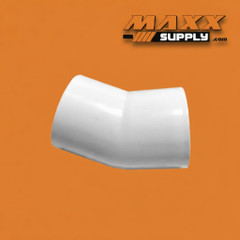


22 1/2 Degree Elbow Slip x Slip PVC SCH 80 12" (865-120)
$500.12
The 12" Schedule 80 Gray PVC 22-1/2 Degree Elbow (865-120, Slip x Slip) is a large-diameter, heavy-wall thermoplastic direction change fitting manufactured to ASTM D2467 in Schedule 80 gray PVC — a two-port elbow fitting in which both socket ends are 12" IPS slip connections and the fitting body deflects the primary main's flow axis by exactly 22.5 degrees from the upstream pipe's straight-run axis, providing a single-body Schedule 80 PVC solution for accomplishing the smallest standard angular deflection available in the commercial PVC socket elbow market at the 12" primary main service level. The 865-120 is the correct fitting wherever a 12" Schedule 80 PVC primary main must change direction by 22.5 degrees — wherever the primary main's routing geometry requires a subtle grade transition, a minor horizontal alignment correction, a compound parallel offset assembly component, or a long-radius routing change that minimizes pressure loss and unbalanced thrust force at the primary main's routing constraint — and wherever the full 45-degree or 90-degree deflection of the adjacent standard elbow angles in the 12" Schedule 80 PVC socket fitting line exceeds the angular displacement required at the routing constraint location. As the anchor small-angle direction change fitting of the 12" Schedule 80 PVC socket fitting ecosystem — alongside the 806-120 (12" Schedule 80 90-degree elbow) as the anchor full-angle fitting and the 12" Schedule 80 45-degree elbow as the standard intermediate-angle fitting — the 865-120 completes the three-elbow standard direction change fitting set that defines the full angular routing capability of the 12" Schedule 80 PVC primary main fitting ecosystem across the complete range of routing geometry requirements encountered in large-diameter primary main construction.
The 22-1/2 degree elbow as a fitting type requires a fitting type introduction at the 12" Schedule 80 PVC service level that is as essential as the reducer coupling type introduction established at the 829-626 page and the street elbow type introduction established at the 409-100 page in this catalog. In the standard commercial PVC socket fitting market, three elbow angles are produced across all pipe sizes and schedule classifications: the 90-degree elbow for full perpendicular quarter-turn routing changes, the 45-degree elbow for half-quarter-turn angular deflections and compound offset assemblies at 45-degree geometry, and the 22-1/2 degree elbow for quarter-of-quarter-turn angular deflections and compound offset assemblies at the minimum standard deflection geometry. The 22-1/2 degree elbow — designated 22.5 degrees, sometimes written 22-1/2 degrees or 22½ degrees in commercial catalogs and construction documents — produces exactly one-fourth of the angular deflection of a 90-degree elbow and exactly one-half of the angular deflection of a 45-degree elbow, making it the elbow whose single-fitting angular displacement is smallest and whose routing geometry contribution to a compound assembly is most incremental. At any routing constraint that requires exactly 22.5 degrees of angular deflection in the primary main's flow axis — and only at such constraints, as the 22-1/2 degree elbow is not a universal substitute for the 45-degree or 90-degree elbow at routing constraints that require those larger deflections — the 865-120 is the correct and most hydraulically efficient single-fitting solution in the 12" Schedule 80 PVC socket fitting line. The 22-1/2 degree elbow's commercial identity is defined by three characteristics that distinguish it from both larger elbow angles in the same series: the minimum standard angular deflection among the three elbow types, the minimum equivalent length contribution to primary main friction loss among direction change elbows at the same pipe size, and the minimum unbalanced hydraulic thrust force among direction change elbows at the same pipe size and operating pressure — three minimum-consequence characteristics that make the 22-1/2 degree elbow the preferred direction change fitting at routing constraints where any of these minimum-consequence properties is a governing design criterion.
The hydraulic performance characteristics of the 865-120 are the most favorable of any direction change elbow in the 12" Schedule 80 PVC socket elbow series — and at the 12" service size where the primary main's design flow, operating pressure, and fitting scale are at the maximum in the standard Schedule 80 PVC socket elbow line, these hydraulic performance advantages over the larger elbow angles carry their greatest absolute engineering significance. The equivalent length contribution of the 22-1/2 degree elbow to the primary main's friction loss — the straight pipe length of 12" Schedule 80 PVC pipe that produces the same pressure drop as one 865-120 fitting body under the primary main's design flow conditions — is the smallest of any direction change elbow in the 12" Schedule 80 PVC socket elbow series, smaller than the equivalent length of the 12" Schedule 80 45-degree elbow and substantially smaller than the equivalent length of the 806-120 (12" Schedule 80 90-degree elbow). At the 12" primary main service scale where the primary system's pressure gradient and available pressure at the most remote service point are formal engineering design parameters established by the hydraulic model, the reduction in equivalent length at each 865-120 location relative to a 45-degree or 90-degree elbow at the same routing constraint directly reduces the primary system's total friction loss — and in primary main systems where multiple direction change fittings are required along the primary main route, specifying the smallest elbow angle that satisfies each routing constraint's angular requirement produces the smallest total friction loss from all direction change fittings in the primary main system. The unbalanced hydraulic thrust force produced by the 865-120 at each routing constraint is governed by the vector resolution of the upstream and downstream momentum forces at the 22.5-degree deflection angle — the resultant unbalanced force is proportional to the sine of half the deflection angle, which at 22.5 degrees produces a thrust force coefficient substantially smaller than at 45 degrees and far smaller than at 90 degrees at the same operating pressure and pipe cross-sectional area. At the 12" primary main service level where the primary main's operating pressure and cross-sectional area combine to produce the largest unbalanced thrust forces in the standard Schedule 80 PVC socket elbow line, the 865-120's reduced thrust force relative to larger elbow angles at the same routing location reduces the required thrust block bearing area — and in primary main systems where thrust block design and bearing area are constrained by site soil conditions, structure proximity, or burial depth, the reduced thrust force at the 865-120 may directly reduce the civil engineering cost and constructability complexity of thrust restraint design at each routing constraint location.
The most important application role of the 865-120 — establishing its primary commercial identity beyond single-fitting 22.5-degree routing changes — is as a component of compound offset assemblies and long-radius routing changes constructed from multiple 22-1/2 degree elbows in series with intermediate straight pipe sections. In a compound offset assembly, multiple 22-1/2 degree elbows separated by intermediate pipe spools are arranged to accomplish a total angular deflection or a parallel offset of the primary main's flow axis that could not be achieved with any single standard elbow or that is more hydraulically efficient and mechanically more favorable when distributed across multiple small-angle deflection points rather than concentrated at a single large-angle deflection. The most commercially significant compound offset assembly configurations using the 865-120 are: the two-elbow 45-degree total deflection parallel offset, where two 865-120 elbows separated by an intermediate 12" Schedule 80 pipe spool are arranged in opposing 22.5-degree deflections to accomplish a 45-degree-equivalent parallel displacement of the primary main's flow axis — producing the same total angular displacement as a single 45-degree elbow but distributing the thrust force and friction loss across two separate fitting locations and providing a straight intermediate pipe section between the two deflection points; the four-elbow 90-degree total deflection parallel offset, where four 865-120 elbows with intermediate pipe spools accomplish a 90-degree-equivalent parallel displacement in a long-radius compound geometry — distributing the total deflection across four 22.5-degree increments with three intermediate straight pipe sections, reducing the maximum thrust force at any single fitting location to the 22.5-degree value rather than the 90-degree value, and producing a long-radius routing change geometry whose total equivalent length may approach the 806-120's single-fitting equivalent length while distributing the thrust restraint requirement across four separate fitting locations; and the three-elbow 67.5-degree total deflection assembly, where three 865-120 elbows accomplish a 67.5-degree routing change that cannot be achieved with any single standard elbow angle in the series. At the 12" service size where each individual elbow fitting and each individual thrust block represents significant material and civil engineering cost, the compound offset assembly approach using multiple 865-120 elbows is most commonly selected for its thrust force distribution advantage rather than for total cost reduction — distributing four 22.5-degree thrust force events across a long-radius assembly with adequate pipe section spacing between fitting locations allows smaller, more constructable individual thrust blocks at each fitting location relative to the single large thrust block required at a 90-degree elbow location.
The specification comparisons within the 12" Schedule 80 PVC socket elbow series — between the 865-120 (22-1/2 degree), the 12" Schedule 80 45-degree elbow, and the 806-120 (12" Schedule 80 90-degree elbow) — are the most commercially consequential angle selection decisions in the 12" Schedule 80 PVC socket fitting ecosystem and must be resolved before any elbow fitting is purchased for a 12" Schedule 80 PVC primary main installation. The selection logic is governed by the routing geometry's specific angular requirement at each direction change location in the primary main layout: the 806-120 is correct where the routing geometry requires a full 90-degree perpendicular direction change — where the downstream pipe's required departure direction is exactly perpendicular to the upstream pipe's approach direction and no intermediate angle achieves the required routing; the 12" Schedule 80 45-degree elbow is correct where the routing geometry requires exactly 45 degrees of angular deflection — where the downstream pipe departs at 45 degrees from the upstream pipe's axis, in direct single-fitting applications and in compound parallel offset assemblies at 45-degree geometry; the 865-120 is correct where the routing geometry requires exactly 22.5 degrees of angular deflection — in direct single-fitting applications and in compound offset assemblies using multiple 22-1/2 degree elbows. At routing constraints where the required deflection is a multiple of 22.5 degrees that can be achieved with either a single larger-angle elbow or a compound assembly of 22-1/2 degree elbows, the elbow angle selection must be based on explicit evaluation of the trade-offs between single-fitting simplicity and compactness at the larger angle versus distributed thrust force and reduced individual thrust block size at the compound 22-1/2 degree assembly — a trade-off whose resolution depends on the specific site's soil bearing conditions, structure proximity, burial depth constraints, available working space, and the primary system's pressure budget at each routing constraint location. In a complete 12" Schedule 80 PVC primary main BOM, all three elbow types — the 865-120, the 12" Schedule 80 45-degree elbow, and the 806-120 — are typically specified together at different routing constraint locations whose individual angular requirements determine which elbow angle is correct at each location, and all three fittings are purchased in quantities corresponding to the count of their specific angular requirement in the primary main's routing layout.
The schedule selection at the 865-120 — Schedule 80 over the Schedule 40 counterpart at the 12" 22-1/2 degree elbow configuration — follows the engineering framework established across all 12" Schedule 80 specialty fitting pages in this catalog. At the 12" service size, the combined pressure loading, thrust force, and structural loading at a direction change fitting are at the maximum in the standard commercial PVC socket elbow line — and at the 22-1/2 degree elbow configuration where the fitting may be deployed in compound offset assemblies with multiple 865-120 elbows per assembly, the schedule selection applies to every elbow in the assembly simultaneously. The 865-120's Schedule 80 construction is the correct specification wherever Schedule 80 is the system-wide material standard, wherever the primary main's operating pressure, surge allowance, and engineering safety margin requirements mandate Schedule 80 wall thickness at direction change fittings in the primary main routing, wherever gray material class identification is required at every fitting in the 12" primary main system for asset management and inspection purposes, and wherever the compound offset assembly's design requires the Schedule 80 pressure ceiling for the complete assembly under all anticipated operating conditions. Where the system's design operating conditions fall within the Schedule 40 pressure ceiling and the specification does not mandate Schedule 80 throughout, the Schedule 40 counterpart at the 12" 22-1/2 degree elbow configuration — if stocked — provides the cost-effective alternative at routing constraints where Schedule 40 material class is appropriate.
Schedule 80 gray PVC construction provides the chemical resistance, NSF certification, and structural capability appropriate for 12" primary main direction change service within the Schedule 80 pressure and wall thickness envelope. PVC Type 1 Grade 1 construction with cell classification 12454 per ASTM D1784 delivers broad chemical resistance across water treatment chemicals, process water service, industrial utility water, and the full range of non-solvent process fluids appropriate for Schedule 80 PVC primary main service at both socket connections. The gray color provides the permanent, inspectable Schedule 80 material class identification at each direction change fitting location along the 12" primary main route. Both socket ends solvent cement directly onto standard 12" IPS Schedule 40 or Schedule 80 PVC pipe using heavy-body solvent cement rated for large-diameter Schedule 80 PVC. At the 865-120, both socket connections are equal 12" large-diameter bonding surfaces — the same bonding surface geometry as the 806-120 at the same pipe size, requiring the complete large-diameter assembly discipline established across all 12" Schedule 80 socket fitting documentation in this catalog: pre-planned assembly with the upstream and downstream pipe ends fully positioned before any cement application begins, the fitting's 22.5-degree exit angle confirmed against the piping layout drawing by dry-fit to establish the downstream pipe's departure direction before cement application — because the 22.5-degree deflection angle's relatively subtle departure from the straight-run axis requires particular attention during dry-fit confirmation to distinguish it from a straight coupling or a larger-angle elbow during assembly, as the 22.5-degree angular offset is visually less obvious than the 45-degree or 90-degree offsets of the adjacent elbow types; working time management across both 12" bonding surfaces, complete circumferential heavy-body cement coverage at both 12" socket joints, and full cure time compliance before any system pressurization are non-negotiable at this large-diameter primary main direction change fitting. At buried 865-120 installations, engineered concrete thrust block design is required at the fitting location — the 22.5-degree deflection produces an unbalanced hydraulic thrust force in the direction of the resultant of the upstream and downstream momentum vectors, and while this thrust force is the smallest produced by any direction change elbow in the 12" Schedule 80 PVC socket elbow series, it is not zero and it is not negligible at the 12" primary main service level where the combination of operating pressure and cross-sectional area produces absolute thrust force magnitudes that require engineered restraint regardless of the elbow angle; the thrust block bearing area required at each buried 865-120 installation must be calculated by the project engineer for the specific site soil bearing capacity, system design operating pressure including surge, 12" pipe cross-sectional area, and burial depth — the reduced thrust force coefficient at 22.5 degrees reduces the required thrust block bearing area relative to the 45-degree and 90-degree elbows at the same operating conditions, but does not eliminate the thrust restraint requirement at the 12" service level. Deburr and bevel both pipe ends before cementing to ensure consistent insertion depths and complete circumferential bond lines at both large-diameter socket connections.
NSF 61 certification lists this fitting for potable water contact, and NSF 14 covers compliance with applicable plastics piping material standards — making it the correct Schedule 80 PVC primary main direction change fitting for municipal water treatment and distribution systems, large potable water pump station primary headers, and large commercial and institutional water supply primary mains where NSF-listed materials are required at every fitting in the primary distribution system including direction change fittings at primary main grade transitions, horizontal alignment corrections, and compound offset routing locations. ASTM D2467 governs Schedule 80 PVC socket fittings and defines the manufacturing, dimensional, and pressure performance requirements the 865-120 is produced to. Verify manufacturer pressure rating documentation for the specific fitting configuration before final system specification — at the 12" 22-1/2 degree elbow configuration, the governing pressure rating is determined by the 12" socket size and the fitting's tested performance at this large-diameter 22.5-degree elbow geometry under direction change loading, and must be confirmed against the manufacturer's published pressure-temperature rating table for SKU 865-120 before installation in systems at or near the fitting's rated pressure ceiling.
Key Features:
- Schedule 80 gray PVC 22-1/2 degree elbow — 12" socket x 12" socket, both slip (female socket) ends; Spears 865 series Schedule 80 PVC 22-1/2 degree elbows
- 22.5-degree angular deflection — the smallest standard elbow angle in the commercial PVC socket fitting market; one-half the deflection of the 12" Schedule 80 45-degree elbow; one-fourth the deflection of the 806-120 (12" Schedule 80 90-degree elbow)
- Smallest equivalent length contribution to primary main friction loss of any direction change elbow in the 12" Schedule 80 PVC socket elbow series — minimum friction loss penalty at each routing constraint location where 22.5-degree deflection satisfies the routing geometry requirement
- Smallest unbalanced hydraulic thrust force of any direction change elbow in the 12" Schedule 80 PVC socket elbow series at the same operating pressure — reduced required thrust block bearing area relative to 45-degree and 90-degree elbows; thrust restraint still required at all buried installations at the 12" service level; design site-specific and non-transferable
- Compound offset assembly component — the 865-120's primary commercial application extends beyond single-fitting 22.5-degree routing changes to compound offset assemblies using multiple 865-120 elbows with intermediate pipe spools: two-elbow 45-degree total parallel offset; four-elbow 90-degree total parallel offset with distributed thrust restraint; three-elbow 67.5-degree total deflection assembly; other compound configurations at multiples of 22.5 degrees
- Compound offset assembly advantage at 12" service size — distributing 90-degree total deflection across four 865-120 locations reduces the maximum thrust force at any single fitting location to the 22.5-degree value, allowing smaller individual thrust blocks relative to a single 806-120 location at sites with constrained soil bearing, structure proximity, or burial depth limitations
- Angle selection within the 12" Schedule 80 PVC socket elbow series: 865-120 where routing geometry requires exactly 22.5-degree deflection or compound multiple-22.5-degree assembly; 12" Schedule 80 45-degree elbow where exactly 45-degree deflection is required; 806-120 where exactly 90-degree perpendicular direction change is required — all three elbow types typically appear together in a complete 12" Schedule 80 PVC primary main BOM at different routing constraint locations
- Dry-fit orientation confirmation is mandatory before cement application — the 22.5-degree exit angle's visual subtlety relative to a straight coupling or larger-angle elbow requires deliberate fitting orientation confirmation against the piping layout drawing; incorrect orientation at cement application commits the downstream pipe to the wrong departure direction and cannot be corrected without full joint destruction
- Both 12" socket connections require full large-diameter heavy-body cement assembly discipline — consistent with all 12" Schedule 80 socket fitting assembly requirements established in this catalog; working time management across both large-diameter bonding surfaces; full cure time compliance before pressurization
- Engineered thrust restraint required at all buried installations — concrete thrust block or mechanical joint restraint at every buried 865-120; thrust force is smallest of any direction change elbow in the 12" series but is not zero at the 12" service level; thrust block design must be calculated site-specifically from soil bearing capacity, design operating pressure, and 12" pipe cross-sectional area
- Manufactured to ASTM D2467 — governing standard for Schedule 80 PVC socket fittings
- NSF 61 certified for potable water contact; NSF 14 listed
- Solvent cement socket connections compatible with Schedule 40 and Schedule 80 IPS 12" pipe at both ends
- Gray color — universal Schedule 80 material class identification at the primary main direction change location
- Cell classification PVC 12454 per ASTM D1784
- Heavy-body solvent cement required at both large-diameter socket connections; full cure time compliance mandatory before pressurization
- Pressure rating: verify against manufacturer pressure-temperature table for SKU 865-120
Specifications:
| Attribute | Value |
|---|---|
| SKU | 865-120 |
| Fitting Type | 22-1/2 Degree Elbow |
| Series | Spears 865 Schedule 80 PVC 22-1/2 Degree Elbows |
| Nominal Size | 12" |
| Deflection Angle | 22.5 Degrees (22-1/2 Degrees) |
| End Connections | Slip x Slip (Both Female Socket) |
| Connection Method | Solvent Cement (IPS) — both ends |
| Compatible Pipe — Both Ends | 12" IPS Schedule 40 or Schedule 80 PVC |
| Relative Deflection | 1/2 of 45-degree elbow; 1/4 of 90-degree elbow at same pipe size |
| Thrust Force Character | Smallest of any direction change elbow in 12" Schedule 80 series at same operating pressure; engineered restraint still required at buried installations |
| Equivalent Length Character | Smallest friction loss contribution of any direction change elbow in 12" Schedule 80 series |
| Compound Assembly Capability | Two-elbow 45° offset; four-elbow 90° offset; three-elbow 67.5° offset; other multiples of 22.5° |
| Schedule | Schedule 80 |
| Material | PVC (Polyvinyl Chloride) Type 1, Grade 1 |
| Cell Classification | 12454 per ASTM D1784 |
| Color | Gray |
| Manufacturing Standard | ASTM D2467 |
| Potable Water Certification | NSF/ANSI 61 |
| Plastics Standard Certification | NSF 14 |
| Max Service Temperature | 140°F (60°C) |
| Pressure Rating | Verify with manufacturer pressure-temperature rating table for SKU 865-120 |
Industries & Applications:
- Municipal Water Distribution — Primary Transmission Main Grade Transitions, Horizontal Alignment Corrections, Long-Radius Compound Offsets, and Minimum-Loss Direction Changes on 12" Schedule 80 Primary Mains — The 12" Schedule 80 PVC 22-1/2 degree elbow is specified at routing constraint locations on 12" municipal water transmission and primary distribution mains in Schedule 80 PVC systems where the routing geometry requires exactly 22.5 degrees of angular deflection or where a compound offset assembly of multiple 865-120 elbows is the preferred solution for a larger total deflection requirement — primary transmission main vertical grade transitions where the 12" primary transmission main must follow a pipeline corridor whose grade changes by exactly 22.5 degrees from the design profile, the 865-120 providing the single-body Schedule 80 socket fitting that accomplishes the grade transition without the over-deflection that either a 45-degree or 90-degree elbow would impose at the same grade transition location; primary transmission main horizontal alignment corrections where the pipeline route deviates from straight-line by 22.5 degrees at a site constraint — a property boundary corner, a utility crossing avoidance, a road right-of-way alignment change, or a topographic obstacle requiring a minor route deflection — with the 865-120 providing the minimum standard angular correction without the larger deflection that adjacent elbow angles would impose; primary transmission main compound parallel offset assemblies where the 12" primary transmission main must shift horizontally or vertically by a specified offset distance while maintaining a straight-line route upstream and downstream of the offset — constructed with two 865-120 elbows in opposing 22.5-degree arrangement separated by an intermediate 12" Schedule 80 pipe spool of calculated length, the compound assembly accomplishing the required parallel offset with the minimum total equivalent length and distributed thrust force of any standard-angle compound offset assembly at the 12" service level; four-elbow long-radius 90-degree routing changes where the primary transmission main's routing constraint requires a 90-degree total direction change but site conditions — constrained soil bearing, proximity to structures, limited burial depth, or thrust block constructability requirements — favor distributing the total deflection across four 865-120 fitting locations with intermediate pipe sections over concentrating the full 90-degree deflection at a single 806-120 location; vertical deflection assemblies where the 12" primary transmission main must accomplish elevation changes or under-crossing deflections in vertical profile using compound assemblies of 865-120 elbows that provide gentler vertical deflection geometry and smaller individual thrust forces than 45-degree or 90-degree elbows at the same total vertical deflection; pressure-sensitive primary transmission main systems where the primary system's pressure budget at the most remote service point is constrained and the minimum-equivalent-length direction change fittings are specified at every routing constraint to preserve maximum available pressure throughout the primary transmission system — the 865-120 contributing the smallest friction loss per direction change of any standard elbow angle in the 12" Schedule 80 series at every routing constraint where 22.5-degree deflection satisfies the routing geometry requirement; NSF 61 listing confirms potable water fitness at every municipal water distribution 12" primary main direction change fitting; engineered concrete thrust block or mechanical joint restraint design is required at every buried 865-120 installation with thrust block bearing area calculated site-specifically from soil bearing capacity, system operating pressure including surge, and 12" pipe cross-sectional area at each installation location
- Water Treatment Plant — Primary Header Grade Transitions, Alignment Corrections, Building Entry Deflections, and Long-Radius Compound Offsets on 12" Schedule 80 Primary Distribution Headers — Installed at routing constraint locations on 12" primary distribution headers in municipal and industrial water treatment plants where the routing geometry requires 22.5-degree deflection or compound 865-120 offset assemblies — primary distribution header vertical grade transitions at treatment plant site grade changes where the 12" primary header must follow the site's ground profile through a 22.5-degree vertical deflection at a grade change point in the header route; clearwell supply and distribution primary header horizontal alignment corrections where the 12" primary header must navigate a 22.5-degree horizontal route deviation around a treatment structure, equipment foundation, or below-grade vault at the treatment facility's primary header routing corridor; treatment building entry deflections where the 12" primary header must accomplish a compound vertical entry deflection from outdoor burial depth to indoor above-slab elevation using multiple 865-120 elbows in a compound vertical offset assembly that distributes the entry deflection geometry across multiple small-angle fittings and minimizes the total equivalent length at the building entry routing transition; filter gallery primary header compound offset assemblies where the 12" primary influent or effluent header must shift horizontally to align with the filter gallery's structural bay spacing using a two-865-120 parallel offset assembly between the outdoor approach main and the indoor gallery header; and plant primary header long-radius routing changes where the treatment facility's primary header route requires gentle directional changes at vault, structure, and equipment clearance locations using 865-120 elbows to accomplish the required route deflection with minimum friction loss contribution at each routing constraint location; at water treatment plants where the primary distribution header's pressure budget and available pressure at process equipment supply points are formal hydraulic design parameters, the 865-120's minimum equivalent length at direction change locations contributes to minimizing the total friction loss from direction change fittings throughout the treatment facility's primary header routing and preserving maximum available pressure at all process supply points; NSF 61 listing confirms potable water fitness at every water treatment plant 12" primary header direction change fitting
- Pump Station — Primary Header Grade Transitions, Vault Entry Deflections, Compound Offset Assemblies, and Minimum-Loss Direction Changes on 12" Schedule 80 Primary Headers — Used at routing constraint locations on 12" primary pump station suction and discharge headers where the routing geometry requires 22.5-degree deflection or compound 865-120 assemblies — pump station primary discharge header vertical grade transitions where the 12" primary discharge header must transition from below-grade burial depth to above-grade pump station floor elevation through a compound vertical offset assembly of 865-120 elbows that distributes the elevation change deflection across multiple small-angle fittings and minimizes the total friction loss at the primary discharge header's floor penetration transition; pump station primary suction header vault entry deflections where the 12" primary suction header must accomplish a 22.5-degree deflection to align with the pump station vault's wall penetration sleeve at the suction entry fitting location; pump station primary header compound parallel offset assemblies where the 12" primary header must shift laterally within the pump station's piping gallery to align with pump unit connection spacing using two-865-120 compound parallel offset assemblies with intermediate header pipe spools between the two fitting locations; pump station external primary header long-radius alignment corrections where the 12" primary discharge main departing the pump station site must accomplish minor horizontal route corrections at site boundary constraints using 865-120 elbows to minimize both friction loss and thrust restraint requirements at the pump station's vicinity where primary header operating pressures are at their highest point in the distribution system; primary discharge header pressure-sensitive direction changes where the pump station's discharge pressure budget requires minimum-equivalent-length direction change fittings at every routing constraint in the primary discharge header to preserve maximum available pressure at the downstream transmission system entry; and pump station compound vertical and horizontal offset assemblies where the combined geometry of grade transition and horizontal alignment correction requires multiple 865-120 elbows in compound three-dimensional offset configurations that accomplish the total required spatial routing transition with minimum total equivalent length and distributed individual thrust forces; at pump stations where primary headers operate at full system pressure including shut-off head and surge, the 865-120's Schedule 80 construction must be confirmed against the pump station's maximum operating conditions at the 12" elbow service size before the fitting is installed at pump station primary header direction change locations
- Large Commercial & Agricultural Irrigation — Primary Transmission Main Grade Transitions, Alignment Corrections, Compound Offsets, and Long-Radius Routing Changes on 12" Schedule 80 Primary Mains — Specified at routing constraint locations on 12" primary irrigation transmission mains at major golf course and resort irrigation systems, large-acreage agricultural operations, and regional landscape irrigation projects where the routing geometry requires 22.5-degree deflection or compound 865-120 assemblies — irrigation primary transmission main vertical grade transitions where the 12" primary transmission main must follow the property's natural ground profile through grade changes of 22.5 degrees at topographic transitions along the transmission main route; primary transmission main undulating terrain routing assemblies where the irrigation transmission main route traverses gently rolling terrain and requires a series of 865-120 elbows at successive grade transition points to follow the terrain profile with minimum total friction loss from direction change fittings along the entire transmission main length; irrigation pump station primary discharge header compound vertical entry assemblies where the 12" primary discharge header transitions from the pump station floor to below-grade burial depth using compound 865-120 vertical offset assemblies that distribute the grade transition across multiple fitting locations and reduce the maximum thrust force at any single fitting location in the pump station exit piping; primary transmission main horizontal alignment corrections at property boundary deviations, road crossing approach adjustments, and irrigation infrastructure clearance corrections where the 12" primary transmission main requires minor 22.5-degree horizontal route corrections that preserve the transmission main's generally straight routing with minimum fitting equivalent length contribution; and compound parallel offset assemblies at primary transmission main rerouting locations where easement constraints, property boundary adjustments, or existing infrastructure conflicts require the 12" primary transmission main to shift its route by a specified horizontal offset using two-865-120 compound assemblies that accomplish the offset with minimum additional pressure loss and distributed thrust restraint; at large commercial irrigation systems where the primary transmission main route may extend for significant distances with multiple direction change locations, specifying 865-120 elbows at every routing constraint where 22.5-degree deflection is sufficient — rather than defaulting to 45-degree elbows at all grade and alignment transitions — produces a meaningfully smaller total equivalent length from all direction change fittings in the primary transmission main system and correspondingly better available pressure at the transmission main's most remote delivery point
- Industrial Process Piping — Primary Header Grade Transitions, Building Entry Deflections, Equipment Clearance Offsets, and Minimum-Loss Direction Changes on 12" Schedule 80 Primary Headers — Used at routing constraint locations on 12" process water primary headers, cooling water primary distribution trunks, and plant utility water primary mains in manufacturing plants, chemical processing facilities, petrochemical support facilities, and heavy industrial environments where the routing geometry requires 22.5-degree deflection or compound 865-120 assemblies — process water primary header vertical grade transitions where the 12" primary header must follow the plant site's grade profile through 22.5-degree vertical deflections at grade change points in the header routing corridor; cooling water primary distribution trunk building entry deflections where the 12" primary cooling water trunk must accomplish a compound vertical entry deflection at a process building wall penetration using multiple 865-120 elbows in a compound vertical offset assembly that transitions the trunk from outdoor burial depth to indoor above-slab routing; plant utility water primary main horizontal alignment corrections at equipment foundation clearance locations, structural column avoidance points, and below-grade vault clearance locations where 22.5-degree horizontal route corrections allow the primary main to navigate the plant's congested below-grade routing environment with minimum angular displacement at each obstacle; primary process header compound parallel offset assemblies where the 12" primary process header must shift its routing within the plant's below-grade pipe gallery to accommodate process unit equipment spacing or pipe rack structural bay requirements using two-865-120 compound parallel offset assemblies; primary header long-radius routing changes at process plant layout boundaries where the primary header must accomplish gentle directional transitions between adjacent process units or between outdoor below-grade routing and indoor pipe rack routing using 865-120 elbows for minimum friction loss at each routing constraint; and process primary header pressure-budget direction changes where the process system's available pressure at the most remote process equipment supply point is a constrained design parameter and minimum-equivalent-length direction change fittings are specified at every primary header routing constraint to preserve maximum available pressure throughout the process distribution system; Schedule 80 gray PVC construction provides the structural integrity, chemical resistance, and permanent material class identification required at primary header direction change locations in industrial process piping systems where Schedule 80 is the system-wide material standard
- Municipal Well Field — Primary Collection and Distribution Header Grade Transitions, Alignment Corrections, and Compound Offset Assemblies on 12" Schedule 80 Primary Headers — Installed at routing constraint locations on 12" primary well field collection or distribution headers where the routing geometry requires 22.5-degree deflection or compound 865-120 assemblies — primary collection header vertical grade transitions where the 12" primary collection header must follow the well field site's ground surface grade through 22.5-degree vertical deflections at grade transition points in the collection header routing corridor connecting individual well pump stations to the primary collection main; primary distribution header horizontal alignment corrections at well field site constraints — existing utility crossings, property boundary deviations, access road crossings, and existing infrastructure clearances — where the 12" primary distribution header requires minor 22.5-degree horizontal route corrections to navigate the well field site's constraint environment; pump station primary discharge header compound vertical entry assemblies where the 12" primary discharge header transitions from the pump station floor to the below-grade primary distribution corridor using compound 865-120 vertical offset assemblies; primary collection header compound parallel offset assemblies where the 12" primary collection header must shift its routing laterally within the well field site to accommodate well pad spacing, access road crossings, or property boundary constraints using two-865-120 compound parallel offset assemblies with intermediate pipe spool between fitting locations; and primary distribution header long-radius route corrections at the well field system's major structural and topographic constraints where gentle 22.5-degree deflections accomplish the required route deviation with minimum friction loss contribution to the primary distribution system's total head loss; at well field primary headers where pump operating pressures including shut-off head and surge must be confirmed within the Schedule 80 pressure ceiling at the 12" elbow service size, the 865-120's direction change loading under full pump operating conditions must be included in the pressure rating confirmation before the fitting is installed at any well field primary header direction change location
- Water & Wastewater Treatment — Primary Process Header Grade Transitions, Building Entry Deflections, and Compound Offset Assemblies on 12" Schedule 80 Primary Process Headers — Specified at routing constraint locations on 12" primary process distribution headers in industrial wastewater treatment, water reclamation, and large-scale industrial water management facilities where the routing geometry requires 22.5-degree deflection or compound 865-120 assemblies — primary influent header vertical grade transitions where the 12" primary influent header must follow the treatment facility site's grade profile through 22.5-degree vertical deflections at grade change points along the influent header routing corridor from the facility's inlet structure to the primary treatment processes; primary effluent distribution header horizontal alignment corrections at treatment facility site constraints — existing utility crossings, structure foundations, secondary treatment process unit footprints, and property boundary conditions — requiring minor 22.5-degree horizontal route corrections in the primary effluent distribution header routing; treatment building primary header entry deflections where the 12" primary process header must accomplish a compound vertical deflection at a treatment building wall penetration using multiple 865-120 elbows in a compound vertical offset assembly; primary sludge handling header compound parallel offset assemblies where the 12" primary sludge header must shift its routing within the treatment facility's below-grade pipe gallery to accommodate process equipment spacing or dewatering facility layout constraints; aeration system primary supply header grade and alignment corrections at blower building entry deflections and outdoor header routing constraint locations where 22.5-degree deflections accomplish the required routing transitions with minimum equivalent length contribution to the aeration system's primary supply header; and primary disinfection and chemical distribution header compound offset assemblies where the 12" primary chemical distribution header must navigate the treatment facility's congested below-grade routing environment at process unit boundaries using compound 865-120 offset assemblies; Schedule 80 PVC construction handles continuous chemical exposure and primary header operating pressures at direction change locations throughout the treatment facility's 12" primary process distribution system; NSF 61 listing confirms fitness for potable and process water contact at every direction change fitting in the primary treatment distribution system
- HVAC & Large Commercial Mechanical Systems — Primary Distribution Main Grade Transitions, Building Entry Deflections, Compound Offset Assemblies, and Minimum-Loss Direction Changes on 12" Schedule 80 Primary Distribution Mains — Used at routing constraint locations on 12" primary chilled water distribution mains, condenser water primary trunks, and large-capacity hydronic heating and cooling primary distribution mains in Schedule 80 PVC systems at large commercial campus, institutional, and industrial mechanical systems where the routing geometry requires 22.5-degree deflection or compound 865-120 assemblies — campus primary chilled water distribution main vertical grade transitions where the 12" primary distribution main must follow the campus underground routing corridor through grade changes of 22.5 degrees at site topographic transitions; campus primary distribution main horizontal alignment corrections at campus infrastructure constraints — existing utility crossings, building foundation clearances, campus road crossing approach adjustments, and site boundary conditions — where the 12" primary distribution main requires minor 22.5-degree horizontal route corrections to navigate the campus below-grade routing environment; central plant primary distribution main building entry deflections where the 12" primary distribution main must accomplish a compound vertical entry deflection at a central plant building wall penetration using multiple 865-120 elbows in a compound vertical offset assembly that transitions from outdoor burial depth to indoor mechanical room routing; campus primary distribution main compound parallel offset assemblies where the 12" primary distribution main must shift laterally within the campus below-grade utility corridor to accommodate existing utility spacing, future utility reservation corridors, or building service entry alignment using two-865-120 compound parallel offset assemblies; primary condenser water distribution trunk long-radius routing changes at cooling tower structural constraint locations and campus property boundary routing adjustments where 865-120 elbows accomplish gentle directional transitions with minimum friction loss at the primary distribution trunk's routing constraints; and pressure-sensitive campus primary distribution main direction changes where the campus distribution system's pressure budget at the most remote campus building supply point is a design constraint and minimum-equivalent-length direction change fittings are specified throughout the primary distribution main routing to preserve maximum available pressure at all campus service points; Schedule 80 PVC construction satisfies the material specification and pressure requirements at 12" primary distribution main direction change locations in large commercial mechanical systems where Schedule 80 is the system material standard
- Aquaculture & Large-Scale Water Management Infrastructure — Installed at routing constraint locations on 12" primary water supply, recirculation, or distribution mains at the largest commercial aquaculture facilities, regional hatchery systems, and large recirculating aquaculture systems (RAS) where the routing geometry requires 22.5-degree deflection or compound 865-120 assemblies — primary recirculation main vertical grade transitions where the 12" primary recirculation main must follow the aquaculture facility site's grade profile through 22.5-degree vertical deflections at grade change points in the primary recirculation main routing; primary supply main horizontal alignment corrections where the 12" primary supply main must navigate minor route deviations at site infrastructure constraints — existing utility crossings, building foundation clearances, production hall structural grid alignments, and property boundary conditions — using 865-120 elbows for minimum angular displacement and minimum friction loss at each routing constraint; pump station primary discharge main compound vertical entry assemblies where the 12" primary discharge main transitions from the pump station floor to below-grade primary supply routing using compound 865-120 vertical offset assemblies at the pump station exit; primary recirculation main compound parallel offset assemblies where the 12" primary recirculation main must shift laterally within the aquaculture facility's below-grade utility corridor to accommodate production hall structural bay spacing, secondary recirculation system routing allocations, or treatment system entry alignments using two-865-120 compound parallel offset assemblies; and primary distribution main long-radius routing changes at production building entry deflections, recirculation system major junction approach alignments, and facility infrastructure constraint locations where 865-120 elbows accomplish the required route deflections with minimum total friction loss contribution to the primary recirculation and supply distribution system; at large commercial aquaculture facilities where primary recirculation system pressure budget and uniform recirculation flow distribution across all production sections are critical operational parameters, specifying 865-120 elbows at every routing constraint where 22.5-degree deflection satisfies the routing geometry requirement contributes meaningfully to minimizing total friction loss from direction change fittings throughout the primary recirculation distribution system and to maintaining uniform available pressure at all production section recirculation supply branches; Schedule 80 PVC handles continuous water contact, treatment chemical exposure, and primary main operating pressures at direction change locations throughout the aquaculture facility's primary supply and recirculation distribution system; NSF 61 listing confirms fitness for potable and process water contact at every direction change fitting in the primary aquaculture distribution system
(No reviews yet)

Write a Review
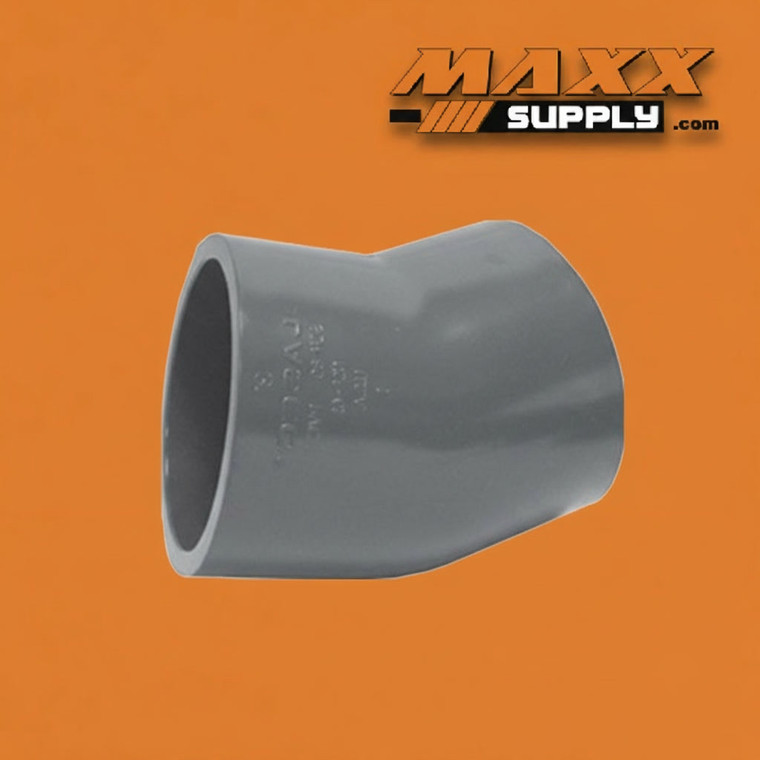
22 1/2 Degree Elbow Slip x Slip PVC SCH 80 12" (865-120)
The 12" Schedule 80 Gray PVC 22-1/2 Degree Elbow (865-120, Slip x Slip) is a large-diameter, heavy-wall thermoplastic direction change fitting manufactured to ASTM D2467 in Schedule 80 gray PVC — a two-port elbow fitting in which both socket ends are 12" IPS slip connections and the fitting body deflects the primary main's flow axis by exactly 22.5 degrees from the upstream pipe's straight-run axis, providing a single-body Schedule 80 PVC solution for accomplishing the smallest standard angular deflection available in the commercial PVC socket elbow market at the 12" primary main service level. The 865-120 is the correct fitting wherever a 12" Schedule 80 PVC primary main must change direction by 22.5 degrees — wherever the primary main's routing geometry requires a subtle grade transition, a minor horizontal alignment correction, a compound parallel offset assembly component, or a long-radius routing change that minimizes pressure loss and unbalanced thrust force at the primary main's routing constraint — and wherever the full 45-degree or 90-degree deflection of the adjacent standard elbow angles in the 12" Schedule 80 PVC socket fitting line exceeds the angular displacement required at the routing constraint location. As the anchor small-angle direction change fitting of the 12" Schedule 80 PVC socket fitting ecosystem — alongside the 806-120 (12" Schedule 80 90-degree elbow) as the anchor full-angle fitting and the 12" Schedule 80 45-degree elbow as the standard intermediate-angle fitting — the 865-120 completes the three-elbow standard direction change fitting set that defines the full angular routing capability of the 12" Schedule 80 PVC primary main fitting ecosystem across the complete range of routing geometry requirements encountered in large-diameter primary main construction.
The 22-1/2 degree elbow as a fitting type requires a fitting type introduction at the 12" Schedule 80 PVC service level that is as essential as the reducer coupling type introduction established at the 829-626 page and the street elbow type introduction established at the 409-100 page in this catalog. In the standard commercial PVC socket fitting market, three elbow angles are produced across all pipe sizes and schedule classifications: the 90-degree elbow for full perpendicular quarter-turn routing changes, the 45-degree elbow for half-quarter-turn angular deflections and compound offset assemblies at 45-degree geometry, and the 22-1/2 degree elbow for quarter-of-quarter-turn angular deflections and compound offset assemblies at the minimum standard deflection geometry. The 22-1/2 degree elbow — designated 22.5 degrees, sometimes written 22-1/2 degrees or 22½ degrees in commercial catalogs and construction documents — produces exactly one-fourth of the angular deflection of a 90-degree elbow and exactly one-half of the angular deflection of a 45-degree elbow, making it the elbow whose single-fitting angular displacement is smallest and whose routing geometry contribution to a compound assembly is most incremental. At any routing constraint that requires exactly 22.5 degrees of angular deflection in the primary main's flow axis — and only at such constraints, as the 22-1/2 degree elbow is not a universal substitute for the 45-degree or 90-degree elbow at routing constraints that require those larger deflections — the 865-120 is the correct and most hydraulically efficient single-fitting solution in the 12" Schedule 80 PVC socket fitting line. The 22-1/2 degree elbow's commercial identity is defined by three characteristics that distinguish it from both larger elbow angles in the same series: the minimum standard angular deflection among the three elbow types, the minimum equivalent length contribution to primary main friction loss among direction change elbows at the same pipe size, and the minimum unbalanced hydraulic thrust force among direction change elbows at the same pipe size and operating pressure — three minimum-consequence characteristics that make the 22-1/2 degree elbow the preferred direction change fitting at routing constraints where any of these minimum-consequence properties is a governing design criterion.
The hydraulic performance characteristics of the 865-120 are the most favorable of any direction change elbow in the 12" Schedule 80 PVC socket elbow series — and at the 12" service size where the primary main's design flow, operating pressure, and fitting scale are at the maximum in the standard Schedule 80 PVC socket elbow line, these hydraulic performance advantages over the larger elbow angles carry their greatest absolute engineering significance. The equivalent length contribution of the 22-1/2 degree elbow to the primary main's friction loss — the straight pipe length of 12" Schedule 80 PVC pipe that produces the same pressure drop as one 865-120 fitting body under the primary main's design flow conditions — is the smallest of any direction change elbow in the 12" Schedule 80 PVC socket elbow series, smaller than the equivalent length of the 12" Schedule 80 45-degree elbow and substantially smaller than the equivalent length of the 806-120 (12" Schedule 80 90-degree elbow). At the 12" primary main service scale where the primary system's pressure gradient and available pressure at the most remote service point are formal engineering design parameters established by the hydraulic model, the reduction in equivalent length at each 865-120 location relative to a 45-degree or 90-degree elbow at the same routing constraint directly reduces the primary system's total friction loss — and in primary main systems where multiple direction change fittings are required along the primary main route, specifying the smallest elbow angle that satisfies each routing constraint's angular requirement produces the smallest total friction loss from all direction change fittings in the primary main system. The unbalanced hydraulic thrust force produced by the 865-120 at each routing constraint is governed by the vector resolution of the upstream and downstream momentum forces at the 22.5-degree deflection angle — the resultant unbalanced force is proportional to the sine of half the deflection angle, which at 22.5 degrees produces a thrust force coefficient substantially smaller than at 45 degrees and far smaller than at 90 degrees at the same operating pressure and pipe cross-sectional area. At the 12" primary main service level where the primary main's operating pressure and cross-sectional area combine to produce the largest unbalanced thrust forces in the standard Schedule 80 PVC socket elbow line, the 865-120's reduced thrust force relative to larger elbow angles at the same routing location reduces the required thrust block bearing area — and in primary main systems where thrust block design and bearing area are constrained by site soil conditions, structure proximity, or burial depth, the reduced thrust force at the 865-120 may directly reduce the civil engineering cost and constructability complexity of thrust restraint design at each routing constraint location.
The most important application role of the 865-120 — establishing its primary commercial identity beyond single-fitting 22.5-degree routing changes — is as a component of compound offset assemblies and long-radius routing changes constructed from multiple 22-1/2 degree elbows in series with intermediate straight pipe sections. In a compound offset assembly, multiple 22-1/2 degree elbows separated by intermediate pipe spools are arranged to accomplish a total angular deflection or a parallel offset of the primary main's flow axis that could not be achieved with any single standard elbow or that is more hydraulically efficient and mechanically more favorable when distributed across multiple small-angle deflection points rather than concentrated at a single large-angle deflection. The most commercially significant compound offset assembly configurations using the 865-120 are: the two-elbow 45-degree total deflection parallel offset, where two 865-120 elbows separated by an intermediate 12" Schedule 80 pipe spool are arranged in opposing 22.5-degree deflections to accomplish a 45-degree-equivalent parallel displacement of the primary main's flow axis — producing the same total angular displacement as a single 45-degree elbow but distributing the thrust force and friction loss across two separate fitting locations and providing a straight intermediate pipe section between the two deflection points; the four-elbow 90-degree total deflection parallel offset, where four 865-120 elbows with intermediate pipe spools accomplish a 90-degree-equivalent parallel displacement in a long-radius compound geometry — distributing the total deflection across four 22.5-degree increments with three intermediate straight pipe sections, reducing the maximum thrust force at any single fitting location to the 22.5-degree value rather than the 90-degree value, and producing a long-radius routing change geometry whose total equivalent length may approach the 806-120's single-fitting equivalent length while distributing the thrust restraint requirement across four separate fitting locations; and the three-elbow 67.5-degree total deflection assembly, where three 865-120 elbows accomplish a 67.5-degree routing change that cannot be achieved with any single standard elbow angle in the series. At the 12" service size where each individual elbow fitting and each individual thrust block represents significant material and civil engineering cost, the compound offset assembly approach using multiple 865-120 elbows is most commonly selected for its thrust force distribution advantage rather than for total cost reduction — distributing four 22.5-degree thrust force events across a long-radius assembly with adequate pipe section spacing between fitting locations allows smaller, more constructable individual thrust blocks at each fitting location relative to the single large thrust block required at a 90-degree elbow location.
The specification comparisons within the 12" Schedule 80 PVC socket elbow series — between the 865-120 (22-1/2 degree), the 12" Schedule 80 45-degree elbow, and the 806-120 (12" Schedule 80 90-degree elbow) — are the most commercially consequential angle selection decisions in the 12" Schedule 80 PVC socket fitting ecosystem and must be resolved before any elbow fitting is purchased for a 12" Schedule 80 PVC primary main installation. The selection logic is governed by the routing geometry's specific angular requirement at each direction change location in the primary main layout: the 806-120 is correct where the routing geometry requires a full 90-degree perpendicular direction change — where the downstream pipe's required departure direction is exactly perpendicular to the upstream pipe's approach direction and no intermediate angle achieves the required routing; the 12" Schedule 80 45-degree elbow is correct where the routing geometry requires exactly 45 degrees of angular deflection — where the downstream pipe departs at 45 degrees from the upstream pipe's axis, in direct single-fitting applications and in compound parallel offset assemblies at 45-degree geometry; the 865-120 is correct where the routing geometry requires exactly 22.5 degrees of angular deflection — in direct single-fitting applications and in compound offset assemblies using multiple 22-1/2 degree elbows. At routing constraints where the required deflection is a multiple of 22.5 degrees that can be achieved with either a single larger-angle elbow or a compound assembly of 22-1/2 degree elbows, the elbow angle selection must be based on explicit evaluation of the trade-offs between single-fitting simplicity and compactness at the larger angle versus distributed thrust force and reduced individual thrust block size at the compound 22-1/2 degree assembly — a trade-off whose resolution depends on the specific site's soil bearing conditions, structure proximity, burial depth constraints, available working space, and the primary system's pressure budget at each routing constraint location. In a complete 12" Schedule 80 PVC primary main BOM, all three elbow types — the 865-120, the 12" Schedule 80 45-degree elbow, and the 806-120 — are typically specified together at different routing constraint locations whose individual angular requirements determine which elbow angle is correct at each location, and all three fittings are purchased in quantities corresponding to the count of their specific angular requirement in the primary main's routing layout.
The schedule selection at the 865-120 — Schedule 80 over the Schedule 40 counterpart at the 12" 22-1/2 degree elbow configuration — follows the engineering framework established across all 12" Schedule 80 specialty fitting pages in this catalog. At the 12" service size, the combined pressure loading, thrust force, and structural loading at a direction change fitting are at the maximum in the standard commercial PVC socket elbow line — and at the 22-1/2 degree elbow configuration where the fitting may be deployed in compound offset assemblies with multiple 865-120 elbows per assembly, the schedule selection applies to every elbow in the assembly simultaneously. The 865-120's Schedule 80 construction is the correct specification wherever Schedule 80 is the system-wide material standard, wherever the primary main's operating pressure, surge allowance, and engineering safety margin requirements mandate Schedule 80 wall thickness at direction change fittings in the primary main routing, wherever gray material class identification is required at every fitting in the 12" primary main system for asset management and inspection purposes, and wherever the compound offset assembly's design requires the Schedule 80 pressure ceiling for the complete assembly under all anticipated operating conditions. Where the system's design operating conditions fall within the Schedule 40 pressure ceiling and the specification does not mandate Schedule 80 throughout, the Schedule 40 counterpart at the 12" 22-1/2 degree elbow configuration — if stocked — provides the cost-effective alternative at routing constraints where Schedule 40 material class is appropriate.
Schedule 80 gray PVC construction provides the chemical resistance, NSF certification, and structural capability appropriate for 12" primary main direction change service within the Schedule 80 pressure and wall thickness envelope. PVC Type 1 Grade 1 construction with cell classification 12454 per ASTM D1784 delivers broad chemical resistance across water treatment chemicals, process water service, industrial utility water, and the full range of non-solvent process fluids appropriate for Schedule 80 PVC primary main service at both socket connections. The gray color provides the permanent, inspectable Schedule 80 material class identification at each direction change fitting location along the 12" primary main route. Both socket ends solvent cement directly onto standard 12" IPS Schedule 40 or Schedule 80 PVC pipe using heavy-body solvent cement rated for large-diameter Schedule 80 PVC. At the 865-120, both socket connections are equal 12" large-diameter bonding surfaces — the same bonding surface geometry as the 806-120 at the same pipe size, requiring the complete large-diameter assembly discipline established across all 12" Schedule 80 socket fitting documentation in this catalog: pre-planned assembly with the upstream and downstream pipe ends fully positioned before any cement application begins, the fitting's 22.5-degree exit angle confirmed against the piping layout drawing by dry-fit to establish the downstream pipe's departure direction before cement application — because the 22.5-degree deflection angle's relatively subtle departure from the straight-run axis requires particular attention during dry-fit confirmation to distinguish it from a straight coupling or a larger-angle elbow during assembly, as the 22.5-degree angular offset is visually less obvious than the 45-degree or 90-degree offsets of the adjacent elbow types; working time management across both 12" bonding surfaces, complete circumferential heavy-body cement coverage at both 12" socket joints, and full cure time compliance before any system pressurization are non-negotiable at this large-diameter primary main direction change fitting. At buried 865-120 installations, engineered concrete thrust block design is required at the fitting location — the 22.5-degree deflection produces an unbalanced hydraulic thrust force in the direction of the resultant of the upstream and downstream momentum vectors, and while this thrust force is the smallest produced by any direction change elbow in the 12" Schedule 80 PVC socket elbow series, it is not zero and it is not negligible at the 12" primary main service level where the combination of operating pressure and cross-sectional area produces absolute thrust force magnitudes that require engineered restraint regardless of the elbow angle; the thrust block bearing area required at each buried 865-120 installation must be calculated by the project engineer for the specific site soil bearing capacity, system design operating pressure including surge, 12" pipe cross-sectional area, and burial depth — the reduced thrust force coefficient at 22.5 degrees reduces the required thrust block bearing area relative to the 45-degree and 90-degree elbows at the same operating conditions, but does not eliminate the thrust restraint requirement at the 12" service level. Deburr and bevel both pipe ends before cementing to ensure consistent insertion depths and complete circumferential bond lines at both large-diameter socket connections.
NSF 61 certification lists this fitting for potable water contact, and NSF 14 covers compliance with applicable plastics piping material standards — making it the correct Schedule 80 PVC primary main direction change fitting for municipal water treatment and distribution systems, large potable water pump station primary headers, and large commercial and institutional water supply primary mains where NSF-listed materials are required at every fitting in the primary distribution system including direction change fittings at primary main grade transitions, horizontal alignment corrections, and compound offset routing locations. ASTM D2467 governs Schedule 80 PVC socket fittings and defines the manufacturing, dimensional, and pressure performance requirements the 865-120 is produced to. Verify manufacturer pressure rating documentation for the specific fitting configuration before final system specification — at the 12" 22-1/2 degree elbow configuration, the governing pressure rating is determined by the 12" socket size and the fitting's tested performance at this large-diameter 22.5-degree elbow geometry under direction change loading, and must be confirmed against the manufacturer's published pressure-temperature rating table for SKU 865-120 before installation in systems at or near the fitting's rated pressure ceiling.
Key Features:
- Schedule 80 gray PVC 22-1/2 degree elbow — 12" socket x 12" socket, both slip (female socket) ends; Spears 865 series Schedule 80 PVC 22-1/2 degree elbows
- 22.5-degree angular deflection — the smallest standard elbow angle in the commercial PVC socket fitting market; one-half the deflection of the 12" Schedule 80 45-degree elbow; one-fourth the deflection of the 806-120 (12" Schedule 80 90-degree elbow)
- Smallest equivalent length contribution to primary main friction loss of any direction change elbow in the 12" Schedule 80 PVC socket elbow series — minimum friction loss penalty at each routing constraint location where 22.5-degree deflection satisfies the routing geometry requirement
- Smallest unbalanced hydraulic thrust force of any direction change elbow in the 12" Schedule 80 PVC socket elbow series at the same operating pressure — reduced required thrust block bearing area relative to 45-degree and 90-degree elbows; thrust restraint still required at all buried installations at the 12" service level; design site-specific and non-transferable
- Compound offset assembly component — the 865-120's primary commercial application extends beyond single-fitting 22.5-degree routing changes to compound offset assemblies using multiple 865-120 elbows with intermediate pipe spools: two-elbow 45-degree total parallel offset; four-elbow 90-degree total parallel offset with distributed thrust restraint; three-elbow 67.5-degree total deflection assembly; other compound configurations at multiples of 22.5 degrees
- Compound offset assembly advantage at 12" service size — distributing 90-degree total deflection across four 865-120 locations reduces the maximum thrust force at any single fitting location to the 22.5-degree value, allowing smaller individual thrust blocks relative to a single 806-120 location at sites with constrained soil bearing, structure proximity, or burial depth limitations
- Angle selection within the 12" Schedule 80 PVC socket elbow series: 865-120 where routing geometry requires exactly 22.5-degree deflection or compound multiple-22.5-degree assembly; 12" Schedule 80 45-degree elbow where exactly 45-degree deflection is required; 806-120 where exactly 90-degree perpendicular direction change is required — all three elbow types typically appear together in a complete 12" Schedule 80 PVC primary main BOM at different routing constraint locations
- Dry-fit orientation confirmation is mandatory before cement application — the 22.5-degree exit angle's visual subtlety relative to a straight coupling or larger-angle elbow requires deliberate fitting orientation confirmation against the piping layout drawing; incorrect orientation at cement application commits the downstream pipe to the wrong departure direction and cannot be corrected without full joint destruction
- Both 12" socket connections require full large-diameter heavy-body cement assembly discipline — consistent with all 12" Schedule 80 socket fitting assembly requirements established in this catalog; working time management across both large-diameter bonding surfaces; full cure time compliance before pressurization
- Engineered thrust restraint required at all buried installations — concrete thrust block or mechanical joint restraint at every buried 865-120; thrust force is smallest of any direction change elbow in the 12" series but is not zero at the 12" service level; thrust block design must be calculated site-specifically from soil bearing capacity, design operating pressure, and 12" pipe cross-sectional area
- Manufactured to ASTM D2467 — governing standard for Schedule 80 PVC socket fittings
- NSF 61 certified for potable water contact; NSF 14 listed
- Solvent cement socket connections compatible with Schedule 40 and Schedule 80 IPS 12" pipe at both ends
- Gray color — universal Schedule 80 material class identification at the primary main direction change location
- Cell classification PVC 12454 per ASTM D1784
- Heavy-body solvent cement required at both large-diameter socket connections; full cure time compliance mandatory before pressurization
- Pressure rating: verify against manufacturer pressure-temperature table for SKU 865-120
Specifications:
| Attribute | Value |
|---|---|
| SKU | 865-120 |
| Fitting Type | 22-1/2 Degree Elbow |
| Series | Spears 865 Schedule 80 PVC 22-1/2 Degree Elbows |
| Nominal Size | 12" |
| Deflection Angle | 22.5 Degrees (22-1/2 Degrees) |
| End Connections | Slip x Slip (Both Female Socket) |
| Connection Method | Solvent Cement (IPS) — both ends |
| Compatible Pipe — Both Ends | 12" IPS Schedule 40 or Schedule 80 PVC |
| Relative Deflection | 1/2 of 45-degree elbow; 1/4 of 90-degree elbow at same pipe size |
| Thrust Force Character | Smallest of any direction change elbow in 12" Schedule 80 series at same operating pressure; engineered restraint still required at buried installations |
| Equivalent Length Character | Smallest friction loss contribution of any direction change elbow in 12" Schedule 80 series |
| Compound Assembly Capability | Two-elbow 45° offset; four-elbow 90° offset; three-elbow 67.5° offset; other multiples of 22.5° |
| Schedule | Schedule 80 |
| Material | PVC (Polyvinyl Chloride) Type 1, Grade 1 |
| Cell Classification | 12454 per ASTM D1784 |
| Color | Gray |
| Manufacturing Standard | ASTM D2467 |
| Potable Water Certification | NSF/ANSI 61 |
| Plastics Standard Certification | NSF 14 |
| Max Service Temperature | 140°F (60°C) |
| Pressure Rating | Verify with manufacturer pressure-temperature rating table for SKU 865-120 |
Industries & Applications:
- Municipal Water Distribution — Primary Transmission Main Grade Transitions, Horizontal Alignment Corrections, Long-Radius Compound Offsets, and Minimum-Loss Direction Changes on 12" Schedule 80 Primary Mains — The 12" Schedule 80 PVC 22-1/2 degree elbow is specified at routing constraint locations on 12" municipal water transmission and primary distribution mains in Schedule 80 PVC systems where the routing geometry requires exactly 22.5 degrees of angular deflection or where a compound offset assembly of multiple 865-120 elbows is the preferred solution for a larger total deflection requirement — primary transmission main vertical grade transitions where the 12" primary transmission main must follow a pipeline corridor whose grade changes by exactly 22.5 degrees from the design profile, the 865-120 providing the single-body Schedule 80 socket fitting that accomplishes the grade transition without the over-deflection that either a 45-degree or 90-degree elbow would impose at the same grade transition location; primary transmission main horizontal alignment corrections where the pipeline route deviates from straight-line by 22.5 degrees at a site constraint — a property boundary corner, a utility crossing avoidance, a road right-of-way alignment change, or a topographic obstacle requiring a minor route deflection — with the 865-120 providing the minimum standard angular correction without the larger deflection that adjacent elbow angles would impose; primary transmission main compound parallel offset assemblies where the 12" primary transmission main must shift horizontally or vertically by a specified offset distance while maintaining a straight-line route upstream and downstream of the offset — constructed with two 865-120 elbows in opposing 22.5-degree arrangement separated by an intermediate 12" Schedule 80 pipe spool of calculated length, the compound assembly accomplishing the required parallel offset with the minimum total equivalent length and distributed thrust force of any standard-angle compound offset assembly at the 12" service level; four-elbow long-radius 90-degree routing changes where the primary transmission main's routing constraint requires a 90-degree total direction change but site conditions — constrained soil bearing, proximity to structures, limited burial depth, or thrust block constructability requirements — favor distributing the total deflection across four 865-120 fitting locations with intermediate pipe sections over concentrating the full 90-degree deflection at a single 806-120 location; vertical deflection assemblies where the 12" primary transmission main must accomplish elevation changes or under-crossing deflections in vertical profile using compound assemblies of 865-120 elbows that provide gentler vertical deflection geometry and smaller individual thrust forces than 45-degree or 90-degree elbows at the same total vertical deflection; pressure-sensitive primary transmission main systems where the primary system's pressure budget at the most remote service point is constrained and the minimum-equivalent-length direction change fittings are specified at every routing constraint to preserve maximum available pressure throughout the primary transmission system — the 865-120 contributing the smallest friction loss per direction change of any standard elbow angle in the 12" Schedule 80 series at every routing constraint where 22.5-degree deflection satisfies the routing geometry requirement; NSF 61 listing confirms potable water fitness at every municipal water distribution 12" primary main direction change fitting; engineered concrete thrust block or mechanical joint restraint design is required at every buried 865-120 installation with thrust block bearing area calculated site-specifically from soil bearing capacity, system operating pressure including surge, and 12" pipe cross-sectional area at each installation location
- Water Treatment Plant — Primary Header Grade Transitions, Alignment Corrections, Building Entry Deflections, and Long-Radius Compound Offsets on 12" Schedule 80 Primary Distribution Headers — Installed at routing constraint locations on 12" primary distribution headers in municipal and industrial water treatment plants where the routing geometry requires 22.5-degree deflection or compound 865-120 offset assemblies — primary distribution header vertical grade transitions at treatment plant site grade changes where the 12" primary header must follow the site's ground profile through a 22.5-degree vertical deflection at a grade change point in the header route; clearwell supply and distribution primary header horizontal alignment corrections where the 12" primary header must navigate a 22.5-degree horizontal route deviation around a treatment structure, equipment foundation, or below-grade vault at the treatment facility's primary header routing corridor; treatment building entry deflections where the 12" primary header must accomplish a compound vertical entry deflection from outdoor burial depth to indoor above-slab elevation using multiple 865-120 elbows in a compound vertical offset assembly that distributes the entry deflection geometry across multiple small-angle fittings and minimizes the total equivalent length at the building entry routing transition; filter gallery primary header compound offset assemblies where the 12" primary influent or effluent header must shift horizontally to align with the filter gallery's structural bay spacing using a two-865-120 parallel offset assembly between the outdoor approach main and the indoor gallery header; and plant primary header long-radius routing changes where the treatment facility's primary header route requires gentle directional changes at vault, structure, and equipment clearance locations using 865-120 elbows to accomplish the required route deflection with minimum friction loss contribution at each routing constraint location; at water treatment plants where the primary distribution header's pressure budget and available pressure at process equipment supply points are formal hydraulic design parameters, the 865-120's minimum equivalent length at direction change locations contributes to minimizing the total friction loss from direction change fittings throughout the treatment facility's primary header routing and preserving maximum available pressure at all process supply points; NSF 61 listing confirms potable water fitness at every water treatment plant 12" primary header direction change fitting
- Pump Station — Primary Header Grade Transitions, Vault Entry Deflections, Compound Offset Assemblies, and Minimum-Loss Direction Changes on 12" Schedule 80 Primary Headers — Used at routing constraint locations on 12" primary pump station suction and discharge headers where the routing geometry requires 22.5-degree deflection or compound 865-120 assemblies — pump station primary discharge header vertical grade transitions where the 12" primary discharge header must transition from below-grade burial depth to above-grade pump station floor elevation through a compound vertical offset assembly of 865-120 elbows that distributes the elevation change deflection across multiple small-angle fittings and minimizes the total friction loss at the primary discharge header's floor penetration transition; pump station primary suction header vault entry deflections where the 12" primary suction header must accomplish a 22.5-degree deflection to align with the pump station vault's wall penetration sleeve at the suction entry fitting location; pump station primary header compound parallel offset assemblies where the 12" primary header must shift laterally within the pump station's piping gallery to align with pump unit connection spacing using two-865-120 compound parallel offset assemblies with intermediate header pipe spools between the two fitting locations; pump station external primary header long-radius alignment corrections where the 12" primary discharge main departing the pump station site must accomplish minor horizontal route corrections at site boundary constraints using 865-120 elbows to minimize both friction loss and thrust restraint requirements at the pump station's vicinity where primary header operating pressures are at their highest point in the distribution system; primary discharge header pressure-sensitive direction changes where the pump station's discharge pressure budget requires minimum-equivalent-length direction change fittings at every routing constraint in the primary discharge header to preserve maximum available pressure at the downstream transmission system entry; and pump station compound vertical and horizontal offset assemblies where the combined geometry of grade transition and horizontal alignment correction requires multiple 865-120 elbows in compound three-dimensional offset configurations that accomplish the total required spatial routing transition with minimum total equivalent length and distributed individual thrust forces; at pump stations where primary headers operate at full system pressure including shut-off head and surge, the 865-120's Schedule 80 construction must be confirmed against the pump station's maximum operating conditions at the 12" elbow service size before the fitting is installed at pump station primary header direction change locations
- Large Commercial & Agricultural Irrigation — Primary Transmission Main Grade Transitions, Alignment Corrections, Compound Offsets, and Long-Radius Routing Changes on 12" Schedule 80 Primary Mains — Specified at routing constraint locations on 12" primary irrigation transmission mains at major golf course and resort irrigation systems, large-acreage agricultural operations, and regional landscape irrigation projects where the routing geometry requires 22.5-degree deflection or compound 865-120 assemblies — irrigation primary transmission main vertical grade transitions where the 12" primary transmission main must follow the property's natural ground profile through grade changes of 22.5 degrees at topographic transitions along the transmission main route; primary transmission main undulating terrain routing assemblies where the irrigation transmission main route traverses gently rolling terrain and requires a series of 865-120 elbows at successive grade transition points to follow the terrain profile with minimum total friction loss from direction change fittings along the entire transmission main length; irrigation pump station primary discharge header compound vertical entry assemblies where the 12" primary discharge header transitions from the pump station floor to below-grade burial depth using compound 865-120 vertical offset assemblies that distribute the grade transition across multiple fitting locations and reduce the maximum thrust force at any single fitting location in the pump station exit piping; primary transmission main horizontal alignment corrections at property boundary deviations, road crossing approach adjustments, and irrigation infrastructure clearance corrections where the 12" primary transmission main requires minor 22.5-degree horizontal route corrections that preserve the transmission main's generally straight routing with minimum fitting equivalent length contribution; and compound parallel offset assemblies at primary transmission main rerouting locations where easement constraints, property boundary adjustments, or existing infrastructure conflicts require the 12" primary transmission main to shift its route by a specified horizontal offset using two-865-120 compound assemblies that accomplish the offset with minimum additional pressure loss and distributed thrust restraint; at large commercial irrigation systems where the primary transmission main route may extend for significant distances with multiple direction change locations, specifying 865-120 elbows at every routing constraint where 22.5-degree deflection is sufficient — rather than defaulting to 45-degree elbows at all grade and alignment transitions — produces a meaningfully smaller total equivalent length from all direction change fittings in the primary transmission main system and correspondingly better available pressure at the transmission main's most remote delivery point
- Industrial Process Piping — Primary Header Grade Transitions, Building Entry Deflections, Equipment Clearance Offsets, and Minimum-Loss Direction Changes on 12" Schedule 80 Primary Headers — Used at routing constraint locations on 12" process water primary headers, cooling water primary distribution trunks, and plant utility water primary mains in manufacturing plants, chemical processing facilities, petrochemical support facilities, and heavy industrial environments where the routing geometry requires 22.5-degree deflection or compound 865-120 assemblies — process water primary header vertical grade transitions where the 12" primary header must follow the plant site's grade profile through 22.5-degree vertical deflections at grade change points in the header routing corridor; cooling water primary distribution trunk building entry deflections where the 12" primary cooling water trunk must accomplish a compound vertical entry deflection at a process building wall penetration using multiple 865-120 elbows in a compound vertical offset assembly that transitions the trunk from outdoor burial depth to indoor above-slab routing; plant utility water primary main horizontal alignment corrections at equipment foundation clearance locations, structural column avoidance points, and below-grade vault clearance locations where 22.5-degree horizontal route corrections allow the primary main to navigate the plant's congested below-grade routing environment with minimum angular displacement at each obstacle; primary process header compound parallel offset assemblies where the 12" primary process header must shift its routing within the plant's below-grade pipe gallery to accommodate process unit equipment spacing or pipe rack structural bay requirements using two-865-120 compound parallel offset assemblies; primary header long-radius routing changes at process plant layout boundaries where the primary header must accomplish gentle directional transitions between adjacent process units or between outdoor below-grade routing and indoor pipe rack routing using 865-120 elbows for minimum friction loss at each routing constraint; and process primary header pressure-budget direction changes where the process system's available pressure at the most remote process equipment supply point is a constrained design parameter and minimum-equivalent-length direction change fittings are specified at every primary header routing constraint to preserve maximum available pressure throughout the process distribution system; Schedule 80 gray PVC construction provides the structural integrity, chemical resistance, and permanent material class identification required at primary header direction change locations in industrial process piping systems where Schedule 80 is the system-wide material standard
- Municipal Well Field — Primary Collection and Distribution Header Grade Transitions, Alignment Corrections, and Compound Offset Assemblies on 12" Schedule 80 Primary Headers — Installed at routing constraint locations on 12" primary well field collection or distribution headers where the routing geometry requires 22.5-degree deflection or compound 865-120 assemblies — primary collection header vertical grade transitions where the 12" primary collection header must follow the well field site's ground surface grade through 22.5-degree vertical deflections at grade transition points in the collection header routing corridor connecting individual well pump stations to the primary collection main; primary distribution header horizontal alignment corrections at well field site constraints — existing utility crossings, property boundary deviations, access road crossings, and existing infrastructure clearances — where the 12" primary distribution header requires minor 22.5-degree horizontal route corrections to navigate the well field site's constraint environment; pump station primary discharge header compound vertical entry assemblies where the 12" primary discharge header transitions from the pump station floor to the below-grade primary distribution corridor using compound 865-120 vertical offset assemblies; primary collection header compound parallel offset assemblies where the 12" primary collection header must shift its routing laterally within the well field site to accommodate well pad spacing, access road crossings, or property boundary constraints using two-865-120 compound parallel offset assemblies with intermediate pipe spool between fitting locations; and primary distribution header long-radius route corrections at the well field system's major structural and topographic constraints where gentle 22.5-degree deflections accomplish the required route deviation with minimum friction loss contribution to the primary distribution system's total head loss; at well field primary headers where pump operating pressures including shut-off head and surge must be confirmed within the Schedule 80 pressure ceiling at the 12" elbow service size, the 865-120's direction change loading under full pump operating conditions must be included in the pressure rating confirmation before the fitting is installed at any well field primary header direction change location
- Water & Wastewater Treatment — Primary Process Header Grade Transitions, Building Entry Deflections, and Compound Offset Assemblies on 12" Schedule 80 Primary Process Headers — Specified at routing constraint locations on 12" primary process distribution headers in industrial wastewater treatment, water reclamation, and large-scale industrial water management facilities where the routing geometry requires 22.5-degree deflection or compound 865-120 assemblies — primary influent header vertical grade transitions where the 12" primary influent header must follow the treatment facility site's grade profile through 22.5-degree vertical deflections at grade change points along the influent header routing corridor from the facility's inlet structure to the primary treatment processes; primary effluent distribution header horizontal alignment corrections at treatment facility site constraints — existing utility crossings, structure foundations, secondary treatment process unit footprints, and property boundary conditions — requiring minor 22.5-degree horizontal route corrections in the primary effluent distribution header routing; treatment building primary header entry deflections where the 12" primary process header must accomplish a compound vertical deflection at a treatment building wall penetration using multiple 865-120 elbows in a compound vertical offset assembly; primary sludge handling header compound parallel offset assemblies where the 12" primary sludge header must shift its routing within the treatment facility's below-grade pipe gallery to accommodate process equipment spacing or dewatering facility layout constraints; aeration system primary supply header grade and alignment corrections at blower building entry deflections and outdoor header routing constraint locations where 22.5-degree deflections accomplish the required routing transitions with minimum equivalent length contribution to the aeration system's primary supply header; and primary disinfection and chemical distribution header compound offset assemblies where the 12" primary chemical distribution header must navigate the treatment facility's congested below-grade routing environment at process unit boundaries using compound 865-120 offset assemblies; Schedule 80 PVC construction handles continuous chemical exposure and primary header operating pressures at direction change locations throughout the treatment facility's 12" primary process distribution system; NSF 61 listing confirms fitness for potable and process water contact at every direction change fitting in the primary treatment distribution system
- HVAC & Large Commercial Mechanical Systems — Primary Distribution Main Grade Transitions, Building Entry Deflections, Compound Offset Assemblies, and Minimum-Loss Direction Changes on 12" Schedule 80 Primary Distribution Mains — Used at routing constraint locations on 12" primary chilled water distribution mains, condenser water primary trunks, and large-capacity hydronic heating and cooling primary distribution mains in Schedule 80 PVC systems at large commercial campus, institutional, and industrial mechanical systems where the routing geometry requires 22.5-degree deflection or compound 865-120 assemblies — campus primary chilled water distribution main vertical grade transitions where the 12" primary distribution main must follow the campus underground routing corridor through grade changes of 22.5 degrees at site topographic transitions; campus primary distribution main horizontal alignment corrections at campus infrastructure constraints — existing utility crossings, building foundation clearances, campus road crossing approach adjustments, and site boundary conditions — where the 12" primary distribution main requires minor 22.5-degree horizontal route corrections to navigate the campus below-grade routing environment; central plant primary distribution main building entry deflections where the 12" primary distribution main must accomplish a compound vertical entry deflection at a central plant building wall penetration using multiple 865-120 elbows in a compound vertical offset assembly that transitions from outdoor burial depth to indoor mechanical room routing; campus primary distribution main compound parallel offset assemblies where the 12" primary distribution main must shift laterally within the campus below-grade utility corridor to accommodate existing utility spacing, future utility reservation corridors, or building service entry alignment using two-865-120 compound parallel offset assemblies; primary condenser water distribution trunk long-radius routing changes at cooling tower structural constraint locations and campus property boundary routing adjustments where 865-120 elbows accomplish gentle directional transitions with minimum friction loss at the primary distribution trunk's routing constraints; and pressure-sensitive campus primary distribution main direction changes where the campus distribution system's pressure budget at the most remote campus building supply point is a design constraint and minimum-equivalent-length direction change fittings are specified throughout the primary distribution main routing to preserve maximum available pressure at all campus service points; Schedule 80 PVC construction satisfies the material specification and pressure requirements at 12" primary distribution main direction change locations in large commercial mechanical systems where Schedule 80 is the system material standard
- Aquaculture & Large-Scale Water Management Infrastructure — Installed at routing constraint locations on 12" primary water supply, recirculation, or distribution mains at the largest commercial aquaculture facilities, regional hatchery systems, and large recirculating aquaculture systems (RAS) where the routing geometry requires 22.5-degree deflection or compound 865-120 assemblies — primary recirculation main vertical grade transitions where the 12" primary recirculation main must follow the aquaculture facility site's grade profile through 22.5-degree vertical deflections at grade change points in the primary recirculation main routing; primary supply main horizontal alignment corrections where the 12" primary supply main must navigate minor route deviations at site infrastructure constraints — existing utility crossings, building foundation clearances, production hall structural grid alignments, and property boundary conditions — using 865-120 elbows for minimum angular displacement and minimum friction loss at each routing constraint; pump station primary discharge main compound vertical entry assemblies where the 12" primary discharge main transitions from the pump station floor to below-grade primary supply routing using compound 865-120 vertical offset assemblies at the pump station exit; primary recirculation main compound parallel offset assemblies where the 12" primary recirculation main must shift laterally within the aquaculture facility's below-grade utility corridor to accommodate production hall structural bay spacing, secondary recirculation system routing allocations, or treatment system entry alignments using two-865-120 compound parallel offset assemblies; and primary distribution main long-radius routing changes at production building entry deflections, recirculation system major junction approach alignments, and facility infrastructure constraint locations where 865-120 elbows accomplish the required route deflections with minimum total friction loss contribution to the primary recirculation and supply distribution system; at large commercial aquaculture facilities where primary recirculation system pressure budget and uniform recirculation flow distribution across all production sections are critical operational parameters, specifying 865-120 elbows at every routing constraint where 22.5-degree deflection satisfies the routing geometry requirement contributes meaningfully to minimizing total friction loss from direction change fittings throughout the primary recirculation distribution system and to maintaining uniform available pressure at all production section recirculation supply branches; Schedule 80 PVC handles continuous water contact, treatment chemical exposure, and primary main operating pressures at direction change locations throughout the aquaculture facility's primary supply and recirculation distribution system; NSF 61 listing confirms fitness for potable and process water contact at every direction change fitting in the primary aquaculture distribution system
- Part #:
- 865-120
- Product Family:
- Sch 80 PVC
- Carton Qty:
- 1
- Pallet Qty:
- 15
- Size:
- 12"