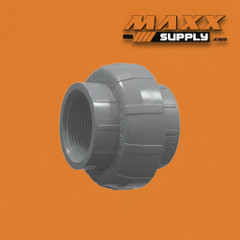
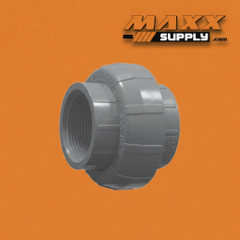

3/4" Union (O-Ring Type), Slip x FPT PVC Schedule 80 (899-007)
$7.89
The 899-007 is a 3/4" PVC Schedule 80 O-ring union with a slip (socket) end on one side and a female NPT (FPT) threaded end on the other, providing a fully disconnectable transition connection between a solvent-cemented PVC pipe run and a male-threaded fitting, nipple, valve, or equipment port. It is a three-piece assembly: a slip-end body that solvent-cements permanently to 3/4" PVC pipe, an FPT-end body that accepts a 3/4" male-threaded connection, and a union nut that draws both body halves together at a gasketed O-ring face joint to create the pressure-rated seal.
The core function of any union is disconnectability — and the 899-007 delivers it at the most common and most useful transition point in Schedule 80 PVC systems. By combining a permanent solvent-weld connection on the slip side with a threaded connection on the FPT side, this fitting accommodates the reality of most equipment installations: one side of the connection is threaded pipe or a threaded equipment port, and the other side is solvent-weld piping. Pumps, in-line valves, chemical metering heads, UV treatment units, pressure gauges, and a wide range of other inline components typically present male NPT threads at their connections — the 899-007 mates to those threads on the FPT side while integrating cleanly into the solvent-weld PVC system on the slip side.
When the union nut is loosened, the two body halves separate at the face joint, allowing the equipment or component between two unions to be lifted free without disturbing the cemented pipe on either side. When the union nut is retightened, the O-ring at the face joint re-establishes the pressure seal. This reconnection capability is repeatable across multiple service cycles — a meaningful advantage over the flat-face union style, where repeated face-to-face contact without a resilient sealing element can progressively compromise the seal surface over time.
The O-ring itself is a critical component specifiers should verify for chemical compatibility with the process fluid. EPDM O-rings — the most common default in PVC union assemblies — perform well in water service, dilute acids and bases, and many chemical process applications, but are not suitable for petroleum-based fluids or certain organic solvents. Buna-N (nitrile) O-rings are available for petroleum and hydrocarbon service. When in doubt, confirm O-ring material compatibility against the specific fluid's chemical resistance data before finalizing the specification.
Installation of the 899-007 follows standard practice for each end type. The slip end is solvent-cemented to 3/4" IPS pipe using PVC primer and cement — standard technique for 3/4" applies, with no large-diameter concerns at this size. The FPT end receives any 3/4" male-threaded connection with PTFE thread tape or approved pipe thread sealant applied to the male threads. The union nut should be threaded onto the slip-end body flange before cementing the slip end to pipe — once the slip joint cures, the nut cannot be removed or repositioned. When connecting the two body halves, ensure the O-ring is properly seated in its groove and both faces are aligned squarely before advancing the nut. Hand-tighten the nut fully, then advance with a strap wrench to achieve a snug, leak-free seat — over-tightening risks cracking the nut body or distorting the O-ring, neither of which is recoverable without replacement of the fitting.
Manufactured from rigid PVC Type I, Grade I (Cell Classification 12454) to ASTM D2467, the 899-007 delivers the corrosion resistance and chemical compatibility expected of Schedule 80 PVC across acids, bases, salts, oxidizing agents, and a broad range of industrial process fluids. NSF/ANSI 61 certification confirms suitability for potable water contact. The union face joint — not the pipe wall — governs the assembly pressure rating; buyers should verify the manufacturer-rated working pressure for the union joint against their operating conditions before specifying in high-pressure circuits.
Specifications:
| Attribute | Detail |
|---|---|
| Part Number | 899-007 |
| Material | PVC (Polyvinyl Chloride) Type I, Grade I |
| Schedule / Pressure Class | Schedule 80 |
| Union Style | O-Ring Type (Three-Piece Assembly) |
| End Connection — Pipe Side | Slip (Socket) — 3/4" Solvent Cement (IPS) |
| End Connection — Equipment Side | FPT — 3/4" Female NPT Threads |
| Sealing Element | Elastomeric O-Ring (EPDM standard; Buna-N available) |
| Union Nut | Included — threads onto slip-end body flange |
| Applicable Standard | ASTM D2467 |
| Pressure Rating | Union face joint governs — verify with manufacturer datasheet |
| Temperature Range | Up to 140°F (pressure derated above 73°F) |
| Color | Dark Gray |
| Certifications | NSF/ANSI 61, ASTM D2467 |
| Installation — Slip End | PVC Primer + Solvent Cement; install union nut on body before cementing |
| Installation — FPT End | PTFE Tape or Approved Thread Sealant on Male Threads |
| Union Nut Installation | Hand-tight + Strap Wrench; avoid over-tightening |
Industries & Applications:
- Pump Stations & Inline Equipment — The defining application for slip × FPT transition unions; 3/4" pump suction and discharge connections where one side is threaded equipment port and the other is solvent-weld piping; union allows pump removal and reinstallation without cutting pipe or disturbing cemented joints on either side
- Chemical Metering & Dosing Systems — Transition connections at metering pump heads, injection quills, and chemical dosing valves where threaded equipment ports tie into solvent-weld distribution piping; union allows component removal for cleaning, calibration, or replacement without system shutdown or pipe cutting
- Water Treatment & Purification — NSF 61 listing supports potable water service; transition unions at inline UV units, membrane housings, pressure gauges, and filter cartridge heads where threaded instrument ports connect to Schedule 80 PVC solvent-weld systems
- Industrial & Chemical Process Piping — Serviceable transition connections at instrumentation ports, control valves, pressure relief tie-ins, and inline sensors in corrosive chemical service lines; O-ring seal integrity supports repeated disconnect/reconnect cycles without degradation
- Irrigation & Agricultural Infrastructure — Transition connections at solenoid valves, pressure regulators, and flow control devices in 3/4" Schedule 80 irrigation systems where threaded valve bodies tie into solvent-weld mainline piping
- Laboratory & Analytical Systems — Serviceable connections at analytical instruments, sample ports, and process tie-ins where threaded instrument connections integrate with PVC process piping and periodic removal for calibration or replacement is required
- HVAC & Chilled Water Systems — Transition unions at chemical treatment feed connections, 3/4" control valve bodies, and instrumentation tie-ins in PVC-piped chilled water and chemical treatment distribution systems
(No reviews yet)

Write a Review

3/4" Union (O-Ring Type), Slip x FPT PVC Schedule 80 (899-007)
The 899-007 is a 3/4" PVC Schedule 80 O-ring union with a slip (socket) end on one side and a female NPT (FPT) threaded end on the other, providing a fully disconnectable transition connection between a solvent-cemented PVC pipe run and a male-threaded fitting, nipple, valve, or equipment port. It is a three-piece assembly: a slip-end body that solvent-cements permanently to 3/4" PVC pipe, an FPT-end body that accepts a 3/4" male-threaded connection, and a union nut that draws both body halves together at a gasketed O-ring face joint to create the pressure-rated seal.
The core function of any union is disconnectability — and the 899-007 delivers it at the most common and most useful transition point in Schedule 80 PVC systems. By combining a permanent solvent-weld connection on the slip side with a threaded connection on the FPT side, this fitting accommodates the reality of most equipment installations: one side of the connection is threaded pipe or a threaded equipment port, and the other side is solvent-weld piping. Pumps, in-line valves, chemical metering heads, UV treatment units, pressure gauges, and a wide range of other inline components typically present male NPT threads at their connections — the 899-007 mates to those threads on the FPT side while integrating cleanly into the solvent-weld PVC system on the slip side.
When the union nut is loosened, the two body halves separate at the face joint, allowing the equipment or component between two unions to be lifted free without disturbing the cemented pipe on either side. When the union nut is retightened, the O-ring at the face joint re-establishes the pressure seal. This reconnection capability is repeatable across multiple service cycles — a meaningful advantage over the flat-face union style, where repeated face-to-face contact without a resilient sealing element can progressively compromise the seal surface over time.
The O-ring itself is a critical component specifiers should verify for chemical compatibility with the process fluid. EPDM O-rings — the most common default in PVC union assemblies — perform well in water service, dilute acids and bases, and many chemical process applications, but are not suitable for petroleum-based fluids or certain organic solvents. Buna-N (nitrile) O-rings are available for petroleum and hydrocarbon service. When in doubt, confirm O-ring material compatibility against the specific fluid's chemical resistance data before finalizing the specification.
Installation of the 899-007 follows standard practice for each end type. The slip end is solvent-cemented to 3/4" IPS pipe using PVC primer and cement — standard technique for 3/4" applies, with no large-diameter concerns at this size. The FPT end receives any 3/4" male-threaded connection with PTFE thread tape or approved pipe thread sealant applied to the male threads. The union nut should be threaded onto the slip-end body flange before cementing the slip end to pipe — once the slip joint cures, the nut cannot be removed or repositioned. When connecting the two body halves, ensure the O-ring is properly seated in its groove and both faces are aligned squarely before advancing the nut. Hand-tighten the nut fully, then advance with a strap wrench to achieve a snug, leak-free seat — over-tightening risks cracking the nut body or distorting the O-ring, neither of which is recoverable without replacement of the fitting.
Manufactured from rigid PVC Type I, Grade I (Cell Classification 12454) to ASTM D2467, the 899-007 delivers the corrosion resistance and chemical compatibility expected of Schedule 80 PVC across acids, bases, salts, oxidizing agents, and a broad range of industrial process fluids. NSF/ANSI 61 certification confirms suitability for potable water contact. The union face joint — not the pipe wall — governs the assembly pressure rating; buyers should verify the manufacturer-rated working pressure for the union joint against their operating conditions before specifying in high-pressure circuits.
Specifications:
| Attribute | Detail |
|---|---|
| Part Number | 899-007 |
| Material | PVC (Polyvinyl Chloride) Type I, Grade I |
| Schedule / Pressure Class | Schedule 80 |
| Union Style | O-Ring Type (Three-Piece Assembly) |
| End Connection — Pipe Side | Slip (Socket) — 3/4" Solvent Cement (IPS) |
| End Connection — Equipment Side | FPT — 3/4" Female NPT Threads |
| Sealing Element | Elastomeric O-Ring (EPDM standard; Buna-N available) |
| Union Nut | Included — threads onto slip-end body flange |
| Applicable Standard | ASTM D2467 |
| Pressure Rating | Union face joint governs — verify with manufacturer datasheet |
| Temperature Range | Up to 140°F (pressure derated above 73°F) |
| Color | Dark Gray |
| Certifications | NSF/ANSI 61, ASTM D2467 |
| Installation — Slip End | PVC Primer + Solvent Cement; install union nut on body before cementing |
| Installation — FPT End | PTFE Tape or Approved Thread Sealant on Male Threads |
| Union Nut Installation | Hand-tight + Strap Wrench; avoid over-tightening |
Industries & Applications:
- Pump Stations & Inline Equipment — The defining application for slip × FPT transition unions; 3/4" pump suction and discharge connections where one side is threaded equipment port and the other is solvent-weld piping; union allows pump removal and reinstallation without cutting pipe or disturbing cemented joints on either side
- Chemical Metering & Dosing Systems — Transition connections at metering pump heads, injection quills, and chemical dosing valves where threaded equipment ports tie into solvent-weld distribution piping; union allows component removal for cleaning, calibration, or replacement without system shutdown or pipe cutting
- Water Treatment & Purification — NSF 61 listing supports potable water service; transition unions at inline UV units, membrane housings, pressure gauges, and filter cartridge heads where threaded instrument ports connect to Schedule 80 PVC solvent-weld systems
- Industrial & Chemical Process Piping — Serviceable transition connections at instrumentation ports, control valves, pressure relief tie-ins, and inline sensors in corrosive chemical service lines; O-ring seal integrity supports repeated disconnect/reconnect cycles without degradation
- Irrigation & Agricultural Infrastructure — Transition connections at solenoid valves, pressure regulators, and flow control devices in 3/4" Schedule 80 irrigation systems where threaded valve bodies tie into solvent-weld mainline piping
- Laboratory & Analytical Systems — Serviceable connections at analytical instruments, sample ports, and process tie-ins where threaded instrument connections integrate with PVC process piping and periodic removal for calibration or replacement is required
- HVAC & Chilled Water Systems — Transition unions at chemical treatment feed connections, 3/4" control valve bodies, and instrumentation tie-ins in PVC-piped chilled water and chemical treatment distribution systems
- Part #:
- 899-007
- Product Family:
- Sch 80 PVC
- Carton Qty:
- 10
- Pallet Qty:
- 3200
- Size:
- 3/4"