

45 Degree Elbow, Slip x Slip PVC Schedule 80 3/8" (817-003)
$4.47
This 3/8" Schedule 80 PVC 45 Degree Elbow provides a solvent-cemented 45° directional change in small-bore Schedule 80 PVC pressure piping, routing a 3/8" pipe run through a half-right-angle turn in a permanent, pressure-rated fitting. Both slip socket ends accept standard 3/8" PVC pipe for solvent cement joining, producing a fully solvent-welded 45° directional change that becomes a continuous, integral part of the piping system once cured.
Two parallel distinctions define where the 817-003 belongs in a system layout. The first is connection type. Within the Schedule 80 45° elbow family, the 817 all-socket series serves fully solvent-welded PVC pipe systems where both sides of the 45° turn are cemented pipe ends; the 818-series mixed elbow bridges a solvent-welded inlet to a female-threaded outlet at the turn; and the 819-series FPT × FPT elbow serves fully threaded assemblies where both sides of the turn receive male-threaded nipples or fittings. When both connections at the 45° directional change point are solvent-welded PVC pipe, the 817-003 is the correct elbow selection.
The second distinction is turn angle. The 817-003 produces a 45° turn — a half-right-angle directional change that is fundamentally different from the 90° turn of the 806-series Slip × Slip elbow. Where a 90° elbow makes an abrupt right-angle turn, the 45° elbow routes the pipe run through a shallower angular offset — enabling diagonal routing around structural members and equipment footprints, gradual directional transitions in congested piping spaces, compound-angle assemblies where two 45° elbows work together to create a custom offset or a 90° turn with lateral displacement between the inlet and outlet centerlines, and direction changes where reduced flow turbulence at the turn is a design consideration. The 45° geometry is the correct selection wherever the piping layout requires an angular transition that a 90° elbow cannot cleanly accomplish — or wherever the shallower sweep and reduced pressure drop of a 45° turn is specified over the sharper geometry of a right-angle elbow.
At 3/8", the 817-003 operates in a small-bore pipe size that appears primarily in instrument supply lines, gauge line assemblies, fine-bore chemical dosing branches, and small-bore process connections rather than primary distribution piping. Three-eighth inch PVC pipe at Schedule 80 is a specialized small-bore material, and the fittings at this size serve the corresponding specialized applications — directional changes in instrument supply runs approaching gauge manifolds and control panels, 45° offsets in gauge line assemblies routed around equipment, diagonal routing transitions in fine-bore chemical injection branch piping, and compound-angle routing in small-bore process connection assemblies where the available space and routing geometry demand the 45° turn rather than a right-angle elbow. In these environments, the all-socket construction of the 817-003 integrates cleanly into the solvent-welded 3/8" Schedule 80 piping, producing a permanent, monolithic directional change at the turn point without threaded interfaces that might require periodic inspection or re-torquing at the small connection size.
The elevated pressure rating at 3/8" Schedule 80 — reflecting the significantly higher pressure capacity of small-bore Schedule 80 PVC fittings — ensures that the elbow is not the limiting component in high-pressure instrument supply lines and small-bore process connections where system pressure may approach or exceed the ratings typical of larger-bore Schedule 80 fittings.
Manufactured in dark gray Schedule 80 PVC, this elbow delivers the wall thickness and mechanical strength required in industrial, chemical, and commercial pressure piping where Schedule 40 ratings are insufficient. PVC's broad chemical resistance covers acids, bases, salts, chlorine, and most common process and instrument fluids, providing long service life in corrosive environments where metal elbows would degrade or contaminate instrument supply lines and chemical handling systems. NSF/ANSI 61 listing confirms suitability for potable water contact.
Rated to approximately 1300 psi at 73°F, this fitting handles the full range of pressures encountered in commercial and industrial small-bore Schedule 80 PVC systems. For installation, clean and dry both pipe ends and socket interiors before application. Apply purple PVC primer to all mating surfaces — both pipe ends and both socket interiors. Apply a uniform coat of Schedule 80 PVC solvent cement to both the pipe end and socket interior at each end before joining. Insert the pipe with a slight quarter-turn twist and hold firmly for 30 seconds to prevent pushback. Plan and confirm the 45° turn orientation before cementing — the direction of the angular offset is set permanently at installation and cannot be adjusted after the joints are cured. Stagger the two joints where possible and allow full cure time per the cement manufacturer's temperature and humidity guidelines before pressurizing. Apply published pressure derating factors for service temperatures above 73°F.
Specifications:
| Attribute | Detail |
|---|---|
| Part Number | 817-003 |
| Fitting Type | 45 Degree Elbow |
| Connection Type | Slip × Slip (Socket × Socket) |
| Size | 3/8" |
| Schedule / Series | Schedule 80 |
| Material | PVC (Polyvinyl Chloride) |
| Color | Dark Gray |
| Pressure Rating | ~1300 psi @ 73°F (verify vs. manufacturer data sheet) |
| ASTM Standard | D2467 |
| NSF/ANSI | NSF/ANSI 61 Listed |
| Temperature Range | Up to 140°F (derate pressure for elevated temps) |
| Turn Angle | 45° |
| Solvent Cement | Standard Schedule 80 PVC cement; primer required at both slip ends |
Industries & Applications:
- Instrument Supply & Gauge Line Piping — Routes 3/8" Schedule 80 PVC solvent-welded instrument supply runs and gauge lines through 45° directional changes at gauge manifold approaches, control panel entries, equipment nozzle offsets, and instrument rack routing transitions in industrial and commercial PVC pressure systems — the defining application for 3/8" Schedule 80 socket elbows across all system types given the prevalence of 3/8" PVC in instrument supply and gauge line piping
- Industrial Process Piping — Provides a 45° solvent-cemented directional change on 3/8" Schedule 80 PVC small-bore process lines at structural clearances, equipment footprint offsets, and angular routing transitions in chemical processing, water treatment, and manufacturing facility piping where diagonal routing or a shallower angular turn is required rather than a right-angle direction change
- Chemical Dosing & Injection Systems — Routes 3/8" Schedule 80 PVC solvent-welded chemical feed lines, reagent distribution branches, and fine-bore injection piping through 45° directional changes at injection quill approach angles, pump outlet routing transitions, and equipment connection offsets in systems handling acids, caustics, and aggressive process fluids where small-bore PVC is specified throughout the dosing assembly
- Compound-Angle Routing — Used in pairs to create a custom lateral offset or a 90° directional change with centerline displacement in 3/8" Schedule 80 solvent-welded systems — a two-elbow compound configuration that achieves routing transitions not possible with a single 90° elbow in congested small-bore instrument and process piping assemblies
- Water & Wastewater Treatment — Routes 3/8" Schedule 80 PVC solvent-welded instrument supply lines, chemical dosing branches, and small-bore process connections through 45° directional changes at tank entry points, process header instrument tap approaches, and equipment connection routing transitions in municipal and industrial water treatment facilities
- Commercial Plumbing & Mechanical Systems — Provides a 45° solvent-cemented direction change on 3/8" Schedule 80 PVC small-bore branch supply runs and instrument connection piping in mechanical room and building utility systems where diagonal routing around structural elements or equipment requires the 45° angular geometry rather than a right-angle turn in the solvent-welded small-bore piping layout
- HVAC & Mechanical Systems — Installed at 45° directional transitions in 3/8" Schedule 80 PVC solvent-welded cooling tower chemical feed lines, treated water monitoring branches, and small-bore instrument supply runs where diagonal routing around structural elements and equipment footprints requires the 45° angular geometry in the cemented small-bore piping
(No reviews yet)

Write a Review
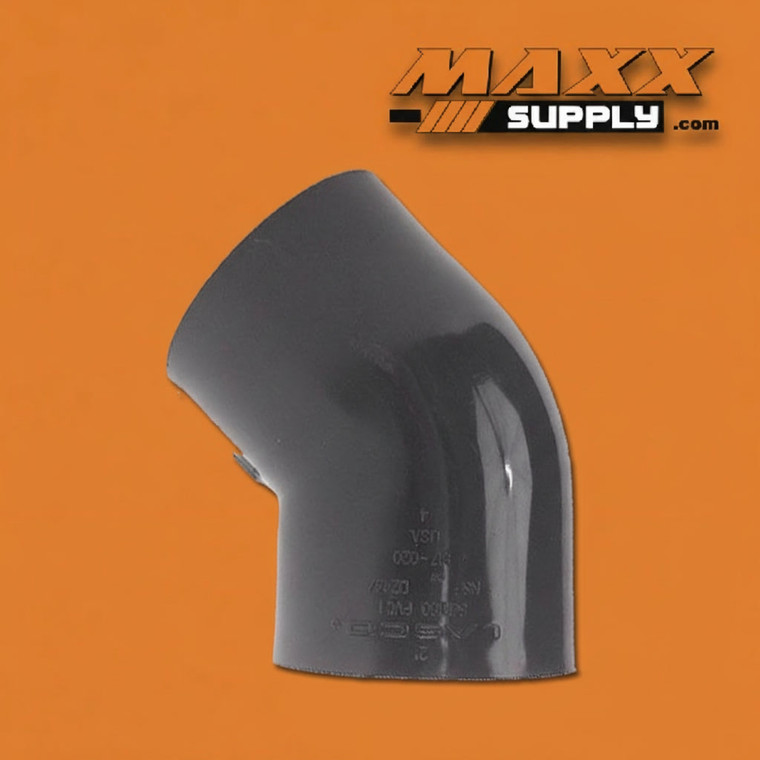
45 Degree Elbow, Slip x Slip PVC Schedule 80 3/8" (817-003)
This 3/8" Schedule 80 PVC 45 Degree Elbow provides a solvent-cemented 45° directional change in small-bore Schedule 80 PVC pressure piping, routing a 3/8" pipe run through a half-right-angle turn in a permanent, pressure-rated fitting. Both slip socket ends accept standard 3/8" PVC pipe for solvent cement joining, producing a fully solvent-welded 45° directional change that becomes a continuous, integral part of the piping system once cured.
Two parallel distinctions define where the 817-003 belongs in a system layout. The first is connection type. Within the Schedule 80 45° elbow family, the 817 all-socket series serves fully solvent-welded PVC pipe systems where both sides of the 45° turn are cemented pipe ends; the 818-series mixed elbow bridges a solvent-welded inlet to a female-threaded outlet at the turn; and the 819-series FPT × FPT elbow serves fully threaded assemblies where both sides of the turn receive male-threaded nipples or fittings. When both connections at the 45° directional change point are solvent-welded PVC pipe, the 817-003 is the correct elbow selection.
The second distinction is turn angle. The 817-003 produces a 45° turn — a half-right-angle directional change that is fundamentally different from the 90° turn of the 806-series Slip × Slip elbow. Where a 90° elbow makes an abrupt right-angle turn, the 45° elbow routes the pipe run through a shallower angular offset — enabling diagonal routing around structural members and equipment footprints, gradual directional transitions in congested piping spaces, compound-angle assemblies where two 45° elbows work together to create a custom offset or a 90° turn with lateral displacement between the inlet and outlet centerlines, and direction changes where reduced flow turbulence at the turn is a design consideration. The 45° geometry is the correct selection wherever the piping layout requires an angular transition that a 90° elbow cannot cleanly accomplish — or wherever the shallower sweep and reduced pressure drop of a 45° turn is specified over the sharper geometry of a right-angle elbow.
At 3/8", the 817-003 operates in a small-bore pipe size that appears primarily in instrument supply lines, gauge line assemblies, fine-bore chemical dosing branches, and small-bore process connections rather than primary distribution piping. Three-eighth inch PVC pipe at Schedule 80 is a specialized small-bore material, and the fittings at this size serve the corresponding specialized applications — directional changes in instrument supply runs approaching gauge manifolds and control panels, 45° offsets in gauge line assemblies routed around equipment, diagonal routing transitions in fine-bore chemical injection branch piping, and compound-angle routing in small-bore process connection assemblies where the available space and routing geometry demand the 45° turn rather than a right-angle elbow. In these environments, the all-socket construction of the 817-003 integrates cleanly into the solvent-welded 3/8" Schedule 80 piping, producing a permanent, monolithic directional change at the turn point without threaded interfaces that might require periodic inspection or re-torquing at the small connection size.
The elevated pressure rating at 3/8" Schedule 80 — reflecting the significantly higher pressure capacity of small-bore Schedule 80 PVC fittings — ensures that the elbow is not the limiting component in high-pressure instrument supply lines and small-bore process connections where system pressure may approach or exceed the ratings typical of larger-bore Schedule 80 fittings.
Manufactured in dark gray Schedule 80 PVC, this elbow delivers the wall thickness and mechanical strength required in industrial, chemical, and commercial pressure piping where Schedule 40 ratings are insufficient. PVC's broad chemical resistance covers acids, bases, salts, chlorine, and most common process and instrument fluids, providing long service life in corrosive environments where metal elbows would degrade or contaminate instrument supply lines and chemical handling systems. NSF/ANSI 61 listing confirms suitability for potable water contact.
Rated to approximately 1300 psi at 73°F, this fitting handles the full range of pressures encountered in commercial and industrial small-bore Schedule 80 PVC systems. For installation, clean and dry both pipe ends and socket interiors before application. Apply purple PVC primer to all mating surfaces — both pipe ends and both socket interiors. Apply a uniform coat of Schedule 80 PVC solvent cement to both the pipe end and socket interior at each end before joining. Insert the pipe with a slight quarter-turn twist and hold firmly for 30 seconds to prevent pushback. Plan and confirm the 45° turn orientation before cementing — the direction of the angular offset is set permanently at installation and cannot be adjusted after the joints are cured. Stagger the two joints where possible and allow full cure time per the cement manufacturer's temperature and humidity guidelines before pressurizing. Apply published pressure derating factors for service temperatures above 73°F.
Specifications:
| Attribute | Detail |
|---|---|
| Part Number | 817-003 |
| Fitting Type | 45 Degree Elbow |
| Connection Type | Slip × Slip (Socket × Socket) |
| Size | 3/8" |
| Schedule / Series | Schedule 80 |
| Material | PVC (Polyvinyl Chloride) |
| Color | Dark Gray |
| Pressure Rating | ~1300 psi @ 73°F (verify vs. manufacturer data sheet) |
| ASTM Standard | D2467 |
| NSF/ANSI | NSF/ANSI 61 Listed |
| Temperature Range | Up to 140°F (derate pressure for elevated temps) |
| Turn Angle | 45° |
| Solvent Cement | Standard Schedule 80 PVC cement; primer required at both slip ends |
Industries & Applications:
- Instrument Supply & Gauge Line Piping — Routes 3/8" Schedule 80 PVC solvent-welded instrument supply runs and gauge lines through 45° directional changes at gauge manifold approaches, control panel entries, equipment nozzle offsets, and instrument rack routing transitions in industrial and commercial PVC pressure systems — the defining application for 3/8" Schedule 80 socket elbows across all system types given the prevalence of 3/8" PVC in instrument supply and gauge line piping
- Industrial Process Piping — Provides a 45° solvent-cemented directional change on 3/8" Schedule 80 PVC small-bore process lines at structural clearances, equipment footprint offsets, and angular routing transitions in chemical processing, water treatment, and manufacturing facility piping where diagonal routing or a shallower angular turn is required rather than a right-angle direction change
- Chemical Dosing & Injection Systems — Routes 3/8" Schedule 80 PVC solvent-welded chemical feed lines, reagent distribution branches, and fine-bore injection piping through 45° directional changes at injection quill approach angles, pump outlet routing transitions, and equipment connection offsets in systems handling acids, caustics, and aggressive process fluids where small-bore PVC is specified throughout the dosing assembly
- Compound-Angle Routing — Used in pairs to create a custom lateral offset or a 90° directional change with centerline displacement in 3/8" Schedule 80 solvent-welded systems — a two-elbow compound configuration that achieves routing transitions not possible with a single 90° elbow in congested small-bore instrument and process piping assemblies
- Water & Wastewater Treatment — Routes 3/8" Schedule 80 PVC solvent-welded instrument supply lines, chemical dosing branches, and small-bore process connections through 45° directional changes at tank entry points, process header instrument tap approaches, and equipment connection routing transitions in municipal and industrial water treatment facilities
- Commercial Plumbing & Mechanical Systems — Provides a 45° solvent-cemented direction change on 3/8" Schedule 80 PVC small-bore branch supply runs and instrument connection piping in mechanical room and building utility systems where diagonal routing around structural elements or equipment requires the 45° angular geometry rather than a right-angle turn in the solvent-welded small-bore piping layout
- HVAC & Mechanical Systems — Installed at 45° directional transitions in 3/8" Schedule 80 PVC solvent-welded cooling tower chemical feed lines, treated water monitoring branches, and small-bore instrument supply runs where diagonal routing around structural elements and equipment footprints requires the 45° angular geometry in the cemented small-bore piping
- Part #:
- 817-003
- Product Family:
- Sch 80 PVC
- Carton Qty:
- 50
- Pallet Qty:
- 4400
- Size:
- 3/8"