
5th Feb 2026
The Best Way to Cut PVC Pipe for Clean, Accurate Results
Clean, square cuts help every PVC connection seal tightly and last longer. When you cut PVC piping with a quality ratcheting pipe cutter instead of a hacksaw or miter saw, you usually get smoother edges that need less prep. Those cuts also fit better for solvent welding.
Precise cutting of PVC pipe matters for more than looks. Clean cuts keep pipe ends round, protect the hub fit, and prevent burrs from disrupting solvent-welded joints. Rough, angled cuts prevent full contact inside the fitting, leading to uneven bonding and stress points that can cause leaks under pressure. Many of the same cutting principles apply when you work with PVC sheets, where clean edges and proper deburring keep panels fitting tight and looking professional.
Over time, poor PVC pipe cutting wastes fittings, increases callbacks, and slows down projects for plumbers, DIYers, and contractors alike. Learning the best way to cut PVC saves you time and money in the long run.
Understanding PVC Before You Cut
PVC pipe uses polyvinyl chloride, which is a rigid thermoplastic that resists corrosion and handles pressure in water, drain, and irrigation systems. Schedule 40 PVC piping has thinner walls than Schedule 80, so it cuts more easily, but needs just as much accuracy at the ends.
Thicker Schedule 80 pipe walls demand more force and a sharper blade, which makes tool choice more important on larger diameters. The larger the diameter, the more you may switch from a handheld PVC cutter or tubing cutter to a miter saw, cable saw, or dedicated pipe cutter that can track square around the circumference.
In cold weather, PVC hardens and becomes more brittle, so you’ll need to cut more slowly and ensure the cutter is sharp so you can avoid crushing or snapping the pipe wall.
The Best Tools for Cutting PVC Pipe
You can cut PVC with anything from a simple hacksaw to a powered miter saw, but not every tool delivers the same quality edge. For most clean, accurate pipe cut jobs, a ratcheting pipe cutter gives you the best combination of control, speed, and finish on pipes with small and medium diameters.
Hand Tools for Small to Medium PVC Pipe
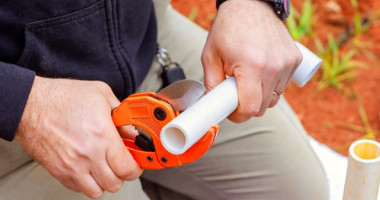
Manual tools shine when you cut PVC in tight spaces or on residential and light commercial jobs that require one-half- to two-inch pipe. A ratcheting pipe cutter grips the pipe and advances the blade in stages, so you apply less hand force while still getting a straight cut. Many pros rely on a PVC pipe cutter with a curved jaw that centers the pipe and a hardened blade that slices instead of crushing it. This leaves a smooth, nearly burr-free edge. That style of PVC cutter works exceptionally well for irrigation lines, soft plastic pipe, and small PVC piping branches where you need to move quickly.
Hand saws and hacksaws still deserve a place in your kit. A fine-tooth saw blade designed for plastic can cut larger sizes or odd angles when the pipe will not fit in a cutter body. You trade some effort and cleanup for flexibility, because saws throw more shavings and leave more burrs that you must remove with a deburring tool. Manual tools give you greater control and lower cost, but they demand more time and attention to keep each straight cut square and smooth.
Power Tools for Larger or High-Volume Cuts
Power tools help when you cut dozens of pieces or work with larger diameters that overwhelm small cutters. A miter saw or chop saw with a fine-tooth blade rated for plastic produces fast, repeatable PVC pipe cutting for racks of identical lengths.
You can set a stop block, hold the pipe firmly and let the saw blade glide through with controlled feed pressure for a consistent, square pipe cut every time, helping prevent melting or chipping. Reciprocating saws work better for demolition or rough cutting PVC, because they bite through pipe, fittings and brackets, but rarely leave a clean cut ready for solvent welding without additional prep.
Step-by-Step: How to Cut PVC Pipe Properly
Follow the same core process whether you use a ratcheting cutter, tubing cutter, or a saw.
- Measure and mark the cut. Mark the line clearly all the way around the pipe, so you don’t guess where the blade should land. Use a marker, tape wrap, or hose clamp as a guide to keep the mark square around the circumference.
- Secure the pipe. Support it on a stable surface, in a vise with soft jaws, or on sawhorses, so it can’t roll or jump while cutting. Keep the cut area close to the support to limit vibration and flex.
- Align the tool and start the cut. Place the ratcheting pipe cutter or the PVC pipe cutter so the blade lines up with the mark. Take the first click gently to score the surface. With a saw, rest the saw blade on the line and start slowly to create a shallow groove before increasing speed.
- Apply steady, even pressure. With a ratcheting PVC cutter, squeeze through each click smoothly. Allow the mechanism to advance the blade without twisting the tool. When cutting PVC with a saw, keep the strokes straight and let the teeth do the work. Move a cable saw or similar flexible cutter in long, even strokes to keep the kerf narrow and square.
- Finish and inspect the cut.
How to Smooth and Prepare PVC After Cutting
Deburring PVC matters as much as the cut itself, because burrs can channel solvent, create voids, and weaken the joint. Use a dedicated deburring tool, reaming blade, or utility knife to scrape the inner and outer edges until they feel smooth and slightly chamfered. Light sanding with fine-grit paper can knock down any remaining high spots around the cut edge. Always wipe or blow away dust and chips before you apply primer, cement or PVC pipe sealants so nothing interferes with the solvent bond.
Common Mistakes to Avoid When Cutting PVC
You avoid many headaches when you watch for these frequent errors during cutting PVC:
- Crushing the pipe wall by over-squeezing a dull cutter or using a tool sized for smaller tubing.
- Making uneven cuts that leave the pipe end out of square and prevent full socket engagement.
- Skipping deburring and leaving loose plastic that can wash into valves or clog small passages.
- Using a worn saw blade, the wrong tool, or an incorrect cutter for thick or large-diameter pipe.
Each mistake shortens system life and raises the odds of leaks or callbacks, especially on pressure lines.
Safety Tips When Cutting PVC Pipe
Cutting PVC creates flying chips and dust, and tools add their own risks. Wear safety glasses whenever you cut, and use cut-resistant gloves if you handle long lengths or sharp edges. Always follow manufacturer instructions for each tool and keep your hands clear of the blade path or ratcheting jaws.
Support the pipe on a stable bench or stands so it can’t roll, pinch the blade or fall when you finish the cut. When you sand or cut indoors, open windows or use ventilation to keep plastic dust and solvent fumes from building up in the workspace.
Clean Cuts Lead to Stronger PVC Connections
Your cutting technique affects how long the PVC system performs without leaks or failures. Clean square cuts made with a good PVC pipe cutter or ratcheting pipe cutter help fittings seat fully and give solvent cement a uniform surface to bond.
The right tool for each pipe size — from a manual cutter to a miter saw — saves time, reduces material waste, and keeps every pipe cut ready for assembly. For projects that depend on reliable PVC pipe, you can choose Schedule 40 and Schedule 80 PVC pipe sizes, match them with Schedule 80 unions or Schedule 40 unions, and finish your joints with quality sealants from trusted suppliers.
When you pair solid materials with a sharp cutter, the right tool, and a careful cut, every PVC pipe cutting job moves faster and produces cleaner, stronger connections.