
5th Feb 2026
Can PVC Be Used for Hot Water?
Plumbing systems may look simple on the outside, but every material choice behind the walls carries real performance, safety, and cost consequences over decades. PVC changed how installers built water systems because it is low-cost, lightweight, and installs quickly. You don’t need torches, threading oils, or heavy equipment. You can cut it with basic tools, bond it with solvent cement, and move long lengths of pipe without straining a ladder or scissor lift, which makes PVC attractive for do-it-yourselfers and maintenance teams. Environmental and industrial engineers also like PVC, as it doesn’t corrode like metal, and it can handle a wide range of non-potable fluids in process and drain applications.
Can You Use PVC for
PVC pipe became a staple in water systems because it stays affordable, resists internal , and supports high pressure at room temperature. Installers like its predictable solvent-weld joints and low-friction losses, which help maintain good flow for cold water supply and irrigation. Those strengths lead many people to assume they can extend the same plastic pipe from cold water lines directly into hot water applications, including connections near a water heater.
The compatibility question keeps coming up because the maximum PVC temperature rating, which is about 140 degrees Fahrenheit, is on the edge of the typical domestic hot water settings, which range 120-160 F at the heater tank. Because PVC softens and loses strength as it approaches the 140-degree limit, you can’t treat “rated to 140 degrees” as an invitation to run potable water or hot water pipes continuously at 135-140 F and expect a -service life.
For proper plumbing design, you need to treat PVC as a cold water and drainpipe material instead of a primary hot water pipe for pressurized service.
Understanding PVC Pipe Temperature Ratings
Standard pressure ratings on PVC piping assume a test temperature of 73 F. At that temperature, Schedule 40 and Schedule 80 PVC can carry substantial pressure safely, and that rating appears clearly on the pipe wall. As fluid temperature rises, you must apply temperature-dating factors that reduce the allowable working pressure, even if the short-term burst strength looks similar in a lab.
By the time water reaches 120-130 F, PVC’s allowable working pressure can fall by 50% or more compared to its rating at 73 F. Near 140 F, even small pressure spikes from pump cycling, quick-closing valves, or elevation changes can exceed safe limits.
Sustained heat exposure matters more than brief spikes because creep and relaxation grow under stress. When a PVC water pipe carries hot water hour after hour, especially in a recirculating system or long horizontal sagging between supports, ovalization, and joint relaxation occur. Even if the pipe never sees boiling water, operating it near its thermal limit for years gradually erodes the safety margin based on the original design.
Why PVC Is Not Recommended for Hot Water
When you run hot water through PVC, the first change occurs in stiffness. The pipe softens, so spans that feel solid under cold water begin to bow or sag when exposed to elevated temperatures. That deflection increases stress at elbows, tees, and transitions, especially where the pipe enters rigid supports or concrete penetrations.
At the joints, thermal softening and pressure combine to cause slow deformation. Solvent-welded sockets that used to grip tightly can relax. That allows tiny movements under pressure cycles and temperature swings. Over time, those movements lead to weeping at the joints and cracks at the edge of fittings. The pipes can even pull apart if the system experiences a transient surge.
Chemical interactions at high temperature can accelerate oxidation and brittleness, especially in chlorinated water, which also reduces long-term ductility.
Can PVC Ever Handle Warm or Heated Water?
If you occasionally run water that is 100-110 F through PVC at low pressure, such as short-duration gray water discharge or a brief warm rinse, the material usually tolerates those conditions without immediate damage. However, the pipe may still experience incremental softening, but the short exposure and long cooling periods give it time to recover.
Once you creep toward 120-140 F, especially under constant pressure, the trade-offs change. Even if you avoid immediate failure, each hour of operation above the “comfortable” range reduces long-term reliability through cumulative creep, microcracking, and joint relaxation.
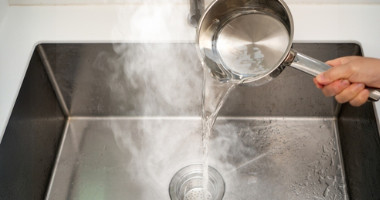
Dumping occasional boiling water into a PVC drain pipe , a common kitchen habit, can also warp or distort the pipe, weaken the wall, and shorten its lifespan, especially if you repeat the practice over months and years.
Better Alternatives for Hot Water Applications
CPVC: The Preferred Choice for Hot Water
CPVC pipe (chlorinated polyvinyl chloride) starts with a PVC base and then adds extra chlorine during manufacturing, which changes the polymer’s thermal and mechanical profile. That modification raises the heat deflection temperature and allows CPVC to handle water in the 180-200 F range, which is above the normal domestic hot water temperature, depending on the product and design. It also has reliable pressure capacity.
In addition to higher temperature tolerance, CPVC maintains better strength and stiffness at elevated temperatures, so you see less creep and deformation over time. Many CPVC products carry NSF/ANSI certifications for hot and cold potable water, meaning they meet strict criteria for chemical extraction and long-term performance in drinking water systems. You find CPVC in residential hot water distribution, commercial plumbing pipes, hydronic loops, and industrial hot water system piping where PVC would not meet code.
Other Hot Water Pipe Options
Cross-linked polyethylene (PEX) offers a flexible, resilient alternative for hot water lines. It handles typical domestic hot water temperatures, routes easily around obstacles, and requires fewer fittings, which reduces potential leak points.
Its cross-linked structure improves high-temperature strength and creep resistance compared to standard polyethylene, which makes it a strong candidate for many indoor hot water systems.
Copper pipe continues to serve as a workhorse for hot water due to its high temperature capability, excellent pressure rating, and long track record. It resists UV and delivers low oxygen permeability, which helps in some heating and industrial water scenarios.
In some regions, engineers and installers rely on PPR pipe for hot and cold water, especially in larger diameter building risers and mechanical rooms, where fusion-welded joints and robust thermal ratings provide durable performance.
How to Identify PVC vs. CPVC in Existing Systems
Accurate identification matters whenever you modify or repair water systems. PVC and CPVC often differ in color. PVC is usually bright white or light gray. CPVC for plumbing typically appears cream, tan or light yellow. Color alone never guarantees identity, but it provides a useful first clue when you inspect mechanical rooms, ceiling spaces, or crawlspaces.
Printed markings on the pipe give you definitive information for PVC vs. CPVC. Check for labels such as “PVC” or “CPVC,” schedule numbers, ASTM standards, and temperature or pressure ratings. CPVC used for hot water often carries markings indicating its suitability for elevated-temperature potable water.
Size standards also differ. Some CPVC plumbing products use copper tube size rather than traditional iron pipe size dimensions, which affects fitting compatibility and transition choices.
Choosing the Right Pipe for Hot Water Systems
Long-term system performance depends heavily on matching material choice to temperature, pressure and water quality. PVC is great for cold water and drains, but you should never use it for hot water because its 140 F limit overlaps too closely with practical hot water settings.
Contact Maxx Supply today for compliant PVC or CPVC for your next install.