
10th Mar 2026
How to Glue PVC Pipe Joints & Fittings
Properly glued PVC joints keep water where it belongs and protects structures, finishes, and equipment from costly damage. Solvent welding creates permanent, leak-resistant connections between PVC pipe and fittings, but it leaves no room for error. Incorrect technique leads to weeping joints, blowouts under pressure, callbacks, and premature system replacement. Contractors, plumbers, and DIYers need consistent, repeatable steps that respect how PVC primer, PVC cement, and cure time actually work in the field.
Solvent cement joints fail most often because installers rush prep, skip PVC primer, use the wrong PVC adhesive, or pressurize too soon. Small mistakes, such as dirty plastic pipe, unchamfered pipe ends, or misaligned PVC fittings, reduce bonding surface and create weak spots. With the correct materials, timing, and a methodical approach, gluing PVC pipe becomes a predictable process that produces strong, code-compliant PVC joints on every job.
UNDERSTANDING HOW PVC CEMENT WORKS
PVC cement is not a typical glue that sticks two surfaces together. It functions as a solvent that softens and fuses PVC plastic. Solvent welding uses a combination of PVC primer and PVC pipe cement to chemically melt a thin layer of the pipe and the PVC fitting socket.
Key points about PVC cement and solvent welding:
- PVC primer cleans and softens the pipe and fitting, which allows the solvent cement to penetrate.
- The cement, often called PVC pipe glue or PVC adhesive, dissolves the surface of the PVC pipe and fitting, so they fuse into a single piece, once cured.
- The finished PVC joint behaves like continuous PVC plastic rather than a glued seam, which gives it high strength and pressure resistance.
- Proper application, including correct coverage and assembly speed, determines joint strength more than the brand of PVC glue.
Because solvent welding chemically alters the plastic, you can’t easily reverse it. If you later need to redo a connection, you usually cut it out instead of relying on ungluing PVC techniques.
TOOLS AND MATERIALS NEEDED TO GLUE PVC PIPE
For reliable plumbing work, assemble the right tools before you glue PVC pipe:
- PVC pipe, such as potable water pipe or drain, waste, and vent, sized and rated for the application. Use quality PVC pipe for consistent wall thickness.
- PVC fitting types that match Schedule 40 fittings or Schedule 80 fittings, pressure rating and pipe size.
- PVC primer or purple primer that is code-approved. Use purple primer where visual verification matters.
- PVC solvent cement that matches the material, size, and temperature/pressure rating, for example, ASTM D2564 PVC cement.
- Pipe cutters, ratcheting cutters, or a fine-tooth saw for square, clean cuts.
- Deburring tool, utility knife, or sandpaper to remove burrs and add a slight bevel to the pipe end.
- Clean rags or wipes to remove dust, oil, or moisture before priming.
- Safety gloves and eye protection rated for chemical splashes, plus adequate ventilation when using primer and solvent cement.
Avoid the following materials for structural PVC pipe connections:
- Standard construction adhesives, hot glue, or epoxies not formulated for PVC pressure pipe.
- Oil-based lubricants or sealants that interfere with solvent cement.
- Random PVC glue products that lack pressure ratings or ASTM standards for plumbing.
STEP-BY-STEP: HOW TO GLUE PVC PIPE PROPERLY
This sequence delivers consistent, strong, leak-free PVC joints when followed carefully:
Step 1: Measure, Cut, and Dry-Fit
Accurate layout and dry-fitting eliminate surprises once solvent cement comes out.
- Measure pipe runs carefully, accounting for the insertion depth of each fitting socket.
- Cut the PVC pipe square to the centerline using a sharp cutter or a fine-tooth saw to maximize contact area.
- Deburr the inside and outside edges, then add a light chamfer to the pipe so that it slides smoothly into the fitting without scraping off cement.
- Dry-fit each PVC pipe and PVC fitting to confirm full insertion and correct orientation, especially on multi-branch assemblies.
- Mark alignment lines across the pipe and fitting with a permanent marker so you can reassemble quickly after priming and cementing
Step 2: Clean and Prime the Pipe and Fitting
Clean, primed surfaces allow PVC primer and cement to penetrate properly and build a strong bond.
- Wipe dirt, grease, and moisture off the pipe end and fitting socket with a clean, lint-free rag.
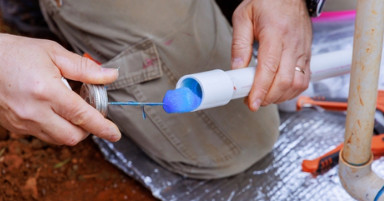
- Apply PVC primer or purple primer evenly to the outside of the pipe and the inside of the fitting socket, avoiding puddles.
- Ensure the primer visibly dulls and softens the PVC plastic surface. That change indicates proper chemical action.
- Follow local plumbing codes, which often require primer, especially purple primer, for inspected work and pressurized systems.
- Only skip primer where the cement manufacturer and local code allow it, and then only on tight, small-diameter, low-pressure joints.
Step 3: Apply PVC Cement
Work quickly when applying PVC cement because the solvent flashes off fast and limits working time.
- While primer remains wet or tacky, apply an even coat of PVC cement to the pipe end from the edge to slightly past the socket depth mark.
- Apply a lighter, uniform coat of cement to the fitting socket, keeping excess from pooling at the bottom.
- Use the correct-sized applicator. A poorly sized applicator can lead to dry spots or oversaturation, which can weaken the PVC joint.
- Avoid multiple heavy coats. Excess cement can puddle, soften the wall excessively, and reduce strength.
- As soon as coverage looks uniform and glossy, move directly to assembly before the solvent cement begins to skin over.
Step 4: Assemble and Hold the Joint
The assembly technique locks the joint in place while the solvent cement begins to cure.
- Insert the pipe fully into the fitting socket in one motion while aligning your orientation marks.
- Push the pipe firmly until it bottoms out, then twist about a quarter turn to spread cement evenly around the joint.
- Hold the joint together with steady pressure for at least 15 to 30 seconds to prevent push back as the softened PVC tries to spring apart.
- Immediately wipe away excess cement bead around the joint with a rag, but don’t disturb alignment.
- Set the assembly aside on a flat surface, so the joint remains undisturbed during its initial set period.
Step 5: Cure Time and Pressure Testing
Cure time depends on pipe size, temperature, humidity, and system pressure.
- Follow the PVC cement manufacturer’s cure chart for minimum handling and pressure times at your site temperature.
- At temperatures above about 60 degrees Fahrenheit, many manufacturers recommend roughly 15 minutes for handling strength and at least two hours before testing up to 180 psi on small diameter PVC pipe.
- Extend cure times significantly for larger diameters, colder conditions, or higher operating pressures.
- Never pressure test with compressed air or gas. Use water to avoid explosive failures and comply with safety guidelines.
- Delay full system pressurization until the longest recommended cure time passes to avoid micro-leaks and long-term weakness.
SAFETY TIPS WHEN GLUING PVC PIPE
PVC primer and cement contain flammable, volatile solvents, so treat them with the same respect as any industrial adhesive.
- Work in well-ventilated areas or use local exhaust to control fumes, especially in confined spaces.
- Wear chemical-resistant gloves and impact-rated safety glasses or goggles to protect skin and eyes from splashes.
- Keep primer, cement, and any PVC pipe glue containers tightly closed when not in use. Store them upright away from heat sources.
- Eliminate ignition sources such as open flames, pilot lights, and sparking tools near solvent cement work.
- Follow all safety data sheets (SDS) instructions, including the use of respirators where ventilation alone doesn’t control exposure.
WHEN NOT TO GLUE PVC PIPE
Some situations call for mechanical connections instead of solvent cement.
- Use threaded or mechanical fittings for systems that require regular disassembly, adjustment or component replacement.
- Choose unions, transition couplings, or specialty adapters when connecting PVC plastic to metal piping or dissimilar materials.
- Specify flexible couplings or expansion joints where movement, vibration, or thermal expansion may stress rigid glued PVC joints.
- In repair scenarios where you can’t cut out a joint, consider techniques for ungluing PVC or use shielded couplings to splice in new sections instead.
STRONG PVC JOINTS START WITH PROPER GLUING
Correct gluing technique yields durable PVC pipe systems that resist leaks, reduce callbacks, and perform reliably for decades. Treat each PVC joint as permanent. Solvent welding with the correct primer, solvent cement, and cure time creates a single piece of PVC plastic.
Follow a consistent process: Measure, cut, deburr, dry-fit, prime, cement, assemble, hold, and cure. Use high-quality PVC pipe, compatible PVC fitting options such as Schedule 40 fittings or Schedule 80 fittings and the correct PVC cement for the application.
Adopt a pro tip mindset: Slow down slightly, respect cure times, and inspect every PVC joint before burying or closing walls. Finally, partner with Maxx Supply for PVC pipe, PVC cement, primer, and accessories so each gluing PVC pipe project starts with proven, professional-grade materials.