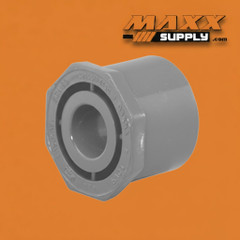


Bushing, Spigot x Slip (Flush Style) PVC Schedule 80 1-1/4" x 3/4" (837-167)
$3.27
Blue Monster 76037 1-Step PVC Cement Clear (32OZ)
This 1-1/4" × 3/4" Schedule 80 PVC Flush Bushing provides a two-step, all-solvent-cement size reduction from a 1-1/4" slip socket position directly to a 3/4" PVC pipe run in a fully solvent-welded Schedule 80 system. The 1-1/4" spigot end inserts into any standard 1-1/4" female slip socket fitting or coupling for solvent cement joining on the upstream side, while the 3/4" slip socket on the outlet end accepts standard 3/4" PVC pipe for solvent cement joining on the downstream side. Both connections are permanent, chemically fused solvent-cemented joints — no threaded interface is introduced at either end of the fitting.
At the 1-1/4" × 3/4" size combination, three Schedule 80 flush bushing series are available — each serving a different downstream connection requirement while sharing the same 1-1/4" spigot upstream end. The 839-167 (MPT × FPT, previously written) is all-threaded, threading into a female-threaded 1-1/4" port upstream rather than cementing into a socket. The 838-167 (Spigot × FPT, previously written) cements into the same 1-1/4" socket upstream but presents a 3/4" female-threaded outlet for connecting a male-threaded valve, nipple, or equipment component downstream. The 837-167 is the correct selection when both the upstream socket and the downstream connection are solvent-welded — when the 1-1/4"-to-3/4" size reduction occurs entirely within the cemented pipe system and the downstream 3/4" run is PVC pipe cementing directly into the bushing outlet socket rather than a threaded component.
This all-cement configuration is the correct design choice wherever the size reduction from 1-1/4" to 3/4" happens within a fully solvent-welded system. In Schedule 80 process piping, water distribution, and secondary distribution layouts where maintaining monolithic, all-cement construction from the 1-1/4" socket position through the size reduction and into the 3/4" downstream run is a design priority — for chemical resistance, system integrity, leak elimination, or simply maintaining the all-socket system construction — the 837-167 extends the cemented system through the size transition without interruption. The 838-167 is the correct fitting at the same position when the downstream component is threaded; the 837-167 is correct when it is a cemented pipe run.
The two-step reduction from 1-1/4" to 3/4" reflects the two-pipe-size span between these adjacent-but-not-adjacent sizes. The 1-1/4" pipe size serves secondary distribution headers, pump suction lines, equipment feed connections, and branch mains where 1" is undersized and 1-1/2" exceeds the flow requirement. The 3/4" pipe size serves the next tier down — branch supply lines, secondary zone connections, equipment feeds, and instrument supply runs that draw from those 1-1/4" secondary headers. The 837-167 sits at the transition point between these two tiers in a fully solvent-welded system, accomplishing both the inline socket-joining function and the two-step size transition at the 1-1/4" socket face in a single compact bushing body.
The flush style eliminates the protruding hex shoulder of a standard hex bushing, producing a streamlined, low-profile assembly that installs cleanly inside the receiving 1-1/4" slip socket. The two-step size differential between the 1-1/4" spigot and the 3/4" outlet socket is contained within the bushing body at the socket face, presenting the 3/4" outlet socket cleanly at the downstream side without axial extension beyond the socket face or interference with adjacent fittings in compact piping assemblies.
Manufactured in dark gray Schedule 80 PVC, this bushing delivers the increased wall thickness and mechanical strength required in industrial, chemical, and commercial pressure piping where Schedule 40 ratings are insufficient. PVC's broad chemical resistance covers acids, bases, salts, chlorine, and most common process fluids, providing long service life in corrosive environments where metal bushings would degrade or contaminate the fluid stream. NSF/ANSI 61 listing confirms suitability for potable water contact.
Rated to 630 psi at 73°F (governed by the 1-1/4" spigot end), this fitting handles standard to elevated pressure service across a wide range of fluid handling applications. Two separate solvent-cemented joints must be made at installation — the spigot end into the receiving 1-1/4" socket, and the 3/4" downstream pipe into the bushing's outlet slip socket. For both joints, clean and dry all mating surfaces before application. Apply purple PVC primer to the spigot exterior and receiving socket interior for the upstream joint; apply primer to the 3/4" pipe end and the bushing's outlet socket interior for the downstream joint. Apply a uniform coat of Schedule 80 PVC solvent cement to both mating surfaces at each joint before inserting. Hold each joint with a slight quarter-turn twist for 30 seconds and allow full cure time per the cement manufacturer's guidelines before pressurizing. Make the upstream spigot joint first to seat the bushing securely in the receiving socket before making the downstream pipe joint at the 3/4" outlet. Apply published pressure derating factors for service temperatures above 73°F.
Specifications:
| Attribute | Detail |
|---|---|
| Part Number | 837-167 |
| Fitting Type | Flush Bushing |
| Connection Type | Spigot × Slip (Male Plain End × Female Socket) |
| Size | 1-1/4" × 3/4" |
| Schedule / Series | Schedule 80 |
| Material | PVC (Polyvinyl Chloride) |
| Color | Dark Gray |
| Pressure Rating | 630 psi @ 73°F (governed by 1-1/4" spigot end) (verify vs. manufacturer data sheet) |
| ASTM Standard | D2467 |
| NSF/ANSI | NSF/ANSI 61 Listed |
| Temperature Range | Up to 140°F (derate pressure for elevated temps) |
| End Configuration | Flush Style (non-hex / low profile) |
| Upstream Connection | 1-1/4" Spigot — cements into 1-1/4" slip socket |
| Downstream Connection | 3/4" Slip Socket — accepts 3/4" PVC pipe for solvent cement |
| Assembly Method | All-cement — two solvent-cemented joints; primer required at both ends; no threaded interface |
| Reduction Steps | Two-step (1-1/4" to 3/4") |
Industries & Applications:
- Industrial Process Piping — Reduces a 1-1/4" slip socket position on a process header, tee branch, or coupling to a 3/4" solvent-welded pipe run within a fully cemented Schedule 80 PVC system in chemical processing, water treatment, and manufacturing facility piping — the correct bushing wherever both the upstream socket and the downstream 3/4" pipe run are cement-joined components and the two-step size reduction occurs at a single fitting position without threaded interfaces in the cemented line
- Secondary Header to Branch Supply Transitions — Provides a compact, single-fitting all-cement transition from a 1-1/4" socket secondary header position to a 3/4" branch supply run in Schedule 80 PVC commercial plumbing, mechanical room, and building utility systems — a common size pairing where a 1-1/4" secondary distribution header must feed multiple 3/4" branch supply lines through a fully cemented system without threading at the transition point
- Pump Suction & Equipment Supply Branch Connections — Delivers an all-cement two-step size reduction from a 1-1/4" slip socket position on a pump suction tee, equipment supply coupling, or secondary distribution fitting to a 3/4" cemented pipe continuation in fully solvent-welded Schedule 80 systems where the size transition serves a 3/4" equipment feed or branch supply run cementing directly into the bushing outlet socket
- Water & Wastewater Treatment — Provides an all-cement two-step size transition from a 1-1/4" socket position to a 3/4" pipe run on secondary distribution assemblies, chemical dosing supply branches, and equipment feed connections in municipal and industrial water treatment facilities where the fully solvent-welded construction is maintained through the size reduction and the downstream 3/4" pipe run cements into the bushing outlet socket
- Chemical Handling — Delivers a corrosion-resistant, all-cement size reduction from a 1-1/4" socket position to a 3/4" cemented pipe run on chemical feed headers, reagent distribution secondary branches, and tank recirculation supply connections in systems handling acids, caustics, and aggressive process fluids where the fully solvent-welded construction eliminates potential leak paths and maintains full chemical resistance through the two-step size transition
- Irrigation & Agricultural Systems — Reduces a 1-1/4" socket position on a tee, coupling, or cross to a 3/4" cemented pipe lateral or secondary branch in solvent-welded Schedule 80 commercial irrigation, greenhouse, and agricultural water supply systems where the downstream 3/4" run cements directly into the bushing outlet socket as a continuous part of the fully cemented system layout
- HVAC & Mechanical Systems — Installed at two-step size reduction points on Schedule 80 PVC cooling tower makeup secondary distribution lines, treated water branch assemblies, glycol system branches, and chilled water drain piping where a 1-1/4" socket position must transition to a 3/4" cemented pipe continuation within a fully solvent-welded mechanical system requiring Schedule 80 pressure performance through the size reduction fitting
(No reviews yet)

Write a Review

Bushing, Spigot x Slip (Flush Style) PVC Schedule 80 1-1/4" x 3/4" (837-167)
Blue Monster 76037 1-Step PVC Cement Clear (32OZ)
This 1-1/4" × 3/4" Schedule 80 PVC Flush Bushing provides a two-step, all-solvent-cement size reduction from a 1-1/4" slip socket position directly to a 3/4" PVC pipe run in a fully solvent-welded Schedule 80 system. The 1-1/4" spigot end inserts into any standard 1-1/4" female slip socket fitting or coupling for solvent cement joining on the upstream side, while the 3/4" slip socket on the outlet end accepts standard 3/4" PVC pipe for solvent cement joining on the downstream side. Both connections are permanent, chemically fused solvent-cemented joints — no threaded interface is introduced at either end of the fitting.
At the 1-1/4" × 3/4" size combination, three Schedule 80 flush bushing series are available — each serving a different downstream connection requirement while sharing the same 1-1/4" spigot upstream end. The 839-167 (MPT × FPT, previously written) is all-threaded, threading into a female-threaded 1-1/4" port upstream rather than cementing into a socket. The 838-167 (Spigot × FPT, previously written) cements into the same 1-1/4" socket upstream but presents a 3/4" female-threaded outlet for connecting a male-threaded valve, nipple, or equipment component downstream. The 837-167 is the correct selection when both the upstream socket and the downstream connection are solvent-welded — when the 1-1/4"-to-3/4" size reduction occurs entirely within the cemented pipe system and the downstream 3/4" run is PVC pipe cementing directly into the bushing outlet socket rather than a threaded component.
This all-cement configuration is the correct design choice wherever the size reduction from 1-1/4" to 3/4" happens within a fully solvent-welded system. In Schedule 80 process piping, water distribution, and secondary distribution layouts where maintaining monolithic, all-cement construction from the 1-1/4" socket position through the size reduction and into the 3/4" downstream run is a design priority — for chemical resistance, system integrity, leak elimination, or simply maintaining the all-socket system construction — the 837-167 extends the cemented system through the size transition without interruption. The 838-167 is the correct fitting at the same position when the downstream component is threaded; the 837-167 is correct when it is a cemented pipe run.
The two-step reduction from 1-1/4" to 3/4" reflects the two-pipe-size span between these adjacent-but-not-adjacent sizes. The 1-1/4" pipe size serves secondary distribution headers, pump suction lines, equipment feed connections, and branch mains where 1" is undersized and 1-1/2" exceeds the flow requirement. The 3/4" pipe size serves the next tier down — branch supply lines, secondary zone connections, equipment feeds, and instrument supply runs that draw from those 1-1/4" secondary headers. The 837-167 sits at the transition point between these two tiers in a fully solvent-welded system, accomplishing both the inline socket-joining function and the two-step size transition at the 1-1/4" socket face in a single compact bushing body.
The flush style eliminates the protruding hex shoulder of a standard hex bushing, producing a streamlined, low-profile assembly that installs cleanly inside the receiving 1-1/4" slip socket. The two-step size differential between the 1-1/4" spigot and the 3/4" outlet socket is contained within the bushing body at the socket face, presenting the 3/4" outlet socket cleanly at the downstream side without axial extension beyond the socket face or interference with adjacent fittings in compact piping assemblies.
Manufactured in dark gray Schedule 80 PVC, this bushing delivers the increased wall thickness and mechanical strength required in industrial, chemical, and commercial pressure piping where Schedule 40 ratings are insufficient. PVC's broad chemical resistance covers acids, bases, salts, chlorine, and most common process fluids, providing long service life in corrosive environments where metal bushings would degrade or contaminate the fluid stream. NSF/ANSI 61 listing confirms suitability for potable water contact.
Rated to 630 psi at 73°F (governed by the 1-1/4" spigot end), this fitting handles standard to elevated pressure service across a wide range of fluid handling applications. Two separate solvent-cemented joints must be made at installation — the spigot end into the receiving 1-1/4" socket, and the 3/4" downstream pipe into the bushing's outlet slip socket. For both joints, clean and dry all mating surfaces before application. Apply purple PVC primer to the spigot exterior and receiving socket interior for the upstream joint; apply primer to the 3/4" pipe end and the bushing's outlet socket interior for the downstream joint. Apply a uniform coat of Schedule 80 PVC solvent cement to both mating surfaces at each joint before inserting. Hold each joint with a slight quarter-turn twist for 30 seconds and allow full cure time per the cement manufacturer's guidelines before pressurizing. Make the upstream spigot joint first to seat the bushing securely in the receiving socket before making the downstream pipe joint at the 3/4" outlet. Apply published pressure derating factors for service temperatures above 73°F.
Specifications:
| Attribute | Detail |
|---|---|
| Part Number | 837-167 |
| Fitting Type | Flush Bushing |
| Connection Type | Spigot × Slip (Male Plain End × Female Socket) |
| Size | 1-1/4" × 3/4" |
| Schedule / Series | Schedule 80 |
| Material | PVC (Polyvinyl Chloride) |
| Color | Dark Gray |
| Pressure Rating | 630 psi @ 73°F (governed by 1-1/4" spigot end) (verify vs. manufacturer data sheet) |
| ASTM Standard | D2467 |
| NSF/ANSI | NSF/ANSI 61 Listed |
| Temperature Range | Up to 140°F (derate pressure for elevated temps) |
| End Configuration | Flush Style (non-hex / low profile) |
| Upstream Connection | 1-1/4" Spigot — cements into 1-1/4" slip socket |
| Downstream Connection | 3/4" Slip Socket — accepts 3/4" PVC pipe for solvent cement |
| Assembly Method | All-cement — two solvent-cemented joints; primer required at both ends; no threaded interface |
| Reduction Steps | Two-step (1-1/4" to 3/4") |
Industries & Applications:
- Industrial Process Piping — Reduces a 1-1/4" slip socket position on a process header, tee branch, or coupling to a 3/4" solvent-welded pipe run within a fully cemented Schedule 80 PVC system in chemical processing, water treatment, and manufacturing facility piping — the correct bushing wherever both the upstream socket and the downstream 3/4" pipe run are cement-joined components and the two-step size reduction occurs at a single fitting position without threaded interfaces in the cemented line
- Secondary Header to Branch Supply Transitions — Provides a compact, single-fitting all-cement transition from a 1-1/4" socket secondary header position to a 3/4" branch supply run in Schedule 80 PVC commercial plumbing, mechanical room, and building utility systems — a common size pairing where a 1-1/4" secondary distribution header must feed multiple 3/4" branch supply lines through a fully cemented system without threading at the transition point
- Pump Suction & Equipment Supply Branch Connections — Delivers an all-cement two-step size reduction from a 1-1/4" slip socket position on a pump suction tee, equipment supply coupling, or secondary distribution fitting to a 3/4" cemented pipe continuation in fully solvent-welded Schedule 80 systems where the size transition serves a 3/4" equipment feed or branch supply run cementing directly into the bushing outlet socket
- Water & Wastewater Treatment — Provides an all-cement two-step size transition from a 1-1/4" socket position to a 3/4" pipe run on secondary distribution assemblies, chemical dosing supply branches, and equipment feed connections in municipal and industrial water treatment facilities where the fully solvent-welded construction is maintained through the size reduction and the downstream 3/4" pipe run cements into the bushing outlet socket
- Chemical Handling — Delivers a corrosion-resistant, all-cement size reduction from a 1-1/4" socket position to a 3/4" cemented pipe run on chemical feed headers, reagent distribution secondary branches, and tank recirculation supply connections in systems handling acids, caustics, and aggressive process fluids where the fully solvent-welded construction eliminates potential leak paths and maintains full chemical resistance through the two-step size transition
- Irrigation & Agricultural Systems — Reduces a 1-1/4" socket position on a tee, coupling, or cross to a 3/4" cemented pipe lateral or secondary branch in solvent-welded Schedule 80 commercial irrigation, greenhouse, and agricultural water supply systems where the downstream 3/4" run cements directly into the bushing outlet socket as a continuous part of the fully cemented system layout
- HVAC & Mechanical Systems — Installed at two-step size reduction points on Schedule 80 PVC cooling tower makeup secondary distribution lines, treated water branch assemblies, glycol system branches, and chilled water drain piping where a 1-1/4" socket position must transition to a 3/4" cemented pipe continuation within a fully solvent-welded mechanical system requiring Schedule 80 pressure performance through the size reduction fitting
- Part #:
- 837-167
- Product Family:
- Sch 80 PVC
- Size:
- 1-1/4"