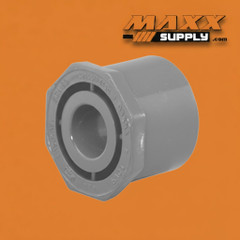


Bushing, Spigot x Slip (Flush Style) PVC Schedule 80 12" x 6" (837-666)
$431.74
The 12" x 6" Schedule 80 Gray PVC Flush-Style Reducing Bushing (837-666, Spigot x Slip) is a large-diameter, heavy-wall thermoplastic socket adapter fitting manufactured to ASTM D2467 in Schedule 80 gray PVC — a two-port fitting in which the large-end connection is a 12" IPS male spigot that inserts into and is permanently bonded within any 12" IPS female socket, and the small-end connection is a 6" IPS female slip socket that accepts 6" IPS PVC pipe in a permanently bonded solvent cement joint — providing a single-body Schedule 80 PVC solution for adapting any 12" IPS socket on any 12" Schedule 80 PVC socket fitting to accept 6" IPS socket PVC pipe directly at the fitting's socket, without inserting an independent inline reducer coupling in the pipe run between the fitting's socket and the downstream 6" IPS pipe, without field fabrication at the fitting socket transition, and without leaving the Schedule 80 gray PVC construction standard at the 12" socket-to-6" pipe adapter location. The 837-666 is the correct fitting wherever a 12" IPS socket on an installed or to-be-installed fitting — a tee body's branch or run socket, an elbow socket, a coupling socket, or any other 12" IPS socket PVC fitting's socket — must be adapted to accept 6" IPS PVC pipe in a permanently bonded socket cement connection, where the downstream pipe is 6" IPS schedule PVC pipe requiring a 6" IPS slip socket receiver rather than a 12" IPS slip socket, and where the adapter must be a manufactured, rated, NSF-listed, ASTM D2467-compliant Schedule 80 gray PVC bushing body whose 12" spigot bonds permanently within the receiving fitting's 12" IPS socket and whose 6" slip socket accepts standard 6" IPS Schedule 40 or Schedule 80 PVC pipe directly in the factory-formed female socket of the bushing's small-end port. As the large-secondary-distribution socket adapter configuration in the Spears 837 series at the 12" receiving socket size — producing a 50% size reduction ratio, approximately 25% cross-sectional area ratio, and approximately 4x velocity increase at constant flow through the bushing body — the 837-666 is the large-secondary-distribution scale socket adapter of the 12" Schedule 80 PVC socket fitting ecosystem, serving 12" IPS socket fitting locations where the downstream pipe connection transitions from the primary infrastructure scale of the 12" receiving socket to the large secondary distribution and large appurtenance supply scale of the 6" IPS downstream pipe.
The 837-666's commercial identity is wholly defined by its structural role as a socket adapter — a role that is categorically distinct from every other fitting type documented in this catalog and that governs every specification decision, every comparison, and every assembly instruction applicable to this fitting. A flush-style reducing bushing is not a pipe-connecting fitting: it does not connect two separate lengths of pipe inline in the primary run the way the Spears 829 series reducer couplings do; it does not provide a three-port perpendicular branch junction the way the Spears 401 and 402 series reducing tees do; and it does not provide a complete independent fitting body with its own structural position in the pipe run. The 837-666's structural role is to insert into the socket of another fitting — the receiving fitting — and adapt that fitting's 12" IPS socket to accept 6" IPS pipe. The receiving fitting remains the structural element of the pipe system at the fitting location; the 837-666 exists entirely within and as part of the receiving fitting's socket, bonded permanently to the receiving fitting's socket inner surface through the 12" spigot's outer bonding surface, and presenting the 6" IPS slip socket as the accessible downstream pipe connection at the receiving fitting's socket face. Every application of the 837-666 begins with the receiving fitting's 12" IPS socket — the socket on the tee, elbow, coupling, or other fitting whose opening must be reduced to 6" IPS — and the 837-666 is the fitting that performs that reduction within the receiving socket rather than in a separate inline fitting between the receiving socket and the downstream 6" IPS pipe.
The "flush style" designation distinguishes the 837-666 from hex-style reducing bushings at the same nominal size combination. A flush-style reducing bushing has a smooth cylindrical exterior profile — the bushing body is designed to insert fully into the receiving fitting's socket with the bushing's face flush with or slightly recessed within the receiving socket's face, presenting no external shoulder, hex head, or protruding feature beyond the receiving socket's opening when fully inserted and cemented. A hex-style reducing bushing has a hexagonal shoulder at the large end that bears against the face of the receiving fitting's socket rather than inserting into it, with the hex shoulder providing a mechanical bearing surface and a wrench engagement feature for threaded or mechanical assembly contexts. The 837-666's flush-style construction is the appropriate configuration for permanently bonded large-diameter Schedule 80 PVC socket fitting assemblies where the bushing must seat fully within the receiving fitting's socket in a continuous solvent cement bond line at the full contact surface between the bushing's 12" spigot and the receiving socket's inner bonding surface — a bond geometry that provides the maximum bonded contact area at the 12" socket interface and is structurally appropriate for the primary main service pressure, flow velocity, and sustained service conditions at 12" primary main fitting locations. At the 12" receiving socket scale, flush-style construction is the standard configuration for Schedule 80 PVC reducing bushings because the hex-style shoulder geometry is impractical at large IPS socket diameters where the hex shoulder would require unreasonably large hex flat dimensions, and because the permanently bonded socket assembly method used at all large-diameter Schedule 80 PVC socket fitting connections does not require the mechanical wrench engagement feature that the hex shoulder provides in smaller-diameter threaded or compression assembly contexts.
The 837-666's 50% size reduction ratio — from 12" spigot outer diameter to 6" IPS slip socket — and the resulting approximately 25% cross-sectional area ratio and approximately 4x velocity increase at constant flow establish its large-secondary-distribution socket adapter role within the 12" Schedule 80 PVC socket fitting ecosystem. At the 6" IPS slip socket, the cross-sectional area available for flow is approximately 25% of the 12" IPS large-end pipe's cross-sectional area — meaning that if the full design flow of a 12" primary main were passed through the 837-666's 6" slip socket at constant flow, the 6" downstream velocity would be approximately 4 times the 12" upstream velocity. At any standard 12" primary main design velocity in the range of 2 to 5 feet per second, the 6" downstream velocity at full primary main flow through the 837-666 would be approximately 8 to 20 feet per second — well above the standard design velocity limits for 6" IPS PVC pipe in primary distribution service, confirming that the 837-666 does not serve as a full-flow inline primary main transition from 12" to 6" at any standard primary main design velocity. The 837-666's ~4x velocity increase is the governing hydraulic parameter that establishes its socket adapter role as a large-secondary-distribution and large-appurtenance supply adapter — the 6" IPS downstream pipe from the 837-666's slip socket must carry only the confirmed design flow appropriate for 6" IPS PVC pipe service at the downstream assembly's design flow rate, not the full 12" primary main's throughput. The design flow through the 837-666's 6" slip socket — whether a large secondary distribution header's design supply demand, a large zone supply header's peak demand, a large fire protection distribution main's design fire flow, a large pump suction or discharge assembly's flow, or a major drain and blowoff structure's drainage capacity — must be explicitly confirmed to produce a downstream 6" velocity within standard design limits for 6" IPS PVC pipe before the 837-666 is specified at any 12" IPS socket fitting location.
The receiving fitting context — the 12" IPS socket fitting into whose socket the 837-666's spigot is inserted — defines the complete range of commercial applications for the 837-666 more precisely than any other specification parameter. The 837-666 is applicable wherever any fitting in the 12" Schedule 80 PVC socket fitting ecosystem has a 12" IPS socket that must connect to a 6" IPS downstream pipe rather than a 12" IPS downstream pipe. The most commercially prominent receiving fitting contexts include: 12" Schedule 80 PVC all-socket reducing tees and FPT branch tees in the Spears 401 and 402 series at the 12" run level — where the tee body's branch socket or run socket has been factory-formed as a 12" IPS socket and the system design requires the branch or run connection to be made to a 6" IPS downstream pipe rather than a 12" IPS downstream pipe, with the 837-666 inserted into the tee's socket to provide the 6" IPS slip socket at the connection point rather than using a separate inline reducer coupling in the pipe run beyond the tee body; 12" Schedule 80 PVC elbows — where the elbow's socket must connect to a 6" IPS downstream pipe continuation, with the 837-666 inserted into the elbow's socket to provide the 6" IPS slip socket at the elbow's downstream face; 12" Schedule 80 PVC couplings — where a coupling's socket must be adapted to a 6" IPS pipe continuation, with the 837-666 inserted into the coupling's socket; 12" Schedule 80 PVC end caps — where an end cap's socket must be converted to provide a 6" IPS access port for chemical injection, sample connection, instrument supply, or controlled service access rather than full end closure, with the 837-666 inserted into the cap socket and the 6" slip socket providing the controlled-access port; 12" Schedule 80 PVC wye fittings, cross fittings, and lateral fittings — wherever any such fitting's 12" IPS socket must accept a 6" IPS downstream connection; and 12" Schedule 80 PVC valve bodies with 12" IPS socket PVC connection ends — where the valve body's downstream socket must transition to a 6" IPS pipe continuation with the 837-666 inserted into the valve's socket to provide the 6" IPS connection. In every receiving fitting context, the 837-666 performs the same function: it occupies the receiving fitting's 12" IPS socket, bonds permanently to the socket's inner bonding surface through the 12" spigot, and presents the 6" IPS slip socket as the downstream pipe connection at the receiving socket's face.
The most important specification comparison at the 837-666 — and the comparison carrying the greatest risk of buyer specification error at the 12"x6" size combination — is the reducing bushing versus inline reducer coupling distinction. The 837-666 is a reducing bushing with one male spigot end and one female socket end; the inline 12"x6" Schedule 80 PVC reducer coupling (Spears 829 series, if stocked) is a fitting with two female socket ends. The bushing inserts into another fitting's socket — it requires a receiving fitting whose 12" IPS socket it occupies; it cannot independently connect two lengths of pipe because its spigot end is male and cannot accept pipe. The reducer coupling has two female socket ends and independently connects two lengths of pipe inline in the primary run — a 12" pipe end at the large-end socket and a 6" pipe end at the small-end socket — without requiring a receiving fitting. The selection between the 837-666 and the inline 12"x6" reducer coupling is determined by the structural situation at the connection point: where there is an existing or to-be-installed 12" IPS socket fitting whose socket must be adapted to accept 6" IPS pipe at the fitting body, the 837-666 is correct — the bushing occupies the fitting's socket and no separate inline reducer coupling is needed in the pipe run at that location; where there is no receiving fitting present and two separate lengths of pipe — one 12" IPS and one 6" IPS — must be connected inline in the primary run, the inline reducer coupling is correct and the 837-666 cannot serve this function because its spigot end has no pipe-receiving capacity. This structural distinction — bushing in a fitting socket versus coupling between two pipe lengths — is the most commercially consequential fitting selection decision at the 12"x6" size combination and must be resolved from the piping layout drawing and the downstream system's design before either fitting is purchased. Buyers who purchase the 837-666 when they need an inline reducer coupling will find that the bushing's male spigot cannot accept the upstream 12" pipe — requiring replacement with the correct inline reducer coupling. Buyers who purchase an inline reducer coupling when they need a bushing to adapt a fitting's socket will find that the coupling's two female sockets create a redundant inline section in the pipe run at the fitting socket location — a structurally inappropriate installation that adds unnecessary pipe length and joint count at the fitting.
The second critical specification comparison at the 837-666 is the flush-style bushing versus hex-style bushing distinction — confirmed before purchasing when the receiving fitting's socket geometry and the assembly context allow either bushing style. As described above, the 837-666's flush-style construction is the standard and appropriate configuration for permanently bonded large-diameter Schedule 80 PVC socket assembly at the 12" receiving socket scale; hex-style bushings in Schedule 80 PVC are more commonly available and appropriate at smaller nominal pipe sizes where the hex shoulder dimensions are practical and where mechanical assembly contexts require wrench engagement. At the 12" receiving socket size, the flush-style 837-666 is the standard commercial configuration and the hex-style is not typically available or appropriate — buyers sourcing a 12"x6" Schedule 80 PVC reducing bushing for a permanently bonded socket PVC primary main assembly need the 837-666 flush-style configuration rather than a hex-style bushing.
The third critical specification comparison is the reducing bushing versus reducing socket distinction — a distinction between the 837-666 (spigot x slip, the bushing inserts into a receiving fitting's socket) and a reducing socket configuration (slip x slip, an independent two-socket adapter that accepts both pipe ends). A reducing socket accepts pipe into both its large-end socket and its small-end socket — it is an independent fitting body that sits in the pipe run between two pipe sections rather than within another fitting's socket. The 837-666's spigot end inserts into a receiving fitting's socket rather than accepting pipe — making it a bushing rather than a reducing socket. Buyers who need to connect 12" IPS pipe into the large end must confirm whether they need the bushing's spigot-into-socket geometry (837-666, requiring a receiving fitting with a 12" IPS socket) or a reducing socket's pipe-into-socket geometry (an independent reducing socket accepting 12" IPS pipe at the large end without a receiving fitting). At the 12"x6" size combination in Schedule 80 gray PVC, the flush-style reducing bushing is the appropriate configuration wherever the downstream pipe transition occurs at the socket face of an existing fitting rather than in the free pipe run between fitting bodies.
The 837-666 also serves an important fabrication flexibility role in the 12" Schedule 80 PVC socket fitting ecosystem — a role unique to the bushing fitting type that no inline reducer coupling, reducing tee, or other two-or-more-port fitting can replicate. When a 12" IPS socket fitting is being assembled at a primary main branch, transition, or direction-change location where one of the fitting's sockets must ultimately accept a 6" IPS downstream pipe rather than a 12" IPS downstream pipe, the 837-666 allows the transition from 12" IPS socket to 6" IPS pipe to be made within the fitting's socket itself — at the fitting face — rather than extending a length of 12" IPS pipe from the fitting's socket to a separate inline reducer coupling location in the pipe run. This socket-face transition eliminates the structural pipe run segment between the fitting and the reducer coupling that would otherwise be required, reduces the total joint count in the assembly by eliminating one inline coupling joint, and concentrates the size transition at the fitting body where the layout drawing establishes the transition point rather than offset from the fitting by the minimum pipe length a separate inline coupling would require. In tight spatial constraint situations — where the physical distance between a 12" IPS socket fitting's face and an adjacent structural element, trench wall, equipment connection, or piping boundary limits the available pipe run length between the fitting socket and the downstream 6" IPS pipe entry — the 837-666's within-socket transition geometry is the solution that accommodates the spatial constraint without relocating the fitting or extending the pipe run.
The assembly requirements at the 837-666 reflect the two-stage bonded installation process required at flush-style reducing bushings in permanently bonded Schedule 80 PVC socket assemblies — a process sequence that differs from the single-stage socket assembly of reducer couplings and from the three-socket assembly of reducing tees, and that must be pre-planned to ensure correct bond quality at both the bushing-to-receiving-socket joint and the downstream-pipe-to-bushing-socket joint. The first assembly stage is the insertion and bonding of the 837-666's 12" spigot into the receiving fitting's 12" IPS socket: the 12" spigot's outer bonding surface and the receiving fitting's 12" socket inner bonding surface must both be cleaned, primed, and coated with heavy-body solvent cement rated for 12" IPS Schedule 80 PVC socket assembly before the spigot is inserted fully into the receiving socket with a quarter-turn to distribute the cement uniformly across the bonding surface; the large-diameter bonding surface at the 12" spigot-to-socket joint requires the full large-diameter working time management, pre-planned assembly staging, and complete circumferential coverage established at every 12" Schedule 80 PVC socket fitting assembly in this catalog — the working time at the 12" bonding surface is limited and the full insertion depth must be achieved before the cement sets within the available working time; the assembly must be held in position for the required joint set time after insertion and allowed to cure fully before any loading or pressurization. The second assembly stage — bonding the downstream 6" IPS PVC pipe into the 837-666's 6" slip socket — follows the standard 6" IPS Schedule 40 or Schedule 80 PVC socket assembly process: the 6" pipe end and the 837-666's 6" socket bonding surface must both be cleaned, primed, and coated with heavy-body solvent cement rated for 6" IPS PVC socket assembly before the pipe is inserted to the full socket depth with a quarter-turn. The critical assembly planning consideration at the 837-666 is the relative timing and staging of these two assembly stages: when the 837-666 is assembled as part of a larger fitting assembly — for example, when the 837-666 is inserted into the branch socket of a 12" reducing tee that is simultaneously having its two run sockets cemented to 12" IPS pipe — the assembly sequence must confirm that the 837-666's 12" spigot is fully bonded and cured within the receiving fitting's socket before the downstream 6" IPS pipe is bonded into the 837-666's 6" socket, or that the complete assembly is staged to prevent any joint from being disturbed during the adjacent joint's cement application and initial set period. Deburr and bevel the 6" downstream pipe end before cementing into the 837-666's 6" socket to ensure consistent insertion depth and a complete circumferential bond line at the 6" socket joint. Comply fully with cure time requirements before any system pressurization at either joint.
The assembly sequence of inserting the bushing into the receiving fitting's socket before bonding the downstream pipe to the bushing's slip socket — rather than pre-assembling the bushing to the pipe and then inserting the combined assembly into the receiving socket — is the standard field assembly approach for flush-style reducing bushings at large diameters where the bushing-and-pipe combined assembly's mass and length make single-motion insertion into the receiving socket impractical. Pre-assembling the 837-666 to the 6" downstream pipe and then inserting the bushing's spigot with the pipe attached into the receiving fitting's 12" socket in a single combined motion is mechanically feasible at smaller bushing sizes but becomes impractical at the 12"x6" scale where the combined mass of the 6" pipe run and the large-diameter bushing body makes controlled full-insertion within the 12" socket's working time difficult. Stage the assembly by completing and curing the bushing-to-receiving-socket joint first, then completing the downstream pipe-to-bushing-socket joint as the second assembly stage, allowing each joint to achieve its initial set and dimensional stability before the adjacent joint's assembly is completed.
No thrust restraint is required at the 837-666's installed position — the bushing is a within-socket adapter that sits inside the receiving fitting's socket rather than at a directional change in the pipe run, and the angular thrust force considerations at the installation location are governed by the receiving fitting's geometry — the receiving fitting's own thrust restraint requirements, if any, apply at the fitting body's structural position in the pipe run, not at the bushing's position within the fitting's socket. Where the receiving fitting is an elbow or other direction-change fitting whose installation location requires engineered thrust restraint at the direction-change pipe run position, that thrust restraint is designed and installed at the receiving fitting's pipe run position and is independent of the 837-666's presence within the fitting's socket. Where the receiving fitting is a tee body at a perpendicular branch junction whose branch port requires engineered thrust restraint at buried installations, that thrust restraint is designed at the tee body's branch port structural position and is independent of whether a 12"x6" bushing or a 12"x12" socket is present at the branch port — the thrust force at the branch port is determined by the operating pressure and the branch pipe's cross-sectional area, and the 837-666's presence within the branch socket changes the branch pipe's cross-sectional area from 12" IPS to 6" IPS, which must be reflected in the branch port thrust block bearing area calculation: the thrust block bearing area is calculated from the 6" IPS cross-sectional area of the downstream branch pipe that the 837-666 connects rather than from the 12" IPS cross-sectional area of the receiving fitting's socket.
The schedule selection at the 837-666 — Schedule 80 over any Schedule 40 counterpart at the 12"x6" flush-style reducing bushing configuration — follows the framework established across all Schedule 80 PVC socket fitting documentation in this catalog. The 837-666's Schedule 80 construction is correct wherever Schedule 80 is the system-wide material standard at the 12" primary main level, wherever the primary main's operating pressure, surge allowance, and safety margin requirements mandate Schedule 80 wall thickness at the 12" socket fitting adapter location, wherever gray material class identification is required for inspection and maintenance purposes throughout the primary main fitting ecosystem, and wherever the receiving fitting and the downstream 6" assembly are both in Schedule 80 construction — in which case the 837-666's Schedule 80 spigot bonds within the receiving fitting's Schedule 80 socket and the 837-666's 6" socket accepts Schedule 80 6" IPS PVC pipe in a consistent Schedule 80 assembly throughout. The 837-666's gray color provides the permanent, inspectable Schedule 80 material class identification at the socket adapter location — confirming the installed material class for inspectors, maintenance engineers, and facility managers at the 12" receiving socket's downstream adapter.
Schedule 80 gray PVC construction provides the chemical resistance, NSF certification, and structural capability appropriate for large-diameter primary main socket adapter service within the Schedule 80 pressure and wall thickness envelope. PVC Type 1 Grade 1 construction with cell classification 12454 per ASTM D1784 delivers broad chemical resistance across water treatment chemicals, process water service, industrial utility water, and the full range of non-solvent process fluids appropriate for Schedule 80 PVC primary main service at both bonded surfaces. The 6" slip socket is compatible with both Schedule 40 and Schedule 80 6" IPS PVC pipe — the schedule of the 6" downstream pipe is selected based on the downstream assembly's own design requirements rather than constrained by the 837-666's socket geometry.
NSF 61 certification lists this fitting for potable water contact, and NSF 14 covers compliance with applicable plastics piping material standards — making it the correct Schedule 80 PVC flush-style reducing bushing for municipal water distribution systems, large potable water pump station primary headers, large commercial irrigation primary mains, and large commercial and institutional water supply primary mains where NSF-listed materials are required at every fitting in the primary distribution system including socket adapter bushings at 12" IPS socket fitting locations where the downstream pipe transitions to 6" IPS construction. ASTM D2467 governs Schedule 80 PVC socket fittings and defines the manufacturing, dimensional, and pressure performance requirements the 837-666 is produced to. Verify manufacturer pressure rating documentation for the specific bushing configuration before final system specification — at the 12"x6" flush-style reducing bushing configuration, the pressure rating is confirmed against the manufacturer's published pressure-temperature rating table for SKU 837-666 before installation in systems at or near the fitting's rated pressure ceiling.
Key Features:
- Schedule 80 gray PVC flush-style reducing bushing — 12" spigot (male, inserts into receiving fitting's 12" IPS socket) x 6" slip socket (female, accepts 6" IPS PVC pipe); Spears 837 series Schedule 80 PVC flush-style reducing bushings
- Socket adapter role — categorically distinct from reducer couplings and reducing tees: inserts into the socket of another fitting (the receiving fitting) and adapts that fitting's 12" IPS socket to accept 6" IPS pipe; does not independently connect two pipe lengths inline in the primary run; requires a receiving fitting with a 12" IPS socket at the installation location
- 6" slip socket at 50% of 12" spigot diameter — ~25% cross-sectional area ratio; ~4x velocity increase at constant flow; large-secondary-distribution socket adapter role — NOT a full-flow inline primary main transition fitting; design flow through the 6" slip socket must be confirmed within 6" IPS PVC pipe velocity limits before specification
- Flush-style construction — bushing body inserts fully into the receiving fitting's 12" IPS socket with the bushing face flush at the socket opening; no protruding hex shoulder or external mechanical bearing feature; permanently bonded solvent cement assembly at the 12" spigot-to-socket joint; standard configuration for large-diameter Schedule 80 PVC socket bushing assemblies where hex-style construction is impractical at the 12" socket scale
- Most important comparison — reducing bushing versus inline reducer coupling: 837-666 inserts into a receiving fitting's socket — requires a receiving fitting with a 12" IPS socket; no capacity to accept 12" IPS pipe at the spigot end; correct at fitting-socket transition locations; inline 12"x6" Schedule 80 reducer coupling (Spears 829 series) has two female sockets and independently connects two pipe lengths — correct where no receiving fitting is present and two pipe sections must connect inline; selection determined by whether a receiving fitting with a 12" IPS socket is present at the connection location; purchasing error at this comparison requires complete fitting replacement — confirm before purchasing
- Second critical comparison — flush-style bushing versus hex-style bushing: 837-666 is flush-style with smooth cylindrical exterior profile, fully inserted and cemented within the receiving socket, no external hex shoulder; hex-style bushing has hexagonal shoulder bearing against socket face and hex wrench engagement feature; flush-style is the standard configuration for permanently bonded large-diameter Schedule 80 PVC socket bushing assemblies at the 12" receiving socket scale; hex-style not appropriate or typically available at this scale
- Third critical comparison — reducing bushing versus reducing socket: 837-666 (spigot x slip) inserts into a receiving fitting's socket — spigot end does not accept pipe; reducing socket (slip x slip) is an independent two-socket adapter accepting pipe at both ends in the free pipe run; selection determined by whether the transition occurs at an existing fitting's socket face (bushing) or between two pipe sections in the free run (reducing socket)
- Thrust block considerations at receiving fitting branch ports — where the 837-666 is installed within a tee body's branch socket, the branch port thrust block bearing area is calculated from the 6" IPS downstream pipe cross-sectional area connected through the 837-666, not from the 12" IPS receiving socket's cross-sectional area; branch port thrust restraint design must reflect the 6" IPS downstream pipe dimensions
- Two-stage assembly sequence — Stage 1: bond 837-666's 12" spigot into receiving fitting's 12" IPS socket using full large-diameter heavy-body cement assembly discipline at the 12" bonding surface; cure to set before Stage 2; Stage 2: bond 6" IPS downstream pipe into 837-666's 6" slip socket using standard 6" IPS heavy-body cement assembly; stage both assembly events with all elements positioned before cement application begins at either joint; full cure time compliance before pressurization
- Assembly staging caution at combined fitting assemblies — when the 837-666 is installed within a fitting that is simultaneously having other sockets cemented (e.g., a tee body's run sockets and branch socket being assembled together), confirm that the bushing-to-socket joint and the pipe-to-bushing joint are staged to prevent any joint from being disturbed during adjacent joint assembly; do not attempt combined bushing-and-pipe insertion into the receiving socket as a single assembly at the 12"x6" scale
- 6" slip socket accepts Schedule 40 and Schedule 80 6" IPS PVC pipe — downstream 6" pipe schedule selected from secondary distribution system, fire protection distribution main, or appurtenance assembly design requirements
- Schedule 80 vs. Schedule 40 selection: Schedule 80 correct where receiving fitting, primary main system standard, operating pressure, surge, safety margin, and gray material class identification requirements mandate Schedule 80 at the 12" socket adapter location; 837-666 must match the Schedule 80 material class of the receiving fitting in all-Schedule-80 primary main systems
- Manufactured to ASTM D2467 — governing standard for Schedule 80 PVC socket fittings
- NSF 61 certified for potable water contact; NSF 14 listed
- 12" spigot compatible with Schedule 40 and Schedule 80 IPS 12" sockets on receiving fittings; 6" slip socket compatible with Schedule 40 and Schedule 80 IPS 6" pipe
- Gray color — Schedule 80 material class identification at the socket adapter location, consistent with receiving fitting's Schedule 80 gray material class
- Cell classification PVC 12454 per ASTM D1784
- Heavy-body solvent cement required at both bonded connections — 12" spigot-to-socket joint and 6" pipe-to-socket joint; full cure time compliance mandatory before pressurization
- Pressure rating: verify against manufacturer pressure-temperature table for SKU 837-666
Specifications:
| Attribute | Value |
|---|---|
| SKU | 837-666 |
| Fitting Type | Reducing Bushing — Flush Style |
| Series | Spears 837 Schedule 80 PVC Flush-Style Reducing Bushings |
| Large-End Size | 12" (Spigot — male, inserts into receiving fitting's 12" IPS socket) |
| Small-End Size | 6" (Slip Socket — female, accepts 6" IPS PVC pipe) |
| Size-Reduction Ratio | 50% (6" is 50% of 12" spigot diameter) |
| Cross-Sectional Area Ratio | ~25% (6" pipe area is ~25% of 12" pipe area) |
| Velocity Increase at Constant Flow | ~4x |
| Structural Role | Socket adapter — inserts into receiving fitting's 12" IPS socket; NOT an independent inline pipe-connecting fitting |
| End Connections | Spigot (male, 12" IPS) x Slip Socket (female, 6" IPS) |
| Connection Method — Large End | Solvent cement — 12" spigot bonded permanently within receiving fitting's 12" IPS socket |
| Connection Method — Small End | Solvent cement — 6" IPS pipe bonded permanently within 837-666's 6" slip socket |
| Compatible Receiving Fitting Socket | Any 12" IPS Schedule 40 or Schedule 80 PVC socket fitting |
| Compatible Pipe — Small End | 6" IPS Schedule 40 or Schedule 80 PVC |
| Assembly Sequence | Two-stage: Stage 1 — bond spigot into receiving socket; Stage 2 — bond 6" pipe into slip socket; cure between stages |
| Thrust Restraint — Bushing Body | Not applicable — receiving fitting's thrust restraint governs at fitting location |
| Thrust Block Note | Where installed in a tee branch socket: thrust block bearing area calculated from 6" IPS downstream pipe cross-sectional area, not 12" IPS socket area |
| Schedule | Schedule 80 |
| Material | PVC (Polyvinyl Chloride) Type 1, Grade 1 |
| Cell Classification | 12454 per ASTM D1784 |
| Color | Gray |
| Manufacturing Standard | ASTM D2467 |
| Potable Water Certification | NSF/ANSI 61 |
| Plastics Standard Certification | NSF 14 |
| Max Service Temperature | 140°F (60°C) |
| Pressure Rating | Verify with manufacturer pressure-temperature rating table for SKU 837-666 |
Industries & Applications:
- Municipal Water Distribution — Adapting 12" IPS Socket Fittings to 6" IPS Downstream Pipe at Large Secondary Distribution Header Branch Points, Major Zone Supply Connection Points, Large Fire Protection Distribution Main Connection Points, and Major Drain and Blowoff Assembly Connection Points on 12" Schedule 80 Primary Mains — The 12" x 6" Schedule 80 PVC flush-style reducing bushing is specified wherever a 12" IPS socket on any fitting in the 12" municipal water transmission and primary distribution main system must accept a 6" IPS downstream pipe in permanently bonded socket PVC construction rather than a 12" IPS downstream pipe — at every 12" Schedule 80 PVC socket fitting installation location on the primary main where the downstream pipe connection transitions from the primary infrastructure scale of the 12" socket fitting to the large secondary distribution or large appurtenance supply scale of the 6" IPS downstream pipe; reducing tee branch socket adaptations where a 12" Schedule 80 PVC reducing tee body's branch socket must be adapted from 12" IPS to 6" IPS to provide a 6" IPS socket PVC branch supply connection to a large secondary distribution header, major zone supply assembly, or large fire protection distribution main at a primary main branch location where the tee body has been specified with 12" socket ports and the downstream branch pipe is 6" IPS — the 837-666 inserted into the tee's branch socket and cemented permanently within the socket, presenting the 6" IPS slip socket as the accessible branch pipe connection at the tee's branch face; large secondary distribution header supply branch socket adaptations where the 12" primary distribution main provides supply to a 6" IPS secondary distribution header at a branch fitting whose socket is adapted by the 837-666 from 12" IPS to 6" IPS at the branch face; major zone supply header connection socket adaptations where the 12" primary distribution main provides supply to a major zone supply header in 6" IPS socket PVC construction through a fitting whose 12" IPS socket is adapted by the 837-666; large-capacity fire protection distribution main branch socket adaptations where the 12" primary supply main provides supply to a 6" IPS fire protection distribution main at a primary main fitting whose 12" socket is adapted by the 837-666 to accept the 6" IPS fire protection supply main pipe; major drain and blowoff assembly connection socket adaptations where the 12" primary transmission main's fitting socket at a major drain or blowoff structure must accept a 6" IPS drain valve assembly or blowoff valve assembly pipe in socket PVC construction through the 837-666 adapter; and elbow, coupling, and end cap socket adaptations wherever any 12" Schedule 80 socket fitting's socket on the primary main must accept a 6" IPS downstream pipe; NSF 61 listing confirms potable water fitness at every municipal distribution primary main 12"x6" socket adapter installation; design flow through the 6" downstream pipe must be confirmed within 6" IPS PVC velocity limits at peak service conditions; where the 837-666 is installed within a tee branch socket at a buried primary main fitting location, thrust block bearing area is calculated from the 6" IPS downstream pipe cross-sectional area
- Water Treatment Plant — Adapting 12" IPS Socket Fittings to 6" IPS Downstream Pipe at Large Secondary Distribution Header Branch Points, Major Zone Supply Connection Points, Major Drain Assembly Connection Points, and Large Equipment Supply Connection Points on 12" Schedule 80 Primary Distribution Headers — Installed wherever a 12" IPS socket on any fitting in the 12" primary distribution header system at municipal and industrial water treatment plants must accept a 6" IPS downstream pipe — filter gallery and treatment process primary header fitting socket adaptations where 12" Schedule 80 socket fitting sockets at large secondary distribution supply branch points and major zone supply connection points must accept 6" IPS socket PVC supply pipe to large treatment sections and parallel process zone supply systems; plant service water primary header fitting socket adaptations where 12" Schedule 80 socket fitting sockets at secondary service water distribution supply connections must accept 6" IPS socket PVC secondary distribution supply pipes; clearwell and distribution header fitting socket adaptations at major large-capacity drain structure connection points where 12" IPS socket fitting sockets must accept 6" IPS drain valve assembly pipes; backwash supply header fitting socket adaptations where 12" Schedule 80 socket fitting sockets at large backwash supply branch points must accept 6" IPS socket PVC backwash supply pipes; primary distribution header fitting socket adaptations at large chemical dosing supply main connection points where 12" IPS socket fitting sockets must accept 6" IPS chemical supply main pipes in socket PVC construction; and primary distribution header fitting socket adaptations at large secondary pump suction and discharge connection points where 12" IPS socket fitting sockets must accept 6" IPS pump supply and return pipes; NSF 61 listing confirms potable water fitness at every water treatment plant primary header 12"x6" socket adapter installation
- Pump Station — Adapting 12" IPS Socket Fittings to 6" IPS Downstream Pipe at Large Secondary Distribution Supply Connection Points, Major Blowoff and Drain Assembly Connection Points, Large Chemical Injection Supply Connection Points, and Large Secondary Pump Connection Points on 12" Schedule 80 Primary Headers — Used wherever a 12" IPS socket on any fitting in the 12" primary pump station header system must accept a 6" IPS downstream pipe — pump station primary discharge header fitting socket adaptations at large secondary distribution supply branch connection points where 12" Schedule 80 socket fitting sockets must accept 6" IPS secondary distribution supply pipes and large zone supply pipe connections in socket PVC construction; pump station primary discharge header fitting socket adaptations at major blowoff structure connection points where 12" IPS socket fitting sockets must accept 6" IPS blowoff valve assembly pipes; pump station primary suction and discharge header fitting socket adaptations at major drain structure connection points where 12" IPS socket fitting sockets must accept 6" IPS drain valve assembly pipes; pump station primary discharge header fitting socket adaptations at large chemical injection supply main connection points where 12" IPS socket fitting sockets must accept 6" IPS chemical dosing supply main pipes; and large secondary pump suction supply connection socket adaptations where 12" IPS socket fitting sockets at secondary pump supply connection points must accept 6" IPS pump suction supply pipes; at pump stations where primary headers operate at full system pressure including shut-off head and surge, Schedule 80 material class confirmation at the 837-666 installation location is mandatory; the 837-666's gray Schedule 80 material class must match the receiving fitting's Schedule 80 material class throughout the pump station primary header system
- Large Commercial & Agricultural Irrigation — Adapting 12" IPS Socket Fittings to 6" IPS Downstream Pipe at Major Sector Supply Connection Points, Large Fire Protection Distribution Main Connection Points, Major Drain and Blowoff Assembly Connection Points, and Large Chemical Injection Supply Connection Points on 12" Schedule 80 Primary Transmission Mains — Specified wherever a 12" IPS socket on any fitting in the 12" primary irrigation transmission main system must accept a 6" IPS downstream pipe — primary transmission main fitting socket adaptations at major sector supply connection points where 12" Schedule 80 socket fitting sockets must accept 6" IPS sector supply header pipes supplying large golf course irrigation sectors, large-acreage agricultural field distribution zones, or major resort landscape irrigation sectors in permanently bonded 6" socket PVC construction; campus and facility fire protection distribution main connection socket adaptations where 12" Schedule 80 socket fitting sockets at campus fire protection supply connection points must accept 6" IPS fire protection distribution main pipes; irrigation pump station primary discharge main fitting socket adaptations at large secondary distribution supply connection points where 12" IPS socket fitting sockets must accept 6" IPS secondary distribution supply pipes; primary transmission main fitting socket adaptations at major large-capacity drain structure and blowoff station connection points where 12" IPS socket fitting sockets must accept 6" IPS drain valve and blowoff valve assembly pipes; irrigation pump station primary discharge main fitting socket adaptations at major chemical injection supply connection points where 12" IPS socket fitting sockets must accept 6" IPS fertilizer injection supply main pipes, soil amendment chemical supply pipes, and large-volume chemical injection assembly supply pipes in socket PVC construction; and primary transmission main fitting socket adaptations at large secondary pump suction supply connection points where 12" IPS socket fitting sockets must accept 6" IPS secondary pump suction supply pipes; the 837-666 appears in irrigation primary transmission main BOMs at major sector supply connection, fire protection distribution main connection, and large drain and blowoff assembly connection locations where the system's fitting inventory has established 12" IPS socket fittings at connection points requiring 6" IPS downstream pipe
- Industrial Process Piping — Adapting 12" IPS Socket Fittings to 6" IPS Downstream Pipe at Large Secondary Distribution Supply Connection Points, Major Zone Supply Connection Points, Major Drain and Blowoff Assembly Connection Points, Large Chemical Treatment Supply Connection Points, and Large Secondary Equipment Connection Points on 12" Schedule 80 Primary Headers — Used wherever a 12" IPS socket on any fitting in the 12" primary process header system at manufacturing plants, chemical processing facilities, petrochemical support facilities, and heavy industrial environments must accept a 6" IPS downstream pipe — process water primary header fitting socket adaptations at large secondary distribution supply connection points where 12" Schedule 80 socket fitting sockets must accept 6" IPS secondary process water distribution pipes supplying major large-capacity process sections; cooling water primary distribution trunk fitting socket adaptations at major large-capacity zone supply connection points where 12" IPS socket fitting sockets must accept 6" IPS cooling water zone supply pipes and large-capacity cooling equipment supply connections; plant utility water primary main fitting socket adaptations at major drain structure connection points where 12" IPS socket fitting sockets must accept 6" IPS drain valve assembly pipes for large-volume primary main drainage; primary process water header fitting socket adaptations at large chemical treatment supply main connection points where 12" IPS socket fitting sockets must accept 6" IPS large-volume chemical supply main pipes — corrosion inhibitor supply, biocide injection supply, scale inhibitor supply, and pH adjustment chemical supply mains in 6" socket PVC construction; facility fire protection distribution main connection socket adaptations where 12" IPS socket fitting sockets must accept 6" IPS fire protection distribution main pipes at plant fire protection grid primary supply connection points; and large secondary and standby process pump suction supply connection socket adaptations where 12" IPS socket fitting sockets must accept 6" IPS secondary pump suction supply pipes; Schedule 80 gray PVC construction provides the system-wide material standard identification and pressure rating appropriate for primary process header socket adapter service throughout the industrial process piping system
- Municipal Well Field — Adapting 12" IPS Socket Fittings to 6" IPS Downstream Pipe at Large Secondary Distribution Supply Connection Points, Major Zone Supply Connection Points, Major Drain and Blowoff Assembly Connection Points, and Large Chemical Injection Supply Connection Points on 12" Schedule 80 Primary Headers — Installed wherever a 12" IPS socket on any fitting in the 12" primary well field collection and distribution header system must accept a 6" IPS downstream pipe — primary distribution header fitting socket adaptations at large secondary distribution supply connection points where 12" Schedule 80 socket fitting sockets must accept 6" IPS secondary distribution main pipes supplying major service zones, large-capacity pressure districts, and major sector transmission systems; pump station primary discharge header fitting socket adaptations at major blowoff structure connection points where 12" IPS socket fitting sockets must accept 6" IPS blowoff valve assembly pipes; primary collection and distribution header fitting socket adaptations at major drain structure connection points where 12" IPS socket fitting sockets must accept 6" IPS drain valve assembly pipes; pump station primary discharge header fitting socket adaptations at large water treatment chemical injection supply main connection points where 12" IPS socket fitting sockets must accept 6" IPS chlorination supply main pipes, fluoridation supply main pipes, and large-volume chemical injection supply assembly pipes; and large secondary pump suction supply connection socket adaptations where 12" IPS socket fitting sockets must accept 6" IPS secondary and standby pump suction supply pipes; at well field primary headers where pump operating pressures including shut-off head and surge must be confirmed within the Schedule 80 pressure ceiling, the 837-666's Schedule 80 construction is mandatory at all primary header socket adapter locations
- Water & Wastewater Treatment — Adapting 12" IPS Socket Fittings to 6" IPS Downstream Pipe at Large Secondary Distribution Supply Connection Points, Major Zone Supply Connection Points, Major Drain and Blowoff Assembly Connection Points, Large Chemical Dosing Supply Connection Points, and Major Process Equipment Connection Points on 12" Schedule 80 Primary Process Headers — Specified wherever a 12" IPS socket on any fitting in the 12" primary process distribution header system at industrial wastewater treatment, water reclamation, and large-scale industrial water management facilities must accept a 6" IPS downstream pipe — primary influent header fitting socket adaptations at major large-capacity zone supply connection points where 12" Schedule 80 socket fitting sockets must accept 6" IPS supply pipes supplying large treatment train clusters and major parallel process unit groups; primary effluent distribution header fitting socket adaptations at large secondary distribution supply connection points where 12" IPS socket fitting sockets must accept 6" IPS secondary effluent distribution main pipes supplying major reclaimed water use zones and downstream treatment connections; primary process distribution header fitting socket adaptations at major drain and blowoff structure connection points where 12" IPS socket fitting sockets must accept 6" IPS drain valve and blowoff valve assembly pipes; primary chemical distribution header fitting socket adaptations at major large-volume dosing supply main connection points where 12" IPS socket fitting sockets must accept 6" IPS large-volume chemical supply main pipes; aeration system primary supply header fitting socket adaptations at major large-capacity zone supply connection points where 12" IPS socket fitting sockets must accept 6" IPS aeration zone supply pipes; and primary process distribution header fitting socket adaptations at major secondary pump connection points where 12" IPS socket fitting sockets must accept 6" IPS secondary pump suction and discharge supply pipes; Schedule 80 PVC handles chemical service and primary header operating pressures at socket adapter locations; NSF 61 listing confirms fitness for every 12"x6" socket adapter installation in the primary treatment distribution system
- HVAC & Large Commercial Mechanical Systems — Adapting 12" IPS Socket Fittings to 6" IPS Downstream Pipe at Large Secondary Distribution Supply Connection Points, Major Zone Supply Connection Points, Major Drain Assembly Connection Points, Large Chemical Treatment Supply Connection Points, and Large Secondary Pump Connection Points on 12" Schedule 80 Primary Distribution Mains — Used wherever a 12" IPS socket on any fitting in the 12" primary chilled water distribution main, condenser water primary trunk, or large-capacity hydronic primary distribution main system in Schedule 80 PVC must accept a 6" IPS downstream pipe — campus primary chilled water distribution main fitting socket adaptations at major large-capacity secondary distribution supply connection points where 12" Schedule 80 socket fitting sockets must accept 6" IPS secondary chilled water distribution main pipes supplying major campus building clusters and campus sector mechanical room supply distributions; primary condenser water distribution trunk fitting socket adaptations at major large-capacity zone supply and equipment supply connection points where 12" IPS socket fitting sockets must accept 6" IPS cooling water zone supply pipes and large-capacity condenser water equipment supply connections; campus primary distribution main fitting socket adaptations at large fire protection distribution main connection points where 12" IPS socket fitting sockets must accept 6" IPS campus fire protection distribution main pipes at major campus building cluster fire protection grid primary supply connection points; primary distribution main fitting socket adaptations at major drain structure connection points where 12" IPS socket fitting sockets must accept 6" IPS large-capacity drain valve assembly pipes; primary distribution main fitting socket adaptations at large chemical treatment supply main connection points where 12" IPS socket fitting sockets must accept 6" IPS large-volume cooling tower treatment chemical supply main pipes and large-capacity glycol supply connection pipes; and large-capacity secondary circulation pump suction supply connection socket adaptations where 12" IPS socket fitting sockets must accept 6" IPS large secondary pump suction supply pipes; Schedule 80 PVC construction satisfies the material specification and pressure requirements at primary distribution main socket adapter locations where Schedule 80 is the system material standard
- Aquaculture & Large-Scale Water Management Infrastructure — Installed wherever a 12" IPS socket on any fitting in the 12" primary water supply, recirculation, or distribution main system at the largest commercial aquaculture facilities, regional hatchery systems, and large recirculating aquaculture systems (RAS) must accept a 6" IPS downstream pipe — primary recirculation main fitting socket adaptations at major large-capacity secondary distribution supply connection points where 12" Schedule 80 socket fitting sockets must accept 6" IPS secondary recirculation distribution main pipes supplying major production hall recirculation zones and large-capacity tank system cluster supply assemblies; primary supply main fitting socket adaptations at major large-capacity zone supply and secondary distribution connection points where 12" IPS socket fitting sockets must accept 6" IPS major zone supply header pipes supplying major aquaculture production sectors and large hatchery incubation hall supply systems; facility fire protection distribution main connection socket adaptations where 12" IPS socket fitting sockets must accept 6" IPS fire protection distribution main pipes at facility fire protection grid primary supply connection points; primary supply main fitting socket adaptations at major large-volume chemical treatment supply main connection points where 12" IPS socket fitting sockets must accept 6" IPS large-volume water quality treatment chemical supply main pipes — sodium bicarbonate supply mains, salt solution supply mains, carbon dioxide injection supply mains, and primary water conditioner supply mains in 6" socket PVC construction; primary recirculation main fitting socket adaptations at large secondary and emergency recirculation pump suction and discharge connection points where 12" IPS socket fitting sockets must accept 6" IPS secondary pump suction supply and discharge return pipes; and primary supply main fitting socket adaptations at major drain structure connection points where 12" IPS socket fitting sockets must accept 6" IPS large-capacity drain valve assembly pipes for large-volume system drainage; Schedule 80 PVC handles continuous water contact, treatment chemical exposure, and primary main operating pressures at socket adapter locations; NSF 61 listing confirms fitness for every 12"x6" socket adapter installation in the primary aquaculture distribution system
(No reviews yet)

Write a Review

Bushing, Spigot x Slip (Flush Style) PVC Schedule 80 12" x 6" (837-666)
The 12" x 6" Schedule 80 Gray PVC Flush-Style Reducing Bushing (837-666, Spigot x Slip) is a large-diameter, heavy-wall thermoplastic socket adapter fitting manufactured to ASTM D2467 in Schedule 80 gray PVC — a two-port fitting in which the large-end connection is a 12" IPS male spigot that inserts into and is permanently bonded within any 12" IPS female socket, and the small-end connection is a 6" IPS female slip socket that accepts 6" IPS PVC pipe in a permanently bonded solvent cement joint — providing a single-body Schedule 80 PVC solution for adapting any 12" IPS socket on any 12" Schedule 80 PVC socket fitting to accept 6" IPS socket PVC pipe directly at the fitting's socket, without inserting an independent inline reducer coupling in the pipe run between the fitting's socket and the downstream 6" IPS pipe, without field fabrication at the fitting socket transition, and without leaving the Schedule 80 gray PVC construction standard at the 12" socket-to-6" pipe adapter location. The 837-666 is the correct fitting wherever a 12" IPS socket on an installed or to-be-installed fitting — a tee body's branch or run socket, an elbow socket, a coupling socket, or any other 12" IPS socket PVC fitting's socket — must be adapted to accept 6" IPS PVC pipe in a permanently bonded socket cement connection, where the downstream pipe is 6" IPS schedule PVC pipe requiring a 6" IPS slip socket receiver rather than a 12" IPS slip socket, and where the adapter must be a manufactured, rated, NSF-listed, ASTM D2467-compliant Schedule 80 gray PVC bushing body whose 12" spigot bonds permanently within the receiving fitting's 12" IPS socket and whose 6" slip socket accepts standard 6" IPS Schedule 40 or Schedule 80 PVC pipe directly in the factory-formed female socket of the bushing's small-end port. As the large-secondary-distribution socket adapter configuration in the Spears 837 series at the 12" receiving socket size — producing a 50% size reduction ratio, approximately 25% cross-sectional area ratio, and approximately 4x velocity increase at constant flow through the bushing body — the 837-666 is the large-secondary-distribution scale socket adapter of the 12" Schedule 80 PVC socket fitting ecosystem, serving 12" IPS socket fitting locations where the downstream pipe connection transitions from the primary infrastructure scale of the 12" receiving socket to the large secondary distribution and large appurtenance supply scale of the 6" IPS downstream pipe.
The 837-666's commercial identity is wholly defined by its structural role as a socket adapter — a role that is categorically distinct from every other fitting type documented in this catalog and that governs every specification decision, every comparison, and every assembly instruction applicable to this fitting. A flush-style reducing bushing is not a pipe-connecting fitting: it does not connect two separate lengths of pipe inline in the primary run the way the Spears 829 series reducer couplings do; it does not provide a three-port perpendicular branch junction the way the Spears 401 and 402 series reducing tees do; and it does not provide a complete independent fitting body with its own structural position in the pipe run. The 837-666's structural role is to insert into the socket of another fitting — the receiving fitting — and adapt that fitting's 12" IPS socket to accept 6" IPS pipe. The receiving fitting remains the structural element of the pipe system at the fitting location; the 837-666 exists entirely within and as part of the receiving fitting's socket, bonded permanently to the receiving fitting's socket inner surface through the 12" spigot's outer bonding surface, and presenting the 6" IPS slip socket as the accessible downstream pipe connection at the receiving fitting's socket face. Every application of the 837-666 begins with the receiving fitting's 12" IPS socket — the socket on the tee, elbow, coupling, or other fitting whose opening must be reduced to 6" IPS — and the 837-666 is the fitting that performs that reduction within the receiving socket rather than in a separate inline fitting between the receiving socket and the downstream 6" IPS pipe.
The "flush style" designation distinguishes the 837-666 from hex-style reducing bushings at the same nominal size combination. A flush-style reducing bushing has a smooth cylindrical exterior profile — the bushing body is designed to insert fully into the receiving fitting's socket with the bushing's face flush with or slightly recessed within the receiving socket's face, presenting no external shoulder, hex head, or protruding feature beyond the receiving socket's opening when fully inserted and cemented. A hex-style reducing bushing has a hexagonal shoulder at the large end that bears against the face of the receiving fitting's socket rather than inserting into it, with the hex shoulder providing a mechanical bearing surface and a wrench engagement feature for threaded or mechanical assembly contexts. The 837-666's flush-style construction is the appropriate configuration for permanently bonded large-diameter Schedule 80 PVC socket fitting assemblies where the bushing must seat fully within the receiving fitting's socket in a continuous solvent cement bond line at the full contact surface between the bushing's 12" spigot and the receiving socket's inner bonding surface — a bond geometry that provides the maximum bonded contact area at the 12" socket interface and is structurally appropriate for the primary main service pressure, flow velocity, and sustained service conditions at 12" primary main fitting locations. At the 12" receiving socket scale, flush-style construction is the standard configuration for Schedule 80 PVC reducing bushings because the hex-style shoulder geometry is impractical at large IPS socket diameters where the hex shoulder would require unreasonably large hex flat dimensions, and because the permanently bonded socket assembly method used at all large-diameter Schedule 80 PVC socket fitting connections does not require the mechanical wrench engagement feature that the hex shoulder provides in smaller-diameter threaded or compression assembly contexts.
The 837-666's 50% size reduction ratio — from 12" spigot outer diameter to 6" IPS slip socket — and the resulting approximately 25% cross-sectional area ratio and approximately 4x velocity increase at constant flow establish its large-secondary-distribution socket adapter role within the 12" Schedule 80 PVC socket fitting ecosystem. At the 6" IPS slip socket, the cross-sectional area available for flow is approximately 25% of the 12" IPS large-end pipe's cross-sectional area — meaning that if the full design flow of a 12" primary main were passed through the 837-666's 6" slip socket at constant flow, the 6" downstream velocity would be approximately 4 times the 12" upstream velocity. At any standard 12" primary main design velocity in the range of 2 to 5 feet per second, the 6" downstream velocity at full primary main flow through the 837-666 would be approximately 8 to 20 feet per second — well above the standard design velocity limits for 6" IPS PVC pipe in primary distribution service, confirming that the 837-666 does not serve as a full-flow inline primary main transition from 12" to 6" at any standard primary main design velocity. The 837-666's ~4x velocity increase is the governing hydraulic parameter that establishes its socket adapter role as a large-secondary-distribution and large-appurtenance supply adapter — the 6" IPS downstream pipe from the 837-666's slip socket must carry only the confirmed design flow appropriate for 6" IPS PVC pipe service at the downstream assembly's design flow rate, not the full 12" primary main's throughput. The design flow through the 837-666's 6" slip socket — whether a large secondary distribution header's design supply demand, a large zone supply header's peak demand, a large fire protection distribution main's design fire flow, a large pump suction or discharge assembly's flow, or a major drain and blowoff structure's drainage capacity — must be explicitly confirmed to produce a downstream 6" velocity within standard design limits for 6" IPS PVC pipe before the 837-666 is specified at any 12" IPS socket fitting location.
The receiving fitting context — the 12" IPS socket fitting into whose socket the 837-666's spigot is inserted — defines the complete range of commercial applications for the 837-666 more precisely than any other specification parameter. The 837-666 is applicable wherever any fitting in the 12" Schedule 80 PVC socket fitting ecosystem has a 12" IPS socket that must connect to a 6" IPS downstream pipe rather than a 12" IPS downstream pipe. The most commercially prominent receiving fitting contexts include: 12" Schedule 80 PVC all-socket reducing tees and FPT branch tees in the Spears 401 and 402 series at the 12" run level — where the tee body's branch socket or run socket has been factory-formed as a 12" IPS socket and the system design requires the branch or run connection to be made to a 6" IPS downstream pipe rather than a 12" IPS downstream pipe, with the 837-666 inserted into the tee's socket to provide the 6" IPS slip socket at the connection point rather than using a separate inline reducer coupling in the pipe run beyond the tee body; 12" Schedule 80 PVC elbows — where the elbow's socket must connect to a 6" IPS downstream pipe continuation, with the 837-666 inserted into the elbow's socket to provide the 6" IPS slip socket at the elbow's downstream face; 12" Schedule 80 PVC couplings — where a coupling's socket must be adapted to a 6" IPS pipe continuation, with the 837-666 inserted into the coupling's socket; 12" Schedule 80 PVC end caps — where an end cap's socket must be converted to provide a 6" IPS access port for chemical injection, sample connection, instrument supply, or controlled service access rather than full end closure, with the 837-666 inserted into the cap socket and the 6" slip socket providing the controlled-access port; 12" Schedule 80 PVC wye fittings, cross fittings, and lateral fittings — wherever any such fitting's 12" IPS socket must accept a 6" IPS downstream connection; and 12" Schedule 80 PVC valve bodies with 12" IPS socket PVC connection ends — where the valve body's downstream socket must transition to a 6" IPS pipe continuation with the 837-666 inserted into the valve's socket to provide the 6" IPS connection. In every receiving fitting context, the 837-666 performs the same function: it occupies the receiving fitting's 12" IPS socket, bonds permanently to the socket's inner bonding surface through the 12" spigot, and presents the 6" IPS slip socket as the downstream pipe connection at the receiving socket's face.
The most important specification comparison at the 837-666 — and the comparison carrying the greatest risk of buyer specification error at the 12"x6" size combination — is the reducing bushing versus inline reducer coupling distinction. The 837-666 is a reducing bushing with one male spigot end and one female socket end; the inline 12"x6" Schedule 80 PVC reducer coupling (Spears 829 series, if stocked) is a fitting with two female socket ends. The bushing inserts into another fitting's socket — it requires a receiving fitting whose 12" IPS socket it occupies; it cannot independently connect two lengths of pipe because its spigot end is male and cannot accept pipe. The reducer coupling has two female socket ends and independently connects two lengths of pipe inline in the primary run — a 12" pipe end at the large-end socket and a 6" pipe end at the small-end socket — without requiring a receiving fitting. The selection between the 837-666 and the inline 12"x6" reducer coupling is determined by the structural situation at the connection point: where there is an existing or to-be-installed 12" IPS socket fitting whose socket must be adapted to accept 6" IPS pipe at the fitting body, the 837-666 is correct — the bushing occupies the fitting's socket and no separate inline reducer coupling is needed in the pipe run at that location; where there is no receiving fitting present and two separate lengths of pipe — one 12" IPS and one 6" IPS — must be connected inline in the primary run, the inline reducer coupling is correct and the 837-666 cannot serve this function because its spigot end has no pipe-receiving capacity. This structural distinction — bushing in a fitting socket versus coupling between two pipe lengths — is the most commercially consequential fitting selection decision at the 12"x6" size combination and must be resolved from the piping layout drawing and the downstream system's design before either fitting is purchased. Buyers who purchase the 837-666 when they need an inline reducer coupling will find that the bushing's male spigot cannot accept the upstream 12" pipe — requiring replacement with the correct inline reducer coupling. Buyers who purchase an inline reducer coupling when they need a bushing to adapt a fitting's socket will find that the coupling's two female sockets create a redundant inline section in the pipe run at the fitting socket location — a structurally inappropriate installation that adds unnecessary pipe length and joint count at the fitting.
The second critical specification comparison at the 837-666 is the flush-style bushing versus hex-style bushing distinction — confirmed before purchasing when the receiving fitting's socket geometry and the assembly context allow either bushing style. As described above, the 837-666's flush-style construction is the standard and appropriate configuration for permanently bonded large-diameter Schedule 80 PVC socket assembly at the 12" receiving socket scale; hex-style bushings in Schedule 80 PVC are more commonly available and appropriate at smaller nominal pipe sizes where the hex shoulder dimensions are practical and where mechanical assembly contexts require wrench engagement. At the 12" receiving socket size, the flush-style 837-666 is the standard commercial configuration and the hex-style is not typically available or appropriate — buyers sourcing a 12"x6" Schedule 80 PVC reducing bushing for a permanently bonded socket PVC primary main assembly need the 837-666 flush-style configuration rather than a hex-style bushing.
The third critical specification comparison is the reducing bushing versus reducing socket distinction — a distinction between the 837-666 (spigot x slip, the bushing inserts into a receiving fitting's socket) and a reducing socket configuration (slip x slip, an independent two-socket adapter that accepts both pipe ends). A reducing socket accepts pipe into both its large-end socket and its small-end socket — it is an independent fitting body that sits in the pipe run between two pipe sections rather than within another fitting's socket. The 837-666's spigot end inserts into a receiving fitting's socket rather than accepting pipe — making it a bushing rather than a reducing socket. Buyers who need to connect 12" IPS pipe into the large end must confirm whether they need the bushing's spigot-into-socket geometry (837-666, requiring a receiving fitting with a 12" IPS socket) or a reducing socket's pipe-into-socket geometry (an independent reducing socket accepting 12" IPS pipe at the large end without a receiving fitting). At the 12"x6" size combination in Schedule 80 gray PVC, the flush-style reducing bushing is the appropriate configuration wherever the downstream pipe transition occurs at the socket face of an existing fitting rather than in the free pipe run between fitting bodies.
The 837-666 also serves an important fabrication flexibility role in the 12" Schedule 80 PVC socket fitting ecosystem — a role unique to the bushing fitting type that no inline reducer coupling, reducing tee, or other two-or-more-port fitting can replicate. When a 12" IPS socket fitting is being assembled at a primary main branch, transition, or direction-change location where one of the fitting's sockets must ultimately accept a 6" IPS downstream pipe rather than a 12" IPS downstream pipe, the 837-666 allows the transition from 12" IPS socket to 6" IPS pipe to be made within the fitting's socket itself — at the fitting face — rather than extending a length of 12" IPS pipe from the fitting's socket to a separate inline reducer coupling location in the pipe run. This socket-face transition eliminates the structural pipe run segment between the fitting and the reducer coupling that would otherwise be required, reduces the total joint count in the assembly by eliminating one inline coupling joint, and concentrates the size transition at the fitting body where the layout drawing establishes the transition point rather than offset from the fitting by the minimum pipe length a separate inline coupling would require. In tight spatial constraint situations — where the physical distance between a 12" IPS socket fitting's face and an adjacent structural element, trench wall, equipment connection, or piping boundary limits the available pipe run length between the fitting socket and the downstream 6" IPS pipe entry — the 837-666's within-socket transition geometry is the solution that accommodates the spatial constraint without relocating the fitting or extending the pipe run.
The assembly requirements at the 837-666 reflect the two-stage bonded installation process required at flush-style reducing bushings in permanently bonded Schedule 80 PVC socket assemblies — a process sequence that differs from the single-stage socket assembly of reducer couplings and from the three-socket assembly of reducing tees, and that must be pre-planned to ensure correct bond quality at both the bushing-to-receiving-socket joint and the downstream-pipe-to-bushing-socket joint. The first assembly stage is the insertion and bonding of the 837-666's 12" spigot into the receiving fitting's 12" IPS socket: the 12" spigot's outer bonding surface and the receiving fitting's 12" socket inner bonding surface must both be cleaned, primed, and coated with heavy-body solvent cement rated for 12" IPS Schedule 80 PVC socket assembly before the spigot is inserted fully into the receiving socket with a quarter-turn to distribute the cement uniformly across the bonding surface; the large-diameter bonding surface at the 12" spigot-to-socket joint requires the full large-diameter working time management, pre-planned assembly staging, and complete circumferential coverage established at every 12" Schedule 80 PVC socket fitting assembly in this catalog — the working time at the 12" bonding surface is limited and the full insertion depth must be achieved before the cement sets within the available working time; the assembly must be held in position for the required joint set time after insertion and allowed to cure fully before any loading or pressurization. The second assembly stage — bonding the downstream 6" IPS PVC pipe into the 837-666's 6" slip socket — follows the standard 6" IPS Schedule 40 or Schedule 80 PVC socket assembly process: the 6" pipe end and the 837-666's 6" socket bonding surface must both be cleaned, primed, and coated with heavy-body solvent cement rated for 6" IPS PVC socket assembly before the pipe is inserted to the full socket depth with a quarter-turn. The critical assembly planning consideration at the 837-666 is the relative timing and staging of these two assembly stages: when the 837-666 is assembled as part of a larger fitting assembly — for example, when the 837-666 is inserted into the branch socket of a 12" reducing tee that is simultaneously having its two run sockets cemented to 12" IPS pipe — the assembly sequence must confirm that the 837-666's 12" spigot is fully bonded and cured within the receiving fitting's socket before the downstream 6" IPS pipe is bonded into the 837-666's 6" socket, or that the complete assembly is staged to prevent any joint from being disturbed during the adjacent joint's cement application and initial set period. Deburr and bevel the 6" downstream pipe end before cementing into the 837-666's 6" socket to ensure consistent insertion depth and a complete circumferential bond line at the 6" socket joint. Comply fully with cure time requirements before any system pressurization at either joint.
The assembly sequence of inserting the bushing into the receiving fitting's socket before bonding the downstream pipe to the bushing's slip socket — rather than pre-assembling the bushing to the pipe and then inserting the combined assembly into the receiving socket — is the standard field assembly approach for flush-style reducing bushings at large diameters where the bushing-and-pipe combined assembly's mass and length make single-motion insertion into the receiving socket impractical. Pre-assembling the 837-666 to the 6" downstream pipe and then inserting the bushing's spigot with the pipe attached into the receiving fitting's 12" socket in a single combined motion is mechanically feasible at smaller bushing sizes but becomes impractical at the 12"x6" scale where the combined mass of the 6" pipe run and the large-diameter bushing body makes controlled full-insertion within the 12" socket's working time difficult. Stage the assembly by completing and curing the bushing-to-receiving-socket joint first, then completing the downstream pipe-to-bushing-socket joint as the second assembly stage, allowing each joint to achieve its initial set and dimensional stability before the adjacent joint's assembly is completed.
No thrust restraint is required at the 837-666's installed position — the bushing is a within-socket adapter that sits inside the receiving fitting's socket rather than at a directional change in the pipe run, and the angular thrust force considerations at the installation location are governed by the receiving fitting's geometry — the receiving fitting's own thrust restraint requirements, if any, apply at the fitting body's structural position in the pipe run, not at the bushing's position within the fitting's socket. Where the receiving fitting is an elbow or other direction-change fitting whose installation location requires engineered thrust restraint at the direction-change pipe run position, that thrust restraint is designed and installed at the receiving fitting's pipe run position and is independent of the 837-666's presence within the fitting's socket. Where the receiving fitting is a tee body at a perpendicular branch junction whose branch port requires engineered thrust restraint at buried installations, that thrust restraint is designed at the tee body's branch port structural position and is independent of whether a 12"x6" bushing or a 12"x12" socket is present at the branch port — the thrust force at the branch port is determined by the operating pressure and the branch pipe's cross-sectional area, and the 837-666's presence within the branch socket changes the branch pipe's cross-sectional area from 12" IPS to 6" IPS, which must be reflected in the branch port thrust block bearing area calculation: the thrust block bearing area is calculated from the 6" IPS cross-sectional area of the downstream branch pipe that the 837-666 connects rather than from the 12" IPS cross-sectional area of the receiving fitting's socket.
The schedule selection at the 837-666 — Schedule 80 over any Schedule 40 counterpart at the 12"x6" flush-style reducing bushing configuration — follows the framework established across all Schedule 80 PVC socket fitting documentation in this catalog. The 837-666's Schedule 80 construction is correct wherever Schedule 80 is the system-wide material standard at the 12" primary main level, wherever the primary main's operating pressure, surge allowance, and safety margin requirements mandate Schedule 80 wall thickness at the 12" socket fitting adapter location, wherever gray material class identification is required for inspection and maintenance purposes throughout the primary main fitting ecosystem, and wherever the receiving fitting and the downstream 6" assembly are both in Schedule 80 construction — in which case the 837-666's Schedule 80 spigot bonds within the receiving fitting's Schedule 80 socket and the 837-666's 6" socket accepts Schedule 80 6" IPS PVC pipe in a consistent Schedule 80 assembly throughout. The 837-666's gray color provides the permanent, inspectable Schedule 80 material class identification at the socket adapter location — confirming the installed material class for inspectors, maintenance engineers, and facility managers at the 12" receiving socket's downstream adapter.
Schedule 80 gray PVC construction provides the chemical resistance, NSF certification, and structural capability appropriate for large-diameter primary main socket adapter service within the Schedule 80 pressure and wall thickness envelope. PVC Type 1 Grade 1 construction with cell classification 12454 per ASTM D1784 delivers broad chemical resistance across water treatment chemicals, process water service, industrial utility water, and the full range of non-solvent process fluids appropriate for Schedule 80 PVC primary main service at both bonded surfaces. The 6" slip socket is compatible with both Schedule 40 and Schedule 80 6" IPS PVC pipe — the schedule of the 6" downstream pipe is selected based on the downstream assembly's own design requirements rather than constrained by the 837-666's socket geometry.
NSF 61 certification lists this fitting for potable water contact, and NSF 14 covers compliance with applicable plastics piping material standards — making it the correct Schedule 80 PVC flush-style reducing bushing for municipal water distribution systems, large potable water pump station primary headers, large commercial irrigation primary mains, and large commercial and institutional water supply primary mains where NSF-listed materials are required at every fitting in the primary distribution system including socket adapter bushings at 12" IPS socket fitting locations where the downstream pipe transitions to 6" IPS construction. ASTM D2467 governs Schedule 80 PVC socket fittings and defines the manufacturing, dimensional, and pressure performance requirements the 837-666 is produced to. Verify manufacturer pressure rating documentation for the specific bushing configuration before final system specification — at the 12"x6" flush-style reducing bushing configuration, the pressure rating is confirmed against the manufacturer's published pressure-temperature rating table for SKU 837-666 before installation in systems at or near the fitting's rated pressure ceiling.
Key Features:
- Schedule 80 gray PVC flush-style reducing bushing — 12" spigot (male, inserts into receiving fitting's 12" IPS socket) x 6" slip socket (female, accepts 6" IPS PVC pipe); Spears 837 series Schedule 80 PVC flush-style reducing bushings
- Socket adapter role — categorically distinct from reducer couplings and reducing tees: inserts into the socket of another fitting (the receiving fitting) and adapts that fitting's 12" IPS socket to accept 6" IPS pipe; does not independently connect two pipe lengths inline in the primary run; requires a receiving fitting with a 12" IPS socket at the installation location
- 6" slip socket at 50% of 12" spigot diameter — ~25% cross-sectional area ratio; ~4x velocity increase at constant flow; large-secondary-distribution socket adapter role — NOT a full-flow inline primary main transition fitting; design flow through the 6" slip socket must be confirmed within 6" IPS PVC pipe velocity limits before specification
- Flush-style construction — bushing body inserts fully into the receiving fitting's 12" IPS socket with the bushing face flush at the socket opening; no protruding hex shoulder or external mechanical bearing feature; permanently bonded solvent cement assembly at the 12" spigot-to-socket joint; standard configuration for large-diameter Schedule 80 PVC socket bushing assemblies where hex-style construction is impractical at the 12" socket scale
- Most important comparison — reducing bushing versus inline reducer coupling: 837-666 inserts into a receiving fitting's socket — requires a receiving fitting with a 12" IPS socket; no capacity to accept 12" IPS pipe at the spigot end; correct at fitting-socket transition locations; inline 12"x6" Schedule 80 reducer coupling (Spears 829 series) has two female sockets and independently connects two pipe lengths — correct where no receiving fitting is present and two pipe sections must connect inline; selection determined by whether a receiving fitting with a 12" IPS socket is present at the connection location; purchasing error at this comparison requires complete fitting replacement — confirm before purchasing
- Second critical comparison — flush-style bushing versus hex-style bushing: 837-666 is flush-style with smooth cylindrical exterior profile, fully inserted and cemented within the receiving socket, no external hex shoulder; hex-style bushing has hexagonal shoulder bearing against socket face and hex wrench engagement feature; flush-style is the standard configuration for permanently bonded large-diameter Schedule 80 PVC socket bushing assemblies at the 12" receiving socket scale; hex-style not appropriate or typically available at this scale
- Third critical comparison — reducing bushing versus reducing socket: 837-666 (spigot x slip) inserts into a receiving fitting's socket — spigot end does not accept pipe; reducing socket (slip x slip) is an independent two-socket adapter accepting pipe at both ends in the free pipe run; selection determined by whether the transition occurs at an existing fitting's socket face (bushing) or between two pipe sections in the free run (reducing socket)
- Thrust block considerations at receiving fitting branch ports — where the 837-666 is installed within a tee body's branch socket, the branch port thrust block bearing area is calculated from the 6" IPS downstream pipe cross-sectional area connected through the 837-666, not from the 12" IPS receiving socket's cross-sectional area; branch port thrust restraint design must reflect the 6" IPS downstream pipe dimensions
- Two-stage assembly sequence — Stage 1: bond 837-666's 12" spigot into receiving fitting's 12" IPS socket using full large-diameter heavy-body cement assembly discipline at the 12" bonding surface; cure to set before Stage 2; Stage 2: bond 6" IPS downstream pipe into 837-666's 6" slip socket using standard 6" IPS heavy-body cement assembly; stage both assembly events with all elements positioned before cement application begins at either joint; full cure time compliance before pressurization
- Assembly staging caution at combined fitting assemblies — when the 837-666 is installed within a fitting that is simultaneously having other sockets cemented (e.g., a tee body's run sockets and branch socket being assembled together), confirm that the bushing-to-socket joint and the pipe-to-bushing joint are staged to prevent any joint from being disturbed during adjacent joint assembly; do not attempt combined bushing-and-pipe insertion into the receiving socket as a single assembly at the 12"x6" scale
- 6" slip socket accepts Schedule 40 and Schedule 80 6" IPS PVC pipe — downstream 6" pipe schedule selected from secondary distribution system, fire protection distribution main, or appurtenance assembly design requirements
- Schedule 80 vs. Schedule 40 selection: Schedule 80 correct where receiving fitting, primary main system standard, operating pressure, surge, safety margin, and gray material class identification requirements mandate Schedule 80 at the 12" socket adapter location; 837-666 must match the Schedule 80 material class of the receiving fitting in all-Schedule-80 primary main systems
- Manufactured to ASTM D2467 — governing standard for Schedule 80 PVC socket fittings
- NSF 61 certified for potable water contact; NSF 14 listed
- 12" spigot compatible with Schedule 40 and Schedule 80 IPS 12" sockets on receiving fittings; 6" slip socket compatible with Schedule 40 and Schedule 80 IPS 6" pipe
- Gray color — Schedule 80 material class identification at the socket adapter location, consistent with receiving fitting's Schedule 80 gray material class
- Cell classification PVC 12454 per ASTM D1784
- Heavy-body solvent cement required at both bonded connections — 12" spigot-to-socket joint and 6" pipe-to-socket joint; full cure time compliance mandatory before pressurization
- Pressure rating: verify against manufacturer pressure-temperature table for SKU 837-666
Specifications:
| Attribute | Value |
|---|---|
| SKU | 837-666 |
| Fitting Type | Reducing Bushing — Flush Style |
| Series | Spears 837 Schedule 80 PVC Flush-Style Reducing Bushings |
| Large-End Size | 12" (Spigot — male, inserts into receiving fitting's 12" IPS socket) |
| Small-End Size | 6" (Slip Socket — female, accepts 6" IPS PVC pipe) |
| Size-Reduction Ratio | 50% (6" is 50% of 12" spigot diameter) |
| Cross-Sectional Area Ratio | ~25% (6" pipe area is ~25% of 12" pipe area) |
| Velocity Increase at Constant Flow | ~4x |
| Structural Role | Socket adapter — inserts into receiving fitting's 12" IPS socket; NOT an independent inline pipe-connecting fitting |
| End Connections | Spigot (male, 12" IPS) x Slip Socket (female, 6" IPS) |
| Connection Method — Large End | Solvent cement — 12" spigot bonded permanently within receiving fitting's 12" IPS socket |
| Connection Method — Small End | Solvent cement — 6" IPS pipe bonded permanently within 837-666's 6" slip socket |
| Compatible Receiving Fitting Socket | Any 12" IPS Schedule 40 or Schedule 80 PVC socket fitting |
| Compatible Pipe — Small End | 6" IPS Schedule 40 or Schedule 80 PVC |
| Assembly Sequence | Two-stage: Stage 1 — bond spigot into receiving socket; Stage 2 — bond 6" pipe into slip socket; cure between stages |
| Thrust Restraint — Bushing Body | Not applicable — receiving fitting's thrust restraint governs at fitting location |
| Thrust Block Note | Where installed in a tee branch socket: thrust block bearing area calculated from 6" IPS downstream pipe cross-sectional area, not 12" IPS socket area |
| Schedule | Schedule 80 |
| Material | PVC (Polyvinyl Chloride) Type 1, Grade 1 |
| Cell Classification | 12454 per ASTM D1784 |
| Color | Gray |
| Manufacturing Standard | ASTM D2467 |
| Potable Water Certification | NSF/ANSI 61 |
| Plastics Standard Certification | NSF 14 |
| Max Service Temperature | 140°F (60°C) |
| Pressure Rating | Verify with manufacturer pressure-temperature rating table for SKU 837-666 |
Industries & Applications:
- Municipal Water Distribution — Adapting 12" IPS Socket Fittings to 6" IPS Downstream Pipe at Large Secondary Distribution Header Branch Points, Major Zone Supply Connection Points, Large Fire Protection Distribution Main Connection Points, and Major Drain and Blowoff Assembly Connection Points on 12" Schedule 80 Primary Mains — The 12" x 6" Schedule 80 PVC flush-style reducing bushing is specified wherever a 12" IPS socket on any fitting in the 12" municipal water transmission and primary distribution main system must accept a 6" IPS downstream pipe in permanently bonded socket PVC construction rather than a 12" IPS downstream pipe — at every 12" Schedule 80 PVC socket fitting installation location on the primary main where the downstream pipe connection transitions from the primary infrastructure scale of the 12" socket fitting to the large secondary distribution or large appurtenance supply scale of the 6" IPS downstream pipe; reducing tee branch socket adaptations where a 12" Schedule 80 PVC reducing tee body's branch socket must be adapted from 12" IPS to 6" IPS to provide a 6" IPS socket PVC branch supply connection to a large secondary distribution header, major zone supply assembly, or large fire protection distribution main at a primary main branch location where the tee body has been specified with 12" socket ports and the downstream branch pipe is 6" IPS — the 837-666 inserted into the tee's branch socket and cemented permanently within the socket, presenting the 6" IPS slip socket as the accessible branch pipe connection at the tee's branch face; large secondary distribution header supply branch socket adaptations where the 12" primary distribution main provides supply to a 6" IPS secondary distribution header at a branch fitting whose socket is adapted by the 837-666 from 12" IPS to 6" IPS at the branch face; major zone supply header connection socket adaptations where the 12" primary distribution main provides supply to a major zone supply header in 6" IPS socket PVC construction through a fitting whose 12" IPS socket is adapted by the 837-666; large-capacity fire protection distribution main branch socket adaptations where the 12" primary supply main provides supply to a 6" IPS fire protection distribution main at a primary main fitting whose 12" socket is adapted by the 837-666 to accept the 6" IPS fire protection supply main pipe; major drain and blowoff assembly connection socket adaptations where the 12" primary transmission main's fitting socket at a major drain or blowoff structure must accept a 6" IPS drain valve assembly or blowoff valve assembly pipe in socket PVC construction through the 837-666 adapter; and elbow, coupling, and end cap socket adaptations wherever any 12" Schedule 80 socket fitting's socket on the primary main must accept a 6" IPS downstream pipe; NSF 61 listing confirms potable water fitness at every municipal distribution primary main 12"x6" socket adapter installation; design flow through the 6" downstream pipe must be confirmed within 6" IPS PVC velocity limits at peak service conditions; where the 837-666 is installed within a tee branch socket at a buried primary main fitting location, thrust block bearing area is calculated from the 6" IPS downstream pipe cross-sectional area
- Water Treatment Plant — Adapting 12" IPS Socket Fittings to 6" IPS Downstream Pipe at Large Secondary Distribution Header Branch Points, Major Zone Supply Connection Points, Major Drain Assembly Connection Points, and Large Equipment Supply Connection Points on 12" Schedule 80 Primary Distribution Headers — Installed wherever a 12" IPS socket on any fitting in the 12" primary distribution header system at municipal and industrial water treatment plants must accept a 6" IPS downstream pipe — filter gallery and treatment process primary header fitting socket adaptations where 12" Schedule 80 socket fitting sockets at large secondary distribution supply branch points and major zone supply connection points must accept 6" IPS socket PVC supply pipe to large treatment sections and parallel process zone supply systems; plant service water primary header fitting socket adaptations where 12" Schedule 80 socket fitting sockets at secondary service water distribution supply connections must accept 6" IPS socket PVC secondary distribution supply pipes; clearwell and distribution header fitting socket adaptations at major large-capacity drain structure connection points where 12" IPS socket fitting sockets must accept 6" IPS drain valve assembly pipes; backwash supply header fitting socket adaptations where 12" Schedule 80 socket fitting sockets at large backwash supply branch points must accept 6" IPS socket PVC backwash supply pipes; primary distribution header fitting socket adaptations at large chemical dosing supply main connection points where 12" IPS socket fitting sockets must accept 6" IPS chemical supply main pipes in socket PVC construction; and primary distribution header fitting socket adaptations at large secondary pump suction and discharge connection points where 12" IPS socket fitting sockets must accept 6" IPS pump supply and return pipes; NSF 61 listing confirms potable water fitness at every water treatment plant primary header 12"x6" socket adapter installation
- Pump Station — Adapting 12" IPS Socket Fittings to 6" IPS Downstream Pipe at Large Secondary Distribution Supply Connection Points, Major Blowoff and Drain Assembly Connection Points, Large Chemical Injection Supply Connection Points, and Large Secondary Pump Connection Points on 12" Schedule 80 Primary Headers — Used wherever a 12" IPS socket on any fitting in the 12" primary pump station header system must accept a 6" IPS downstream pipe — pump station primary discharge header fitting socket adaptations at large secondary distribution supply branch connection points where 12" Schedule 80 socket fitting sockets must accept 6" IPS secondary distribution supply pipes and large zone supply pipe connections in socket PVC construction; pump station primary discharge header fitting socket adaptations at major blowoff structure connection points where 12" IPS socket fitting sockets must accept 6" IPS blowoff valve assembly pipes; pump station primary suction and discharge header fitting socket adaptations at major drain structure connection points where 12" IPS socket fitting sockets must accept 6" IPS drain valve assembly pipes; pump station primary discharge header fitting socket adaptations at large chemical injection supply main connection points where 12" IPS socket fitting sockets must accept 6" IPS chemical dosing supply main pipes; and large secondary pump suction supply connection socket adaptations where 12" IPS socket fitting sockets at secondary pump supply connection points must accept 6" IPS pump suction supply pipes; at pump stations where primary headers operate at full system pressure including shut-off head and surge, Schedule 80 material class confirmation at the 837-666 installation location is mandatory; the 837-666's gray Schedule 80 material class must match the receiving fitting's Schedule 80 material class throughout the pump station primary header system
- Large Commercial & Agricultural Irrigation — Adapting 12" IPS Socket Fittings to 6" IPS Downstream Pipe at Major Sector Supply Connection Points, Large Fire Protection Distribution Main Connection Points, Major Drain and Blowoff Assembly Connection Points, and Large Chemical Injection Supply Connection Points on 12" Schedule 80 Primary Transmission Mains — Specified wherever a 12" IPS socket on any fitting in the 12" primary irrigation transmission main system must accept a 6" IPS downstream pipe — primary transmission main fitting socket adaptations at major sector supply connection points where 12" Schedule 80 socket fitting sockets must accept 6" IPS sector supply header pipes supplying large golf course irrigation sectors, large-acreage agricultural field distribution zones, or major resort landscape irrigation sectors in permanently bonded 6" socket PVC construction; campus and facility fire protection distribution main connection socket adaptations where 12" Schedule 80 socket fitting sockets at campus fire protection supply connection points must accept 6" IPS fire protection distribution main pipes; irrigation pump station primary discharge main fitting socket adaptations at large secondary distribution supply connection points where 12" IPS socket fitting sockets must accept 6" IPS secondary distribution supply pipes; primary transmission main fitting socket adaptations at major large-capacity drain structure and blowoff station connection points where 12" IPS socket fitting sockets must accept 6" IPS drain valve and blowoff valve assembly pipes; irrigation pump station primary discharge main fitting socket adaptations at major chemical injection supply connection points where 12" IPS socket fitting sockets must accept 6" IPS fertilizer injection supply main pipes, soil amendment chemical supply pipes, and large-volume chemical injection assembly supply pipes in socket PVC construction; and primary transmission main fitting socket adaptations at large secondary pump suction supply connection points where 12" IPS socket fitting sockets must accept 6" IPS secondary pump suction supply pipes; the 837-666 appears in irrigation primary transmission main BOMs at major sector supply connection, fire protection distribution main connection, and large drain and blowoff assembly connection locations where the system's fitting inventory has established 12" IPS socket fittings at connection points requiring 6" IPS downstream pipe
- Industrial Process Piping — Adapting 12" IPS Socket Fittings to 6" IPS Downstream Pipe at Large Secondary Distribution Supply Connection Points, Major Zone Supply Connection Points, Major Drain and Blowoff Assembly Connection Points, Large Chemical Treatment Supply Connection Points, and Large Secondary Equipment Connection Points on 12" Schedule 80 Primary Headers — Used wherever a 12" IPS socket on any fitting in the 12" primary process header system at manufacturing plants, chemical processing facilities, petrochemical support facilities, and heavy industrial environments must accept a 6" IPS downstream pipe — process water primary header fitting socket adaptations at large secondary distribution supply connection points where 12" Schedule 80 socket fitting sockets must accept 6" IPS secondary process water distribution pipes supplying major large-capacity process sections; cooling water primary distribution trunk fitting socket adaptations at major large-capacity zone supply connection points where 12" IPS socket fitting sockets must accept 6" IPS cooling water zone supply pipes and large-capacity cooling equipment supply connections; plant utility water primary main fitting socket adaptations at major drain structure connection points where 12" IPS socket fitting sockets must accept 6" IPS drain valve assembly pipes for large-volume primary main drainage; primary process water header fitting socket adaptations at large chemical treatment supply main connection points where 12" IPS socket fitting sockets must accept 6" IPS large-volume chemical supply main pipes — corrosion inhibitor supply, biocide injection supply, scale inhibitor supply, and pH adjustment chemical supply mains in 6" socket PVC construction; facility fire protection distribution main connection socket adaptations where 12" IPS socket fitting sockets must accept 6" IPS fire protection distribution main pipes at plant fire protection grid primary supply connection points; and large secondary and standby process pump suction supply connection socket adaptations where 12" IPS socket fitting sockets must accept 6" IPS secondary pump suction supply pipes; Schedule 80 gray PVC construction provides the system-wide material standard identification and pressure rating appropriate for primary process header socket adapter service throughout the industrial process piping system
- Municipal Well Field — Adapting 12" IPS Socket Fittings to 6" IPS Downstream Pipe at Large Secondary Distribution Supply Connection Points, Major Zone Supply Connection Points, Major Drain and Blowoff Assembly Connection Points, and Large Chemical Injection Supply Connection Points on 12" Schedule 80 Primary Headers — Installed wherever a 12" IPS socket on any fitting in the 12" primary well field collection and distribution header system must accept a 6" IPS downstream pipe — primary distribution header fitting socket adaptations at large secondary distribution supply connection points where 12" Schedule 80 socket fitting sockets must accept 6" IPS secondary distribution main pipes supplying major service zones, large-capacity pressure districts, and major sector transmission systems; pump station primary discharge header fitting socket adaptations at major blowoff structure connection points where 12" IPS socket fitting sockets must accept 6" IPS blowoff valve assembly pipes; primary collection and distribution header fitting socket adaptations at major drain structure connection points where 12" IPS socket fitting sockets must accept 6" IPS drain valve assembly pipes; pump station primary discharge header fitting socket adaptations at large water treatment chemical injection supply main connection points where 12" IPS socket fitting sockets must accept 6" IPS chlorination supply main pipes, fluoridation supply main pipes, and large-volume chemical injection supply assembly pipes; and large secondary pump suction supply connection socket adaptations where 12" IPS socket fitting sockets must accept 6" IPS secondary and standby pump suction supply pipes; at well field primary headers where pump operating pressures including shut-off head and surge must be confirmed within the Schedule 80 pressure ceiling, the 837-666's Schedule 80 construction is mandatory at all primary header socket adapter locations
- Water & Wastewater Treatment — Adapting 12" IPS Socket Fittings to 6" IPS Downstream Pipe at Large Secondary Distribution Supply Connection Points, Major Zone Supply Connection Points, Major Drain and Blowoff Assembly Connection Points, Large Chemical Dosing Supply Connection Points, and Major Process Equipment Connection Points on 12" Schedule 80 Primary Process Headers — Specified wherever a 12" IPS socket on any fitting in the 12" primary process distribution header system at industrial wastewater treatment, water reclamation, and large-scale industrial water management facilities must accept a 6" IPS downstream pipe — primary influent header fitting socket adaptations at major large-capacity zone supply connection points where 12" Schedule 80 socket fitting sockets must accept 6" IPS supply pipes supplying large treatment train clusters and major parallel process unit groups; primary effluent distribution header fitting socket adaptations at large secondary distribution supply connection points where 12" IPS socket fitting sockets must accept 6" IPS secondary effluent distribution main pipes supplying major reclaimed water use zones and downstream treatment connections; primary process distribution header fitting socket adaptations at major drain and blowoff structure connection points where 12" IPS socket fitting sockets must accept 6" IPS drain valve and blowoff valve assembly pipes; primary chemical distribution header fitting socket adaptations at major large-volume dosing supply main connection points where 12" IPS socket fitting sockets must accept 6" IPS large-volume chemical supply main pipes; aeration system primary supply header fitting socket adaptations at major large-capacity zone supply connection points where 12" IPS socket fitting sockets must accept 6" IPS aeration zone supply pipes; and primary process distribution header fitting socket adaptations at major secondary pump connection points where 12" IPS socket fitting sockets must accept 6" IPS secondary pump suction and discharge supply pipes; Schedule 80 PVC handles chemical service and primary header operating pressures at socket adapter locations; NSF 61 listing confirms fitness for every 12"x6" socket adapter installation in the primary treatment distribution system
- HVAC & Large Commercial Mechanical Systems — Adapting 12" IPS Socket Fittings to 6" IPS Downstream Pipe at Large Secondary Distribution Supply Connection Points, Major Zone Supply Connection Points, Major Drain Assembly Connection Points, Large Chemical Treatment Supply Connection Points, and Large Secondary Pump Connection Points on 12" Schedule 80 Primary Distribution Mains — Used wherever a 12" IPS socket on any fitting in the 12" primary chilled water distribution main, condenser water primary trunk, or large-capacity hydronic primary distribution main system in Schedule 80 PVC must accept a 6" IPS downstream pipe — campus primary chilled water distribution main fitting socket adaptations at major large-capacity secondary distribution supply connection points where 12" Schedule 80 socket fitting sockets must accept 6" IPS secondary chilled water distribution main pipes supplying major campus building clusters and campus sector mechanical room supply distributions; primary condenser water distribution trunk fitting socket adaptations at major large-capacity zone supply and equipment supply connection points where 12" IPS socket fitting sockets must accept 6" IPS cooling water zone supply pipes and large-capacity condenser water equipment supply connections; campus primary distribution main fitting socket adaptations at large fire protection distribution main connection points where 12" IPS socket fitting sockets must accept 6" IPS campus fire protection distribution main pipes at major campus building cluster fire protection grid primary supply connection points; primary distribution main fitting socket adaptations at major drain structure connection points where 12" IPS socket fitting sockets must accept 6" IPS large-capacity drain valve assembly pipes; primary distribution main fitting socket adaptations at large chemical treatment supply main connection points where 12" IPS socket fitting sockets must accept 6" IPS large-volume cooling tower treatment chemical supply main pipes and large-capacity glycol supply connection pipes; and large-capacity secondary circulation pump suction supply connection socket adaptations where 12" IPS socket fitting sockets must accept 6" IPS large secondary pump suction supply pipes; Schedule 80 PVC construction satisfies the material specification and pressure requirements at primary distribution main socket adapter locations where Schedule 80 is the system material standard
- Aquaculture & Large-Scale Water Management Infrastructure — Installed wherever a 12" IPS socket on any fitting in the 12" primary water supply, recirculation, or distribution main system at the largest commercial aquaculture facilities, regional hatchery systems, and large recirculating aquaculture systems (RAS) must accept a 6" IPS downstream pipe — primary recirculation main fitting socket adaptations at major large-capacity secondary distribution supply connection points where 12" Schedule 80 socket fitting sockets must accept 6" IPS secondary recirculation distribution main pipes supplying major production hall recirculation zones and large-capacity tank system cluster supply assemblies; primary supply main fitting socket adaptations at major large-capacity zone supply and secondary distribution connection points where 12" IPS socket fitting sockets must accept 6" IPS major zone supply header pipes supplying major aquaculture production sectors and large hatchery incubation hall supply systems; facility fire protection distribution main connection socket adaptations where 12" IPS socket fitting sockets must accept 6" IPS fire protection distribution main pipes at facility fire protection grid primary supply connection points; primary supply main fitting socket adaptations at major large-volume chemical treatment supply main connection points where 12" IPS socket fitting sockets must accept 6" IPS large-volume water quality treatment chemical supply main pipes — sodium bicarbonate supply mains, salt solution supply mains, carbon dioxide injection supply mains, and primary water conditioner supply mains in 6" socket PVC construction; primary recirculation main fitting socket adaptations at large secondary and emergency recirculation pump suction and discharge connection points where 12" IPS socket fitting sockets must accept 6" IPS secondary pump suction supply and discharge return pipes; and primary supply main fitting socket adaptations at major drain structure connection points where 12" IPS socket fitting sockets must accept 6" IPS large-capacity drain valve assembly pipes for large-volume system drainage; Schedule 80 PVC handles continuous water contact, treatment chemical exposure, and primary main operating pressures at socket adapter locations; NSF 61 listing confirms fitness for every 12"x6" socket adapter installation in the primary aquaculture distribution system
- Part #:
- 837-666
- Product Family:
- Sch 80 PVC
- Carton Qty:
- 1
- Pallet Qty:
- 27
- Size:
- 12"