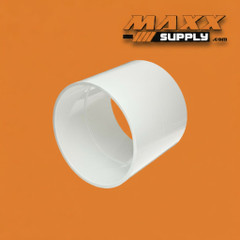


Coupling, Slip x Slip PVC Schedule 40 4" x 1" (429-417)
$26.52
Blue Monster 76037 1-Step PVC Cement Clear (32OZ)
The 429-417 is a 4" x 1" Schedule 40 PVC Reducing Coupling with Slip x Slip connections. This fitting joins two different pipe sizes inline — one socket accepts 4" PVC pipe and the opposite socket accepts 1" PVC pipe, both solvent cemented for a permanent, pressure-rated bond. The reduction from 4" to 1" is accomplished in a single fitting body, eliminating the need for a full-size coupling plus a separate reducer or bushing to achieve the same size transition in the pipe run.
The 4" to 1" size step is one of the most aggressive inline reductions in the Schedule 40 reducing coupling category — a reduction to one-quarter of the inlet diameter in a single fitting. At this size differential, the 429-417 is unambiguously a purpose-specific reduction fitting rather than a transitional flow-balancing coupling. It is engineered for applications where a large-diameter supply or collection main must connect directly to a much smaller downstream pipe: small-capacity equipment inlets, individual outlet connections off heavily oversized distribution headers, drainage systems where a 4" collection main discharges through a 1" outlet, and similar configurations where the upstream and downstream pipe sizes are intentionally and substantially mismatched by design.
Both sockets are slip connections accepting solvent cement — the 4" socket on the large side and the 1" socket on the small side — making the entire assembly a fully cemented, permanent, solvent-welded reduction with no threads involved. The size difference between the two ends is visually obvious and immediately apparent during installation, which reduces the risk of incorrect pipe insertion before cementing. Proper solvent cementing practice applies to both ends: primer should be applied to both the pipe end and socket interior on each side before cement application, with pipe inserted fully to socket depth and held in alignment through the set period. At 4", the large-side socket requires thorough primer and cement coverage given the larger surface area of the joint.
The 429-417 is the next increment down in the same reducing coupling series as the 429-418 (4" x 1-1/4") and 429-419 (4" x 1-1/2") — same large-end size, same fitting type, same schedule, progressively smaller outlet sizes. Buyers working through this series should confirm the outlet size carefully before ordering, as the sequential part numbers differ by a single digit and the correct SKU is determined entirely by the downstream pipe size required.
Manufactured in white Schedule 40 PVC, the 429-417 provides solid corrosion resistance across a broad range of fluids, good impact performance under normal service conditions, and a substantially lower installed weight compared to metal reducing couplings of equivalent size. Schedule 40 remains the correct specification for the majority of commercial, irrigation, and light industrial applications where system pressures fall within its rated range and the cost and weight advantages of Schedule 40 are the governing specification factors.
Specifications:
| Specification | Detail |
|---|---|
| Part Number | 429-417 |
| Material | PVC (Polyvinyl Chloride) |
| Schedule | Schedule 40 |
| Fitting Type | Reducing Coupling |
| Large End Size | 4" |
| Small End Size | 1" |
| Connection Type | Slip x Slip (Socket) |
| Color | White |
| Pressure Rating | ~450 PSI @ 73°F (1" end governs) |
| Temperature Range | Up to 140°F (60°C) |
| Standard | ASTM D1784, ASTM D2465 |
| End Use | Pressure Systems |
⚠️ Note: In a reducing fitting, the smaller end governs the pressure rating. The 4" and 1" sockets are visually distinct — confirm correct pipe size insertion on each end before cementing. Use primer on both sockets and both pipe ends before cement application; do not skip priming on the 4" socket. Once cemented, neither end can be disassembled without cutting pipe. Confirm 429-417 (1" outlet) vs. 429-418 (1-1/4" outlet) and 429-419 (1-1/2" outlet) before ordering.
Industries & Applications:
- Irrigation & Agricultural Systems — Transitions a 4" PVC supply main down to a 1" pipe run at individual emitter connections, drip zone inlets, and small-capacity equipment ports where the supply header is heavily oversized relative to the downstream circuit and a single inline reduction fitting is the most compact solution at the transition point
- Water & Wastewater Treatment — Used where a 4" collection or distribution main must transition to a 1" downstream pipe serving a very low-flow sub-circuit, chemical dosing inlet, or minor instrumentation branch that draws minimally from the main line flow
- Industrial Process Piping — Reduces a 4" process line inline to a 1" pipe run at small-capacity equipment inlets, chemical injection connections, and process sub-circuits where the upstream main is substantially oversized relative to the downstream component it supplies and a direct inline reduction is the most space-efficient solution
- Commercial Plumbing & Mechanical Systems — Applied in commercial building utility piping where a 4" service main must be reduced to a 1" branch connection in a single fitting, particularly where the downstream equipment or fixture connection requires 1" pipe and the available installation space precludes a multi-component reducer assembly
- Pump Station & Equipment Connections — Installed where a 4" suction or discharge header transitions directly to a 1" equipment port, bypass line, or secondary pipe run, concentrating the full size transition into a single cemented fitting at the connection point rather than a stepped reducer series
- Swimming Pool & Aquatic Facilities — Used in pool and spa equipment pad plumbing where large-diameter supply or return lines must transition to 1" connections on chemical feeders, small inline devices, or auxiliary equipment ports specified with 1" pipe inlets
(No reviews yet)

Write a Review

Coupling, Slip x Slip PVC Schedule 40 4" x 1" (429-417)
Blue Monster 76037 1-Step PVC Cement Clear (32OZ)
The 429-417 is a 4" x 1" Schedule 40 PVC Reducing Coupling with Slip x Slip connections. This fitting joins two different pipe sizes inline — one socket accepts 4" PVC pipe and the opposite socket accepts 1" PVC pipe, both solvent cemented for a permanent, pressure-rated bond. The reduction from 4" to 1" is accomplished in a single fitting body, eliminating the need for a full-size coupling plus a separate reducer or bushing to achieve the same size transition in the pipe run.
The 4" to 1" size step is one of the most aggressive inline reductions in the Schedule 40 reducing coupling category — a reduction to one-quarter of the inlet diameter in a single fitting. At this size differential, the 429-417 is unambiguously a purpose-specific reduction fitting rather than a transitional flow-balancing coupling. It is engineered for applications where a large-diameter supply or collection main must connect directly to a much smaller downstream pipe: small-capacity equipment inlets, individual outlet connections off heavily oversized distribution headers, drainage systems where a 4" collection main discharges through a 1" outlet, and similar configurations where the upstream and downstream pipe sizes are intentionally and substantially mismatched by design.
Both sockets are slip connections accepting solvent cement — the 4" socket on the large side and the 1" socket on the small side — making the entire assembly a fully cemented, permanent, solvent-welded reduction with no threads involved. The size difference between the two ends is visually obvious and immediately apparent during installation, which reduces the risk of incorrect pipe insertion before cementing. Proper solvent cementing practice applies to both ends: primer should be applied to both the pipe end and socket interior on each side before cement application, with pipe inserted fully to socket depth and held in alignment through the set period. At 4", the large-side socket requires thorough primer and cement coverage given the larger surface area of the joint.
The 429-417 is the next increment down in the same reducing coupling series as the 429-418 (4" x 1-1/4") and 429-419 (4" x 1-1/2") — same large-end size, same fitting type, same schedule, progressively smaller outlet sizes. Buyers working through this series should confirm the outlet size carefully before ordering, as the sequential part numbers differ by a single digit and the correct SKU is determined entirely by the downstream pipe size required.
Manufactured in white Schedule 40 PVC, the 429-417 provides solid corrosion resistance across a broad range of fluids, good impact performance under normal service conditions, and a substantially lower installed weight compared to metal reducing couplings of equivalent size. Schedule 40 remains the correct specification for the majority of commercial, irrigation, and light industrial applications where system pressures fall within its rated range and the cost and weight advantages of Schedule 40 are the governing specification factors.
Specifications:
| Specification | Detail |
|---|---|
| Part Number | 429-417 |
| Material | PVC (Polyvinyl Chloride) |
| Schedule | Schedule 40 |
| Fitting Type | Reducing Coupling |
| Large End Size | 4" |
| Small End Size | 1" |
| Connection Type | Slip x Slip (Socket) |
| Color | White |
| Pressure Rating | ~450 PSI @ 73°F (1" end governs) |
| Temperature Range | Up to 140°F (60°C) |
| Standard | ASTM D1784, ASTM D2465 |
| End Use | Pressure Systems |
⚠️ Note: In a reducing fitting, the smaller end governs the pressure rating. The 4" and 1" sockets are visually distinct — confirm correct pipe size insertion on each end before cementing. Use primer on both sockets and both pipe ends before cement application; do not skip priming on the 4" socket. Once cemented, neither end can be disassembled without cutting pipe. Confirm 429-417 (1" outlet) vs. 429-418 (1-1/4" outlet) and 429-419 (1-1/2" outlet) before ordering.
Industries & Applications:
- Irrigation & Agricultural Systems — Transitions a 4" PVC supply main down to a 1" pipe run at individual emitter connections, drip zone inlets, and small-capacity equipment ports where the supply header is heavily oversized relative to the downstream circuit and a single inline reduction fitting is the most compact solution at the transition point
- Water & Wastewater Treatment — Used where a 4" collection or distribution main must transition to a 1" downstream pipe serving a very low-flow sub-circuit, chemical dosing inlet, or minor instrumentation branch that draws minimally from the main line flow
- Industrial Process Piping — Reduces a 4" process line inline to a 1" pipe run at small-capacity equipment inlets, chemical injection connections, and process sub-circuits where the upstream main is substantially oversized relative to the downstream component it supplies and a direct inline reduction is the most space-efficient solution
- Commercial Plumbing & Mechanical Systems — Applied in commercial building utility piping where a 4" service main must be reduced to a 1" branch connection in a single fitting, particularly where the downstream equipment or fixture connection requires 1" pipe and the available installation space precludes a multi-component reducer assembly
- Pump Station & Equipment Connections — Installed where a 4" suction or discharge header transitions directly to a 1" equipment port, bypass line, or secondary pipe run, concentrating the full size transition into a single cemented fitting at the connection point rather than a stepped reducer series
- Swimming Pool & Aquatic Facilities — Used in pool and spa equipment pad plumbing where large-diameter supply or return lines must transition to 1" connections on chemical feeders, small inline devices, or auxiliary equipment ports specified with 1" pipe inlets
- Part #:
- 429-417
- Product Family:
- Sch 40 PVC
- Carton Qty:
- 5
- Pallet Qty:
- 320
- Size:
- 4"