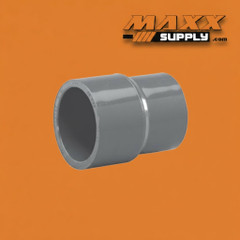
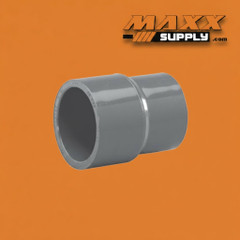

Coupling, Slip x Slip PVC Schedule 80 12" x 10" (829-670)
$511.53
Blue Monster 76037 1-Step PVC Cement Clear (32OZ)
The 12" x 10" Schedule 80 Gray PVC Reducer Coupling (829-670, Slip x Slip) is a large-diameter, heavy-wall inline diameter reduction fitting manufactured to ASTM D2467 in Schedule 80 gray PVC — a two-port inline fitting in which one socket end accepts 12" IPS PVC pipe and the other socket end accepts 10" IPS PVC pipe, providing a single-body Schedule 80 PVC solution for transitioning a 12" primary transmission or distribution main to a 10" downstream primary distribution system in a straight inline run without branching, without direction change, without intermediate adapter fittings between the two primary pipe diameters, and without leaving the Schedule 80 gray PVC socket fitting construction standard at the primary main diameter transition point. As the most near-equal reducer coupling configuration in the standard Spears 829 series Schedule 80 PVC reducer coupling line at the 12" large-end service size — with the 10" small-end socket at 83.3% of the 12" large-end diameter and a downstream-to-upstream velocity ratio of approximately 1.44 at constant volumetric flow — the 829-670 is the only configuration in the 12" Spears 829 series where the fitting's full primary main design flow can be transitioned inline from the 12" upstream primary main to the 10" downstream primary distribution system at standard primary main design velocities, making it the fitting whose application role is defined not by terminal service, drain, sample, or low-flow specialty connections but by the straight-run primary infrastructure transition between the two largest and most commercially prevalent standard primary pipe sizes in the Schedule 80 PVC socket fitting line. The 829-670 is the correct fitting wherever a 12" Schedule 80 PVC primary main must reduce inline to 10" IPS — wherever the hydraulic design has established 10" IPS as the correct pipe diameter for the downstream continuing primary distribution system, wherever the transition from the 12" upstream primary transmission level to the 10" downstream primary distribution level must be accomplished at a single inline fitting location in the primary main's straight run, and wherever the fitting must carry the full Schedule 80 specification, NSF certification, and ASTM D2467 compliance of every other fitting in the 12" Schedule 80 primary main system through the inline primary diameter transition.
The 829-670's 83.3% size-reduction ratio positions it at the upper extreme of the Spears 829 series Schedule 80 PVC reducer coupling line at the 12" large-end service size — the most near-equal standard reducer coupling configuration available in the series at this service level, and the configuration where the size-reduction ratio is closest to the 100% equal coupling that connects two pipes of the same diameter in the same inline run. At 83.3%, the 10" small-end socket is so close in diameter to the 12" large-end socket that the 829-670's fitting body geometry — with its transition cone stepping down from 12" to 10" across the fitting length — represents the most gradual and hydraulically least disruptive inline diameter reduction in the 12" Spears 829 series. The downstream velocity increase from the 12" upstream pipe to the 10" downstream pipe — governed by the continuity equation and the inverse relationship between flow velocity and cross-sectional area at constant volumetric flow — is approximately 1.44 times the upstream 12" pipe velocity at the same design flow rate, corresponding to the ratio of the 12" pipe's cross-sectional area to the 10" pipe's cross-sectional area at these two nominal sizes. At a typical 12" primary main design velocity of 3 to 5 feet per second, the downstream 10" pipe velocity at the 829-670 transition ranges from approximately 4.3 to 7.2 feet per second — a velocity range that falls within standard design velocity limits for 10" Schedule 80 PVC primary distribution pipe across the full range of primary main design flow rates, confirming the 829-670 as the one configuration in the 12" Spears 829 series where full primary main flow transition from the 12" upstream main to the 10" downstream main is hydraulically practical at standard primary main design conditions. This full-flow primary main transition capability distinguishes the 829-670 from every less near-equal reducer coupling configuration in the 12" Spears 829 series and establishes its application role as the inline primary infrastructure transition fitting rather than the terminal-service or low-flow specialty-connection fitting that the more extreme size-reduction configurations serve.
The 829-670 occupies the infrastructure-to-infrastructure inline transition role at the primary system's most hydraulically significant inline diameter reduction point — the exact location where the 12" primary transmission level ends and the 10" primary distribution level begins in the same straight pipe run. This is the same infrastructure-to-infrastructure character established at the 401-628 (10" x 10" x 8" reducing tee at the branch junction) and the 829-626 (10" x 6" reducer coupling at the inline transition), applied here at the highest-ratio inline primary infrastructure transition in the standard 12" Schedule 80 PVC socket fitting line. The 12" large-end socket connects the fitting to the 12" large-commercial primary transmission level — the largest standard commercial primary pipe size in the Schedule 80 PVC socket fitting line, the same pipe size served by the 806-120 (12" Schedule 80 90-degree elbow), the 401-120 (12" Schedule 40 equal tee), the 401-628 (10" x 8" Schedule 40 reducing tee run side), and the complete 12" primary main fitting ecosystem. The 10" small-end socket connects the fitting to the 10" large-commercial primary distribution level — the most broadly specified large-diameter primary pipe size across the full range of commercial and industrial primary main applications in the Schedule 80 PVC socket fitting line, the same pipe size served by the 817-100 (10" Schedule 80 45-degree elbow), the 806-100 (10" Schedule 80 90-degree elbow), the 409-100 (10" Schedule 40 90-degree street elbow), and the complete 10" primary main fitting ecosystem established across this catalog. The 829-670 is accordingly the single-body inline fitting at which the 12" primary transmission infrastructure ends and the 10" primary distribution infrastructure begins in a straight continuing run — connecting two of the most extensively documented and fully specified primary pipe size ecosystems in the Maxx-Supply Schedule 80 PVC socket fitting catalog at their most hydraulically efficient inline transition point.
The 829-670 also serves the inline diameter increase role — the installation configuration in which the 10" socket is connected to the upstream 10" pipe and the 12" socket is connected to the downstream 12" primary main, accomplishing a straight-run inline diameter increase from 10" to 12" at locations where the upstream primary distribution system transitions to a larger 12" primary transmission main, where a 10" pump station discharge header increases to a 12" primary transmission main departure connection, or where an existing 10" primary distribution system extends into a new 12" primary transmission main segment. In the 10"-to-12" increasing installation orientation, the downstream 12" pipe velocity is approximately 69% of the upstream 10" pipe velocity at the same volumetric flow rate — a velocity decrease accompanied by a static pressure recovery at the fitting that partially offsets the fitting body's friction losses at the inline expansion geometry. The increasing installation orientation is the hydraulically gentler of the two flow directions at the 829-670, as the flow expansion from 10" to 12" produces a decelerating flow pattern with a partial pressure recovery rather than the accelerating flow and pressure drop of the reducing orientation. Both installation orientations must be addressed explicitly in the primary system's hydraulic analysis — the reducing orientation's pressure drop and velocity increase at the 12"-to-10" transition and the increasing orientation's pressure recovery and velocity decrease at the 10"-to-12" transition are both material hydraulic parameters that affect the primary system's available pressure at the fitting location and must be included in the primary system's complete friction loss and pressure gradient calculation before the 829-670 installation location and orientation are finalized.
The most important specification comparison at the 829-670 is the inline reducer coupling versus the lateral branch reducing tee at the same 12" x 10" size combination — the selection between the 829-670 and the Schedule 40 or Schedule 80 PVC reducing tee at 12" x 12" x 10" at the 12"-to-10" primary main junction point. The 829-670 is an inline two-port fitting with no straight-run continuation at the 12" diameter downstream of the fitting — the entire upstream 12" primary main flow must pass through the 829-670's inline transition and continue in the 10" downstream primary distribution system; there is no continuing 12" run after the 829-670, and no lateral branch port at any angle. The 12" x 12" x 10" reducing tee maintains the primary run diameter at 12" through both straight-run ports — the upstream 12" primary main flow continues at 12" diameter through the straight-run ports while the 10" branch port serves a lateral takeoff at a perpendicular angle. The selection criterion is therefore precisely defined: the 829-670 is the correct specification at the exact inline transition point where the 12" primary main terminates as the primary flow path and the 10" downstream primary distribution system receives the complete primary main flow in the same straight run; the 12" x 12" x 10" reducing tee is the correct specification wherever the 12" primary main must continue downstream of the 10" branch connection and the 10" port serves a lateral branch supply to a parallel or zone distribution system rather than the continuation of the entire primary flow. Buyers who need a 10" supply connection at a point where the 12" primary main continues downstream must specify the reducing tee; buyers who need the 12" primary main to transition the full primary flow inline to the 10" downstream distribution system at a single straight-run fitting location must specify the 829-670. This distinction is the most commercially consequential fitting selection decision in the 12"-to-10" primary system junction design and must be resolved explicitly before either fitting is purchased for installation at the primary main junction point.
The second most important specification comparison at the 829-670 is the Schedule 80 829-670 against the Schedule 40 counterpart reducer coupling at the same 12" x 10" size combination. The 829-670 is manufactured in Schedule 80 gray PVC and serves every application where the primary system requires Schedule 80 wall thickness, gray material class identification, and the higher pressure ceiling that Schedule 80 provides at large-diameter primary main inline transition fittings. At a 12"-to-10" near-equal inline transition where the full primary main design flow passes through the fitting body and both socket connections carry the primary main's full operating pressure, the schedule selection carries the same consequence as at any other 12" primary main fitting — the combined pressure loading across both the 12" and 10" socket connections and through the fitting's full transition body must be confirmed within the Schedule 80 pressure ceiling before the 829-670 is finalized as the correct inline transition fitting for the primary system's operating conditions. Where the system's design operating pressure, surge allowance, and engineering safety margin requirements fall within the Schedule 40 pressure ceiling and the system specification does not mandate Schedule 80 throughout, the Schedule 40 counterpart reducer coupling at the 12" x 10" size is the cost-effective alternative; the 829-670's Schedule 80 construction is the correct specification wherever Schedule 80 is the system-wide material standard or wherever the primary main's operating conditions exceed the Schedule 40 ceiling at the 12" fitting size.
The hydraulic pressure drop at the 829-670 inline transition must be included in the primary system's complete hydraulic analysis. At the 12"-to-10" reducing installation, the pressure drop across the fitting includes the velocity head increase from the 12" inlet velocity to the 10" outlet velocity — governed by the Bernoulli relationship between velocity and static pressure in an incompressible flow system — plus the additional fitting body friction and flow contraction losses associated with the inline reducer coupling geometry at the 12"-to-10" size transition. The velocity head change from the 12" to 10" pipe represents a conversion of static pressure energy to kinetic energy — the downstream 10" pipe's higher velocity is accompanied by a lower static pressure than the upstream 12" pipe at the same flow rate, and this pressure difference must be accounted for in the primary system's hydraulic model to confirm that the available pressure at the 10" downstream side of the 829-670 satisfies the downstream 10" primary distribution system's minimum supply pressure requirement at the design flow rate. The 829-670's pressure drop at the 12"-to-10" near-equal transition is the most moderate of any reducer coupling configuration in the 12" Spears 829 series — the 83.3% size-reduction ratio and the 44% velocity increase produce the smallest velocity head change and the lowest inline contraction pressure loss of any configuration in the series at the 12" large-end service size, and the pressure drop correction for the 829-670 transition is correspondingly the least significant hydraulic design parameter adjustment of any reducer coupling in the 12" series. Nevertheless, the pressure drop must be included in the primary system's hydraulic analysis — at the 12" primary main service scale where primary system pressure budgets are formal engineering design parameters and the available pressure at the downstream 10" primary distribution system's most remote service point is determined by the accumulated losses through the entire primary transmission and distribution system including every inline fitting body, the 829-670's contribution to the primary system's total friction loss must be quantified and included in the complete hydraulic model.
Schedule 80 gray PVC construction is the correct material specification for this fitting across every application where an inline diameter transition from 12" to 10" on a Schedule 80 PVC primary main is required. The Schedule 80 wall thickness applied uniformly through the complete reducer coupling body — through the 12" large socket section, through the full transition cone body across the 12"-to-10" diameter step, and through the 10" small socket section — provides the structural integrity required to resist the combined internal pressure loading and the hydrodynamic forces associated with the velocity increase and flow contraction at the near-equal 12"-to-10" inline transition under sustained primary main operating conditions. The gray color provides the permanent, inspectable Schedule 80 material class identification at the primary main diameter transition — confirming the installed material class at the inline transition point where the 12" and 10" primary pipe systems meet in the same straight run and distinguishing the installed fitting from white Schedule 40 components that may be present elsewhere in the system. PVC Type 1 Grade 1 construction with cell classification 12454 per ASTM D1784 provides broad chemical resistance across water treatment chemicals, process water service, industrial utility water, and the full range of non-solvent process fluids appropriate for Schedule 80 PVC primary main service. Both socket ends solvent cement directly onto standard IPS Schedule 40 or Schedule 80 PVC pipe of the corresponding nominal sizes — 12" IPS schedule pipe at the large socket and 10" IPS schedule pipe at the small socket. Both the 12" large socket and the 10" small socket are large-diameter connections requiring heavy-body solvent cement rated for large-diameter Schedule 80 PVC — the 12" socket connection demands full large-diameter assembly discipline including pre-planned assembly positioning, working time management across the full circumference of the 12" bonding surface, complete circumferential heavy-body cement coverage, and full cure time compliance before system pressurization; the 10" small socket, while the smaller of the two connections on the 829-670, is itself a primary main pipe size connection that requires the same heavy-body cement specification, complete circumferential coverage, and full cure time compliance as the 12" socket — the 10"-to-12" size differential on the 829-670 is the smallest of any reducer coupling configuration in the 12" Spears 829 series, and neither socket on the 829-670 can be treated as a secondary or reduced-rigor assembly connection; both connections carry the full primary main operating pressure and the complete primary main design flow, and both require the assembly discipline appropriate for Schedule 80 PVC socket joints at the primary main service scale. The flow orientation must be confirmed before cement application begins — the 12" socket must be connected to the 12" upstream pipe and the 10" socket to the 10" downstream pipe in reducing installations, and the reverse in increasing installations; the fitting's internal geometry is directional with the contraction cone oriented toward the smaller socket, and correct orientation relative to the primary flow direction must be confirmed by inspection before any cement is applied at either end. Deburr and bevel both pipe ends before cementing to ensure consistent insertion depths and complete circumferential bond lines at both large-diameter socket connections.
NSF 61 certification lists this fitting for potable water contact, and NSF 14 covers compliance with applicable plastics piping material standards — making it the correct Schedule 80 PVC inline primary main diameter transition fitting for municipal water treatment and distribution systems, large potable water pump station primary headers, and large commercial and institutional water supply primary mains where NSF-listed materials are required at every fitting in the primary distribution system including inline diameter transition fittings at primary main size step-down and step-up locations. ASTM D2467 governs Schedule 80 PVC socket fittings and defines the manufacturing, dimensional, and pressure performance requirements the 829-670 is produced to. Verify manufacturer pressure rating documentation for the specific fitting configuration before final system specification — at the 12" x 10" near-equal reducer coupling configuration where the full primary main design flow passes through both socket connections, the governing pressure rating is determined by the larger port size (12") and the fitting's tested performance at the near-equal inline transition geometry under combined pressure and full-flow contraction conditions, and must be confirmed against the manufacturer's published pressure-temperature rating table for SKU 829-670 before installation in systems at or near the fitting's rated pressure ceiling.
Key Features:
- Schedule 80 gray PVC reducer coupling — 12" socket x 10" socket, both slip (female socket) ends; Spears 829 series Schedule 80 PVC reducer coupling
- Most near-equal reducer coupling in the standard Spears 829 series Schedule 80 PVC reducer coupling line at the 12" large-end service size — 10" small-end socket at 83.3% of 12" large-end diameter; most gradual and hydraulically least disruptive inline diameter reduction in the 12" series
- Full primary main flow transition capability — approximately 1.44x downstream velocity increase at constant flow; downstream 10" pipe velocity within standard primary main design velocity limits at all standard 12" primary main design flow rates; the only 12" Spears 829 series configuration where full primary main throughput can be transitioned inline to the smaller diameter at primary main design velocities
- Infrastructure-to-infrastructure inline transition — connects 12" large-commercial primary transmission level to 10" large-commercial primary distribution level; both pipe systems are primary infrastructure requiring engineered design on both sides; most commercially significant primary main inline diameter transition in the 12" Spears 829 series
- Bidirectional installation capability — reducing orientation (12"→10") for primary transmission main to primary distribution main transitions; increasing orientation (10"→12") for primary distribution to primary transmission main connections and pump station discharge header step-ups; confirm orientation before cement application; internal cone geometry is directional
- Inline reducer coupling vs. reducing tee selection: 829-670 where the 12" primary main terminates as the primary flow path and the full primary flow continues downstream in the 10" distribution system; 12" x 12" x 10" reducing tee where the 12" primary main continues downstream of the 10" lateral branch connection
- Both sockets are large-diameter primary main connections — 12" socket and 10" socket both require full heavy-body cement, large-diameter assembly discipline, and full cure time compliance; the 12"-to-10" size differential is the smallest in the 12" Spears 829 series; neither socket permits reduced assembly standards
- Inline pressure drop must be included in primary system hydraulic analysis — velocity head change from 12" to 10" produces static pressure reduction in downstream 10" pipe; confirm available pressure at 10" downstream side satisfies downstream primary distribution system's minimum supply pressure at design flow
- Manufactured to ASTM D2467 — governing standard for Schedule 80 PVC socket fittings
- NSF 61 certified for potable water contact; NSF 14 listed
- Solvent cement socket connections compatible with Schedule 40 and Schedule 80 IPS pipe at both ends
- Gray color — universal Schedule 80 material class identification at the primary main inline transition point
- Cell classification PVC 12454 per ASTM D1784
- Heavy-body solvent cement required at both large-diameter socket connections; full cure time compliance mandatory before pressurization
- Pressure rating: verify against manufacturer pressure-temperature table for SKU 829-670
Specifications:
| Attribute | Value |
|---|---|
| SKU | 829-670 |
| Fitting Type | Reducer Coupling (Reducing Coupling) |
| Series | Spears 829 Schedule 80 PVC Reducer Coupling |
| Large-End Size | 12" |
| Small-End Size | 10" |
| Size-Reduction Ratio | 83.3% (10" small end ÷ 12" large end) |
| Downstream Velocity Ratio (Reducing) | ~1.44x (12"→10" at constant flow) |
| End Connections | Slip x Slip (Both Female Socket) |
| Connection Method | Solvent Cement (IPS) — both ends |
| Compatible Pipe — Large End | 12" IPS Schedule 40 or Schedule 80 PVC |
| Compatible Pipe — Small End | 10" IPS Schedule 40 or Schedule 80 PVC |
| Flow Direction | Reducing (12"→10") or Increasing (10"→12") — confirm orientation before cementing |
| Primary Application Role | Full primary flow inline transition between 12" primary transmission and 10" primary distribution infrastructure |
| Schedule | Schedule 80 |
| Material | PVC (Polyvinyl Chloride) Type 1, Grade 1 |
| Cell Classification | 12454 per ASTM D1784 |
| Color | Gray |
| Manufacturing Standard | ASTM D2467 |
| Potable Water Certification | NSF/ANSI 61 |
| Plastics Standard Certification | NSF 14 |
| Max Service Temperature | 140°F (60°C) |
| Pressure Rating | Verify with manufacturer pressure-temperature rating table for SKU 829-670 |
Industries & Applications:
- Municipal Water Distribution — Primary Transmission Main Inline 12"-to-10" Diameter Transition at Zone Boundary, Pressure Zone Entry, and Primary Distribution System Inception Points — The 12" x 10" Schedule 80 PVC reducer coupling is specified at inline full-flow diameter transition points on 12" municipal water transmission mains in Schedule 80 PVC systems where the hydraulic design has established 10" IPS as the correct diameter for the continuing downstream primary distribution system and the complete primary main flow must transition inline from the 12" transmission level to the 10" distribution level at a single straight-run fitting location — primary transmission main terminal transitions where the 12" transmission main reaches its designed distribution boundary and the continuing primary distribution system serving the downstream pressure zone has been established at 10" IPS, requiring the 829-670 to accomplish the inline 12"-to-10" transition of the complete primary transmission flow into the downstream 10" primary distribution main at the single inline transition fitting; pressure zone boundary connections where a 12" high-pressure transmission main must supply a 10" primary distribution system within the downstream pressure zone — the 829-670 providing the inline 12"-to-10" transition at the pressure zone boundary structure's primary main entry fitting after the pressure reducing valve station or zone boundary isolation assembly; primary transmission main diameter step-down transitions at hydraulic design boundaries where the upstream primary transmission flow demand has been established at 12" IPS but the downstream primary distribution system's maximum coincident demand has been correctly sized at 10" IPS — the 829-670 providing the inline transition at the precise hydraulic boundary where the required pipe diameter steps down from 12" to 10" in the continuing primary flow path; primary transmission main diameter step-up connections in the increasing installation orientation where an existing or new 10" primary distribution main must connect to a 12" primary transmission main extension or interconnect at the inline junction point — the 829-670 installed with the 10" socket toward the upstream primary distribution pipe and the 12" socket toward the downstream transmission main connection; and pump station primary discharge header inline transitions where a 12" pump station primary discharge header must reduce to a 10" primary transmission main at the station's primary distribution connection point — the 829-670 providing the single inline Schedule 80 socket fitting transition between the pump station's 12" internal header and the external 10" primary transmission departure main; NSF 61 listing confirms potable water fitness at every municipal water distribution inline primary main diameter transition; the inline pressure drop across the 829-670's 12"-to-10" near-equal transition must be included in the municipal distribution system's hydraulic model to confirm that the available pressure at the 10" downstream primary distribution system's most remote service point satisfies minimum pressure requirements at peak design flow
- Water Treatment Plant — Primary Header Inline 12"-to-10" Full-Flow Transition at Process Section Boundaries and Primary Distribution Entry Points — Installed at inline full-flow diameter transition points on 12" primary distribution headers in municipal and industrial water treatment plants where the downstream continuing primary distribution path has been established at 10" IPS — clearwell supply and distribution primary headers transitioning inline from the 12" primary distribution level to the 10" primary distribution level at the exact treatment facility boundary where the combined downstream demand has been sized at 10" IPS for the continuing primary distribution run; filter gallery primary headers stepping down inline from 12" to 10" at the gallery entry fitting where the filter gallery's primary influent or effluent header enters the gallery structure and the continuing header inside the gallery has been designed at 10" IPS; plant service water primary headers transitioning inline from the 12" primary service water distribution level to the 10" primary service water distribution level at the distribution system's internal boundary where the downstream service area's demand has been correctly sized at 10" IPS; backwash primary supply headers stepping down inline from 12" to 10" at the backwash system entry fitting where the 12" primary backwash supply main transitions to the 10" backwash distribution header serving the filter gallery's backwash manifold assembly; process water primary distribution headers at treatment building entry points where the 12" primary main enters the treatment building through a wall sleeve and transitions inline to the building's 10" internal primary distribution header at the building entry fitting — the 829-670 providing the single inline Schedule 80 socket transition at the wall penetration fitting location; and primary chemical distribution headers transitioning inline from the 12" primary chemical supply level to the 10" major chemical distribution level at the transition point where the continuing downstream chemical distribution header has been sized at 10" IPS; NSF 61 listing confirms potable water fitness at every water treatment plant primary distribution inline diameter transition point in Schedule 80 PVC systems
- Pump Station — Primary Header Inline 12"-to-10" Transitions at Distribution Boundary, Equipment Header, and Transmission Main Departure Points — Used at inline full-flow diameter transition points on 12" primary pump station discharge and suction headers where the downstream primary distribution connection or transmission main departure has been established at 10" IPS — pump station primary discharge header inline transitions where the 12" primary discharge header must reduce to a 10" primary transmission main at the pump station's distribution boundary — the exact inline location where the pump station's internal 12" header transitions to the external 10" primary transmission main; the 829-670 providing the single inline Schedule 80 socket fitting transition at the station boundary fitting location without additional reducer adapters or intermediate pipe sections between the 12" pump station header and the 10" primary transmission departure; pump station primary suction header inline transitions where a 12" primary suction collection header receives the combined flow from a 10" primary suction approach main, installed in the increasing orientation to transition the 10" approach main inline to the 12" pump station suction header at the suction entry point — the 829-670 providing the inline 10"-to-12" transition at the suction entry fitting without the perpendicular branch geometry of a reducing tee; pump station manifold primary transitions where the 12" primary discharge manifold must connect inline to a 10" primary transmission departure at the manifold's outlet fitting location — a transition that requires the complete primary manifold output to pass through the 829-670's inline transition body at the manifold outlet rather than branching to a 10" lateral at the manifold body; pump station primary discharge header connections to 10" primary distribution systems at booster stations and transfer pump stations where the entire booster station output must transition from the 12" pump station internal header to the 10" external primary distribution main at the station boundary; and pump station primary suction header connections where multiple parallel 10" suction approach mains converge in a 12" primary suction header and the 829-670 is installed at the header inlet fitting in the increasing orientation to accomplish the 10"-to-12" inline transition at each suction approach convergence point; at pump stations where primary headers operate at full system operating pressure including shut-off head and surge, the Schedule 80 pressure ceiling at the 12" fitting size must be confirmed for all anticipated operating conditions before the 829-670 is finalized at the pump station primary header transition point; the downstream 10" pipe velocity at full pump output must be confirmed within the 10" pipe's design velocity limits — a confirmation that requires explicit calculation of the pump station's maximum combined output flow rate and the resulting 10" pipe velocity at the 829-670 transition before the fitting is specified at the pump station primary header service location
- Large Commercial & Agricultural Irrigation — Primary Transmission Main Inline 12"-to-10" Transitions at Sector Supply Boundary and Primary Distribution Entry Points — Specified at inline full-flow diameter transition points on 12" primary irrigation transmission mains at major golf course and resort irrigation systems, large-acreage agricultural operations, and regional landscape irrigation projects where the downstream continuing primary distribution or sector transmission system has been established at 10" IPS — irrigation primary transmission main terminal transitions where the 12" primary transmission main serves as the backbone supply for the complete property irrigation system and the continuing primary distribution trunk serving the property's main irrigation sectors has been designed at 10" IPS, requiring the 829-670 to accomplish the inline full-flow transition from the 12" primary transmission main to the 10" primary sector distribution trunk at the transmission main's terminal distribution transition point; irrigation pump station primary discharge header inline transitions where the 12" pump station primary output must transition to a 10" primary transmission main at the pump station's discharge boundary — the single inline transition between the pump station's 12" internal header and the external 10" primary irrigation transmission main accomplished at the 829-670 fitting body without branching or direction change at the station outlet; compound large-scale irrigation system primary main step-down transitions where the 12" primary transmission backbone main reduces to 10" at the hydraulic design boundary where the downstream sector supply route's maximum coincident demand has been correctly sized at 10" IPS from the peak design flow analysis; large commercial irrigation system primary main return and recirculation connections in the increasing installation orientation where a 10" primary collection or return main must increase inline to a 12" primary return header at the pump station inlet collection fitting; and primary irrigation main system interconnect transitions where an existing 10" primary irrigation distribution system must be connected inline to a new 12" primary transmission main extension at the interconnect fitting location — the 829-670 providing the inline 10"-to-12" transition in the increasing orientation at the interconnect point; engineered pipe anchoring and support design at buried 829-670 installation locations must account for the velocity head pressure force on the fitting body in the flow direction — while the inline reducer coupling does not produce the angular thrust force component that requires concrete thrust blocks at direction change fittings such as elbows and tees, the momentum change from the 12" inlet to the 10" outlet produces a net pressure force on the fitting body in the flow direction that must be addressed through adequate pipe burial compaction, concrete encasement, or mechanical joint restraint at the fitting location depending on the soil bearing conditions, operating pressure, and burial depth at each 829-670 installation point on the irrigation primary transmission main route
- Industrial Process Piping — Primary Header Inline 12"-to-10" Full-Flow Transitions at Major Section Supply Boundaries and Primary Distribution Step-Down Points — Specified at inline full-flow diameter transition points on 12" process water primary headers, cooling water primary distribution trunks, and plant utility water primary mains in manufacturing plants, chemical processing facilities, petrochemical support facilities, and heavy industrial environments where the downstream continuing primary distribution system has been established at 10" IPS — process water primary headers transitioning inline from the 12" primary process water distribution level to the 10" primary process water distribution level at the hydraulic design boundary where the downstream process area's combined equipment demand has been correctly sized at 10" IPS for the continuing primary distribution run; cooling water primary distribution trunks reducing inline from the 12" primary cooling water trunk to the 10" major distribution trunk at the boundary where the downstream cooling circuit's combined heat exchanger demand has been sized at 10" IPS; plant utility water primary mains stepping down inline from the 12" primary distribution level to the 10" primary distribution level at the internal facility distribution boundary where the combined downstream service demand has been correctly sized at 10" IPS; primary process water headers in recirculation systems where a 10" process section return main must connect inline to a 12" primary recirculation collection header at the collection junction — installed in the increasing orientation at each 10"-to-12" process return collection transition point where the return flow enters the primary collection header inline rather than through a lateral branch tee; and primary distribution headers at industrial facility building entry points where the 12" primary external distribution main transitions inline to the building's 10" internal primary distribution header at the wall penetration fitting location — the 829-670 providing the single inline Schedule 80 socket transition at the building entry fitting without the perpendicular branch geometry that a reducing tee would impose at the inline entry point; in industrial process piping at the 12"-to-10" near-equal inline transition level, the 829-670's velocity increase and pressure drop must be included in the primary process header's hydraulic balance calculation before the fitting's installation location is finalized — the downstream 10" process distribution header's elevated velocity and marginally reduced static pressure relative to the 12" upstream trunk must be confirmed against the process section's minimum supply pressure and maximum velocity requirements at the primary header boundary; Schedule 80 gray PVC construction provides the chemical resistance, structural wall thickness, and permanent material class documentation required at primary header inline diameter transition points in industrial process piping systems where Schedule 80 is the system-wide material standard
- Municipal Well Field — Primary Collection and Distribution Header Inline 12"-to-10" Full-Flow Transitions — Used at inline full-flow diameter transition points on 12" primary well field collection or distribution headers in large municipal and commercial well field installations where the downstream continuing distribution path or collection continuation has been established at 10" IPS — primary distribution headers transitioning inline from the 12" primary distribution trunk level to the 10" zone transmission level at the distribution system boundary where the downstream zone's combined demand has been sized at 10" IPS for the continuing primary zone transmission main; primary collection headers at sub-collection integration points installed in the increasing orientation to transition a 10" primary sub-collection main inline to the 12" primary collection header at the main collection junction — providing the inline 10"-to-12" transition at the collection integration point where the sub-collection system's full flow enters the primary collection header inline without a perpendicular branch geometry; pump station primary discharge header inline transitions where the 12" pump station primary output must reduce to a 10" primary distribution transmission main at the well field's pump station distribution boundary — the single inline transition between the 12" station header and the 10" external primary distribution main at the station outlet; booster pump station primary header transitions where a 12" primary suction header receives a 10" primary approach main in the increasing orientation, or where a 12" primary discharge header reduces to a 10" primary distribution departure in the reducing orientation, at the booster station primary header boundary fitting; and primary collection system stage transitions in multi-stage well field collection systems where the 12" primary collection trunk steps down to a 10" secondary collection header at the stage boundary fitting — the 829-670 providing the inline transition at the collection stage boundary where the primary collection trunk's design flow has been established at 10" IPS for the downstream stage; at well field primary headers where pump operating pressures, shut-off head, and surge conditions must be confirmed within the Schedule 80 pressure ceiling at the 12" fitting size, the inline pressure drop at the 829-670's near-equal transition must be included in the well field primary distribution system's hydraulic model to confirm available pressure at the 10" downstream primary transmission system's most remote delivery point
- Water & Wastewater Treatment — Primary Process Header Inline 12"-to-10" Full-Flow Transitions at Process Train Boundaries and Primary Distribution Step-Down Points — Installed at inline full-flow diameter transition points on 12" primary process distribution headers in industrial wastewater treatment, water reclamation, and large-scale industrial water management facilities where the downstream continuing primary process distribution path has been established at 10" IPS — primary influent headers transitioning inline from the 12" primary influent distribution level to the 10" individual treatment train feed level at the process train entry boundary — the 829-670 providing the inline full-flow transition at the exact process boundary where the 12" primary influent header steps down to the 10" individual treatment train feed header as the primary influent flow continues in the downstream 10" system; primary effluent distribution headers stepping down inline from the 12" primary effluent collection level to the 10" primary effluent distribution level at the effluent system's distribution boundary; aeration system primary supply headers transitioning inline from the 12" primary aeration supply trunk to the 10" major aeration zone supply level at the zone distribution boundary; primary sludge handling headers stepping down inline from the 12" primary collection level to the 10" process section supply level at the process section entry boundary fitting; primary disinfection and water quality treatment headers transitioning inline from the 12" primary distribution level to the 10" process section distribution level at the treatment process boundary fitting; and primary effluent distribution headers at treatment building or process unit entry points where the 12" external primary effluent main transitions inline to the process unit's 10" internal primary distribution header at the wall penetration fitting — the 829-670 providing the single inline Schedule 80 socket transition at the process unit entry fitting location; Schedule 80 PVC construction handles continuous chemical exposure, high-pressure primary header service, and the hydrodynamic forces at the near-equal 12"-to-10" inline transition under sustained process flow conditions; NSF 61 listing confirms fitness for potable and process water contact at every inline diameter transition fitting in the primary treatment distribution system
- HVAC & Large Commercial Mechanical Systems — Primary Distribution Main Inline 12"-to-10" Full-Flow Transitions at Campus Sector Boundary, Building Entry, and Central Plant Distribution Points — Specified at inline full-flow diameter transition points on 12" primary chilled water distribution mains, condenser water primary trunks, and large-capacity hydronic heating and cooling primary distribution headers in Schedule 80 PVC systems at large commercial campus, institutional, and industrial mechanical systems where the downstream continuing primary distribution path has been established at 10" IPS — campus primary chilled water distribution main inline transitions where the 12" campus primary distribution backbone steps down to the 10" campus sector distribution level at the sector boundary fitting, transitioning the complete sector supply flow inline from the 12" backbone to the 10" sector distribution main at the single inline transition fitting location; primary condenser water distribution trunk inline transitions where the 12" primary condenser water trunk steps down to the 10" major cooling tower circuit distribution header at the circuit boundary fitting; central plant primary distribution connections where the 12" central plant primary distribution header transitions inline to the 10" campus backbone distribution main at the plant boundary fitting — the exact inline transition where the plant's internal 12" primary header connects to the campus's external 10" distribution infrastructure in a single permanently bonded Schedule 80 socket inline fitting; campus primary distribution main step-up connections in the increasing orientation where a 10" campus distribution main must connect inline to a 12" primary distribution backbone extension at the system interconnect point — the 829-670 installed in the increasing orientation at the inline junction where the 10" existing distribution main connects to the new 12" backbone extension; and primary distribution main transitions at central plant building penetrations where the 12" primary external distribution main enters the central plant building and transitions inline to the building's 10" internal primary header at the wall penetration fitting — the 829-670 providing the inline transition at the penetration sleeve fitting in a single permanently bonded Schedule 80 socket inline fitting body; the 829-670's near-equal transition pressure drop must be included in the campus primary distribution system's hydraulic balance model — the downstream 10" sector or building loop supply header's marginally elevated velocity and reduced static pressure relative to the 12" backbone distribution main must be confirmed against the sector or building loop's minimum supply pressure requirement at peak coincident demand before the 829-670 is confirmed as the inline transition fitting at the campus primary distribution boundary; Schedule 80 PVC construction satisfies the material specification and pressure requirements at 12"-to-10" primary distribution inline transition points in large commercial mechanical systems where Schedule 80 is the system material standard
- Aquaculture & Large-Scale Water Management Infrastructure — Used at inline full-flow diameter transition points on 12" primary water supply, recirculation, or distribution headers at the largest commercial aquaculture facilities, regional hatchery systems, and large recirculating aquaculture systems (RAS) where the downstream continuing primary recirculation or distribution path has been established at 10" IPS — primary recirculation headers transitioning inline from the 12" primary recirculation distribution backbone to the 10" production hall or treatment section distribution level at the section boundary fitting, where the combined recirculation demand for the downstream production section or treatment complex has been sized at 10" IPS and the 829-670 accomplishes the inline full-flow transition from the 12" backbone to the 10" section distribution header at the single inline transition fitting; primary supply headers stepping down inline from the 12" primary supply trunk to the 10" major production section supply distribution header at the section distribution boundary — the 829-670 providing the inline transition at the section entry fitting where the complete section supply flow transitions from the 12" primary supply trunk to the 10" section distribution header; primary treatment supply headers transitioning inline from the 12" primary treatment supply level to the 10" major filtration system or treatment section supply level at the filtration system entry boundary fitting; primary oxygenation supply headers stepping down inline from the 12" primary oxygenation supply trunk to the 10" major production area oxygenation distribution header at the area distribution boundary; and primary collection and recirculation headers in the increasing installation orientation at pump station inlet collection fittings where multiple 10" production section or treatment section return mains combine into a 12" primary collection header — the 829-670 providing the inline 10"-to-12" transition at each primary collection junction point where a 10" collection branch connects inline to the 12" primary collection trunk without the perpendicular branch geometry that a reducing tee would impose at the inline collection junction; the velocity increase from the 12" supply inlet to the 10" section distribution outlet must be confirmed against the downstream 10" section distribution header's design velocity limits and the section's minimum supply pressure requirements before the 829-670 is finalized at the primary recirculation header transition point; Schedule 80 PVC construction handles continuous water contact, treatment chemical exposure, and the hydrodynamic forces at the near-equal inline transition under sustained primary recirculation flow conditions; NSF 61 listing confirms fitness for potable and process water contact at every inline primary flow transition fitting in the primary aquaculture distribution system
(No reviews yet)

Write a Review

Coupling, Slip x Slip PVC Schedule 80 12" x 10" (829-670)
Blue Monster 76037 1-Step PVC Cement Clear (32OZ)
The 12" x 10" Schedule 80 Gray PVC Reducer Coupling (829-670, Slip x Slip) is a large-diameter, heavy-wall inline diameter reduction fitting manufactured to ASTM D2467 in Schedule 80 gray PVC — a two-port inline fitting in which one socket end accepts 12" IPS PVC pipe and the other socket end accepts 10" IPS PVC pipe, providing a single-body Schedule 80 PVC solution for transitioning a 12" primary transmission or distribution main to a 10" downstream primary distribution system in a straight inline run without branching, without direction change, without intermediate adapter fittings between the two primary pipe diameters, and without leaving the Schedule 80 gray PVC socket fitting construction standard at the primary main diameter transition point. As the most near-equal reducer coupling configuration in the standard Spears 829 series Schedule 80 PVC reducer coupling line at the 12" large-end service size — with the 10" small-end socket at 83.3% of the 12" large-end diameter and a downstream-to-upstream velocity ratio of approximately 1.44 at constant volumetric flow — the 829-670 is the only configuration in the 12" Spears 829 series where the fitting's full primary main design flow can be transitioned inline from the 12" upstream primary main to the 10" downstream primary distribution system at standard primary main design velocities, making it the fitting whose application role is defined not by terminal service, drain, sample, or low-flow specialty connections but by the straight-run primary infrastructure transition between the two largest and most commercially prevalent standard primary pipe sizes in the Schedule 80 PVC socket fitting line. The 829-670 is the correct fitting wherever a 12" Schedule 80 PVC primary main must reduce inline to 10" IPS — wherever the hydraulic design has established 10" IPS as the correct pipe diameter for the downstream continuing primary distribution system, wherever the transition from the 12" upstream primary transmission level to the 10" downstream primary distribution level must be accomplished at a single inline fitting location in the primary main's straight run, and wherever the fitting must carry the full Schedule 80 specification, NSF certification, and ASTM D2467 compliance of every other fitting in the 12" Schedule 80 primary main system through the inline primary diameter transition.
The 829-670's 83.3% size-reduction ratio positions it at the upper extreme of the Spears 829 series Schedule 80 PVC reducer coupling line at the 12" large-end service size — the most near-equal standard reducer coupling configuration available in the series at this service level, and the configuration where the size-reduction ratio is closest to the 100% equal coupling that connects two pipes of the same diameter in the same inline run. At 83.3%, the 10" small-end socket is so close in diameter to the 12" large-end socket that the 829-670's fitting body geometry — with its transition cone stepping down from 12" to 10" across the fitting length — represents the most gradual and hydraulically least disruptive inline diameter reduction in the 12" Spears 829 series. The downstream velocity increase from the 12" upstream pipe to the 10" downstream pipe — governed by the continuity equation and the inverse relationship between flow velocity and cross-sectional area at constant volumetric flow — is approximately 1.44 times the upstream 12" pipe velocity at the same design flow rate, corresponding to the ratio of the 12" pipe's cross-sectional area to the 10" pipe's cross-sectional area at these two nominal sizes. At a typical 12" primary main design velocity of 3 to 5 feet per second, the downstream 10" pipe velocity at the 829-670 transition ranges from approximately 4.3 to 7.2 feet per second — a velocity range that falls within standard design velocity limits for 10" Schedule 80 PVC primary distribution pipe across the full range of primary main design flow rates, confirming the 829-670 as the one configuration in the 12" Spears 829 series where full primary main flow transition from the 12" upstream main to the 10" downstream main is hydraulically practical at standard primary main design conditions. This full-flow primary main transition capability distinguishes the 829-670 from every less near-equal reducer coupling configuration in the 12" Spears 829 series and establishes its application role as the inline primary infrastructure transition fitting rather than the terminal-service or low-flow specialty-connection fitting that the more extreme size-reduction configurations serve.
The 829-670 occupies the infrastructure-to-infrastructure inline transition role at the primary system's most hydraulically significant inline diameter reduction point — the exact location where the 12" primary transmission level ends and the 10" primary distribution level begins in the same straight pipe run. This is the same infrastructure-to-infrastructure character established at the 401-628 (10" x 10" x 8" reducing tee at the branch junction) and the 829-626 (10" x 6" reducer coupling at the inline transition), applied here at the highest-ratio inline primary infrastructure transition in the standard 12" Schedule 80 PVC socket fitting line. The 12" large-end socket connects the fitting to the 12" large-commercial primary transmission level — the largest standard commercial primary pipe size in the Schedule 80 PVC socket fitting line, the same pipe size served by the 806-120 (12" Schedule 80 90-degree elbow), the 401-120 (12" Schedule 40 equal tee), the 401-628 (10" x 8" Schedule 40 reducing tee run side), and the complete 12" primary main fitting ecosystem. The 10" small-end socket connects the fitting to the 10" large-commercial primary distribution level — the most broadly specified large-diameter primary pipe size across the full range of commercial and industrial primary main applications in the Schedule 80 PVC socket fitting line, the same pipe size served by the 817-100 (10" Schedule 80 45-degree elbow), the 806-100 (10" Schedule 80 90-degree elbow), the 409-100 (10" Schedule 40 90-degree street elbow), and the complete 10" primary main fitting ecosystem established across this catalog. The 829-670 is accordingly the single-body inline fitting at which the 12" primary transmission infrastructure ends and the 10" primary distribution infrastructure begins in a straight continuing run — connecting two of the most extensively documented and fully specified primary pipe size ecosystems in the Maxx-Supply Schedule 80 PVC socket fitting catalog at their most hydraulically efficient inline transition point.
The 829-670 also serves the inline diameter increase role — the installation configuration in which the 10" socket is connected to the upstream 10" pipe and the 12" socket is connected to the downstream 12" primary main, accomplishing a straight-run inline diameter increase from 10" to 12" at locations where the upstream primary distribution system transitions to a larger 12" primary transmission main, where a 10" pump station discharge header increases to a 12" primary transmission main departure connection, or where an existing 10" primary distribution system extends into a new 12" primary transmission main segment. In the 10"-to-12" increasing installation orientation, the downstream 12" pipe velocity is approximately 69% of the upstream 10" pipe velocity at the same volumetric flow rate — a velocity decrease accompanied by a static pressure recovery at the fitting that partially offsets the fitting body's friction losses at the inline expansion geometry. The increasing installation orientation is the hydraulically gentler of the two flow directions at the 829-670, as the flow expansion from 10" to 12" produces a decelerating flow pattern with a partial pressure recovery rather than the accelerating flow and pressure drop of the reducing orientation. Both installation orientations must be addressed explicitly in the primary system's hydraulic analysis — the reducing orientation's pressure drop and velocity increase at the 12"-to-10" transition and the increasing orientation's pressure recovery and velocity decrease at the 10"-to-12" transition are both material hydraulic parameters that affect the primary system's available pressure at the fitting location and must be included in the primary system's complete friction loss and pressure gradient calculation before the 829-670 installation location and orientation are finalized.
The most important specification comparison at the 829-670 is the inline reducer coupling versus the lateral branch reducing tee at the same 12" x 10" size combination — the selection between the 829-670 and the Schedule 40 or Schedule 80 PVC reducing tee at 12" x 12" x 10" at the 12"-to-10" primary main junction point. The 829-670 is an inline two-port fitting with no straight-run continuation at the 12" diameter downstream of the fitting — the entire upstream 12" primary main flow must pass through the 829-670's inline transition and continue in the 10" downstream primary distribution system; there is no continuing 12" run after the 829-670, and no lateral branch port at any angle. The 12" x 12" x 10" reducing tee maintains the primary run diameter at 12" through both straight-run ports — the upstream 12" primary main flow continues at 12" diameter through the straight-run ports while the 10" branch port serves a lateral takeoff at a perpendicular angle. The selection criterion is therefore precisely defined: the 829-670 is the correct specification at the exact inline transition point where the 12" primary main terminates as the primary flow path and the 10" downstream primary distribution system receives the complete primary main flow in the same straight run; the 12" x 12" x 10" reducing tee is the correct specification wherever the 12" primary main must continue downstream of the 10" branch connection and the 10" port serves a lateral branch supply to a parallel or zone distribution system rather than the continuation of the entire primary flow. Buyers who need a 10" supply connection at a point where the 12" primary main continues downstream must specify the reducing tee; buyers who need the 12" primary main to transition the full primary flow inline to the 10" downstream distribution system at a single straight-run fitting location must specify the 829-670. This distinction is the most commercially consequential fitting selection decision in the 12"-to-10" primary system junction design and must be resolved explicitly before either fitting is purchased for installation at the primary main junction point.
The second most important specification comparison at the 829-670 is the Schedule 80 829-670 against the Schedule 40 counterpart reducer coupling at the same 12" x 10" size combination. The 829-670 is manufactured in Schedule 80 gray PVC and serves every application where the primary system requires Schedule 80 wall thickness, gray material class identification, and the higher pressure ceiling that Schedule 80 provides at large-diameter primary main inline transition fittings. At a 12"-to-10" near-equal inline transition where the full primary main design flow passes through the fitting body and both socket connections carry the primary main's full operating pressure, the schedule selection carries the same consequence as at any other 12" primary main fitting — the combined pressure loading across both the 12" and 10" socket connections and through the fitting's full transition body must be confirmed within the Schedule 80 pressure ceiling before the 829-670 is finalized as the correct inline transition fitting for the primary system's operating conditions. Where the system's design operating pressure, surge allowance, and engineering safety margin requirements fall within the Schedule 40 pressure ceiling and the system specification does not mandate Schedule 80 throughout, the Schedule 40 counterpart reducer coupling at the 12" x 10" size is the cost-effective alternative; the 829-670's Schedule 80 construction is the correct specification wherever Schedule 80 is the system-wide material standard or wherever the primary main's operating conditions exceed the Schedule 40 ceiling at the 12" fitting size.
The hydraulic pressure drop at the 829-670 inline transition must be included in the primary system's complete hydraulic analysis. At the 12"-to-10" reducing installation, the pressure drop across the fitting includes the velocity head increase from the 12" inlet velocity to the 10" outlet velocity — governed by the Bernoulli relationship between velocity and static pressure in an incompressible flow system — plus the additional fitting body friction and flow contraction losses associated with the inline reducer coupling geometry at the 12"-to-10" size transition. The velocity head change from the 12" to 10" pipe represents a conversion of static pressure energy to kinetic energy — the downstream 10" pipe's higher velocity is accompanied by a lower static pressure than the upstream 12" pipe at the same flow rate, and this pressure difference must be accounted for in the primary system's hydraulic model to confirm that the available pressure at the 10" downstream side of the 829-670 satisfies the downstream 10" primary distribution system's minimum supply pressure requirement at the design flow rate. The 829-670's pressure drop at the 12"-to-10" near-equal transition is the most moderate of any reducer coupling configuration in the 12" Spears 829 series — the 83.3% size-reduction ratio and the 44% velocity increase produce the smallest velocity head change and the lowest inline contraction pressure loss of any configuration in the series at the 12" large-end service size, and the pressure drop correction for the 829-670 transition is correspondingly the least significant hydraulic design parameter adjustment of any reducer coupling in the 12" series. Nevertheless, the pressure drop must be included in the primary system's hydraulic analysis — at the 12" primary main service scale where primary system pressure budgets are formal engineering design parameters and the available pressure at the downstream 10" primary distribution system's most remote service point is determined by the accumulated losses through the entire primary transmission and distribution system including every inline fitting body, the 829-670's contribution to the primary system's total friction loss must be quantified and included in the complete hydraulic model.
Schedule 80 gray PVC construction is the correct material specification for this fitting across every application where an inline diameter transition from 12" to 10" on a Schedule 80 PVC primary main is required. The Schedule 80 wall thickness applied uniformly through the complete reducer coupling body — through the 12" large socket section, through the full transition cone body across the 12"-to-10" diameter step, and through the 10" small socket section — provides the structural integrity required to resist the combined internal pressure loading and the hydrodynamic forces associated with the velocity increase and flow contraction at the near-equal 12"-to-10" inline transition under sustained primary main operating conditions. The gray color provides the permanent, inspectable Schedule 80 material class identification at the primary main diameter transition — confirming the installed material class at the inline transition point where the 12" and 10" primary pipe systems meet in the same straight run and distinguishing the installed fitting from white Schedule 40 components that may be present elsewhere in the system. PVC Type 1 Grade 1 construction with cell classification 12454 per ASTM D1784 provides broad chemical resistance across water treatment chemicals, process water service, industrial utility water, and the full range of non-solvent process fluids appropriate for Schedule 80 PVC primary main service. Both socket ends solvent cement directly onto standard IPS Schedule 40 or Schedule 80 PVC pipe of the corresponding nominal sizes — 12" IPS schedule pipe at the large socket and 10" IPS schedule pipe at the small socket. Both the 12" large socket and the 10" small socket are large-diameter connections requiring heavy-body solvent cement rated for large-diameter Schedule 80 PVC — the 12" socket connection demands full large-diameter assembly discipline including pre-planned assembly positioning, working time management across the full circumference of the 12" bonding surface, complete circumferential heavy-body cement coverage, and full cure time compliance before system pressurization; the 10" small socket, while the smaller of the two connections on the 829-670, is itself a primary main pipe size connection that requires the same heavy-body cement specification, complete circumferential coverage, and full cure time compliance as the 12" socket — the 10"-to-12" size differential on the 829-670 is the smallest of any reducer coupling configuration in the 12" Spears 829 series, and neither socket on the 829-670 can be treated as a secondary or reduced-rigor assembly connection; both connections carry the full primary main operating pressure and the complete primary main design flow, and both require the assembly discipline appropriate for Schedule 80 PVC socket joints at the primary main service scale. The flow orientation must be confirmed before cement application begins — the 12" socket must be connected to the 12" upstream pipe and the 10" socket to the 10" downstream pipe in reducing installations, and the reverse in increasing installations; the fitting's internal geometry is directional with the contraction cone oriented toward the smaller socket, and correct orientation relative to the primary flow direction must be confirmed by inspection before any cement is applied at either end. Deburr and bevel both pipe ends before cementing to ensure consistent insertion depths and complete circumferential bond lines at both large-diameter socket connections.
NSF 61 certification lists this fitting for potable water contact, and NSF 14 covers compliance with applicable plastics piping material standards — making it the correct Schedule 80 PVC inline primary main diameter transition fitting for municipal water treatment and distribution systems, large potable water pump station primary headers, and large commercial and institutional water supply primary mains where NSF-listed materials are required at every fitting in the primary distribution system including inline diameter transition fittings at primary main size step-down and step-up locations. ASTM D2467 governs Schedule 80 PVC socket fittings and defines the manufacturing, dimensional, and pressure performance requirements the 829-670 is produced to. Verify manufacturer pressure rating documentation for the specific fitting configuration before final system specification — at the 12" x 10" near-equal reducer coupling configuration where the full primary main design flow passes through both socket connections, the governing pressure rating is determined by the larger port size (12") and the fitting's tested performance at the near-equal inline transition geometry under combined pressure and full-flow contraction conditions, and must be confirmed against the manufacturer's published pressure-temperature rating table for SKU 829-670 before installation in systems at or near the fitting's rated pressure ceiling.
Key Features:
- Schedule 80 gray PVC reducer coupling — 12" socket x 10" socket, both slip (female socket) ends; Spears 829 series Schedule 80 PVC reducer coupling
- Most near-equal reducer coupling in the standard Spears 829 series Schedule 80 PVC reducer coupling line at the 12" large-end service size — 10" small-end socket at 83.3% of 12" large-end diameter; most gradual and hydraulically least disruptive inline diameter reduction in the 12" series
- Full primary main flow transition capability — approximately 1.44x downstream velocity increase at constant flow; downstream 10" pipe velocity within standard primary main design velocity limits at all standard 12" primary main design flow rates; the only 12" Spears 829 series configuration where full primary main throughput can be transitioned inline to the smaller diameter at primary main design velocities
- Infrastructure-to-infrastructure inline transition — connects 12" large-commercial primary transmission level to 10" large-commercial primary distribution level; both pipe systems are primary infrastructure requiring engineered design on both sides; most commercially significant primary main inline diameter transition in the 12" Spears 829 series
- Bidirectional installation capability — reducing orientation (12"→10") for primary transmission main to primary distribution main transitions; increasing orientation (10"→12") for primary distribution to primary transmission main connections and pump station discharge header step-ups; confirm orientation before cement application; internal cone geometry is directional
- Inline reducer coupling vs. reducing tee selection: 829-670 where the 12" primary main terminates as the primary flow path and the full primary flow continues downstream in the 10" distribution system; 12" x 12" x 10" reducing tee where the 12" primary main continues downstream of the 10" lateral branch connection
- Both sockets are large-diameter primary main connections — 12" socket and 10" socket both require full heavy-body cement, large-diameter assembly discipline, and full cure time compliance; the 12"-to-10" size differential is the smallest in the 12" Spears 829 series; neither socket permits reduced assembly standards
- Inline pressure drop must be included in primary system hydraulic analysis — velocity head change from 12" to 10" produces static pressure reduction in downstream 10" pipe; confirm available pressure at 10" downstream side satisfies downstream primary distribution system's minimum supply pressure at design flow
- Manufactured to ASTM D2467 — governing standard for Schedule 80 PVC socket fittings
- NSF 61 certified for potable water contact; NSF 14 listed
- Solvent cement socket connections compatible with Schedule 40 and Schedule 80 IPS pipe at both ends
- Gray color — universal Schedule 80 material class identification at the primary main inline transition point
- Cell classification PVC 12454 per ASTM D1784
- Heavy-body solvent cement required at both large-diameter socket connections; full cure time compliance mandatory before pressurization
- Pressure rating: verify against manufacturer pressure-temperature table for SKU 829-670
Specifications:
| Attribute | Value |
|---|---|
| SKU | 829-670 |
| Fitting Type | Reducer Coupling (Reducing Coupling) |
| Series | Spears 829 Schedule 80 PVC Reducer Coupling |
| Large-End Size | 12" |
| Small-End Size | 10" |
| Size-Reduction Ratio | 83.3% (10" small end ÷ 12" large end) |
| Downstream Velocity Ratio (Reducing) | ~1.44x (12"→10" at constant flow) |
| End Connections | Slip x Slip (Both Female Socket) |
| Connection Method | Solvent Cement (IPS) — both ends |
| Compatible Pipe — Large End | 12" IPS Schedule 40 or Schedule 80 PVC |
| Compatible Pipe — Small End | 10" IPS Schedule 40 or Schedule 80 PVC |
| Flow Direction | Reducing (12"→10") or Increasing (10"→12") — confirm orientation before cementing |
| Primary Application Role | Full primary flow inline transition between 12" primary transmission and 10" primary distribution infrastructure |
| Schedule | Schedule 80 |
| Material | PVC (Polyvinyl Chloride) Type 1, Grade 1 |
| Cell Classification | 12454 per ASTM D1784 |
| Color | Gray |
| Manufacturing Standard | ASTM D2467 |
| Potable Water Certification | NSF/ANSI 61 |
| Plastics Standard Certification | NSF 14 |
| Max Service Temperature | 140°F (60°C) |
| Pressure Rating | Verify with manufacturer pressure-temperature rating table for SKU 829-670 |
Industries & Applications:
- Municipal Water Distribution — Primary Transmission Main Inline 12"-to-10" Diameter Transition at Zone Boundary, Pressure Zone Entry, and Primary Distribution System Inception Points — The 12" x 10" Schedule 80 PVC reducer coupling is specified at inline full-flow diameter transition points on 12" municipal water transmission mains in Schedule 80 PVC systems where the hydraulic design has established 10" IPS as the correct diameter for the continuing downstream primary distribution system and the complete primary main flow must transition inline from the 12" transmission level to the 10" distribution level at a single straight-run fitting location — primary transmission main terminal transitions where the 12" transmission main reaches its designed distribution boundary and the continuing primary distribution system serving the downstream pressure zone has been established at 10" IPS, requiring the 829-670 to accomplish the inline 12"-to-10" transition of the complete primary transmission flow into the downstream 10" primary distribution main at the single inline transition fitting; pressure zone boundary connections where a 12" high-pressure transmission main must supply a 10" primary distribution system within the downstream pressure zone — the 829-670 providing the inline 12"-to-10" transition at the pressure zone boundary structure's primary main entry fitting after the pressure reducing valve station or zone boundary isolation assembly; primary transmission main diameter step-down transitions at hydraulic design boundaries where the upstream primary transmission flow demand has been established at 12" IPS but the downstream primary distribution system's maximum coincident demand has been correctly sized at 10" IPS — the 829-670 providing the inline transition at the precise hydraulic boundary where the required pipe diameter steps down from 12" to 10" in the continuing primary flow path; primary transmission main diameter step-up connections in the increasing installation orientation where an existing or new 10" primary distribution main must connect to a 12" primary transmission main extension or interconnect at the inline junction point — the 829-670 installed with the 10" socket toward the upstream primary distribution pipe and the 12" socket toward the downstream transmission main connection; and pump station primary discharge header inline transitions where a 12" pump station primary discharge header must reduce to a 10" primary transmission main at the station's primary distribution connection point — the 829-670 providing the single inline Schedule 80 socket fitting transition between the pump station's 12" internal header and the external 10" primary transmission departure main; NSF 61 listing confirms potable water fitness at every municipal water distribution inline primary main diameter transition; the inline pressure drop across the 829-670's 12"-to-10" near-equal transition must be included in the municipal distribution system's hydraulic model to confirm that the available pressure at the 10" downstream primary distribution system's most remote service point satisfies minimum pressure requirements at peak design flow
- Water Treatment Plant — Primary Header Inline 12"-to-10" Full-Flow Transition at Process Section Boundaries and Primary Distribution Entry Points — Installed at inline full-flow diameter transition points on 12" primary distribution headers in municipal and industrial water treatment plants where the downstream continuing primary distribution path has been established at 10" IPS — clearwell supply and distribution primary headers transitioning inline from the 12" primary distribution level to the 10" primary distribution level at the exact treatment facility boundary where the combined downstream demand has been sized at 10" IPS for the continuing primary distribution run; filter gallery primary headers stepping down inline from 12" to 10" at the gallery entry fitting where the filter gallery's primary influent or effluent header enters the gallery structure and the continuing header inside the gallery has been designed at 10" IPS; plant service water primary headers transitioning inline from the 12" primary service water distribution level to the 10" primary service water distribution level at the distribution system's internal boundary where the downstream service area's demand has been correctly sized at 10" IPS; backwash primary supply headers stepping down inline from 12" to 10" at the backwash system entry fitting where the 12" primary backwash supply main transitions to the 10" backwash distribution header serving the filter gallery's backwash manifold assembly; process water primary distribution headers at treatment building entry points where the 12" primary main enters the treatment building through a wall sleeve and transitions inline to the building's 10" internal primary distribution header at the building entry fitting — the 829-670 providing the single inline Schedule 80 socket transition at the wall penetration fitting location; and primary chemical distribution headers transitioning inline from the 12" primary chemical supply level to the 10" major chemical distribution level at the transition point where the continuing downstream chemical distribution header has been sized at 10" IPS; NSF 61 listing confirms potable water fitness at every water treatment plant primary distribution inline diameter transition point in Schedule 80 PVC systems
- Pump Station — Primary Header Inline 12"-to-10" Transitions at Distribution Boundary, Equipment Header, and Transmission Main Departure Points — Used at inline full-flow diameter transition points on 12" primary pump station discharge and suction headers where the downstream primary distribution connection or transmission main departure has been established at 10" IPS — pump station primary discharge header inline transitions where the 12" primary discharge header must reduce to a 10" primary transmission main at the pump station's distribution boundary — the exact inline location where the pump station's internal 12" header transitions to the external 10" primary transmission main; the 829-670 providing the single inline Schedule 80 socket fitting transition at the station boundary fitting location without additional reducer adapters or intermediate pipe sections between the 12" pump station header and the 10" primary transmission departure; pump station primary suction header inline transitions where a 12" primary suction collection header receives the combined flow from a 10" primary suction approach main, installed in the increasing orientation to transition the 10" approach main inline to the 12" pump station suction header at the suction entry point — the 829-670 providing the inline 10"-to-12" transition at the suction entry fitting without the perpendicular branch geometry of a reducing tee; pump station manifold primary transitions where the 12" primary discharge manifold must connect inline to a 10" primary transmission departure at the manifold's outlet fitting location — a transition that requires the complete primary manifold output to pass through the 829-670's inline transition body at the manifold outlet rather than branching to a 10" lateral at the manifold body; pump station primary discharge header connections to 10" primary distribution systems at booster stations and transfer pump stations where the entire booster station output must transition from the 12" pump station internal header to the 10" external primary distribution main at the station boundary; and pump station primary suction header connections where multiple parallel 10" suction approach mains converge in a 12" primary suction header and the 829-670 is installed at the header inlet fitting in the increasing orientation to accomplish the 10"-to-12" inline transition at each suction approach convergence point; at pump stations where primary headers operate at full system operating pressure including shut-off head and surge, the Schedule 80 pressure ceiling at the 12" fitting size must be confirmed for all anticipated operating conditions before the 829-670 is finalized at the pump station primary header transition point; the downstream 10" pipe velocity at full pump output must be confirmed within the 10" pipe's design velocity limits — a confirmation that requires explicit calculation of the pump station's maximum combined output flow rate and the resulting 10" pipe velocity at the 829-670 transition before the fitting is specified at the pump station primary header service location
- Large Commercial & Agricultural Irrigation — Primary Transmission Main Inline 12"-to-10" Transitions at Sector Supply Boundary and Primary Distribution Entry Points — Specified at inline full-flow diameter transition points on 12" primary irrigation transmission mains at major golf course and resort irrigation systems, large-acreage agricultural operations, and regional landscape irrigation projects where the downstream continuing primary distribution or sector transmission system has been established at 10" IPS — irrigation primary transmission main terminal transitions where the 12" primary transmission main serves as the backbone supply for the complete property irrigation system and the continuing primary distribution trunk serving the property's main irrigation sectors has been designed at 10" IPS, requiring the 829-670 to accomplish the inline full-flow transition from the 12" primary transmission main to the 10" primary sector distribution trunk at the transmission main's terminal distribution transition point; irrigation pump station primary discharge header inline transitions where the 12" pump station primary output must transition to a 10" primary transmission main at the pump station's discharge boundary — the single inline transition between the pump station's 12" internal header and the external 10" primary irrigation transmission main accomplished at the 829-670 fitting body without branching or direction change at the station outlet; compound large-scale irrigation system primary main step-down transitions where the 12" primary transmission backbone main reduces to 10" at the hydraulic design boundary where the downstream sector supply route's maximum coincident demand has been correctly sized at 10" IPS from the peak design flow analysis; large commercial irrigation system primary main return and recirculation connections in the increasing installation orientation where a 10" primary collection or return main must increase inline to a 12" primary return header at the pump station inlet collection fitting; and primary irrigation main system interconnect transitions where an existing 10" primary irrigation distribution system must be connected inline to a new 12" primary transmission main extension at the interconnect fitting location — the 829-670 providing the inline 10"-to-12" transition in the increasing orientation at the interconnect point; engineered pipe anchoring and support design at buried 829-670 installation locations must account for the velocity head pressure force on the fitting body in the flow direction — while the inline reducer coupling does not produce the angular thrust force component that requires concrete thrust blocks at direction change fittings such as elbows and tees, the momentum change from the 12" inlet to the 10" outlet produces a net pressure force on the fitting body in the flow direction that must be addressed through adequate pipe burial compaction, concrete encasement, or mechanical joint restraint at the fitting location depending on the soil bearing conditions, operating pressure, and burial depth at each 829-670 installation point on the irrigation primary transmission main route
- Industrial Process Piping — Primary Header Inline 12"-to-10" Full-Flow Transitions at Major Section Supply Boundaries and Primary Distribution Step-Down Points — Specified at inline full-flow diameter transition points on 12" process water primary headers, cooling water primary distribution trunks, and plant utility water primary mains in manufacturing plants, chemical processing facilities, petrochemical support facilities, and heavy industrial environments where the downstream continuing primary distribution system has been established at 10" IPS — process water primary headers transitioning inline from the 12" primary process water distribution level to the 10" primary process water distribution level at the hydraulic design boundary where the downstream process area's combined equipment demand has been correctly sized at 10" IPS for the continuing primary distribution run; cooling water primary distribution trunks reducing inline from the 12" primary cooling water trunk to the 10" major distribution trunk at the boundary where the downstream cooling circuit's combined heat exchanger demand has been sized at 10" IPS; plant utility water primary mains stepping down inline from the 12" primary distribution level to the 10" primary distribution level at the internal facility distribution boundary where the combined downstream service demand has been correctly sized at 10" IPS; primary process water headers in recirculation systems where a 10" process section return main must connect inline to a 12" primary recirculation collection header at the collection junction — installed in the increasing orientation at each 10"-to-12" process return collection transition point where the return flow enters the primary collection header inline rather than through a lateral branch tee; and primary distribution headers at industrial facility building entry points where the 12" primary external distribution main transitions inline to the building's 10" internal primary distribution header at the wall penetration fitting location — the 829-670 providing the single inline Schedule 80 socket transition at the building entry fitting without the perpendicular branch geometry that a reducing tee would impose at the inline entry point; in industrial process piping at the 12"-to-10" near-equal inline transition level, the 829-670's velocity increase and pressure drop must be included in the primary process header's hydraulic balance calculation before the fitting's installation location is finalized — the downstream 10" process distribution header's elevated velocity and marginally reduced static pressure relative to the 12" upstream trunk must be confirmed against the process section's minimum supply pressure and maximum velocity requirements at the primary header boundary; Schedule 80 gray PVC construction provides the chemical resistance, structural wall thickness, and permanent material class documentation required at primary header inline diameter transition points in industrial process piping systems where Schedule 80 is the system-wide material standard
- Municipal Well Field — Primary Collection and Distribution Header Inline 12"-to-10" Full-Flow Transitions — Used at inline full-flow diameter transition points on 12" primary well field collection or distribution headers in large municipal and commercial well field installations where the downstream continuing distribution path or collection continuation has been established at 10" IPS — primary distribution headers transitioning inline from the 12" primary distribution trunk level to the 10" zone transmission level at the distribution system boundary where the downstream zone's combined demand has been sized at 10" IPS for the continuing primary zone transmission main; primary collection headers at sub-collection integration points installed in the increasing orientation to transition a 10" primary sub-collection main inline to the 12" primary collection header at the main collection junction — providing the inline 10"-to-12" transition at the collection integration point where the sub-collection system's full flow enters the primary collection header inline without a perpendicular branch geometry; pump station primary discharge header inline transitions where the 12" pump station primary output must reduce to a 10" primary distribution transmission main at the well field's pump station distribution boundary — the single inline transition between the 12" station header and the 10" external primary distribution main at the station outlet; booster pump station primary header transitions where a 12" primary suction header receives a 10" primary approach main in the increasing orientation, or where a 12" primary discharge header reduces to a 10" primary distribution departure in the reducing orientation, at the booster station primary header boundary fitting; and primary collection system stage transitions in multi-stage well field collection systems where the 12" primary collection trunk steps down to a 10" secondary collection header at the stage boundary fitting — the 829-670 providing the inline transition at the collection stage boundary where the primary collection trunk's design flow has been established at 10" IPS for the downstream stage; at well field primary headers where pump operating pressures, shut-off head, and surge conditions must be confirmed within the Schedule 80 pressure ceiling at the 12" fitting size, the inline pressure drop at the 829-670's near-equal transition must be included in the well field primary distribution system's hydraulic model to confirm available pressure at the 10" downstream primary transmission system's most remote delivery point
- Water & Wastewater Treatment — Primary Process Header Inline 12"-to-10" Full-Flow Transitions at Process Train Boundaries and Primary Distribution Step-Down Points — Installed at inline full-flow diameter transition points on 12" primary process distribution headers in industrial wastewater treatment, water reclamation, and large-scale industrial water management facilities where the downstream continuing primary process distribution path has been established at 10" IPS — primary influent headers transitioning inline from the 12" primary influent distribution level to the 10" individual treatment train feed level at the process train entry boundary — the 829-670 providing the inline full-flow transition at the exact process boundary where the 12" primary influent header steps down to the 10" individual treatment train feed header as the primary influent flow continues in the downstream 10" system; primary effluent distribution headers stepping down inline from the 12" primary effluent collection level to the 10" primary effluent distribution level at the effluent system's distribution boundary; aeration system primary supply headers transitioning inline from the 12" primary aeration supply trunk to the 10" major aeration zone supply level at the zone distribution boundary; primary sludge handling headers stepping down inline from the 12" primary collection level to the 10" process section supply level at the process section entry boundary fitting; primary disinfection and water quality treatment headers transitioning inline from the 12" primary distribution level to the 10" process section distribution level at the treatment process boundary fitting; and primary effluent distribution headers at treatment building or process unit entry points where the 12" external primary effluent main transitions inline to the process unit's 10" internal primary distribution header at the wall penetration fitting — the 829-670 providing the single inline Schedule 80 socket transition at the process unit entry fitting location; Schedule 80 PVC construction handles continuous chemical exposure, high-pressure primary header service, and the hydrodynamic forces at the near-equal 12"-to-10" inline transition under sustained process flow conditions; NSF 61 listing confirms fitness for potable and process water contact at every inline diameter transition fitting in the primary treatment distribution system
- HVAC & Large Commercial Mechanical Systems — Primary Distribution Main Inline 12"-to-10" Full-Flow Transitions at Campus Sector Boundary, Building Entry, and Central Plant Distribution Points — Specified at inline full-flow diameter transition points on 12" primary chilled water distribution mains, condenser water primary trunks, and large-capacity hydronic heating and cooling primary distribution headers in Schedule 80 PVC systems at large commercial campus, institutional, and industrial mechanical systems where the downstream continuing primary distribution path has been established at 10" IPS — campus primary chilled water distribution main inline transitions where the 12" campus primary distribution backbone steps down to the 10" campus sector distribution level at the sector boundary fitting, transitioning the complete sector supply flow inline from the 12" backbone to the 10" sector distribution main at the single inline transition fitting location; primary condenser water distribution trunk inline transitions where the 12" primary condenser water trunk steps down to the 10" major cooling tower circuit distribution header at the circuit boundary fitting; central plant primary distribution connections where the 12" central plant primary distribution header transitions inline to the 10" campus backbone distribution main at the plant boundary fitting — the exact inline transition where the plant's internal 12" primary header connects to the campus's external 10" distribution infrastructure in a single permanently bonded Schedule 80 socket inline fitting; campus primary distribution main step-up connections in the increasing orientation where a 10" campus distribution main must connect inline to a 12" primary distribution backbone extension at the system interconnect point — the 829-670 installed in the increasing orientation at the inline junction where the 10" existing distribution main connects to the new 12" backbone extension; and primary distribution main transitions at central plant building penetrations where the 12" primary external distribution main enters the central plant building and transitions inline to the building's 10" internal primary header at the wall penetration fitting — the 829-670 providing the inline transition at the penetration sleeve fitting in a single permanently bonded Schedule 80 socket inline fitting body; the 829-670's near-equal transition pressure drop must be included in the campus primary distribution system's hydraulic balance model — the downstream 10" sector or building loop supply header's marginally elevated velocity and reduced static pressure relative to the 12" backbone distribution main must be confirmed against the sector or building loop's minimum supply pressure requirement at peak coincident demand before the 829-670 is confirmed as the inline transition fitting at the campus primary distribution boundary; Schedule 80 PVC construction satisfies the material specification and pressure requirements at 12"-to-10" primary distribution inline transition points in large commercial mechanical systems where Schedule 80 is the system material standard
- Aquaculture & Large-Scale Water Management Infrastructure — Used at inline full-flow diameter transition points on 12" primary water supply, recirculation, or distribution headers at the largest commercial aquaculture facilities, regional hatchery systems, and large recirculating aquaculture systems (RAS) where the downstream continuing primary recirculation or distribution path has been established at 10" IPS — primary recirculation headers transitioning inline from the 12" primary recirculation distribution backbone to the 10" production hall or treatment section distribution level at the section boundary fitting, where the combined recirculation demand for the downstream production section or treatment complex has been sized at 10" IPS and the 829-670 accomplishes the inline full-flow transition from the 12" backbone to the 10" section distribution header at the single inline transition fitting; primary supply headers stepping down inline from the 12" primary supply trunk to the 10" major production section supply distribution header at the section distribution boundary — the 829-670 providing the inline transition at the section entry fitting where the complete section supply flow transitions from the 12" primary supply trunk to the 10" section distribution header; primary treatment supply headers transitioning inline from the 12" primary treatment supply level to the 10" major filtration system or treatment section supply level at the filtration system entry boundary fitting; primary oxygenation supply headers stepping down inline from the 12" primary oxygenation supply trunk to the 10" major production area oxygenation distribution header at the area distribution boundary; and primary collection and recirculation headers in the increasing installation orientation at pump station inlet collection fittings where multiple 10" production section or treatment section return mains combine into a 12" primary collection header — the 829-670 providing the inline 10"-to-12" transition at each primary collection junction point where a 10" collection branch connects inline to the 12" primary collection trunk without the perpendicular branch geometry that a reducing tee would impose at the inline collection junction; the velocity increase from the 12" supply inlet to the 10" section distribution outlet must be confirmed against the downstream 10" section distribution header's design velocity limits and the section's minimum supply pressure requirements before the 829-670 is finalized at the primary recirculation header transition point; Schedule 80 PVC construction handles continuous water contact, treatment chemical exposure, and the hydrodynamic forces at the near-equal inline transition under sustained primary recirculation flow conditions; NSF 61 listing confirms fitness for potable and process water contact at every inline primary flow transition fitting in the primary aquaculture distribution system
- Part #:
- 829-670
- Product Family:
- Sch 80 PVC
- Carton Qty:
- 1
- Pallet Qty:
- 27
- Size:
- 12"