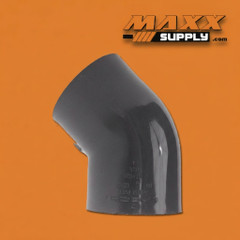


Elbow, 45 Degree, Slip x Slip PVC Schedule 80 10" (817-100)
$578.02
The 10" Schedule 80 Gray PVC 45 Degree Elbow (817-100, Slip x Slip) is a large-diameter, heavy-wall directional change fitting manufactured to ASTM D2467 in Schedule 80 gray PVC — providing a single-body Schedule 80 PVC solution for 45-degree direction changes on 10" primary transmission and distribution mains where the routing offset, angular deflection, or pipe run geometry requires a 45-degree direction change rather than a 90-degree turn, where the lower hydraulic thrust force, reduced pressure loss, and more gradual flow direction transition of the 45-degree elbow geometry provide measurable hydraulic and structural advantages over the 90-degree elbow at the 10" primary main service scale, and where the direction change must be accomplished within a single manufactured fitting body that carries the full Schedule 80 specification, NSF certification, and ASTM D2467 dimensional and pressure compliance of every other fitting in the 10" Schedule 80 primary main system. The 817-100 is the correct direction change fitting wherever a 10" Schedule 80 PVC primary main must change direction by 45 degrees — wherever the piping route must offset around an existing underground utility, navigate between structural foundations at a non-perpendicular angle, transition from a buried main to an above-grade riser at a 45-degree entry angle, accomplish a compound routing change as part of a multi-elbow offset assembly, or make a gradual angular transition at a pump station, valve vault, or mechanical room boundary that does not require a full 90-degree direction change and where the reduced hydraulic and structural loading of the 45-degree elbow is the preferred engineering specification over the 90-degree alternative. As the most broadly specified large-diameter Schedule 80 PVC 45-degree elbow in the standard commercial fitting line, the 817-100 serves the largest installed base of 10" primary main directional routing applications across every industry the Spears 817 series reaches — a fitting that appears more frequently in large commercial and municipal 10" primary main routing assemblies than any adjacent size in the Schedule 80 PVC 45-degree elbow series because 10" IPS is the standard large-diameter primary pipe size across the broadest range of commercial and industrial primary main applications.
The 45-degree elbow's hydraulic and structural advantages over the 90-degree elbow are the central specification facts that drive every application where the 817-100 is the preferred or required direction change fitting over the 806-100 at the 10" primary main service scale — and these advantages are identical in character to those established for the 817-120 at the 12" service size, applied at the 10" service level where they serve the most commercially prevalent large-diameter primary main routing context in the Schedule 80 PVC socket fitting line. In a 90-degree elbow, flow entering the bend must undergo a complete quarter-turn direction change — a 90-degree angular deflection that produces a large flow separation zone at the inner radius of the bend, substantial turbulence throughout the elbow arc, an elevated pressure loss coefficient that translates to a longer equivalent length in the system's hydraulic friction loss calculation, a significant velocity profile distortion in the pipe run immediately downstream of the elbow exit that persists for multiple pipe diameters before the flow profile recovers uniform distribution, and a large unbalanced hydraulic thrust force directed outward at the outside of the bend that is proportional to both the internal operating pressure and the pipe cross-sectional area at the 10" service size. In the 45-degree elbow, flow entering the bend undergoes only a half-turn direction change — a 45-degree angular deflection that produces a substantially smaller flow separation zone at the inner radius, reduced turbulence throughout the shorter elbow arc, a meaningfully lower pressure loss coefficient reflecting a shorter equivalent length in the system's hydraulic friction loss calculation, a less severe and more rapidly recovering velocity profile distortion downstream of the elbow exit, and a hydraulic thrust force that is substantially lower than at the 90-degree elbow under equivalent operating conditions — because the thrust force at an elbow is proportional to both the pressure force and the directional momentum change, and the 45-degree direction change produces a smaller vector component of unbalanced force than the 90-degree change at the same 10" pipe size and operating pressure. These hydraulic and structural advantages of the 45-degree elbow over the 90-degree elbow at the 10" primary main scale are quantifiable, consistent, and operationally consequential — the 817-100's lower equivalent length relative to the 806-100 directly reduces the friction loss contribution of the direction change fitting in the primary main's hydraulic design, and the 817-100's lower thrust force directly reduces the size and cost of the engineered thrust restraint assembly required at the fitting location in buried primary main installations.
The thrust restraint requirement at the 10" 45-degree elbow is substantially less demanding than at the 10" 90-degree elbow at the same operating conditions, but it is not eliminated and must not be treated as negligible at the 10" primary main service scale. A 45-degree direction change on a pressurized 10" primary main generates an unbalanced hydraulic thrust force at the elbow body — smaller in magnitude than at the 806-100 under the same operating conditions, but present and requiring engineered restraint in buried installations where the soil bearing capacity and pipe burial conditions determine the thrust block design. The reduction in thrust block size relative to the 806-100 at the same installation location is a direct cost advantage of the 817-100 specification — at 10" primary main operating pressures across municipal water distribution, large commercial irrigation, and pump station primary header service, the thrust force reduction at the 45-degree geometry produces a meaningfully smaller required thrust block bearing area relative to the 90-degree geometry at the same pipe size and pressure, and this reduction in concrete and excavation quantities at each 45-degree elbow location accumulates into a measurable project-level cost benefit wherever multiple 817-100 locations occur along an extended 10" primary main route. Concrete thrust blocks at buried 10" 45-degree elbow locations must be designed by the project's civil or structural engineer based on the site-specific soil bearing capacity, pipe diameter, operating pressure, burial depth, and the fitting's thrust force magnitude at the 45-degree deflection angle — the project engineer must confirm the 817-100-specific thrust force calculation and thrust block design before installation rather than adapting thrust block designs from the 806-100 at the same location.
The 817-100 serves both the standalone 45-degree offset routing role and the compound two-elbow parallel offset assembly role at the 10" primary main service scale — the two distinct routing applications that define the 45-degree elbow's specification value relative to the 90-degree elbow across every industry the 817-100 serves, applied at the 10" size where these routing applications are most commercially prevalent in the Schedule 80 PVC socket fitting line. In the standalone 45-degree offset role, the 817-100 provides a single 45-degree direction change at a specific routing constraint — an underground utility crossing, a structural foundation clearance, a property boundary offset, or a grade transition — where the lesser angle is geometrically feasible and produces the directional transition required by the routing design at that specific location. In the compound two-elbow parallel offset assembly role, two 817-100 elbows are combined with a spool piece of 10" Schedule 80 PVC pipe between them to accomplish a parallel offset of the 10" primary main — transitioning the primary main from one horizontal alignment to a parallel alignment offset by a specific perpendicular distance, accomplished at lower accumulated pressure loss and with shorter perpendicular spool length than a two-90-degree-elbow offset assembly at the same parallel displacement distance. The compound 45-degree parallel offset is a standard 10" primary main routing tool across municipal water distribution, large commercial irrigation, pump station primary header, and industrial process primary distribution installations where extended primary main routes encounter alignment constraints requiring parallel main offsets at specific locations along the route — and the 817-100 is the correct fitting for both elbows in every two-elbow 45-degree parallel offset assembly at the 10" Schedule 80 PVC service level.
The 817-100's position as the most commercially prevalent large-diameter Schedule 80 PVC 45-degree elbow in the standard fitting line reflects the unique commercial role of the 10" IPS pipe size in the large-diameter PVC primary main market. At 10" IPS, the Schedule 80 PVC primary main serves the broadest range of large commercial and industrial primary distribution applications — large commercial and agricultural irrigation primary transmission mains at major golf course, resort, and large-acreage agricultural operations; municipal water distribution primary mains at the sector and zone transmission level; industrial process water primary headers at manufacturing and chemical processing facilities; water treatment plant primary distribution headers; pump station primary suction and discharge headers at large commercial pump stations; and large commercial HVAC primary chilled water and condenser water distribution mains. The 817-100 appears at every 45-degree direction change location on every 10" Schedule 80 PVC primary main in every one of these application contexts — a fitting whose specification frequency across the full commercial large-diameter PVC market is higher than any adjacent size in the Spears 817 series because 10" IPS primary main installations are more numerous than 12" installations across the commercial market, while the 8" and smaller Schedule 80 PVC 45-degree elbows serve primary distribution rather than primary transmission applications. The cumulative specification frequency of the 817-100 across all commercial 10" Schedule 80 PVC primary main installations — each of which requires a 45-degree elbow at every routing offset and compound parallel offset location along the primary main route — establishes the 817-100 as the most broadly specified fitting in the Spears 817 series Schedule 80 PVC 45-degree socket elbow line.
Schedule 80 gray PVC construction is the correct and only material specification for this fitting across every application where a 45-degree direction change on a 10" Schedule 80 PVC primary main is required. The Schedule 80 wall thickness applied uniformly through the full elbow body — across the straight entry and exit legs, through the complete arc of the 45-degree bend, and at the socket connection sections at both ports — provides the structural integrity required to resist the combined pressure and thrust loading at a 45-degree direction change on a 10" primary main under sustained operating conditions. The gray color provides the permanent, inspectable Schedule 80 material class identification at the primary main direction change — confirming the installed material class for inspectors, maintenance engineers, and facility managers at every elbow location in the 10" primary main route. PVC Type 1 Grade 1 construction with cell classification 12454 per ASTM D1784 provides broad chemical resistance across water treatment chemicals, process water service, industrial utility water, and the full range of non-solvent process fluids appropriate for Schedule 80 PVC primary main service. Both socket ends solvent cement directly onto standard 10" IPS Schedule 40 or Schedule 80 PVC pipe using heavy-body solvent cement appropriate for the large bonding surface areas of the 10" socket connections. At the 10" socket connections on the 817-100, the full large-diameter assembly discipline established across the Spears 817 and 806 series Schedule 80 PVC elbow pages applies without reduction: heavy-body solvent cement rated for large-diameter Schedule 80 PVC is mandatory at both connections, pre-planned assembly with both pipe ends fully accessible and positioned in their correct alignment before any cement application begins is essential — the elbow's exit alignment against the downstream pipe routing must be confirmed by dry-fit before cement is applied because the 45-degree exit angle is fixed and misalignment after cement application begins cannot be corrected without full joint destruction and pipe re-cutting at this service size — full circumferential heavy-body cement coverage across the complete bonding surface of each 10" pipe end and fitting socket must be achieved at both ports, and full cure time compliance before any system pressurization is non-negotiable at this large-diameter primary main direction change. The 45-degree exit angle's routing geometry must be verified with particular care during dry-fit assembly — the 45-degree exit direction is geometrically less immediately intuitive to confirm against the piping layout than the perpendicular exit of the 90-degree elbow, and buyers installing 45-degree elbows for the first time or in unusual orientations must confirm the exit direction explicitly by measurement or layout reference before any cement application begins.
NSF 61 certification lists this fitting for potable water contact, and NSF 14 covers compliance with applicable plastics piping material standards — making it the correct primary main direction change fitting for municipal water treatment and distribution systems, large potable water pump station primary headers, and large commercial and institutional water supply primary mains where NSF-listed materials are required at every fitting in the primary distribution system. ASTM D2467 governs Schedule 80 PVC socket fittings and defines the manufacturing, dimensional, and pressure performance requirements the 817-100 is produced to. Verify manufacturer pressure rating documentation for the specific fitting configuration before final system specification — at the 10" 45-degree elbow configuration, the governing pressure rating is determined by the 10" port size and the fitting's tested performance at this large-diameter elbow geometry under the combined pressure and thrust loading conditions of 45-degree direction change service, and must be confirmed against the manufacturer's published pressure-temperature rating table for SKU 817-100 before installation in systems at or near the fitting's rated pressure ceiling.
Key Features:
- Schedule 80 gray PVC 45-degree elbow — 10" slip x slip, both socket ends; Spears 817 series Schedule 80 PVC 45-degree socket elbow
- 45-degree direction change — lower hydraulic thrust force, reduced pressure loss, and shorter equivalent length than the 10" 90-degree elbow (806-100) under equivalent operating conditions at the same primary main service size and pressure
- Substantially lower hydraulic thrust than the 806-100 at the same 10" service size and operating pressure — reduces required thrust block bearing area at buried installation locations relative to 90-degree elbow at the same size; engineered thrust block sizing by project engineer for 45-degree-specific thrust force magnitude is required
- Most commercially prevalent large-diameter Schedule 80 PVC 45-degree elbow in the standard commercial fitting line — 10" IPS is the most broadly specified large-diameter primary pipe size across commercial irrigation, industrial process, municipal distribution, and pump station primary header markets served by the Spears 817 series
- Serves standalone 45-degree offset routing and compound two-elbow parallel offset assemblies — both primary routing applications where the 45-degree elbow is the preferred or required direction change fitting over the 90-degree alternative at the 10" primary main service scale
- Direct smaller-size companion to the 817-120 (12") in the Spears 817 series Schedule 80 PVC 45-degree socket elbow line — same series, same specification framework, adjacent size
- Direct complement to the 10" Schedule 80 90-degree elbow (806-100) — select 817-100 for 45-degree direction changes; select 806-100 for 90-degree direction changes; both fittings specified together at different routing locations in the same 10" Schedule 80 PVC primary main installation
- Manufactured to ASTM D2467 — governing standard for Schedule 80 PVC socket fittings
- NSF 61 certified for potable water contact; NSF 14 listed
- Solvent cement socket connections compatible with Schedule 40 and Schedule 80 IPS 10" pipe at both ends
- Gray color — universal Schedule 80 material class identification at the primary main direction change
- Schedule 80 wall thickness through the full 45-degree elbow arc — mandatory structural specification at 10" primary main service
- Cell classification PVC 12454 per ASTM D1784
- 45-degree exit angle is fixed — confirm exit alignment and downstream pipe routing clearances by dry-fit before cement application; alignment cannot be adjusted after cement application begins
- Heavy-body solvent cement required at both 10" socket connections; full cure time compliance mandatory before pressurization
- Pressure rating: verify against manufacturer pressure-temperature table for SKU 817-100
Specifications:
| Attribute | Value |
|---|---|
| SKU | 817-100 |
| Fitting Type | 45-Degree Elbow |
| Series | Spears 817 Schedule 80 PVC 45-Degree Socket Elbow |
| Nominal Size | 10" |
| End Connections | Slip x Slip (Both Socket) |
| Connection Method | Solvent Cement (IPS) |
| Compatible Pipe | 10" IPS Schedule 40 or Schedule 80 PVC |
| Turn Angle | 45 Degrees |
| Schedule | Schedule 80 |
| Material | PVC (Polyvinyl Chloride) Type 1, Grade 1 |
| Cell Classification | 12454 per ASTM D1784 |
| Color | Gray |
| Manufacturing Standard | ASTM D2467 |
| Potable Water Certification | NSF/ANSI 61 |
| Plastics Standard Certification | NSF 14 |
| Max Service Temperature | 140°F (60°C) |
| Pressure Rating | Verify with manufacturer pressure-temperature rating table for SKU 817-100 |
| Thrust Restraint | Required at buried installations — engineered thrust block or mechanical restraint by project engineer for 45-degree-specific thrust force magnitude at 10" service size and system operating pressure |
Industries & Applications:
- Municipal Water Distribution — Primary Transmission Main 45-Degree Offset Routing and Parallel Main Offsets — The 10" Schedule 80 PVC 45-degree elbow is the most frequently specified 45-degree direction change fitting in the Schedule 80 PVC socket elbow line at the municipal water distribution primary main service level — specified at every 45-degree direction change location on 10" municipal water transmission and primary distribution mains in Schedule 80 PVC systems where the routing must navigate underground utility crossings at non-perpendicular angles, negotiate structural foundation clearances or right-of-way constraints at 45-degree deflections, transition from horizontal burial to an angled riser entry into a pump station, booster station, or valve vault at a 45-degree entry angle, or accomplish a parallel main offset using two 817-100 elbows and a spool piece to transition the 10" primary main between parallel horizontal alignments required by the distribution system's routing design; in densely developed municipal service areas where multiple underground utilities, structural foundations, and underground infrastructure crossings constrain primary main routing at numerous locations along the primary main route, the 817-100 is specified at each 45-degree offset location alongside the 806-100 at each 90-degree turn location — both direction change fittings appearing at different points along the same primary main installation depending on the angular routing requirement at each constraint location; the lower thrust force of the 817-100 relative to the 806-100 reduces the concrete thrust block size and excavation volume at each 45-degree elbow location along the municipal primary main route — a project-level cost advantage at large municipal water distribution installations where multiple 817-100 locations occur along extended primary main routes through developed service areas; NSF 61 listing confirms potable water fitness at every municipal water distribution 45-degree direction change; engineered thrust block sizing for the 45-degree-specific thrust force is required at every buried 817-100 installation and must be confirmed by the project's civil or structural engineer before installation
- Water Treatment Plant — Primary Header 45-Degree Routing Transitions and Angular Offsets — Installed at 45-degree direction change points on 10" primary distribution headers in municipal and industrial water treatment plants where the primary header routing must navigate the physical layout constraints of the treatment facility at angles that do not require a full 90-degree turn — clearwell supply and primary distribution headers transitioning between horizontal distribution runs at 45-degree deflections within the facility's primary piping corridors; filter influent and effluent primary headers changing direction at 45 degrees to navigate between filter gallery structural elements, equipment room boundaries, and process unit walls; backwash primary supply mains routing from horizontal distribution runs to angled pump or blower connections at 45-degree deflections where the equipment's inlet orientation does not align perpendicularly with the primary supply header's approach direction; plant service water primary headers executing 45-degree routing transitions through confined pipe galleries and equipment corridors where consecutive direction changes at angles other than 90 degrees are required by the facility's structural and equipment layout; and water treatment plant primary distribution headers transitioning from underground supply mains to above-grade process connections at 45-degree riser entry angles through wall or slab penetrations where the penetration's orientation relative to the primary header's burial alignment produces a 45-degree transition requirement; the 817-100's lower pressure loss relative to the 806-100 benefits water treatment plant primary header design where friction loss budgets across multiple direction changes throughout the treatment facility's piping layout affect the primary system's available pressure at process equipment supply points and zone distribution connections; NSF 61 listing confirms potable water fitness at every water treatment plant primary distribution 45-degree direction change in Schedule 80 PVC systems
- Pump Station — Primary Suction and Discharge Header 45-Degree Routing and Compound Offset Assemblies — Used at 45-degree direction change points in large pump station primary suction and discharge header piping at the 10" service size — the most commonly occurring pump station primary header size in large commercial pump station construction — where primary connections must negotiate angular routing constraints at pump inlet and outlet orientations that are not perpendicular to the primary header direction, where discharge piping must route around structural elements within the pump station building at 45-degree deflections, where suction and discharge piping must penetrate vault walls or floor slabs at 45-degree angles to the primary header run, or where compound two-elbow 45-degree offset assemblies are required to transition the 10" primary suction or discharge piping between parallel alignments within the constrained spatial envelope of the pump station mechanical room; in pump station primary header routing at the 10" service size, the 817-100 is frequently specified in combination with the 806-100 to accomplish complex three-dimensional pipe routing within the pump station structure — a combination where both direction change fittings appear at different routing locations in the same 10" primary header installation depending on the angular requirement at each routing constraint; the 817-100's lower thrust force relative to the 806-100 reduces the pipe support and anchoring requirements at 45-degree elbow locations in above-ground pump station primary header piping where mechanical restraint rather than concrete thrust blocks is the thrust management approach; at pump stations where Schedule 80 PVC is the system-wide material standard and operating pressures, shut-off head, and surge conditions fall within the Schedule 80 pressure envelope, the 817-100 is the correct 45-degree direction change fitting at every 45-degree routing constraint in the 10" primary suction and discharge header system
- Large Commercial & Agricultural Irrigation — Primary Transmission Main 45-Degree Offset Routing and Parallel Sector Supply Offsets — The single highest-volume application driving 817-100 specification demand across all markets — specified at every 45-degree direction change location on 10" primary irrigation transmission mains at large commercial and agricultural irrigation systems including major golf course and resort irrigation systems, large-acreage agricultural operations, regional landscape and municipal park irrigation projects, and large commercial sports facility irrigation systems where 10" IPS is the standard primary transmission main pipe size and the 817-100 is the most frequently purchased direction change elbow in the 10" Schedule 80 PVC primary main BOM; at large commercial irrigation systems with extended 10" primary transmission main routes traversing property boundaries, roadway crossings, drainage structures, buried utility crossings, and terrain transitions, the 817-100 is specified at every routing location where the primary main must deflect 45 degrees rather than the full 90-degree turn that the 806-100 serves — a specification pattern where both the 817-100 and the 806-100 appear at different routing locations along the same primary transmission main route, each at the angular routing constraint that matches its specific 45-degree or 90-degree directional geometry; the compound two-elbow 45-degree parallel offset assembly is particularly common at large commercial irrigation primary transmission mains where the main must offset between parallel alignments to navigate property boundary constraints, roadway medians, drainage infrastructure, or terrain contours — accomplished with two 817-100 elbows and a 10" spool piece providing both a lower accumulated pressure loss and a shorter perpendicular spool length than the two-806-100 90-degree offset alternative at the same parallel displacement; engineered thrust restraint at every buried 10" 45-degree elbow location on irrigation primary transmission mains is required — irrigation pump station operating pressures generate thrust forces at 10" 45-degree elbows that require engineered concrete thrust blocks designed for the 45-degree-specific force magnitude, and the 817-100's lower thrust relative to the 806-100 translates directly into smaller required thrust block dimensions at each 45-degree elbow location along the irrigation primary main route; at large commercial irrigation systems where multiple 817-100 units are purchased per project for the primary transmission main's routing offset locations, the thrust block size reduction at each 817-100 location accumulates into a meaningful project-level concrete and excavation cost saving relative to specifying 90-degree elbows with offset spool assemblies at the same routing constraint locations
- Industrial Process Piping — Primary Header 45-Degree Angular Routing and Parallel Offset Assemblies — Specified at 45-degree direction change points on 10" process water primary headers, cooling water primary distribution trunks, and plant utility water primary mains in manufacturing plants, chemical processing facilities, petrochemical support facilities, and heavy industrial environments where the primary header routing must navigate the structural and equipment constraints of the industrial facility at 45-degree deflections — transitioning from underground supply mains to above-ground equipment rack distribution at angled riser entry points where the equipment rack's orientation relative to the underground supply main produces a 45-degree transition requirement; routing around building structural columns and process equipment foundations at non-perpendicular angles where the perpendicular routing that a 90-degree elbow would require is geometrically infeasible within the available structural clearances; accomplishing parallel main offsets using compound two-elbow 45-degree assemblies within constrained equipment corridor spaces where the available corridor width limits the perpendicular spool length of a 90-degree parallel offset assembly to below practical cut lengths; and connecting to process equipment primary inlets and outlets oriented at 45-degree angles to the primary header run where equipment manufacturers have designed the equipment's primary connection in an angular orientation relative to the facility's standard piping rack direction; in industrial process piping where primary header routing is constrained by dense equipment layouts, structural grids, and equipment vendor connection orientations at multiple locations along the primary distribution route, the 817-100 is as frequently specified as the 806-100 — both direction change fittings serving different angular routing requirements within the same 10" primary distribution system, and the 817-100 providing the lower-loss, lower-thrust 45-degree alternative at every routing location where the full 90-degree turn is not geometrically required or hydraulically optimal; the 817-100's lower equivalent length contribution to the primary header's friction loss calculation benefits industrial process systems where the hydraulic head budget is explicitly accounted for at every direction change fitting location in the primary system design
- Municipal Well Field — Primary Collection and Distribution Header 45-Degree Routing Transitions — Used at 45-degree direction change points on 10" primary well field collection or distribution headers in large municipal and commercial well field installations where the primary header routing must navigate the angular constraints of the well field's subsurface infrastructure at 45-degree deflections — collection headers routing from individual well cluster sub-collection laterals to the primary collection header at 45-degree confluence angles where the sub-collection lateral's alignment relative to the primary header's routing direction produces a 45-degree rather than perpendicular connection geometry; primary distribution headers transitioning between parallel burial alignments through compound two-elbow 45-degree offset assemblies where the distribution header must shift alignment to avoid geological constraints, buried utility crossings, or property boundary conditions along the well field's distribution route; well head structure connection assemblies where the 10" primary collection or distribution header must transition between horizontal burial alignment and above-grade well head structure connections at 45-degree angles through the well head pad penetration; and booster station primary header assemblies where the 10" primary suction or discharge header must navigate 45-degree angular routing transitions between the buried primary main and the booster station building's primary header entry alignment; at well field primary header installations where Schedule 80 is the system-wide material standard and operating pressures including well pump shut-off head and surge must be confirmed within the Schedule 80 pressure ceiling, the 817-100 is the correct 45-degree direction change fitting at every 45-degree routing constraint in the 10" primary collection and distribution system
- Water & Wastewater Treatment — Primary Process Header 45-Degree Routing and Angular Offset Assemblies — Installed at 45-degree direction change points on 10" primary process distribution headers in industrial wastewater treatment, water reclamation, and large-scale industrial water management facilities where the primary header routing must navigate 45-degree angular constraints imposed by facility structural elements, process equipment layouts, and underground infrastructure — clarifier influent headers routing from underground supply mains to above-ground clarifier inlet connections at angled riser entry angles; primary effluent distribution mains navigating process unit boundaries and structural elements at 45-degree deflections along the treatment facility's primary effluent distribution route; aeration system primary supply headers routing around structural columns and blower equipment at non-perpendicular angles where the aeration system's piping corridor constraints prevent perpendicular routing at the direction change locations; dewatering and sludge handling primary distribution headers accomplishing compound parallel offset assemblies within treatment facility process corridors using two-elbow 45-degree offset configurations at locations where the corridor's cross-sectional dimensions prevent the perpendicular spool of a two-90-degree-elbow offset; and chemical distribution primary headers transitioning between horizontal distribution runs and angled equipment connection points at 45-degree deflections where process equipment chemical inlet connections are oriented at angles to the primary distribution header's routing direction; the 817-100's lower equivalent length and lower thrust force relative to the 806-100 provide measurable hydraulic and structural advantages at 45-degree direction changes in treatment facility primary process headers where both the primary system's friction loss budget and the fitting body's structural loading under sustained chemical service conditions are explicitly accounted for in the primary system's engineering design
- HVAC & Large Commercial Mechanical Systems — Primary Distribution Main 45-Degree Routing Transitions and Compact Offset Assemblies — Specified at 45-degree direction change points on 10" primary chilled water distribution mains, condenser water primary trunks, and large-capacity hydronic heating and cooling primary distribution headers in large commercial campus, institutional, and industrial mechanical systems where the primary distribution main routing must navigate mechanical room structural constraints, building penetration angles, and equipment corridor spatial limitations at 45-degree deflections — primary distribution mains transitioning from horizontal underground distribution to angled mechanical room entry at 45-degree building penetration angles where the primary main's burial alignment relative to the building's wall produces a 45-degree entry transition requirement; primary distribution headers routing around structural columns and major mechanical equipment at non-perpendicular angles within large equipment rooms and mechanical penthouses where the equipment layout prevents perpendicular routing at the direction change locations; compound two-elbow 45-degree parallel offset assemblies accomplishing primary main alignment transitions within constrained mechanical corridor cross-sectional dimensions where the corridor's available width limits the perpendicular spool of a two-90-degree-elbow offset to below practical lengths; and campus primary distribution main transitions between underground campus distribution routes and above-grade central plant connections at 45-degree angles where the campus infrastructure's routing geometry produces non-perpendicular entry angles at primary plant connection points; at large campus and institutional mechanical systems where the primary distribution main's routing must accommodate the complex three-dimensional constraints of campus infrastructure, building geometry, and mechanical room layouts, the 817-100 is the standard complement to the 806-100 — both elbows specified together in complete primary distribution system routing designs where some direction changes require 90-degree turns and others are most efficiently accomplished at 45-degree deflections; at every 45-degree routing constraint in the 10" primary distribution system, the 817-100 provides the lower-loss, lower-thrust alternative that maximizes the primary distribution main's hydraulic performance and minimizes the structural loading at each direction change location relative to the 90-degree alternative
- Aquaculture & Large-Scale Water Management Infrastructure — Used at 45-degree direction change points on 10" primary water supply, recirculation, or distribution headers at the largest commercial aquaculture facilities, regional hatchery systems, and large recirculating aquaculture systems (RAS) where the primary header routing must navigate the structural and equipment constraints of large commercial aquaculture facility layouts at 45-degree deflections — transitioning from outdoor buried supply mains to indoor facility connections at angled entry points where the facility's building orientation relative to the primary supply main's approach alignment produces a 45-degree wall penetration requirement; routing from horizontal primary distribution headers to angled equipment inlet connections at recirculation pump and filtration equipment locations where the equipment manufacturer's inlet orientation is at 45 degrees to the primary header's routing direction; accomplishing compound parallel offset assemblies within aquaculture facility production and treatment corridors at locations where the corridor's cross-sectional dimensions limit the perpendicular spool of a two-90-degree-elbow offset; and navigating underwater structural constraints, tank foundation elements, and production hall column grids at 45-degree angular deflections along the primary distribution route within large commercial aquaculture facility floor plans; the 817-100's lower pressure loss relative to the 806-100 benefits large aquaculture primary distribution systems where accumulated friction loss across multiple direction changes in extended indoor facility piping routes affects the available pressure at recirculation pump suction headers and production section supply connections throughout the facility's complete primary distribution network; Schedule 80 PVC construction handles continuous water contact and treatment chemical exposure at the primary distribution level in commercial aquaculture infrastructure, and NSF 61 listing confirms fitness for potable and process water contact at every 45-degree direction change fitting in the primary aquaculture distribution system
(No reviews yet)

Write a Review

Elbow, 45 Degree, Slip x Slip PVC Schedule 80 10" (817-100)
The 10" Schedule 80 Gray PVC 45 Degree Elbow (817-100, Slip x Slip) is a large-diameter, heavy-wall directional change fitting manufactured to ASTM D2467 in Schedule 80 gray PVC — providing a single-body Schedule 80 PVC solution for 45-degree direction changes on 10" primary transmission and distribution mains where the routing offset, angular deflection, or pipe run geometry requires a 45-degree direction change rather than a 90-degree turn, where the lower hydraulic thrust force, reduced pressure loss, and more gradual flow direction transition of the 45-degree elbow geometry provide measurable hydraulic and structural advantages over the 90-degree elbow at the 10" primary main service scale, and where the direction change must be accomplished within a single manufactured fitting body that carries the full Schedule 80 specification, NSF certification, and ASTM D2467 dimensional and pressure compliance of every other fitting in the 10" Schedule 80 primary main system. The 817-100 is the correct direction change fitting wherever a 10" Schedule 80 PVC primary main must change direction by 45 degrees — wherever the piping route must offset around an existing underground utility, navigate between structural foundations at a non-perpendicular angle, transition from a buried main to an above-grade riser at a 45-degree entry angle, accomplish a compound routing change as part of a multi-elbow offset assembly, or make a gradual angular transition at a pump station, valve vault, or mechanical room boundary that does not require a full 90-degree direction change and where the reduced hydraulic and structural loading of the 45-degree elbow is the preferred engineering specification over the 90-degree alternative. As the most broadly specified large-diameter Schedule 80 PVC 45-degree elbow in the standard commercial fitting line, the 817-100 serves the largest installed base of 10" primary main directional routing applications across every industry the Spears 817 series reaches — a fitting that appears more frequently in large commercial and municipal 10" primary main routing assemblies than any adjacent size in the Schedule 80 PVC 45-degree elbow series because 10" IPS is the standard large-diameter primary pipe size across the broadest range of commercial and industrial primary main applications.
The 45-degree elbow's hydraulic and structural advantages over the 90-degree elbow are the central specification facts that drive every application where the 817-100 is the preferred or required direction change fitting over the 806-100 at the 10" primary main service scale — and these advantages are identical in character to those established for the 817-120 at the 12" service size, applied at the 10" service level where they serve the most commercially prevalent large-diameter primary main routing context in the Schedule 80 PVC socket fitting line. In a 90-degree elbow, flow entering the bend must undergo a complete quarter-turn direction change — a 90-degree angular deflection that produces a large flow separation zone at the inner radius of the bend, substantial turbulence throughout the elbow arc, an elevated pressure loss coefficient that translates to a longer equivalent length in the system's hydraulic friction loss calculation, a significant velocity profile distortion in the pipe run immediately downstream of the elbow exit that persists for multiple pipe diameters before the flow profile recovers uniform distribution, and a large unbalanced hydraulic thrust force directed outward at the outside of the bend that is proportional to both the internal operating pressure and the pipe cross-sectional area at the 10" service size. In the 45-degree elbow, flow entering the bend undergoes only a half-turn direction change — a 45-degree angular deflection that produces a substantially smaller flow separation zone at the inner radius, reduced turbulence throughout the shorter elbow arc, a meaningfully lower pressure loss coefficient reflecting a shorter equivalent length in the system's hydraulic friction loss calculation, a less severe and more rapidly recovering velocity profile distortion downstream of the elbow exit, and a hydraulic thrust force that is substantially lower than at the 90-degree elbow under equivalent operating conditions — because the thrust force at an elbow is proportional to both the pressure force and the directional momentum change, and the 45-degree direction change produces a smaller vector component of unbalanced force than the 90-degree change at the same 10" pipe size and operating pressure. These hydraulic and structural advantages of the 45-degree elbow over the 90-degree elbow at the 10" primary main scale are quantifiable, consistent, and operationally consequential — the 817-100's lower equivalent length relative to the 806-100 directly reduces the friction loss contribution of the direction change fitting in the primary main's hydraulic design, and the 817-100's lower thrust force directly reduces the size and cost of the engineered thrust restraint assembly required at the fitting location in buried primary main installations.
The thrust restraint requirement at the 10" 45-degree elbow is substantially less demanding than at the 10" 90-degree elbow at the same operating conditions, but it is not eliminated and must not be treated as negligible at the 10" primary main service scale. A 45-degree direction change on a pressurized 10" primary main generates an unbalanced hydraulic thrust force at the elbow body — smaller in magnitude than at the 806-100 under the same operating conditions, but present and requiring engineered restraint in buried installations where the soil bearing capacity and pipe burial conditions determine the thrust block design. The reduction in thrust block size relative to the 806-100 at the same installation location is a direct cost advantage of the 817-100 specification — at 10" primary main operating pressures across municipal water distribution, large commercial irrigation, and pump station primary header service, the thrust force reduction at the 45-degree geometry produces a meaningfully smaller required thrust block bearing area relative to the 90-degree geometry at the same pipe size and pressure, and this reduction in concrete and excavation quantities at each 45-degree elbow location accumulates into a measurable project-level cost benefit wherever multiple 817-100 locations occur along an extended 10" primary main route. Concrete thrust blocks at buried 10" 45-degree elbow locations must be designed by the project's civil or structural engineer based on the site-specific soil bearing capacity, pipe diameter, operating pressure, burial depth, and the fitting's thrust force magnitude at the 45-degree deflection angle — the project engineer must confirm the 817-100-specific thrust force calculation and thrust block design before installation rather than adapting thrust block designs from the 806-100 at the same location.
The 817-100 serves both the standalone 45-degree offset routing role and the compound two-elbow parallel offset assembly role at the 10" primary main service scale — the two distinct routing applications that define the 45-degree elbow's specification value relative to the 90-degree elbow across every industry the 817-100 serves, applied at the 10" size where these routing applications are most commercially prevalent in the Schedule 80 PVC socket fitting line. In the standalone 45-degree offset role, the 817-100 provides a single 45-degree direction change at a specific routing constraint — an underground utility crossing, a structural foundation clearance, a property boundary offset, or a grade transition — where the lesser angle is geometrically feasible and produces the directional transition required by the routing design at that specific location. In the compound two-elbow parallel offset assembly role, two 817-100 elbows are combined with a spool piece of 10" Schedule 80 PVC pipe between them to accomplish a parallel offset of the 10" primary main — transitioning the primary main from one horizontal alignment to a parallel alignment offset by a specific perpendicular distance, accomplished at lower accumulated pressure loss and with shorter perpendicular spool length than a two-90-degree-elbow offset assembly at the same parallel displacement distance. The compound 45-degree parallel offset is a standard 10" primary main routing tool across municipal water distribution, large commercial irrigation, pump station primary header, and industrial process primary distribution installations where extended primary main routes encounter alignment constraints requiring parallel main offsets at specific locations along the route — and the 817-100 is the correct fitting for both elbows in every two-elbow 45-degree parallel offset assembly at the 10" Schedule 80 PVC service level.
The 817-100's position as the most commercially prevalent large-diameter Schedule 80 PVC 45-degree elbow in the standard fitting line reflects the unique commercial role of the 10" IPS pipe size in the large-diameter PVC primary main market. At 10" IPS, the Schedule 80 PVC primary main serves the broadest range of large commercial and industrial primary distribution applications — large commercial and agricultural irrigation primary transmission mains at major golf course, resort, and large-acreage agricultural operations; municipal water distribution primary mains at the sector and zone transmission level; industrial process water primary headers at manufacturing and chemical processing facilities; water treatment plant primary distribution headers; pump station primary suction and discharge headers at large commercial pump stations; and large commercial HVAC primary chilled water and condenser water distribution mains. The 817-100 appears at every 45-degree direction change location on every 10" Schedule 80 PVC primary main in every one of these application contexts — a fitting whose specification frequency across the full commercial large-diameter PVC market is higher than any adjacent size in the Spears 817 series because 10" IPS primary main installations are more numerous than 12" installations across the commercial market, while the 8" and smaller Schedule 80 PVC 45-degree elbows serve primary distribution rather than primary transmission applications. The cumulative specification frequency of the 817-100 across all commercial 10" Schedule 80 PVC primary main installations — each of which requires a 45-degree elbow at every routing offset and compound parallel offset location along the primary main route — establishes the 817-100 as the most broadly specified fitting in the Spears 817 series Schedule 80 PVC 45-degree socket elbow line.
Schedule 80 gray PVC construction is the correct and only material specification for this fitting across every application where a 45-degree direction change on a 10" Schedule 80 PVC primary main is required. The Schedule 80 wall thickness applied uniformly through the full elbow body — across the straight entry and exit legs, through the complete arc of the 45-degree bend, and at the socket connection sections at both ports — provides the structural integrity required to resist the combined pressure and thrust loading at a 45-degree direction change on a 10" primary main under sustained operating conditions. The gray color provides the permanent, inspectable Schedule 80 material class identification at the primary main direction change — confirming the installed material class for inspectors, maintenance engineers, and facility managers at every elbow location in the 10" primary main route. PVC Type 1 Grade 1 construction with cell classification 12454 per ASTM D1784 provides broad chemical resistance across water treatment chemicals, process water service, industrial utility water, and the full range of non-solvent process fluids appropriate for Schedule 80 PVC primary main service. Both socket ends solvent cement directly onto standard 10" IPS Schedule 40 or Schedule 80 PVC pipe using heavy-body solvent cement appropriate for the large bonding surface areas of the 10" socket connections. At the 10" socket connections on the 817-100, the full large-diameter assembly discipline established across the Spears 817 and 806 series Schedule 80 PVC elbow pages applies without reduction: heavy-body solvent cement rated for large-diameter Schedule 80 PVC is mandatory at both connections, pre-planned assembly with both pipe ends fully accessible and positioned in their correct alignment before any cement application begins is essential — the elbow's exit alignment against the downstream pipe routing must be confirmed by dry-fit before cement is applied because the 45-degree exit angle is fixed and misalignment after cement application begins cannot be corrected without full joint destruction and pipe re-cutting at this service size — full circumferential heavy-body cement coverage across the complete bonding surface of each 10" pipe end and fitting socket must be achieved at both ports, and full cure time compliance before any system pressurization is non-negotiable at this large-diameter primary main direction change. The 45-degree exit angle's routing geometry must be verified with particular care during dry-fit assembly — the 45-degree exit direction is geometrically less immediately intuitive to confirm against the piping layout than the perpendicular exit of the 90-degree elbow, and buyers installing 45-degree elbows for the first time or in unusual orientations must confirm the exit direction explicitly by measurement or layout reference before any cement application begins.
NSF 61 certification lists this fitting for potable water contact, and NSF 14 covers compliance with applicable plastics piping material standards — making it the correct primary main direction change fitting for municipal water treatment and distribution systems, large potable water pump station primary headers, and large commercial and institutional water supply primary mains where NSF-listed materials are required at every fitting in the primary distribution system. ASTM D2467 governs Schedule 80 PVC socket fittings and defines the manufacturing, dimensional, and pressure performance requirements the 817-100 is produced to. Verify manufacturer pressure rating documentation for the specific fitting configuration before final system specification — at the 10" 45-degree elbow configuration, the governing pressure rating is determined by the 10" port size and the fitting's tested performance at this large-diameter elbow geometry under the combined pressure and thrust loading conditions of 45-degree direction change service, and must be confirmed against the manufacturer's published pressure-temperature rating table for SKU 817-100 before installation in systems at or near the fitting's rated pressure ceiling.
Key Features:
- Schedule 80 gray PVC 45-degree elbow — 10" slip x slip, both socket ends; Spears 817 series Schedule 80 PVC 45-degree socket elbow
- 45-degree direction change — lower hydraulic thrust force, reduced pressure loss, and shorter equivalent length than the 10" 90-degree elbow (806-100) under equivalent operating conditions at the same primary main service size and pressure
- Substantially lower hydraulic thrust than the 806-100 at the same 10" service size and operating pressure — reduces required thrust block bearing area at buried installation locations relative to 90-degree elbow at the same size; engineered thrust block sizing by project engineer for 45-degree-specific thrust force magnitude is required
- Most commercially prevalent large-diameter Schedule 80 PVC 45-degree elbow in the standard commercial fitting line — 10" IPS is the most broadly specified large-diameter primary pipe size across commercial irrigation, industrial process, municipal distribution, and pump station primary header markets served by the Spears 817 series
- Serves standalone 45-degree offset routing and compound two-elbow parallel offset assemblies — both primary routing applications where the 45-degree elbow is the preferred or required direction change fitting over the 90-degree alternative at the 10" primary main service scale
- Direct smaller-size companion to the 817-120 (12") in the Spears 817 series Schedule 80 PVC 45-degree socket elbow line — same series, same specification framework, adjacent size
- Direct complement to the 10" Schedule 80 90-degree elbow (806-100) — select 817-100 for 45-degree direction changes; select 806-100 for 90-degree direction changes; both fittings specified together at different routing locations in the same 10" Schedule 80 PVC primary main installation
- Manufactured to ASTM D2467 — governing standard for Schedule 80 PVC socket fittings
- NSF 61 certified for potable water contact; NSF 14 listed
- Solvent cement socket connections compatible with Schedule 40 and Schedule 80 IPS 10" pipe at both ends
- Gray color — universal Schedule 80 material class identification at the primary main direction change
- Schedule 80 wall thickness through the full 45-degree elbow arc — mandatory structural specification at 10" primary main service
- Cell classification PVC 12454 per ASTM D1784
- 45-degree exit angle is fixed — confirm exit alignment and downstream pipe routing clearances by dry-fit before cement application; alignment cannot be adjusted after cement application begins
- Heavy-body solvent cement required at both 10" socket connections; full cure time compliance mandatory before pressurization
- Pressure rating: verify against manufacturer pressure-temperature table for SKU 817-100
Specifications:
| Attribute | Value |
|---|---|
| SKU | 817-100 |
| Fitting Type | 45-Degree Elbow |
| Series | Spears 817 Schedule 80 PVC 45-Degree Socket Elbow |
| Nominal Size | 10" |
| End Connections | Slip x Slip (Both Socket) |
| Connection Method | Solvent Cement (IPS) |
| Compatible Pipe | 10" IPS Schedule 40 or Schedule 80 PVC |
| Turn Angle | 45 Degrees |
| Schedule | Schedule 80 |
| Material | PVC (Polyvinyl Chloride) Type 1, Grade 1 |
| Cell Classification | 12454 per ASTM D1784 |
| Color | Gray |
| Manufacturing Standard | ASTM D2467 |
| Potable Water Certification | NSF/ANSI 61 |
| Plastics Standard Certification | NSF 14 |
| Max Service Temperature | 140°F (60°C) |
| Pressure Rating | Verify with manufacturer pressure-temperature rating table for SKU 817-100 |
| Thrust Restraint | Required at buried installations — engineered thrust block or mechanical restraint by project engineer for 45-degree-specific thrust force magnitude at 10" service size and system operating pressure |
Industries & Applications:
- Municipal Water Distribution — Primary Transmission Main 45-Degree Offset Routing and Parallel Main Offsets — The 10" Schedule 80 PVC 45-degree elbow is the most frequently specified 45-degree direction change fitting in the Schedule 80 PVC socket elbow line at the municipal water distribution primary main service level — specified at every 45-degree direction change location on 10" municipal water transmission and primary distribution mains in Schedule 80 PVC systems where the routing must navigate underground utility crossings at non-perpendicular angles, negotiate structural foundation clearances or right-of-way constraints at 45-degree deflections, transition from horizontal burial to an angled riser entry into a pump station, booster station, or valve vault at a 45-degree entry angle, or accomplish a parallel main offset using two 817-100 elbows and a spool piece to transition the 10" primary main between parallel horizontal alignments required by the distribution system's routing design; in densely developed municipal service areas where multiple underground utilities, structural foundations, and underground infrastructure crossings constrain primary main routing at numerous locations along the primary main route, the 817-100 is specified at each 45-degree offset location alongside the 806-100 at each 90-degree turn location — both direction change fittings appearing at different points along the same primary main installation depending on the angular routing requirement at each constraint location; the lower thrust force of the 817-100 relative to the 806-100 reduces the concrete thrust block size and excavation volume at each 45-degree elbow location along the municipal primary main route — a project-level cost advantage at large municipal water distribution installations where multiple 817-100 locations occur along extended primary main routes through developed service areas; NSF 61 listing confirms potable water fitness at every municipal water distribution 45-degree direction change; engineered thrust block sizing for the 45-degree-specific thrust force is required at every buried 817-100 installation and must be confirmed by the project's civil or structural engineer before installation
- Water Treatment Plant — Primary Header 45-Degree Routing Transitions and Angular Offsets — Installed at 45-degree direction change points on 10" primary distribution headers in municipal and industrial water treatment plants where the primary header routing must navigate the physical layout constraints of the treatment facility at angles that do not require a full 90-degree turn — clearwell supply and primary distribution headers transitioning between horizontal distribution runs at 45-degree deflections within the facility's primary piping corridors; filter influent and effluent primary headers changing direction at 45 degrees to navigate between filter gallery structural elements, equipment room boundaries, and process unit walls; backwash primary supply mains routing from horizontal distribution runs to angled pump or blower connections at 45-degree deflections where the equipment's inlet orientation does not align perpendicularly with the primary supply header's approach direction; plant service water primary headers executing 45-degree routing transitions through confined pipe galleries and equipment corridors where consecutive direction changes at angles other than 90 degrees are required by the facility's structural and equipment layout; and water treatment plant primary distribution headers transitioning from underground supply mains to above-grade process connections at 45-degree riser entry angles through wall or slab penetrations where the penetration's orientation relative to the primary header's burial alignment produces a 45-degree transition requirement; the 817-100's lower pressure loss relative to the 806-100 benefits water treatment plant primary header design where friction loss budgets across multiple direction changes throughout the treatment facility's piping layout affect the primary system's available pressure at process equipment supply points and zone distribution connections; NSF 61 listing confirms potable water fitness at every water treatment plant primary distribution 45-degree direction change in Schedule 80 PVC systems
- Pump Station — Primary Suction and Discharge Header 45-Degree Routing and Compound Offset Assemblies — Used at 45-degree direction change points in large pump station primary suction and discharge header piping at the 10" service size — the most commonly occurring pump station primary header size in large commercial pump station construction — where primary connections must negotiate angular routing constraints at pump inlet and outlet orientations that are not perpendicular to the primary header direction, where discharge piping must route around structural elements within the pump station building at 45-degree deflections, where suction and discharge piping must penetrate vault walls or floor slabs at 45-degree angles to the primary header run, or where compound two-elbow 45-degree offset assemblies are required to transition the 10" primary suction or discharge piping between parallel alignments within the constrained spatial envelope of the pump station mechanical room; in pump station primary header routing at the 10" service size, the 817-100 is frequently specified in combination with the 806-100 to accomplish complex three-dimensional pipe routing within the pump station structure — a combination where both direction change fittings appear at different routing locations in the same 10" primary header installation depending on the angular requirement at each routing constraint; the 817-100's lower thrust force relative to the 806-100 reduces the pipe support and anchoring requirements at 45-degree elbow locations in above-ground pump station primary header piping where mechanical restraint rather than concrete thrust blocks is the thrust management approach; at pump stations where Schedule 80 PVC is the system-wide material standard and operating pressures, shut-off head, and surge conditions fall within the Schedule 80 pressure envelope, the 817-100 is the correct 45-degree direction change fitting at every 45-degree routing constraint in the 10" primary suction and discharge header system
- Large Commercial & Agricultural Irrigation — Primary Transmission Main 45-Degree Offset Routing and Parallel Sector Supply Offsets — The single highest-volume application driving 817-100 specification demand across all markets — specified at every 45-degree direction change location on 10" primary irrigation transmission mains at large commercial and agricultural irrigation systems including major golf course and resort irrigation systems, large-acreage agricultural operations, regional landscape and municipal park irrigation projects, and large commercial sports facility irrigation systems where 10" IPS is the standard primary transmission main pipe size and the 817-100 is the most frequently purchased direction change elbow in the 10" Schedule 80 PVC primary main BOM; at large commercial irrigation systems with extended 10" primary transmission main routes traversing property boundaries, roadway crossings, drainage structures, buried utility crossings, and terrain transitions, the 817-100 is specified at every routing location where the primary main must deflect 45 degrees rather than the full 90-degree turn that the 806-100 serves — a specification pattern where both the 817-100 and the 806-100 appear at different routing locations along the same primary transmission main route, each at the angular routing constraint that matches its specific 45-degree or 90-degree directional geometry; the compound two-elbow 45-degree parallel offset assembly is particularly common at large commercial irrigation primary transmission mains where the main must offset between parallel alignments to navigate property boundary constraints, roadway medians, drainage infrastructure, or terrain contours — accomplished with two 817-100 elbows and a 10" spool piece providing both a lower accumulated pressure loss and a shorter perpendicular spool length than the two-806-100 90-degree offset alternative at the same parallel displacement; engineered thrust restraint at every buried 10" 45-degree elbow location on irrigation primary transmission mains is required — irrigation pump station operating pressures generate thrust forces at 10" 45-degree elbows that require engineered concrete thrust blocks designed for the 45-degree-specific force magnitude, and the 817-100's lower thrust relative to the 806-100 translates directly into smaller required thrust block dimensions at each 45-degree elbow location along the irrigation primary main route; at large commercial irrigation systems where multiple 817-100 units are purchased per project for the primary transmission main's routing offset locations, the thrust block size reduction at each 817-100 location accumulates into a meaningful project-level concrete and excavation cost saving relative to specifying 90-degree elbows with offset spool assemblies at the same routing constraint locations
- Industrial Process Piping — Primary Header 45-Degree Angular Routing and Parallel Offset Assemblies — Specified at 45-degree direction change points on 10" process water primary headers, cooling water primary distribution trunks, and plant utility water primary mains in manufacturing plants, chemical processing facilities, petrochemical support facilities, and heavy industrial environments where the primary header routing must navigate the structural and equipment constraints of the industrial facility at 45-degree deflections — transitioning from underground supply mains to above-ground equipment rack distribution at angled riser entry points where the equipment rack's orientation relative to the underground supply main produces a 45-degree transition requirement; routing around building structural columns and process equipment foundations at non-perpendicular angles where the perpendicular routing that a 90-degree elbow would require is geometrically infeasible within the available structural clearances; accomplishing parallel main offsets using compound two-elbow 45-degree assemblies within constrained equipment corridor spaces where the available corridor width limits the perpendicular spool length of a 90-degree parallel offset assembly to below practical cut lengths; and connecting to process equipment primary inlets and outlets oriented at 45-degree angles to the primary header run where equipment manufacturers have designed the equipment's primary connection in an angular orientation relative to the facility's standard piping rack direction; in industrial process piping where primary header routing is constrained by dense equipment layouts, structural grids, and equipment vendor connection orientations at multiple locations along the primary distribution route, the 817-100 is as frequently specified as the 806-100 — both direction change fittings serving different angular routing requirements within the same 10" primary distribution system, and the 817-100 providing the lower-loss, lower-thrust 45-degree alternative at every routing location where the full 90-degree turn is not geometrically required or hydraulically optimal; the 817-100's lower equivalent length contribution to the primary header's friction loss calculation benefits industrial process systems where the hydraulic head budget is explicitly accounted for at every direction change fitting location in the primary system design
- Municipal Well Field — Primary Collection and Distribution Header 45-Degree Routing Transitions — Used at 45-degree direction change points on 10" primary well field collection or distribution headers in large municipal and commercial well field installations where the primary header routing must navigate the angular constraints of the well field's subsurface infrastructure at 45-degree deflections — collection headers routing from individual well cluster sub-collection laterals to the primary collection header at 45-degree confluence angles where the sub-collection lateral's alignment relative to the primary header's routing direction produces a 45-degree rather than perpendicular connection geometry; primary distribution headers transitioning between parallel burial alignments through compound two-elbow 45-degree offset assemblies where the distribution header must shift alignment to avoid geological constraints, buried utility crossings, or property boundary conditions along the well field's distribution route; well head structure connection assemblies where the 10" primary collection or distribution header must transition between horizontal burial alignment and above-grade well head structure connections at 45-degree angles through the well head pad penetration; and booster station primary header assemblies where the 10" primary suction or discharge header must navigate 45-degree angular routing transitions between the buried primary main and the booster station building's primary header entry alignment; at well field primary header installations where Schedule 80 is the system-wide material standard and operating pressures including well pump shut-off head and surge must be confirmed within the Schedule 80 pressure ceiling, the 817-100 is the correct 45-degree direction change fitting at every 45-degree routing constraint in the 10" primary collection and distribution system
- Water & Wastewater Treatment — Primary Process Header 45-Degree Routing and Angular Offset Assemblies — Installed at 45-degree direction change points on 10" primary process distribution headers in industrial wastewater treatment, water reclamation, and large-scale industrial water management facilities where the primary header routing must navigate 45-degree angular constraints imposed by facility structural elements, process equipment layouts, and underground infrastructure — clarifier influent headers routing from underground supply mains to above-ground clarifier inlet connections at angled riser entry angles; primary effluent distribution mains navigating process unit boundaries and structural elements at 45-degree deflections along the treatment facility's primary effluent distribution route; aeration system primary supply headers routing around structural columns and blower equipment at non-perpendicular angles where the aeration system's piping corridor constraints prevent perpendicular routing at the direction change locations; dewatering and sludge handling primary distribution headers accomplishing compound parallel offset assemblies within treatment facility process corridors using two-elbow 45-degree offset configurations at locations where the corridor's cross-sectional dimensions prevent the perpendicular spool of a two-90-degree-elbow offset; and chemical distribution primary headers transitioning between horizontal distribution runs and angled equipment connection points at 45-degree deflections where process equipment chemical inlet connections are oriented at angles to the primary distribution header's routing direction; the 817-100's lower equivalent length and lower thrust force relative to the 806-100 provide measurable hydraulic and structural advantages at 45-degree direction changes in treatment facility primary process headers where both the primary system's friction loss budget and the fitting body's structural loading under sustained chemical service conditions are explicitly accounted for in the primary system's engineering design
- HVAC & Large Commercial Mechanical Systems — Primary Distribution Main 45-Degree Routing Transitions and Compact Offset Assemblies — Specified at 45-degree direction change points on 10" primary chilled water distribution mains, condenser water primary trunks, and large-capacity hydronic heating and cooling primary distribution headers in large commercial campus, institutional, and industrial mechanical systems where the primary distribution main routing must navigate mechanical room structural constraints, building penetration angles, and equipment corridor spatial limitations at 45-degree deflections — primary distribution mains transitioning from horizontal underground distribution to angled mechanical room entry at 45-degree building penetration angles where the primary main's burial alignment relative to the building's wall produces a 45-degree entry transition requirement; primary distribution headers routing around structural columns and major mechanical equipment at non-perpendicular angles within large equipment rooms and mechanical penthouses where the equipment layout prevents perpendicular routing at the direction change locations; compound two-elbow 45-degree parallel offset assemblies accomplishing primary main alignment transitions within constrained mechanical corridor cross-sectional dimensions where the corridor's available width limits the perpendicular spool of a two-90-degree-elbow offset to below practical lengths; and campus primary distribution main transitions between underground campus distribution routes and above-grade central plant connections at 45-degree angles where the campus infrastructure's routing geometry produces non-perpendicular entry angles at primary plant connection points; at large campus and institutional mechanical systems where the primary distribution main's routing must accommodate the complex three-dimensional constraints of campus infrastructure, building geometry, and mechanical room layouts, the 817-100 is the standard complement to the 806-100 — both elbows specified together in complete primary distribution system routing designs where some direction changes require 90-degree turns and others are most efficiently accomplished at 45-degree deflections; at every 45-degree routing constraint in the 10" primary distribution system, the 817-100 provides the lower-loss, lower-thrust alternative that maximizes the primary distribution main's hydraulic performance and minimizes the structural loading at each direction change location relative to the 90-degree alternative
- Aquaculture & Large-Scale Water Management Infrastructure — Used at 45-degree direction change points on 10" primary water supply, recirculation, or distribution headers at the largest commercial aquaculture facilities, regional hatchery systems, and large recirculating aquaculture systems (RAS) where the primary header routing must navigate the structural and equipment constraints of large commercial aquaculture facility layouts at 45-degree deflections — transitioning from outdoor buried supply mains to indoor facility connections at angled entry points where the facility's building orientation relative to the primary supply main's approach alignment produces a 45-degree wall penetration requirement; routing from horizontal primary distribution headers to angled equipment inlet connections at recirculation pump and filtration equipment locations where the equipment manufacturer's inlet orientation is at 45 degrees to the primary header's routing direction; accomplishing compound parallel offset assemblies within aquaculture facility production and treatment corridors at locations where the corridor's cross-sectional dimensions limit the perpendicular spool of a two-90-degree-elbow offset; and navigating underwater structural constraints, tank foundation elements, and production hall column grids at 45-degree angular deflections along the primary distribution route within large commercial aquaculture facility floor plans; the 817-100's lower pressure loss relative to the 806-100 benefits large aquaculture primary distribution systems where accumulated friction loss across multiple direction changes in extended indoor facility piping routes affects the available pressure at recirculation pump suction headers and production section supply connections throughout the facility's complete primary distribution network; Schedule 80 PVC construction handles continuous water contact and treatment chemical exposure at the primary distribution level in commercial aquaculture infrastructure, and NSF 61 listing confirms fitness for potable and process water contact at every 45-degree direction change fitting in the primary aquaculture distribution system
- Part #:
- 817-100
- Product Family:
- Sch 80 PVC
- Carton Qty:
- 1
- Pallet Qty:
- 18
- Size:
- 10"