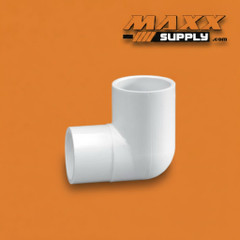


Elbow, 45 Degree Street, Spigot x Slip PVC Schedule 40 1-1/2" (423-015)
$1.59
This 1-1/2" Schedule 40 PVC 45 Degree Street Elbow provides a shallow angular directional change in a single all-cement fitting that combines a 1-1/2" spigot end with a 1-1/2" female slip socket — allowing the spigot end to insert directly into the female socket of an adjacent fitting while the slip socket outlet receives solvent-cemented PVC pipe at the 45° turn. Both connections are permanent, chemically fused solvent-cemented joints; no threaded interface is present at either end of the fitting.
Two parallel distinctions define where the 423-015 belongs in a system layout. The first is the street elbow configuration itself. A standard Slip × Slip 45° elbow (417-series) requires a section of PVC pipe on both sides — pipe enters one socket, the elbow changes direction at 45°, and pipe exits the other socket. The 423-015 street elbow's spigot end changes this on the inlet side: the spigot — a male plain end with an OD matching standard 1-1/2" PVC pipe — inserts directly into the female socket of any adjacent fitting without a pipe section between them. A tee branch socket, a coupling socket, a cross port, or any fitting presenting a female slip opening becomes the upstream connection point, and the 45° direction change begins at the face of that fitting. This direct fitting-to-fitting connection eliminates the short pipe stub between the upstream socket and the elbow that a standard two-socket elbow would require.
The second distinction is turn angle. The 423-015 produces a 45° half-right-angle turn rather than the 90° full right-angle turn of the 409-series Spigot × Slip 90° Street Elbow (previously written at 2"). Both are all-cement spigot × slip street elbows that allow direct fitting-to-fitting connection at the inlet; the routing geometry at the outlet is what differs. The 90° street elbow routes the pipe through a full right angle at the socket face — correct for sharp direction changes, horizontal-to-vertical transitions, and corner routing. The 45° street elbow routes the pipe through a shallower half-right-angle offset at the socket face — correct for diagonal routing, gradual directional transitions, compound-angle assemblies where two 45° street elbows create an offset that a 90° would not fit, and situations where a 90° turn at the socket face would create clearance conflicts with surrounding structure or equipment.
At 1-1/2", the 423-015 appears at a pipe size common across secondary distribution headers, equipment supply connections, pump suction piping, and primary branch supply lines in commercial and residential Schedule 40 systems. At these positions where a 1-1/2" run must simultaneously change direction at a shallower 45° angle and connect directly to an upstream fitting socket — in irrigation main assemblies, pool and spa equipment pad piping, commercial plumbing branch supply runs, and pump suction approach piping — the 423-015 provides the most compact single-fitting solution.
The compound-angle application is a particularly valuable use case for the 45° street elbow. When two 423-015 fittings are installed in series — the spigot of the second inserting into the slip socket of the first — the combined 90° direction change occurs with a lateral offset between the inlet centerline and the outlet centerline, unlike a standard 90° street elbow which changes direction without offset. This offset routing is useful wherever a pipe run must negotiate a 90° direction change while simultaneously shifting the outlet centerline laterally to clear a structural member, align with an equipment port, or match a specific connection point that a direct right-angle turn would not reach.
Manufactured in white Schedule 40 PVC, this fitting delivers reliable performance across residential, commercial, and light industrial piping applications. PVC's resistance to acids, bases, salts, chlorine, and common process fluids provides long service life where metal elbows would corrode or scale. NSF/ANSI 61 and NSF/ANSI 14 listings confirm suitability for potable water contact.
Rated to 280 psi at 73°F, this fitting handles standard pressure service across irrigation, commercial plumbing, pool and spa, water treatment, and light industrial applications at 1-1/2". For installation, the spigot end must be inserted and cemented into the receiving upstream socket before the downstream slip socket pipe joint is made — this sequence preserves rotational freedom to align the spigot and confirm the 45° outlet socket orientation before committing the joint. Clean and dry the spigot exterior and receiving socket interior before the upstream joint; apply purple PVC primer to both surfaces; apply a uniform coat of Schedule 40 PVC solvent cement to both the spigot exterior and socket interior and insert with a slight quarter-turn twist, holding firmly for 30 seconds. Before cementing the upstream joint, confirm the 45° outlet socket is correctly oriented toward the downstream pipe run in the correct spatial plane — this angular orientation is set permanently at the upstream joint. Then make the downstream slip socket pipe joint with the same primer-and-cement procedure. Allow full cure time per the cement manufacturer's temperature and humidity guidelines before pressurizing the system. Apply published pressure derating factors for service temperatures above 73°F.
Specifications:
| Attribute | Detail |
|---|---|
| Part Number | 423-015 |
| Fitting Type | 45 Degree Street Elbow |
| Connection Type | Spigot × Slip (Male Plain End × Female Socket) |
| Size | 1-1/2" |
| Schedule / Series | Schedule 40 |
| Material | PVC (Polyvinyl Chloride) |
| Color | White |
| Pressure Rating | 280 psi @ 73°F (verify vs. manufacturer data sheet) |
| ASTM Standard | D2466 |
| NSF/ANSI | NSF/ANSI 61 & NSF/ANSI 14 Listed |
| Temperature Range | Up to 140°F (derate pressure for elevated temps) |
| Turn Angle | 45° |
| Spigot End | Inserts into 1-1/2" female slip socket of adjacent fitting — no pipe section required |
| Assembly Method | All-cement — two solvent-cemented joints; primer required at both ends; no threaded interface |
| Solvent Cement | Standard Schedule 40 PVC cement; primer required at both ends |
| Installation Note | Cement spigot end into upstream socket first; confirm 45° outlet orientation in the correct spatial plane before committing joint |
Industries & Applications:
- Irrigation & Agriculture — Provides a compact 45° direction change at 1-1/2" slip socket positions on mainline tee branches, coupling sockets, distribution fitting ports, and submain transition points in commercial and agricultural irrigation systems where the pipe run must change direction at a shallower 45° angle directly at the slip socket face — eliminating the pipe stub between the upstream socket and a standard 45° two-socket elbow in irrigation mainline assemblies and pump station outlet routing where diagonal transitions must occur at the fitting body
- Pump Station & Equipment Routing — Inserts into a 1-1/2" slip socket at pump discharge connections, suction approach piping, and equipment outlet fittings to route the pipe at 45° directly at the socket face in compact pump station assemblies where the shallower 45° geometry provides clearance that a 90° turn at the same position would not — particularly valuable in approach piping to pump suction inlets where gradual angular transitions reduce turbulence and improve pump inlet conditions
- Pool, Spa & Aquaculture — Used at 1-1/2" slip socket positions on pump discharge adapter sockets, filter head ports, valve body sockets, and manifold fitting sockets in pool and spa equipment pad piping where the 45° street elbow provides diagonal routing at the socket face — particularly in equipment pad layouts where pipe runs must angle off from equipment connection sockets at 45° to clear adjacent equipment, pad boundaries, or structural elements within the confined equipment pad space
- Commercial Plumbing — Provides a compact 45° direction change at 1-1/2" slip socket positions on branch supply tee sockets, coupling connections, and distribution fitting outlets in commercial building water supply, mechanical room piping, and utility chase assemblies where diagonal routing at the socket face is required to navigate around structural members, existing services, or equipment footprints within constrained mechanical spaces
- Compound-Angle Offset Routing — Used in pairs to create a 90° direction change with lateral centerline offset in 1-1/2" Schedule 40 solvent-welded systems — the spigot of the second 423-015 inserts into the slip socket of the first, creating a compound offset turn that shifts the outlet centerline laterally while achieving the 90° routing change; this two-fitting compound configuration is used wherever the pipe must navigate a right-angle change while simultaneously offsetting to clear an obstruction or align with a specific connection point that a standard single 90° elbow cannot reach
- Water & Wastewater Treatment — Changes direction at a shallow 45° angle directly at 1-1/2" slip socket positions on distribution tee branches, process header coupling sockets, and equipment connection adapter ports in water treatment facility piping where diagonal routing at the socket face serves the layout geometry at the angular transition point
- HVAC & Mechanical Systems — Provides a compact 45° directional change at 1-1/2" slip socket positions in Schedule 40 PVC cooling tower makeup lines, treated water distribution branch sockets, and equipment connection assembly sockets in commercial mechanical system piping where the shallower 45° geometry at the socket face serves diagonal routing requirements that a 90° street elbow or standard 45° two-socket elbow would not accommodate within the available clearance
(No reviews yet)

Write a Review

Elbow, 45 Degree Street, Spigot x Slip PVC Schedule 40 1-1/2" (423-015)
This 1-1/2" Schedule 40 PVC 45 Degree Street Elbow provides a shallow angular directional change in a single all-cement fitting that combines a 1-1/2" spigot end with a 1-1/2" female slip socket — allowing the spigot end to insert directly into the female socket of an adjacent fitting while the slip socket outlet receives solvent-cemented PVC pipe at the 45° turn. Both connections are permanent, chemically fused solvent-cemented joints; no threaded interface is present at either end of the fitting.
Two parallel distinctions define where the 423-015 belongs in a system layout. The first is the street elbow configuration itself. A standard Slip × Slip 45° elbow (417-series) requires a section of PVC pipe on both sides — pipe enters one socket, the elbow changes direction at 45°, and pipe exits the other socket. The 423-015 street elbow's spigot end changes this on the inlet side: the spigot — a male plain end with an OD matching standard 1-1/2" PVC pipe — inserts directly into the female socket of any adjacent fitting without a pipe section between them. A tee branch socket, a coupling socket, a cross port, or any fitting presenting a female slip opening becomes the upstream connection point, and the 45° direction change begins at the face of that fitting. This direct fitting-to-fitting connection eliminates the short pipe stub between the upstream socket and the elbow that a standard two-socket elbow would require.
The second distinction is turn angle. The 423-015 produces a 45° half-right-angle turn rather than the 90° full right-angle turn of the 409-series Spigot × Slip 90° Street Elbow (previously written at 2"). Both are all-cement spigot × slip street elbows that allow direct fitting-to-fitting connection at the inlet; the routing geometry at the outlet is what differs. The 90° street elbow routes the pipe through a full right angle at the socket face — correct for sharp direction changes, horizontal-to-vertical transitions, and corner routing. The 45° street elbow routes the pipe through a shallower half-right-angle offset at the socket face — correct for diagonal routing, gradual directional transitions, compound-angle assemblies where two 45° street elbows create an offset that a 90° would not fit, and situations where a 90° turn at the socket face would create clearance conflicts with surrounding structure or equipment.
At 1-1/2", the 423-015 appears at a pipe size common across secondary distribution headers, equipment supply connections, pump suction piping, and primary branch supply lines in commercial and residential Schedule 40 systems. At these positions where a 1-1/2" run must simultaneously change direction at a shallower 45° angle and connect directly to an upstream fitting socket — in irrigation main assemblies, pool and spa equipment pad piping, commercial plumbing branch supply runs, and pump suction approach piping — the 423-015 provides the most compact single-fitting solution.
The compound-angle application is a particularly valuable use case for the 45° street elbow. When two 423-015 fittings are installed in series — the spigot of the second inserting into the slip socket of the first — the combined 90° direction change occurs with a lateral offset between the inlet centerline and the outlet centerline, unlike a standard 90° street elbow which changes direction without offset. This offset routing is useful wherever a pipe run must negotiate a 90° direction change while simultaneously shifting the outlet centerline laterally to clear a structural member, align with an equipment port, or match a specific connection point that a direct right-angle turn would not reach.
Manufactured in white Schedule 40 PVC, this fitting delivers reliable performance across residential, commercial, and light industrial piping applications. PVC's resistance to acids, bases, salts, chlorine, and common process fluids provides long service life where metal elbows would corrode or scale. NSF/ANSI 61 and NSF/ANSI 14 listings confirm suitability for potable water contact.
Rated to 280 psi at 73°F, this fitting handles standard pressure service across irrigation, commercial plumbing, pool and spa, water treatment, and light industrial applications at 1-1/2". For installation, the spigot end must be inserted and cemented into the receiving upstream socket before the downstream slip socket pipe joint is made — this sequence preserves rotational freedom to align the spigot and confirm the 45° outlet socket orientation before committing the joint. Clean and dry the spigot exterior and receiving socket interior before the upstream joint; apply purple PVC primer to both surfaces; apply a uniform coat of Schedule 40 PVC solvent cement to both the spigot exterior and socket interior and insert with a slight quarter-turn twist, holding firmly for 30 seconds. Before cementing the upstream joint, confirm the 45° outlet socket is correctly oriented toward the downstream pipe run in the correct spatial plane — this angular orientation is set permanently at the upstream joint. Then make the downstream slip socket pipe joint with the same primer-and-cement procedure. Allow full cure time per the cement manufacturer's temperature and humidity guidelines before pressurizing the system. Apply published pressure derating factors for service temperatures above 73°F.
Specifications:
| Attribute | Detail |
|---|---|
| Part Number | 423-015 |
| Fitting Type | 45 Degree Street Elbow |
| Connection Type | Spigot × Slip (Male Plain End × Female Socket) |
| Size | 1-1/2" |
| Schedule / Series | Schedule 40 |
| Material | PVC (Polyvinyl Chloride) |
| Color | White |
| Pressure Rating | 280 psi @ 73°F (verify vs. manufacturer data sheet) |
| ASTM Standard | D2466 |
| NSF/ANSI | NSF/ANSI 61 & NSF/ANSI 14 Listed |
| Temperature Range | Up to 140°F (derate pressure for elevated temps) |
| Turn Angle | 45° |
| Spigot End | Inserts into 1-1/2" female slip socket of adjacent fitting — no pipe section required |
| Assembly Method | All-cement — two solvent-cemented joints; primer required at both ends; no threaded interface |
| Solvent Cement | Standard Schedule 40 PVC cement; primer required at both ends |
| Installation Note | Cement spigot end into upstream socket first; confirm 45° outlet orientation in the correct spatial plane before committing joint |
Industries & Applications:
- Irrigation & Agriculture — Provides a compact 45° direction change at 1-1/2" slip socket positions on mainline tee branches, coupling sockets, distribution fitting ports, and submain transition points in commercial and agricultural irrigation systems where the pipe run must change direction at a shallower 45° angle directly at the slip socket face — eliminating the pipe stub between the upstream socket and a standard 45° two-socket elbow in irrigation mainline assemblies and pump station outlet routing where diagonal transitions must occur at the fitting body
- Pump Station & Equipment Routing — Inserts into a 1-1/2" slip socket at pump discharge connections, suction approach piping, and equipment outlet fittings to route the pipe at 45° directly at the socket face in compact pump station assemblies where the shallower 45° geometry provides clearance that a 90° turn at the same position would not — particularly valuable in approach piping to pump suction inlets where gradual angular transitions reduce turbulence and improve pump inlet conditions
- Pool, Spa & Aquaculture — Used at 1-1/2" slip socket positions on pump discharge adapter sockets, filter head ports, valve body sockets, and manifold fitting sockets in pool and spa equipment pad piping where the 45° street elbow provides diagonal routing at the socket face — particularly in equipment pad layouts where pipe runs must angle off from equipment connection sockets at 45° to clear adjacent equipment, pad boundaries, or structural elements within the confined equipment pad space
- Commercial Plumbing — Provides a compact 45° direction change at 1-1/2" slip socket positions on branch supply tee sockets, coupling connections, and distribution fitting outlets in commercial building water supply, mechanical room piping, and utility chase assemblies where diagonal routing at the socket face is required to navigate around structural members, existing services, or equipment footprints within constrained mechanical spaces
- Compound-Angle Offset Routing — Used in pairs to create a 90° direction change with lateral centerline offset in 1-1/2" Schedule 40 solvent-welded systems — the spigot of the second 423-015 inserts into the slip socket of the first, creating a compound offset turn that shifts the outlet centerline laterally while achieving the 90° routing change; this two-fitting compound configuration is used wherever the pipe must navigate a right-angle change while simultaneously offsetting to clear an obstruction or align with a specific connection point that a standard single 90° elbow cannot reach
- Water & Wastewater Treatment — Changes direction at a shallow 45° angle directly at 1-1/2" slip socket positions on distribution tee branches, process header coupling sockets, and equipment connection adapter ports in water treatment facility piping where diagonal routing at the socket face serves the layout geometry at the angular transition point
- HVAC & Mechanical Systems — Provides a compact 45° directional change at 1-1/2" slip socket positions in Schedule 40 PVC cooling tower makeup lines, treated water distribution branch sockets, and equipment connection assembly sockets in commercial mechanical system piping where the shallower 45° geometry at the socket face serves diagonal routing requirements that a 90° street elbow or standard 45° two-socket elbow would not accommodate within the available clearance
- Part #:
- 423-015
- Product Family:
- Sch 40 PVC
- Carton Qty:
- 25
- Pallet Qty:
- 2500
- Size:
- 1-1/2"