

Reducer Bushing, Spigot x Slip PVC Schedule 40 2" x 1" (437-249)
$1.34
This 2" × 1" Schedule 40 PVC Bushing provides the shallowest available all-solvent-cement size transition in the 437-series 2" inlet sub-run — a three-step reduction from a 2" slip socket position directly to a 1" PVC pipe run in a fully solvent-welded Schedule 40 system. The 2" spigot end inserts into any standard 2" female slip socket fitting or coupling for solvent cement joining on the upstream side, while the 1" slip socket on the outlet end accepts standard 1" PVC pipe for solvent cement joining on the downstream side. Both connections are permanent, chemically fused solvent-cemented joints — no threaded interface is introduced at either end of the fitting.
Within the 437-series 2" inlet sub-run, the 437-249 occupies the shallowest-reduction position — the closest to a same-size bushing of the three standard all-cement configurations at the 2" inlet. The 437-247 makes the deepest five-step reduction to a 1/2" outlet for chemical dosing and instrument supply cemented pipe runs. The 437-248 makes an intermediate four-step reduction to a 3/4" outlet for secondary supply runs, zone laterals, and equipment connection pipe runs. The 437-249 makes the minimal three-step reduction to a 1" outlet — the adjacent-hierarchy pipe size that is the most prevalent in commercial and residential Schedule 40 systems — serving the broadest downstream application population of the three. The three-entry selection guide for the 2" inlet sub-run is now complete: a 1" downstream pipe run requires the 437-249; a 3/4" downstream pipe run requires the 437-248; a 1/2" downstream pipe run requires the 437-247.
The 1" outlet is what gives the 437-249 the broadest downstream application reach in the 2" inlet sub-run. One-inch PVC pipe is among the most prevalent pipe sizes across the full range of residential and commercial Schedule 40 systems — appearing at primary headers, equipment supply connections, secondary distribution runs, branch supply mains, and lateral distribution lines throughout irrigation, pool and spa, commercial plumbing, water treatment, and light industrial layouts. Wherever a 2" slip socket position must supply a 1" cemented downstream run, the 437-249 bridges that three-step transition at the socket face in a single compact bushing body.
The three-step reduction also produces the smoothest hydraulic transition of the three 2" inlet sub-run entries. The smaller size differential between the 2" inlet and the 1" outlet — compared to the larger differentials of the 437-248 (2" to 3/4") and 437-247 (2" to 1/2") — minimizes the velocity change at the bushing body. This hydraulic advantage is relevant in pump station outlet piping, equipment supply branch connections, and flow-sensitive primary distribution transitions where smooth velocity profiles at inline size reduction points are a design consideration alongside the connection function.
Achieving the same 2"-to-1" all-cement transition without the 437-249 would require at minimum two intermediate reducing components — a 2"-to-1-1/2" reducer followed by a 1-1/2"-to-1-1/4" reducer and then a 1-1/4"-to-1" reducer, or some equivalent multi-step sequence. The 437-249 accomplishes the complete three-step all-cement transition at the 2" socket face in a single compact bushing body, reducing joint count and assembly length to the minimum at the size transition position.
The 437-249 should be distinguished from any 438-series equivalent at 2" × 1" (if stocked). The 437-249 produces a 1" slip socket outlet — the downstream connection is a cemented 1" PVC pipe run. If the downstream connection is a 1" male-threaded valve, pump port, strainer body, or threaded equipment component rather than a cemented pipe run, the 438-series equivalent with a 1" FPT outlet applies. The upstream spigot end is identical for both — the downstream connection type (cemented pipe vs. threaded component) is the sole selection criterion.
Manufactured in white Schedule 40 PVC, this bushing delivers reliable performance across commercial, light industrial, and residential large-bore-to-standard-supply transition applications. PVC's resistance to acids, bases, salts, chlorine, and common process fluids provides long service life where metal bushings would corrode or introduce contamination at the size transition point. NSF/ANSI 61 and NSF/ANSI 14 listings confirm suitability for potable water contact.
Rated to 280 psi at 73°F (governed by the 2" spigot end), this bushing handles standard pressure service across irrigation, commercial plumbing, pool and spa, water treatment, and light industrial applications. Two separate solvent-cemented joints must be made at installation — the spigot end into the receiving 2" socket, and the 1" downstream pipe into the bushing's outlet slip socket. For both joints, clean and dry all mating surfaces before application. Apply purple PVC primer to the spigot exterior and receiving socket interior for the upstream joint; apply primer to the 1" pipe end and the bushing's outlet socket interior for the downstream joint. At 2", use medium-body PVC solvent cement on the spigot end; standard-body cement is appropriate for the 1" outlet socket joint. Apply a uniform coat to both mating surfaces at each joint before inserting. Hold each joint with a slight quarter-turn twist for 30 seconds. Make the upstream spigot joint first to seat the bushing securely in the receiving 2" socket before making the downstream pipe joint at the 1" outlet. Allow full cure time per the cement manufacturer's temperature and humidity guidelines before pressurizing. Apply published pressure derating factors for service temperatures above 73°F.
Specifications:
| Attribute | Detail |
|---|---|
| Part Number | 437-249 |
| Fitting Type | Bushing |
| Connection Type | Spigot × Slip (Male Plain End × Female Socket) |
| Size | 2" × 1" (Inlet × Outlet) |
| Schedule / Series | Schedule 40 |
| Material | PVC (Polyvinyl Chloride) |
| Color | White |
| Pressure Rating | 280 psi @ 73°F (governed by 2" spigot end) (verify vs. manufacturer data sheet) |
| ASTM Standard | D2466 |
| NSF/ANSI | NSF/ANSI 61 & NSF/ANSI 14 Listed |
| Temperature Range | Up to 140°F (derate pressure for elevated temps) |
| End Configuration | Flush Style — spigot × slip socket |
| Upstream Connection | 2" Spigot — cements into 2" slip socket |
| Downstream Connection | 1" Slip Socket — accepts 1" PVC pipe for solvent cement |
| Assembly Method | All-cement — two solvent-cemented joints; primer required at both ends; no threaded interface |
| Reduction Steps | Three-step (2" to 1") — shallowest in the 2" inlet sub-run |
| Solvent Cement | Medium-body at 2" spigot end; standard-body at 1" outlet socket |
Industries & Applications:
- Large-Bore-to-Primary-Supply Transitions in Irrigation — The defining and highest-frequency application for the 2" × 1" all-cement bushing: reduces a 2" slip socket position on an irrigation mainline tee, cross, wye, or manifold fitting directly to a 1" solvent-welded primary supply or zone header run in residential, commercial, golf course, and agricultural irrigation systems — the most prevalent downstream pipe size at 2" mainline branch positions, making the 437-249 the highest-frequency SKU in the 437-series 2" inlet sub-run
- Commercial & Residential Irrigation Distribution — Transitions a 2" Schedule 40 PVC mainline socket position on a tee or cross to a 1" cemented zone header, primary lateral, or secondary distribution run in residential and commercial irrigation systems where the 2" primary mainline must supply 1" primary distribution runs through socket positions on tee branch outlets, cross ports, and manifold fittings
- Pool, Spa & Aquaculture — Transitions a 2" slip socket position on recirculation header tees, filter manifold fittings, and equipment distribution crosses to a 1" cemented pipe run in residential and commercial pool, spa, and aquatic facility installations where the primary 2" recirculation or distribution system must supply 1" primary equipment supply connections, secondary return lines, and primary distribution branches at socket positions
- Commercial Plumbing — Reduces a 2" slip socket port on a tee, cross, or manifold fitting to a 1" cemented primary branch supply run in commercial building water distribution and mechanical room systems where the primary 2" distribution main must supply 1" primary branch connections to major fixture supply zones, primary equipment feeds, and secondary distribution headers at socket branch positions
- Pump Station & Equipment Supply Transitions — Reduces a 2" slip socket position on pump station outlet tees, distribution manifold fittings, and header crosses to a 1" cemented primary supply run in residential and commercial pump station assemblies where the primary 2" pump outlet distribution system must supply 1" primary equipment supply or zone distribution branches through socket positions on the outlet manifold
- Water & Wastewater Treatment — Transitions a 2" slip socket position on process distribution tees, pump manifold fittings, and secondary distribution crosses to a 1" cemented primary branch run in light-duty municipal and industrial water treatment facilities where the primary 2" process distribution header must supply 1" primary branch connections at socket positions along the distribution layout
- Light Industrial Process Piping — Provides a three-step all-cement size transition from a 2" slip socket position on process distribution tees, coupling sockets, and manifold fitting branch sockets to a 1" cemented primary process supply run in light industrial Schedule 40 systems where the primary 2" process distribution header supplies 1" primary process branch runs within the fully solvent-welded layout
(No reviews yet)

Write a Review
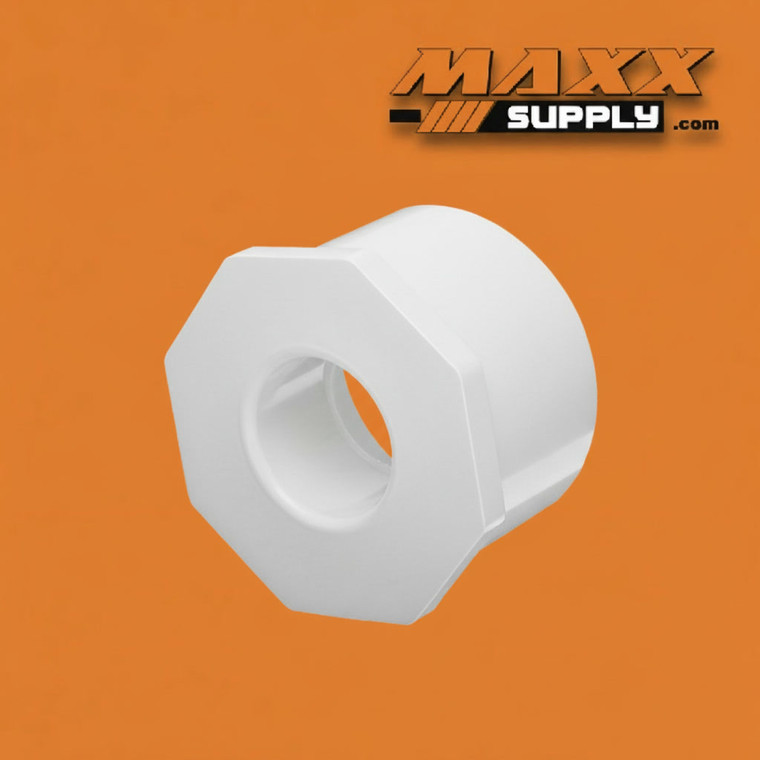
Reducer Bushing, Spigot x Slip PVC Schedule 40 2" x 1" (437-249)
This 2" × 1" Schedule 40 PVC Bushing provides the shallowest available all-solvent-cement size transition in the 437-series 2" inlet sub-run — a three-step reduction from a 2" slip socket position directly to a 1" PVC pipe run in a fully solvent-welded Schedule 40 system. The 2" spigot end inserts into any standard 2" female slip socket fitting or coupling for solvent cement joining on the upstream side, while the 1" slip socket on the outlet end accepts standard 1" PVC pipe for solvent cement joining on the downstream side. Both connections are permanent, chemically fused solvent-cemented joints — no threaded interface is introduced at either end of the fitting.
Within the 437-series 2" inlet sub-run, the 437-249 occupies the shallowest-reduction position — the closest to a same-size bushing of the three standard all-cement configurations at the 2" inlet. The 437-247 makes the deepest five-step reduction to a 1/2" outlet for chemical dosing and instrument supply cemented pipe runs. The 437-248 makes an intermediate four-step reduction to a 3/4" outlet for secondary supply runs, zone laterals, and equipment connection pipe runs. The 437-249 makes the minimal three-step reduction to a 1" outlet — the adjacent-hierarchy pipe size that is the most prevalent in commercial and residential Schedule 40 systems — serving the broadest downstream application population of the three. The three-entry selection guide for the 2" inlet sub-run is now complete: a 1" downstream pipe run requires the 437-249; a 3/4" downstream pipe run requires the 437-248; a 1/2" downstream pipe run requires the 437-247.
The 1" outlet is what gives the 437-249 the broadest downstream application reach in the 2" inlet sub-run. One-inch PVC pipe is among the most prevalent pipe sizes across the full range of residential and commercial Schedule 40 systems — appearing at primary headers, equipment supply connections, secondary distribution runs, branch supply mains, and lateral distribution lines throughout irrigation, pool and spa, commercial plumbing, water treatment, and light industrial layouts. Wherever a 2" slip socket position must supply a 1" cemented downstream run, the 437-249 bridges that three-step transition at the socket face in a single compact bushing body.
The three-step reduction also produces the smoothest hydraulic transition of the three 2" inlet sub-run entries. The smaller size differential between the 2" inlet and the 1" outlet — compared to the larger differentials of the 437-248 (2" to 3/4") and 437-247 (2" to 1/2") — minimizes the velocity change at the bushing body. This hydraulic advantage is relevant in pump station outlet piping, equipment supply branch connections, and flow-sensitive primary distribution transitions where smooth velocity profiles at inline size reduction points are a design consideration alongside the connection function.
Achieving the same 2"-to-1" all-cement transition without the 437-249 would require at minimum two intermediate reducing components — a 2"-to-1-1/2" reducer followed by a 1-1/2"-to-1-1/4" reducer and then a 1-1/4"-to-1" reducer, or some equivalent multi-step sequence. The 437-249 accomplishes the complete three-step all-cement transition at the 2" socket face in a single compact bushing body, reducing joint count and assembly length to the minimum at the size transition position.
The 437-249 should be distinguished from any 438-series equivalent at 2" × 1" (if stocked). The 437-249 produces a 1" slip socket outlet — the downstream connection is a cemented 1" PVC pipe run. If the downstream connection is a 1" male-threaded valve, pump port, strainer body, or threaded equipment component rather than a cemented pipe run, the 438-series equivalent with a 1" FPT outlet applies. The upstream spigot end is identical for both — the downstream connection type (cemented pipe vs. threaded component) is the sole selection criterion.
Manufactured in white Schedule 40 PVC, this bushing delivers reliable performance across commercial, light industrial, and residential large-bore-to-standard-supply transition applications. PVC's resistance to acids, bases, salts, chlorine, and common process fluids provides long service life where metal bushings would corrode or introduce contamination at the size transition point. NSF/ANSI 61 and NSF/ANSI 14 listings confirm suitability for potable water contact.
Rated to 280 psi at 73°F (governed by the 2" spigot end), this bushing handles standard pressure service across irrigation, commercial plumbing, pool and spa, water treatment, and light industrial applications. Two separate solvent-cemented joints must be made at installation — the spigot end into the receiving 2" socket, and the 1" downstream pipe into the bushing's outlet slip socket. For both joints, clean and dry all mating surfaces before application. Apply purple PVC primer to the spigot exterior and receiving socket interior for the upstream joint; apply primer to the 1" pipe end and the bushing's outlet socket interior for the downstream joint. At 2", use medium-body PVC solvent cement on the spigot end; standard-body cement is appropriate for the 1" outlet socket joint. Apply a uniform coat to both mating surfaces at each joint before inserting. Hold each joint with a slight quarter-turn twist for 30 seconds. Make the upstream spigot joint first to seat the bushing securely in the receiving 2" socket before making the downstream pipe joint at the 1" outlet. Allow full cure time per the cement manufacturer's temperature and humidity guidelines before pressurizing. Apply published pressure derating factors for service temperatures above 73°F.
Specifications:
| Attribute | Detail |
|---|---|
| Part Number | 437-249 |
| Fitting Type | Bushing |
| Connection Type | Spigot × Slip (Male Plain End × Female Socket) |
| Size | 2" × 1" (Inlet × Outlet) |
| Schedule / Series | Schedule 40 |
| Material | PVC (Polyvinyl Chloride) |
| Color | White |
| Pressure Rating | 280 psi @ 73°F (governed by 2" spigot end) (verify vs. manufacturer data sheet) |
| ASTM Standard | D2466 |
| NSF/ANSI | NSF/ANSI 61 & NSF/ANSI 14 Listed |
| Temperature Range | Up to 140°F (derate pressure for elevated temps) |
| End Configuration | Flush Style — spigot × slip socket |
| Upstream Connection | 2" Spigot — cements into 2" slip socket |
| Downstream Connection | 1" Slip Socket — accepts 1" PVC pipe for solvent cement |
| Assembly Method | All-cement — two solvent-cemented joints; primer required at both ends; no threaded interface |
| Reduction Steps | Three-step (2" to 1") — shallowest in the 2" inlet sub-run |
| Solvent Cement | Medium-body at 2" spigot end; standard-body at 1" outlet socket |
Industries & Applications:
- Large-Bore-to-Primary-Supply Transitions in Irrigation — The defining and highest-frequency application for the 2" × 1" all-cement bushing: reduces a 2" slip socket position on an irrigation mainline tee, cross, wye, or manifold fitting directly to a 1" solvent-welded primary supply or zone header run in residential, commercial, golf course, and agricultural irrigation systems — the most prevalent downstream pipe size at 2" mainline branch positions, making the 437-249 the highest-frequency SKU in the 437-series 2" inlet sub-run
- Commercial & Residential Irrigation Distribution — Transitions a 2" Schedule 40 PVC mainline socket position on a tee or cross to a 1" cemented zone header, primary lateral, or secondary distribution run in residential and commercial irrigation systems where the 2" primary mainline must supply 1" primary distribution runs through socket positions on tee branch outlets, cross ports, and manifold fittings
- Pool, Spa & Aquaculture — Transitions a 2" slip socket position on recirculation header tees, filter manifold fittings, and equipment distribution crosses to a 1" cemented pipe run in residential and commercial pool, spa, and aquatic facility installations where the primary 2" recirculation or distribution system must supply 1" primary equipment supply connections, secondary return lines, and primary distribution branches at socket positions
- Commercial Plumbing — Reduces a 2" slip socket port on a tee, cross, or manifold fitting to a 1" cemented primary branch supply run in commercial building water distribution and mechanical room systems where the primary 2" distribution main must supply 1" primary branch connections to major fixture supply zones, primary equipment feeds, and secondary distribution headers at socket branch positions
- Pump Station & Equipment Supply Transitions — Reduces a 2" slip socket position on pump station outlet tees, distribution manifold fittings, and header crosses to a 1" cemented primary supply run in residential and commercial pump station assemblies where the primary 2" pump outlet distribution system must supply 1" primary equipment supply or zone distribution branches through socket positions on the outlet manifold
- Water & Wastewater Treatment — Transitions a 2" slip socket position on process distribution tees, pump manifold fittings, and secondary distribution crosses to a 1" cemented primary branch run in light-duty municipal and industrial water treatment facilities where the primary 2" process distribution header must supply 1" primary branch connections at socket positions along the distribution layout
- Light Industrial Process Piping — Provides a three-step all-cement size transition from a 2" slip socket position on process distribution tees, coupling sockets, and manifold fitting branch sockets to a 1" cemented primary process supply run in light industrial Schedule 40 systems where the primary 2" process distribution header supplies 1" primary process branch runs within the fully solvent-welded layout
- Part #:
- 437-249
- Product Family:
- Sch 40 PVC
- Size:
- 2"