

Reducing Coupling, Slip PVC Schedule 80 4" x 1" (829-417)
$49.06
The 4" x 1" PVC Schedule 80 Reducing Coupling (Slip x Slip) is a heavy-duty thermoplastic inline reducer designed to transition between two different pipe sizes in a straight run — joining 4-inch Schedule 80 PVC pipe on the large-end socket to 1-inch Schedule 80 PVC pipe on the small-end socket, both via permanent solvent cement installation. The result is a compact, full-bore size transition accomplished mid-run without elbows, offsets, or additional fittings introduced into the assembly.
The reducing coupling is a fundamentally different fitting from the spigot bushing described elsewhere in this catalog, and the distinction matters at the point of specification. A spigot bushing inserts into the socket of an existing fitting — it performs the size reduction at a fitting connection point, consuming no additional linear space in the run. A reducing coupling stands alone between two pipe sections, occupying its own position in the run between a 4-inch pipe section on one side and a 1-inch pipe section on the other. The reducing coupling is specified when the size transition must occur in open pipe — between two pipe sections rather than at a fitting socket — or when no existing fitting socket is available to receive a spigot bushing at the required transition point.
The 4" to 1" size differential is among the most pronounced available in the Schedule 80 PVC reducing coupling line — a three-nominal-size step-down that reduces the cross-sectional flow area by roughly 94% through the transition. This degree of reduction is not a general-purpose mid-run pipe size change. It is characteristic of systems where a large-diameter process or distribution header must feed a very small downstream function at a specific point along the run: a chemical injection circuit, an instrumentation supply line, a sample port connection, a drain outlet, or a small-bore secondary process feed that operates at a flow volume far below the capacity of the primary 4-inch system. The reducing coupling places that transition wherever it is needed in the open run, independent of fitting socket locations in the assembly.
At the 4" to 1" differential, the hydraulic implications at the transition point are significant. Flow velocity increases dramatically through the small end — a consideration that must be accounted for in the downstream hydraulic design, particularly in pressure-sensitive process applications or systems where the 1-inch downstream fitting assembly is sized for a specific flow rate and pressure profile. In gravity or low-pressure applications, the small-end outlet functions as a controlled restriction point, limiting flow from the 4-inch main to the downstream 1-inch circuit at whatever rate the system pressure and downstream resistance permit.
All slip socket connections are sized for Schedule 80 PVC pipe at their respective ends and designed for solvent cement installation per ASTM D2564 procedures. Schedule 80 PVC provides the elevated wall thickness, higher pressure rating, and chemical resistance required for the industrial service environments where a 4" x 1" reducing coupling is most commonly specified. Manufactured to ASTM D2467 standards and compatible with Schedule 80 PVC pipe in both 4-inch and 1-inch sizes.
Specifications:
| Attribute | Detail |
|---|---|
| Part Number | 829-417 |
| Material | PVC (Polyvinyl Chloride) |
| Schedule | Schedule 80 |
| Large End Size | 4 Inch |
| Small End Size | 1 Inch |
| End Connections | Slip x Slip (Socket Both Ends) |
| Fitting Type | Reducing Coupling |
| Standard | ASTM D2467 |
| Color | Dark Gray |
| Max Pressure (Water @ 73°F) | 150 PSI (verify with manufacturer for this size differential) |
| Temperature Range | Up to 140°F (60°C) |
| Compatible Pipe | Schedule 80 PVC Pipe (4" large end; 1" small end) |
| Joint Method | Solvent Cement Weld (ASTM D2564, both ends) |
Industries & Applications:
- Chemical Injection & Dosing Systems — The most characteristic open-run application for this size differential; used in chemical process headers where the size transition from a 4-inch main to a 1-inch downstream injection circuit must occur mid-run rather than at a fitting socket — placing the reduction at the precise point in the run where the injection circuit departs, with no available fitting socket to receive a spigot bushing
- Process Instrumentation & Sampling Lines — Specified in 4-inch Schedule 80 process mains where the transition to a 1-inch instrumentation supply, sample port connection, or sensor feed line must occur at a designated mid-run point — the reducing coupling providing a standalone transition fitting that can be positioned anywhere along the open run independent of the surrounding fitting layout
- Water & Wastewater Treatment — Applied in treatment plant process piping where a 4-inch Schedule 80 distribution header must transition to a 1-inch downstream supply line at a mid-run point serving a chemical dosing circuit, monitoring instrument, pH probe supply, or individual treatment equipment connection requiring a very small flow volume relative to the primary header capacity
- Industrial Process Piping — Incorporated in process plant pipe racks and distribution assemblies where a 4-inch main must feed a 1-inch secondary process circuit at a designed mid-run transition point — the reducing coupling providing the size step-down in open pipe where the system layout does not allow the use of a spigot bushing in an existing fitting socket at the required transition location
- Pump & Equipment Bypass Connections — Used in pump system assemblies where a small-bore bypass, recirculation, or pressure relief circuit departs from a 4-inch discharge or suction line at a mid-run point — the reducing coupling providing the transition from the 4-inch main to the 1-inch bypass circuit in open pipe, with the precise transition point determined by system pressure, flow, and bypass circuit design requirements
- Irrigation & Agricultural Chemical Systems — Specified in 4-inch Schedule 80 irrigation mains or chemical distribution headers where a 1-inch downstream chemical injection line, fertilizer circuit, or small-zone supply must branch off the main at a mid-run transition point — the reducing coupling enabling the size transition at any point along the open run where a tee or bushing-compatible fitting socket is not positioned in the existing assembly layout
(No reviews yet)

Write a Review
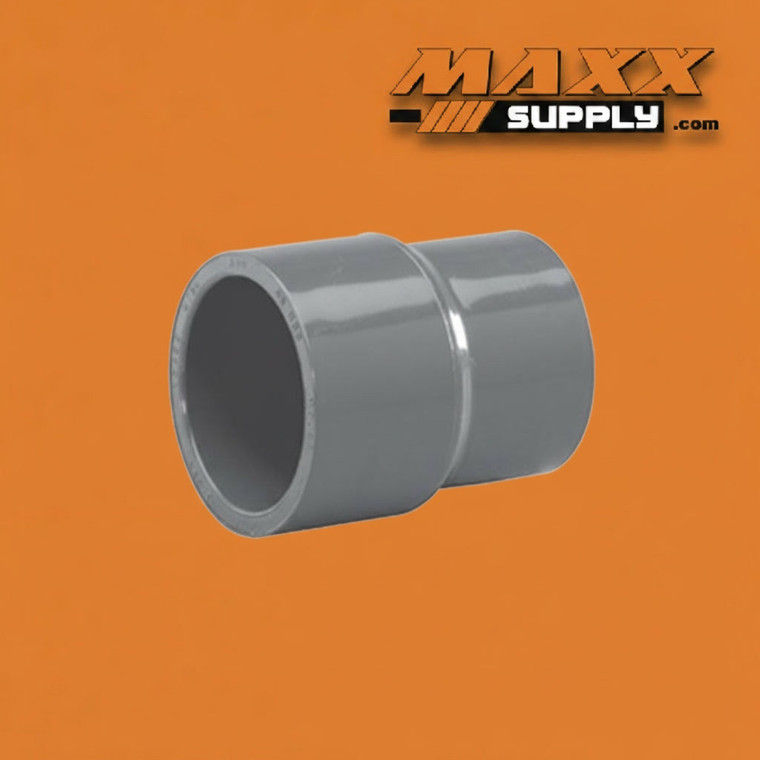
Reducing Coupling, Slip PVC Schedule 80 4" x 1" (829-417)
The 4" x 1" PVC Schedule 80 Reducing Coupling (Slip x Slip) is a heavy-duty thermoplastic inline reducer designed to transition between two different pipe sizes in a straight run — joining 4-inch Schedule 80 PVC pipe on the large-end socket to 1-inch Schedule 80 PVC pipe on the small-end socket, both via permanent solvent cement installation. The result is a compact, full-bore size transition accomplished mid-run without elbows, offsets, or additional fittings introduced into the assembly.
The reducing coupling is a fundamentally different fitting from the spigot bushing described elsewhere in this catalog, and the distinction matters at the point of specification. A spigot bushing inserts into the socket of an existing fitting — it performs the size reduction at a fitting connection point, consuming no additional linear space in the run. A reducing coupling stands alone between two pipe sections, occupying its own position in the run between a 4-inch pipe section on one side and a 1-inch pipe section on the other. The reducing coupling is specified when the size transition must occur in open pipe — between two pipe sections rather than at a fitting socket — or when no existing fitting socket is available to receive a spigot bushing at the required transition point.
The 4" to 1" size differential is among the most pronounced available in the Schedule 80 PVC reducing coupling line — a three-nominal-size step-down that reduces the cross-sectional flow area by roughly 94% through the transition. This degree of reduction is not a general-purpose mid-run pipe size change. It is characteristic of systems where a large-diameter process or distribution header must feed a very small downstream function at a specific point along the run: a chemical injection circuit, an instrumentation supply line, a sample port connection, a drain outlet, or a small-bore secondary process feed that operates at a flow volume far below the capacity of the primary 4-inch system. The reducing coupling places that transition wherever it is needed in the open run, independent of fitting socket locations in the assembly.
At the 4" to 1" differential, the hydraulic implications at the transition point are significant. Flow velocity increases dramatically through the small end — a consideration that must be accounted for in the downstream hydraulic design, particularly in pressure-sensitive process applications or systems where the 1-inch downstream fitting assembly is sized for a specific flow rate and pressure profile. In gravity or low-pressure applications, the small-end outlet functions as a controlled restriction point, limiting flow from the 4-inch main to the downstream 1-inch circuit at whatever rate the system pressure and downstream resistance permit.
All slip socket connections are sized for Schedule 80 PVC pipe at their respective ends and designed for solvent cement installation per ASTM D2564 procedures. Schedule 80 PVC provides the elevated wall thickness, higher pressure rating, and chemical resistance required for the industrial service environments where a 4" x 1" reducing coupling is most commonly specified. Manufactured to ASTM D2467 standards and compatible with Schedule 80 PVC pipe in both 4-inch and 1-inch sizes.
Specifications:
| Attribute | Detail |
|---|---|
| Part Number | 829-417 |
| Material | PVC (Polyvinyl Chloride) |
| Schedule | Schedule 80 |
| Large End Size | 4 Inch |
| Small End Size | 1 Inch |
| End Connections | Slip x Slip (Socket Both Ends) |
| Fitting Type | Reducing Coupling |
| Standard | ASTM D2467 |
| Color | Dark Gray |
| Max Pressure (Water @ 73°F) | 150 PSI (verify with manufacturer for this size differential) |
| Temperature Range | Up to 140°F (60°C) |
| Compatible Pipe | Schedule 80 PVC Pipe (4" large end; 1" small end) |
| Joint Method | Solvent Cement Weld (ASTM D2564, both ends) |
Industries & Applications:
- Chemical Injection & Dosing Systems — The most characteristic open-run application for this size differential; used in chemical process headers where the size transition from a 4-inch main to a 1-inch downstream injection circuit must occur mid-run rather than at a fitting socket — placing the reduction at the precise point in the run where the injection circuit departs, with no available fitting socket to receive a spigot bushing
- Process Instrumentation & Sampling Lines — Specified in 4-inch Schedule 80 process mains where the transition to a 1-inch instrumentation supply, sample port connection, or sensor feed line must occur at a designated mid-run point — the reducing coupling providing a standalone transition fitting that can be positioned anywhere along the open run independent of the surrounding fitting layout
- Water & Wastewater Treatment — Applied in treatment plant process piping where a 4-inch Schedule 80 distribution header must transition to a 1-inch downstream supply line at a mid-run point serving a chemical dosing circuit, monitoring instrument, pH probe supply, or individual treatment equipment connection requiring a very small flow volume relative to the primary header capacity
- Industrial Process Piping — Incorporated in process plant pipe racks and distribution assemblies where a 4-inch main must feed a 1-inch secondary process circuit at a designed mid-run transition point — the reducing coupling providing the size step-down in open pipe where the system layout does not allow the use of a spigot bushing in an existing fitting socket at the required transition location
- Pump & Equipment Bypass Connections — Used in pump system assemblies where a small-bore bypass, recirculation, or pressure relief circuit departs from a 4-inch discharge or suction line at a mid-run point — the reducing coupling providing the transition from the 4-inch main to the 1-inch bypass circuit in open pipe, with the precise transition point determined by system pressure, flow, and bypass circuit design requirements
- Irrigation & Agricultural Chemical Systems — Specified in 4-inch Schedule 80 irrigation mains or chemical distribution headers where a 1-inch downstream chemical injection line, fertilizer circuit, or small-zone supply must branch off the main at a mid-run transition point — the reducing coupling enabling the size transition at any point along the open run where a tee or bushing-compatible fitting socket is not positioned in the existing assembly layout
- Part #:
- 829-417
- Product Family:
- Sch 80 PVC
- Carton Qty:
- 6
- Pallet Qty:
- 384
- Size:
- 4"