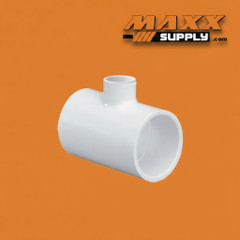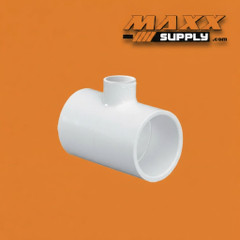


Tee, Slip x Slip x Slip PVC Schedule 40 10" (401-100)
$607.11
The 10" Schedule 40 White PVC Equal Tee (401-100, Slip x Slip x Slip) is a large-diameter thermoplastic equal three-way junction fitting manufactured to ASTM D2466 in Schedule 40 white PVC — in which all three socket connections are 10" IPS, providing a single-body Schedule 40 PVC solution for equal three-way junctions, equal flow divisions, equal flow merges, and full-diameter perpendicular lateral branch connections on 10" Schedule 40 PVC primary transmission and distribution systems without reducing any port diameter, without branching to a smaller-scale distribution or service system, without field-fabricated saddle taps or custom junction assemblies, and without leaving the Schedule 40 white PVC construction standard at the primary main's most hydraulically consequential junction location. The 401-100 is the anchor tee fitting of the 10" Schedule 40 PVC socket fitting ecosystem — the fitting that appears at every equal three-way junction on every 10" Schedule 40 PVC primary main installation, that completes the primary main BOM alongside the 10" Schedule 40 PVC 90-degree elbow, the 10" Schedule 40 PVC 45-degree elbow, the 10" Schedule 40 PVC street elbow (409-100), 10" Schedule 40 pipe, and 10" Schedule 40 couplings and caps, and that is purchased in quantities determined by the number of equal three-way junctions, equal flow division points, equal flow merge locations, and full-diameter lateral branch takeoff points in each primary main routing and distribution layout. As the most broadly specified equal tee in the Schedule 40 PVC socket equal tee line — a consequence of 10" IPS being the most commercially prevalent large-diameter primary pipe size across the complete range of commercial and industrial primary main applications in the Schedule 40 PVC socket fitting market — the 401-100 appears on more 10" Schedule 40 PVC primary main BOMs, more large commercial irrigation system primary main layouts, more pump station primary header assemblies, and more municipal water distribution primary main projects than any other equal tee in the Spears 401 series Schedule 40 PVC socket fitting line.
The 401-100 serves three distinct hydraulic roles that together define its complete application profile across every industry and system type where 10" Schedule 40 PVC primary main construction is the standard: equal flow division, equal flow merge, and full-diameter perpendicular lateral branch with straight-run continuation. In the equal flow division role, the 401-100 functions as an equal primary main split fitting — a single-body fitting for dividing the upstream 10" primary main flow equally between a continuing 10" run and a 10" perpendicular branch in a symmetric or hydraulically designed flow proportion, accomplished at the 90-degree perpendicular branch geometry of the equal tee configuration rather than the 45-degree angular branch of the Schedule 40 PVC equal wye at the same service size where one is available. This equal flow division role is most common at pump station primary discharge header splits where the station's combined 10" output must be divided between two parallel 10" primary transmission paths, at municipal water distribution primary main splits serving parallel pressure zones or distribution sectors of equal coincident demand, at large commercial irrigation primary main splits serving parallel sector transmission systems of equal flow capacity, and at industrial process primary header splits distributing equal flow fractions to parallel process sections. In the equal flow merge role, the 401-100 functions as a two-source flow combiner — accepting flow from two 10" upstream runs and combining them into a single 10" downstream run at a junction where the perpendicular confluence of the tee branch and the continuing run produces the combined downstream flow in the primary transmission or distribution main; this flow merge role is most common at well field primary collection headers where multiple well field pump outputs are combined at collection junctions, at pump station primary suction headers where parallel pump unit suction laterals combine before the primary suction manifold, and at irrigation primary main collection configurations where parallel sector flows combine at the primary main junction. In the full-diameter perpendicular lateral branch role, the 401-100 functions as the equal-branch configuration of the Spears 401 series reducing tee line — providing a full-diameter 10" perpendicular lateral branch at 90 degrees to the primary 10" run axis at a junction where the branch carries the full primary run flow fraction under equal flow division conditions and where the 10" branch pipe system is a primary distribution or transmission main in its own right rather than a service lateral or zone supply header.
The 401-100's position as the anchor tee fitting of the 10" Schedule 40 PVC socket fitting ecosystem establishes its specification relationship with the complete Spears 401 series reducing tee line at the 10" run — and at the top of that series, its relationship with the 401-628, the most important reducing tee comparison in the 10" run Schedule 40 all-socket series. The 401-100 at 100% is the upper bound against which every reducing tee in the 10" run Schedule 40 all-socket series is positioned by branch-to-run ratio. The 401-628 (10" x 10" x 8") at 80% is the most near-equal reducing tee in the standard Schedule 40 PVC socket fitting line at the 10" run — the one step below the 401-100 in the 10" run series, separated from the 401-100 by the single step-down from 10" branch to 8" branch that represents the smallest branch-to-run differential between an equal tee and a reducing tee in the standard Schedule 40 socket fitting series. The specification selection between the 401-100 and the 401-628 is the most consequential fitting type decision in the 10" run Schedule 40 all-socket tee series and the primary related product comparison on both product pages: the 401-100 is correct where all three downstream systems are 10" IPS and the junction is a full-diameter equal three-way connection with symmetric or near-symmetric flow division between all three 10" ports; the 401-628 is correct where the hydraulic design has established a two-path flow division between a continuing 10" primary run and an 8" near-equal distribution branch at the 80% ratio determined by the downstream demand distribution. Buyers who are deciding between the 401-100 and the 401-628 at a 10" primary main junction point are making the most fundamental branch pipe size selection in the 10" run Schedule 40 all-socket tee series — a decision that determines whether the downstream branch system is 10" IPS equal or 8" IPS near-equal and whose consequences propagate through the entire downstream primary distribution system on the branch side of the junction.
The 401-100's equal three-port geometry at the 10" service size establishes the hydraulic accounting requirements that are most demanding within the Spears 401 series at the 10" run. At the 100% equal branch-to-run ratio — the maximum possible within the 401 series — the branch carries the full primary run flow fraction under equal flow division conditions, and the full primary run flow must pass through the tee junction body and distribute between the continuing 10" run and the 10" perpendicular branch in a proportion determined by the relative hydraulic resistance of the two downstream primary paths. The junction's effect on the primary main's flow, velocity, and pressure profile is at its maximum in the 401 series at the 10" run at this equal configuration — the tee junction pressure loss under equal flow division conditions is greater than at any reducing tee configuration in the 10" run series because both downstream ports carry substantial flow fractions simultaneously, and the hydraulic analysis of the primary system at the 401-100 junction must account for the pressure loss through the fitting body under the specific flow division proportion established by the downstream demand distribution. Full explicit hydraulic accounting of all three connected primary systems is mandatory at every 401-100 installation — the continuing 10" run's flow fraction, the perpendicular 10" branch's flow fraction, and the upstream 10" primary main's total supply must all be established by the hydraulic design before the 401-100's installation location and port orientation are finalized in the primary system design. Unlike the minimal lateral configurations in the reducing tee series where the primary trunk's hydraulic dominance allows simplified hydraulic treatment of the branch junction, the 401-100's equal three-port geometry places all three connected systems in full hydraulic parity — no port is dominant, all three carry primary infrastructure flow fractions, and the junction's hydraulic behavior must be modeled explicitly in the primary system design.
The specification comparison between the 401-100 and the 10" Schedule 40 PVC equal wye — where one is available in the Schedule 40 PVC socket fitting line at the 10" service size — reflects the same wye-vs-tee hydraulic framework established across the 875 series Schedule 80 PVC wye documentation in this catalog. At the equal three-port configuration, the wye geometry's pressure loss, turbulence, and structural loading advantages over the perpendicular tee geometry are at their maximum — the same scaling relationship established at the 875-080 (8" Schedule 80 equal wye) applies at the 10" Schedule 40 service level where a Schedule 40 equal wye is available. The 401-100 equal tee is correct where the perpendicular branch geometry is required by the system's layout, where the 90-degree branch orientation serves the physical routing requirements of the 10" primary branch pipe's departure direction from the primary main's axis, where the hydraulic loss difference between the perpendicular tee and the 45-degree wye at the equal flow fraction is acceptable within the primary system's pressure budget, and where the tee geometry's lower fitting cost relative to the equal wye is appropriate for the system's design parameters. The Schedule 40 equal wye at 10" — where available — is correct where lower branch entry pressure loss, reduced turbulence at the equal three-way junction, and the minimum fitting body lateral loading at the full equal flow fraction are the governing specification criteria. At the 10" primary main service scale in large commercial and municipal systems where the equal junction's hydraulic performance directly affects the primary distribution system's available pressure at the most remote service point, the wye-vs-tee specification comparison at the equal configuration is a formal hydraulic design parameter decision that the project engineer must resolve with the same rigor applied to every other junction fitting specification in the primary system design.
The schedule selection at the 401-100 — choosing Schedule 40 over the Schedule 80 counterpart at the 10" equal tee configuration — follows the engineering framework established across all 10" Schedule 40 specialty fitting pages in the catalog and carries its own consequence at the equal tee as the fitting where the combined hydraulic and structural loading at the junction is at the maximum within the 10" run Schedule 40 all-socket tee series. At the 100% equal configuration, all three 10" socket connections simultaneously carry the primary main's full operating pressure, the junction body is subject to the combined hydrodynamic loading of the equal three-way flow division or merge under all operating conditions, and the schedule selection must be confirmed against the system's design operating pressure, surge allowance, and engineering safety margin requirements at the 10" equal tee junction's maximum loading conditions. Schedule 40 is the correct and cost-effective specification where the system's operating pressure, surge, and safety margin requirements fall within the Schedule 40 pressure ceiling at the 10" fitting size, where the system specification does not mandate Schedule 80 gray PVC throughout, and where the design engineer has confirmed that Schedule 40 wall thickness and white material class identification satisfy all engineering requirements at the primary main equal junction location. Where the system requires Schedule 80 wall thickness, gray material class identification, or the higher pressure ceiling that Schedule 80 provides at large-diameter equal three-way junction fittings, the Schedule 80 counterpart at the 10" equal tee configuration is the correct specification — at pump station primary headers, well field primary mains at high shut-off head conditions, and large commercial irrigation systems where primary main operating pressures approach or exceed the Schedule 40 pressure ceiling at the 10" fitting size, the schedule selection at the 401-100 must be confirmed with explicit attention to the equal junction's maximum loading conditions before the Schedule 40 material class is finalized.
Schedule 40 white PVC construction provides the chemical resistance, NSF certification, and structural capability appropriate for large-diameter primary main equal junction service within the Schedule 40 pressure and wall thickness envelope. PVC Type 1 Grade 1 construction with cell classification 12454 per ASTM D1784 delivers broad chemical resistance across water treatment chemicals, process water service, industrial utility water, and the full range of non-solvent process fluids appropriate for Schedule 40 PVC primary main service at all three socket connections. The white color provides the permanent, inspectable Schedule 40 material class identification at the primary main equal junction — confirming the installed material class for inspectors, maintenance engineers, and facility managers at the most hydraulically central fitting location in the 10" primary main system and distinguishing the installed fitting from gray Schedule 80 components elsewhere in the system. All three socket connections solvent cement directly onto standard 10" IPS Schedule 40 or Schedule 80 PVC pipe using heavy-body solvent cement appropriate for the large bonding surface areas of the 10" socket connections. At the 401-100, all three socket connections are equal 10" large-diameter bonding surfaces — there is no smaller branch socket with different assembly characteristics, no size asymmetry to provide visual or tactile distinction between the branch port and the run ports during assembly, and no size differential to indicate the fitting's orientation in the primary main layout during cement application. The pre-assembly discipline required at the 401-100 is accordingly the most demanding of any fitting in the 10" run Schedule 40 all-socket tee series: all three pipe ends must be fully accessible and positioned in their correct alignment before any cement application begins, the branch port's 90-degree orientation relative to the run axis must be confirmed against the piping layout drawing by dry-fit before any cement is applied — because the fitting's port orientation commits all three connected primary pipe runs simultaneously once cement application begins and cannot be adjusted without full joint destruction and 10" pipe re-cutting at all three socket connections — working time management across three equal large-diameter 10" bonding surfaces is critical and requires adequate working hands and staged cement application sequencing, complete circumferential heavy-body cement coverage must be achieved at all three 10" sockets within the available working time, and full cure time compliance before any system pressurization is non-negotiable at this equal three-port primary main junction where all three large-diameter socket joints carry the full primary main operating pressure simultaneously. The branch port orientation — its 90-degree perpendicular exit direction relative to the primary run axis — determines the downstream branch pipe's routing direction and must be confirmed against the complete primary main layout, including clearances for the branch pipe's continuing route, valve assembly positioning, and thrust block or mechanical restraint requirements at the branch direction change, before the first cement application begins at any of the three 10" sockets on the 401-100 body. Deburr and bevel all three pipe ends before cementing to ensure consistent insertion depths and complete circumferential bond lines at every socket joint.
NSF 61 certification lists this fitting for potable water contact, and NSF 14 covers compliance with applicable plastics piping material standards — making it the correct primary main equal junction fitting for municipal water treatment and distribution systems designed to Schedule 40 specifications, large potable water pump station primary headers, and large commercial and institutional water supply primary mains where NSF-listed materials are required at every fitting in the primary distribution system including equal junction fittings at the primary main's most hydraulically central junction locations. ASTM D2466 governs Schedule 40 PVC socket fittings and defines the manufacturing, dimensional, and pressure performance requirements the 401-100 is produced to. Verify manufacturer pressure rating documentation for the specific fitting configuration before final system specification — at the 10" equal tee configuration where all three sockets carry the full primary main operating pressure simultaneously, the governing pressure rating is determined by the 10" port size and the fitting's tested performance at this large-diameter equal three-port junction geometry under full-flow equal division and merge conditions, and must be confirmed against the manufacturer's published pressure-temperature rating table for SKU 401-100 before installation in systems at or near the fitting's rated pressure ceiling.
Key Features:
- Schedule 40 white PVC equal tee — 10" x 10" x 10", all socket (slip) ends; Spears 401 series Schedule 40 PVC socket fittings
- Anchor tee fitting of the 10" Schedule 40 PVC socket fitting ecosystem — the most broadly specified equal tee in the Schedule 40 PVC socket equal tee line; 10" IPS is the most commercially prevalent large-diameter primary pipe size across commercial irrigation, pump station, industrial process, and municipal distribution primary main markets
- Equal three-port geometry — all three sockets 10" IPS; 100% branch-to-run ratio; most hydraulically and structurally demanding configuration in the 10" run Spears 401 series all-socket tee line
- Serves equal flow division, equal flow merge, and full-diameter perpendicular lateral branch with straight-run continuation — all three equal three-way junction hydraulic functions in a single Schedule 40 PVC body
- Full explicit hydraulic accounting of all three connected 10" primary systems mandatory — all three ports carry primary infrastructure flow fractions; no hydraulically dominant port; junction pressure loss under equal flow division conditions must be included in primary system hydraulic analysis
- Anchor tee and anchor direction change fitting together: 401-100 (equal tee) and 10" Schedule 40 90-degree elbow are the two most fundamental junction and routing fittings in the 10" Schedule 40 PVC socket fitting ecosystem — both specified together in every complete 10" Schedule 40 PVC primary main BOM
- Most important related product comparison — 401-628 (10" x 10" x 8" reducing tee at 80%): 401-100 where all three downstream systems are 10" IPS at equal junction; 401-628 where downstream branch is 8" IPS at 80% near-equal ratio; this is the most consequential branch size selection in the 10" run Schedule 40 all-socket tee series
- All three socket connections are equal large-diameter 10" joints — no branch socket exception; full heavy-body cement, pre-planned sequencing, working time management across three equal bonding surfaces, branch port orientation confirmation by dry-fit before any cement is applied, and full cure time compliance all mandatory
- Branch port orientation is fixed at cement application — all three 10" primary pipe run routing directions must be confirmed against the piping layout before cement is applied; orientation of all three connected pipe runs committed simultaneously
- Schedule 40 vs. Schedule 80 selection: Schedule 40 correct where system operating pressure, surge, and safety margin requirements fall within Schedule 40 pressure ceiling — verify against Schedule 80 counterpart at equal junction's maximum loading conditions before final specification
- Manufactured to ASTM D2466 — governing standard for Schedule 40 PVC socket fittings
- NSF 61 certified for potable water contact; NSF 14 listed
- Solvent cement socket connections compatible with Schedule 40 and Schedule 80 IPS 10" pipe at all three ports
- White color — standard Schedule 40 material class identification at the primary main equal junction
- Cell classification PVC 12454 per ASTM D1784
- Heavy-body solvent cement required at all three equal 10" socket connections; full cure time compliance mandatory before pressurization
- Pressure rating: verify against manufacturer pressure-temperature table for SKU 401-100
Specifications:
| Attribute | Value |
|---|---|
| SKU | 401-100 |
| Fitting Type | Equal Tee |
| Series | Spears 401 Schedule 40 PVC Socket Fittings |
| Nominal Size | 10" x 10" x 10" |
| Branch-to-Run Ratio | 100% (Equal) |
| Branch Angle | 90 Degrees to Run Axis |
| End Connections | Slip x Slip x Slip (All Socket) |
| Connection Method | Solvent Cement (IPS) |
| Compatible Pipe — All Three Ports | 10" IPS Schedule 40 or Schedule 80 PVC |
| Schedule | Schedule 40 |
| Material | PVC (Polyvinyl Chloride) Type 1, Grade 1 |
| Cell Classification | 12454 per ASTM D1784 |
| Color | White |
| Manufacturing Standard | ASTM D2466 |
| Potable Water Certification | NSF/ANSI 61 |
| Plastics Standard Certification | NSF 14 |
| Max Service Temperature | 140°F (60°C) |
| Pressure Rating | Verify with manufacturer pressure-temperature rating table for SKU 401-100 |
Industries & Applications:
- Municipal Water Distribution — Primary Transmission Main Equal Three-Way Splits, Full-Diameter Zone Supply Branches, and Primary Main Merge Junctions — The 10" Schedule 40 PVC equal tee is the anchor tee fitting of every 10" Schedule 40 PVC primary main installation in the municipal water distribution market — specified at every equal three-way junction on 10" municipal water transmission and primary distribution mains in Schedule 40 PVC systems where the hydraulic design has established an equal or near-equal three-way junction with all three connected systems at the full 10" IPS primary main pipe size; primary transmission main equal splits where the 10" transmission main must divide between a continuing 10" primary distribution run and a 10" perpendicular lateral branch serving a parallel pressure zone or distribution sector of equal coincident demand — the 401-100 providing the single-body Schedule 40 all-socket equal tee at the split junction where the flow division proportion between the two downstream 10" primary paths is determined by the downstream demand distribution in the hydraulic model; primary transmission main full-diameter perpendicular zone supply branches where the most demanding single zone supply connection is sized at the full 10" primary main diameter — the 401-100 serving as the primary main junction fitting at the full-diameter zone supply branch point where the branch carries the full 10" primary supply demand for the downstream zone and the continuing primary run serves the remaining primary distribution system; primary distribution main merge junctions where two parallel 10" primary distribution mains combine into a single 10" downstream primary transmission run at a collection or recombination junction — the 401-100 serving the merge role at the perpendicular collection junction with the combining run's flow entering the primary main at the branch port and the combined flow continuing in the downstream primary run; municipal primary transmission main equal splits at pressure zone boundaries where the 10" primary main must simultaneously supply a continuing 10" primary run serving downstream service areas and a full-diameter 10" perpendicular branch supplying a pressure zone transmission system through a pressure reducing valve station — both downstream systems at the full 10" primary infrastructure pipe size requiring the equal tee rather than any reducing tee configuration; and primary main junction structures at municipal vault and meter station entry points where the 10" primary main must provide a full-diameter 10" perpendicular branch to a major service connection in permanently bonded socket PVC construction; NSF 61 listing confirms potable water fitness at every municipal water distribution 10" primary main equal junction; Schedule 40 white PVC satisfies the material class and pressure requirements at primary main equal junction locations where Schedule 40 construction satisfies the system operating pressure, surge, and safety margin criteria at the 10" equal tee service size; full explicit hydraulic accounting of all three connected 10" primary systems is mandatory at every 401-100 installation — the flow division proportion between the continuing run and the perpendicular branch must be established from the downstream demand analysis and confirmed in the primary system's hydraulic model before the 401-100's port orientation and installation location are finalized
- Water Treatment Plant — Primary Header Equal Three-Way Splits, Full-Diameter Branch Connections, and Primary Distribution Merge Junctions — Installed at equal three-way junction points on 10" primary distribution headers in municipal and industrial water treatment plants where the hydraulic design has established a full-diameter equal three-way junction with all three connected primary distribution paths at the 10" IPS pipe size — clearwell supply and primary distribution headers splitting equally between two parallel 10" primary distribution mains serving two parallel treatment buildings or process areas of equal hydraulic demand at a perpendicular equal split junction; filter gallery primary headers providing full-diameter 10" perpendicular branch connections to major parallel filter gallery supply systems where the downstream filter gallery supply demand is sized at the full 10" primary header diameter; plant service water primary headers at equal split junctions where the 10" primary service water header must divide between two parallel service water distribution systems of equal combined demand; backwash primary supply headers at equal split junctions where the 10" primary backwash supply must simultaneously feed two parallel filter bank backwash systems at equal instantaneous demand; primary distribution headers serving two parallel major process sections at equal split junctions where the flow division between the two parallel sections is symmetric at the full 10" primary diameter; and primary distribution header merge junctions at treatment facility flow recombination points where two parallel 10" treatment train effluents or service supply returns combine at a perpendicular collection junction before the combined flow continues in the downstream primary header; at water treatment plants where primary header equal junction points are the most hydraulically sensitive fitting locations in the primary distribution system, the 401-100's equal three-port configuration demands the most rigorous hydraulic analysis of any fitting in the 10" run Schedule 40 all-socket tee series — the pressure loss at the equal junction under simultaneous flow to both downstream primary paths must be explicitly modeled and confirmed against the downstream primary distribution systems' minimum supply pressure requirements at peak coincident demand; NSF 61 listing confirms potable water fitness at every water treatment plant 10" primary distribution equal junction
- Pump Station — Primary Header Equal Three-Way Splits, Parallel Pump Output Collection, and Primary Distribution Junction Assemblies — Used at equal three-way junction points on 10" primary pump station suction and discharge headers where the hydraulic design has established equal three-way junctions with all three connected systems at the full 10" primary infrastructure pipe size — pump station primary discharge header equal splits where the station's combined 10" primary output must divide between two parallel 10" primary transmission paths serving parallel pressure zones or distribution sectors of equal combined demand, the 401-100 providing the single-body Schedule 40 all-socket equal tee at the discharge header split junction where both downstream transmission paths receive equal output fractions from the pump station's combined discharge; pump station primary manifold header equal splits where the 10" primary manifold must simultaneously supply two parallel 10" primary distribution paths of equal flow capacity from the pump station's central manifold assembly; pump station primary suction header equal supply junctions where the 10" primary suction header must simultaneously supply two parallel pump unit suction lines of equal flow demand — the 401-100 providing the full-diameter perpendicular suction supply branch to the second pump unit's suction line at the primary suction header junction; pump station primary discharge header parallel output merges where two parallel 10" pump unit discharge runs combine at a perpendicular merge junction into a single 10" primary discharge manifold continuation — the 401-100 serving the merge role at the perpendicular collection junction with the combining pump discharge entering at the branch port; and pump station primary header full-diameter perpendicular branches to major downstream distribution paths where the downstream distribution demand justifies a full 10" primary connection at the pump station header level; at pump stations where primary headers operate at full system operating pressure including shut-off head and surge, the schedule selection at the 401-100 requires explicit confirmation that all three 10" socket connections satisfy the Schedule 40 pressure ceiling at the pump station's maximum operating conditions — at large commercial and municipal pump stations where shut-off head and surge conditions approach the Schedule 40 pressure ceiling at the 10" fitting size, the schedule comparison against the Schedule 80 counterpart must be completed before the 401-100 is confirmed as the correct material class at the pump station primary header equal junction
- Large Commercial & Agricultural Irrigation — Primary Transmission Main Equal Three-Way Splits, Full-Diameter Sector Supply Branches, and Primary Main Merge Junctions — The single highest-volume application driving 401-100 specification demand across all markets — specified at every equal three-way junction on 10" primary irrigation transmission mains at major golf course and resort irrigation systems, large-acreage agricultural operations, and regional landscape and municipal park irrigation projects where 10" IPS is the standard primary transmission main pipe size and the 401-100 is the most broadly specified junction fitting in the 10" Schedule 40 PVC primary main BOM after the direction change elbows; at large commercial irrigation systems with 10" primary transmission mains, the 401-100 is specified at every equal three-way junction where the primary main must simultaneously supply a continuing 10" primary run and a full-diameter 10" perpendicular sector supply branch — the equal tee appearing at the primary main's most hydraulically prominent junction points where the downstream sector supply system's peak coincident demand justifies a full 10" perpendicular branch connection rather than any reducing tee configuration at a smaller branch size; primary transmission main equal splits at major property sector boundaries where the 10" primary transmission backbone must divide equally between two parallel 10" sector transmission systems serving property sectors of equal combined irrigation demand — both downstream transmission systems sized at the full 10" primary diameter confirming the 401-100 over every reducing tee configuration in the 10" run series; pump station primary discharge header equal splits where the irrigation pump station's combined 10" primary output divides between two parallel 10" primary transmission mains serving property sectors of equal combined demand; primary main merge junctions at irrigation pump station primary collection inlets where two parallel 10" sector return or collection mains combine at a perpendicular junction before the combined collection flow continues to the pump station's primary suction header; and large commercial irrigation system primary manifold equal three-way junction assemblies where the 10" primary manifold must provide equal-diameter perpendicular branch connections to parallel primary sector transmission systems from the pump station manifold assembly; at large commercial irrigation systems where the primary transmission main route includes multiple 401-100 junction points along the transmission backbone, the fitting is purchased in quantities determined by the count of equal three-way junctions in the primary main layout — each junction requiring one 401-100 in the complete primary main BOM alongside the companion direction change elbows, couplings, and pipe quantities; engineered concrete thrust block or mechanical joint restraint at buried 401-100 installation locations is required at the perpendicular branch port — the 90-degree branch direction change produces an unbalanced hydraulic thrust force at the branch port proportional to the branch pipe's operating pressure and cross-sectional area, requiring the same engineered thrust restraint design applied at direction change elbows in the same primary main system; the thrust block design at each 401-100 branch port location must be calculated by the project engineer for the specific soil bearing conditions, operating pressure, and 10" branch pipe cross-sectional area at each installation
- Industrial Process Piping — Primary Header Equal Three-Way Splits, Full-Diameter Section Supply Branches, and Primary Distribution Merge Junctions — Specified at equal three-way junction points on 10" process water primary headers, cooling water primary distribution trunks, and plant utility water primary mains in manufacturing plants, chemical processing facilities, petrochemical support facilities, and heavy industrial environments where the hydraulic design has established equal three-way junctions with all three connected systems at the 10" primary infrastructure pipe size — process water primary headers splitting equally between two parallel 10" process section supply systems of equal combined equipment cooling and process water demand; cooling water primary distribution trunks at equal split junctions where the 10" primary cooling water header must simultaneously supply two parallel heat exchanger bank supply systems of equal cooling water demand at full 10" primary pipe size branches; plant utility water primary mains at equal three-way junction points where the primary utility water distribution must divide between two parallel 10" distribution paths of equal combined service demand; primary process water headers in recirculation systems at equal merge junctions where two parallel 10" process section return mains combine at a perpendicular collection junction before the combined return flow continues to the primary recirculation pump station; and process primary distribution headers at full-diameter perpendicular branch connection points where the most demanding individual process section requires a full 10" primary supply branch at the primary header junction level; in industrial process piping at the 10" primary header equal junction level, the 401-100's all-three-ports-equal geometry and maximum hydraulic loading among 10" run Schedule 40 all-socket tee configurations make it the fitting whose specification requires the most rigorous primary system hydraulic analysis — the pressure loss at the equal junction under simultaneous flow to both downstream process section supply systems must be explicitly modeled and confirmed against both downstream sections' minimum supply pressure requirements at peak coincident process demand before the 401-100 is finalized in the primary process header design; Schedule 40 construction satisfies the material class requirements where Schedule 40 is the system-wide material standard and all operating pressure, surge, and safety margin requirements fall within the Schedule 40 pressure ceiling at the 10" equal tee service size
- Municipal Well Field — Primary Collection and Distribution Header Equal Three-Way Junctions — Used at equal three-way junction points on 10" primary well field collection or distribution headers in large municipal and commercial well field installations where the hydraulic design has established full-diameter equal three-way junctions with all three connected systems at the 10" primary infrastructure pipe size — primary collection headers at equal flow merge junctions where two parallel 10" well cluster sub-collection mains of equal combined well output combine at a perpendicular collection junction before the combined collection flow continues in the single downstream 10" primary collection header — the 401-100 serving the merge role at the perpendicular collection junction where both sub-collection mains are sized at the full 10" primary infrastructure diameter; primary distribution headers at equal split junctions where the 10" primary distribution header must divide equally between two parallel 10" zone transmission mains serving service areas of equal combined demand, both downstream transmission mains sized at the full 10" primary infrastructure diameter; pump station primary discharge header equal splits where the 10" primary pump station output divides between two parallel 10" primary transmission paths serving service areas of equal demand; and well field primary header full-diameter perpendicular branch connections where a major zone supply connection is sized at the full 10" primary main diameter from the primary distribution header level; at well field primary collection and distribution headers where pump operating pressures, shut-off head, and surge conditions must be explicitly confirmed within the Schedule 40 pressure ceiling at the 10" fitting size before the 401-100 is confirmed over the Schedule 80 counterpart, the equal three-port configuration's maximum loading conditions — all three 10" sockets simultaneously at primary main operating pressure under full-flow equal junction conditions — must be addressed with the maximum schedule selection rigor applied to any configuration in the 10" run Schedule 40 all-socket tee series
- Water & Wastewater Treatment — Primary Process Header Equal Three-Way Splits, Merges, and Full-Diameter Distribution Junctions — Installed at equal three-way junction points on 10" primary process distribution headers in industrial wastewater treatment, water reclamation, and large-scale industrial water management facilities where the hydraulic design has established full-diameter equal three-way junctions with all three connected primary process paths at the 10" IPS pipe size — primary influent headers at equal split junctions where the 10" primary influent header must divide equally between two parallel 10" treatment train feed systems of equal hydraulic loading, with equal flow distribution between the two parallel treatment trains required for process performance balance; primary effluent distribution headers at equal merge junctions where two parallel 10" treatment train effluents of equal flow combine at a perpendicular collection junction before the combined effluent continues in the single downstream primary effluent header; aeration system primary supply headers at equal split junctions where the 10" primary aeration supply must divide equally between two parallel 10" aeration zone supply systems of equal combined aeration demand; primary dewatering and sludge handling headers at equal split junctions where the 10" primary distribution header serves two parallel process sections of equal combined demand; primary chemical distribution headers at full-diameter perpendicular branch connections where the complete chemical supply for a major treatment section is sized at the full 10" primary distribution header diameter; and primary process headers at equal merge junctions where parallel 10" process section outputs combine at perpendicular collection junctions throughout the treatment facility's primary process distribution system; Schedule 40 white PVC handles chemical service, process fluid conditions, and primary header operating pressures at 10" primary distribution equal junction points in treatment environments where Schedule 40 satisfies the operating pressure and material specification requirements; NSF 61 listing confirms fitness for potable and process water contact at every 10" equal tee junction in the primary treatment distribution system
- HVAC & Large Commercial Mechanical Systems — Primary Distribution Main Equal Three-Way Splits, Full-Diameter Zone Supply Junctions, and Merge Points — Specified at equal three-way junction points on 10" primary chilled water distribution mains, condenser water primary trunks, and large-capacity hydronic heating and cooling primary distribution headers in Schedule 40 PVC systems at large commercial campus, institutional, and industrial mechanical systems where the hydraulic design has established full-diameter equal three-way junctions with all three connected primary distribution paths at the 10" IPS pipe size — campus primary chilled water distribution mains at equal split junctions where the 10" primary loop must divide equally between two parallel 10" campus sector supply mains serving campus sectors of equal combined chilled water demand; primary condenser water distribution trunks at equal split junctions where the 10" primary condenser water trunk must supply two parallel 10" cooling tower circuit supply systems of equal flow capacity; campus primary distribution main merge junctions at central plant return headers where two parallel 10" campus sector return mains of equal flow combine at a perpendicular collection junction before the combined return continues to the central plant primary return header; primary distribution main full-diameter perpendicular branch connections where the most demanding single campus building or sector requires a full 10" primary supply branch at the campus primary distribution main level — confirming the 401-100 over every reducing tee configuration in the 10" run series where the downstream building or sector demand justifies the full 10" primary supply branch; and large campus primary distribution main equal three-way junction assemblies at central plant distribution boundaries where the primary loop must simultaneously supply two parallel equal-capacity campus sectors from the central plant's 10" primary distribution header; at large campus and institutional HVAC primary distribution systems where the 10" primary distribution main's equal three-way junctions are the most hydraulically sensitive fitting locations in the campus distribution network, the system design engineer must confirm both downstream branch pressure and flow fraction and the continuing run's residual pressure in the campus hydraulic model before finalizing the primary distribution layout at each 401-100 junction; Schedule 40 PVC construction satisfies the material specification at 10" primary distribution equal junction points in large commercial mechanical systems where Schedule 40 is the system material standard
- Aquaculture & Large-Scale Water Management Infrastructure — Used at equal three-way junction points on 10" primary water supply, recirculation, or distribution headers at the largest commercial aquaculture facilities, regional hatchery systems, and large recirculating aquaculture systems (RAS) where the production engineer has established full-diameter equal three-way junctions with all three connected primary distribution paths at the 10" IPS pipe size — primary recirculation headers at equal split junctions where the 10" primary recirculation distribution backbone must divide equally between two parallel 10" production hall recirculation supply systems of equal combined production section demand; primary treatment supply headers at equal split junctions where the 10" primary treatment supply must divide equally between two parallel 10" filtration train supply systems of equal treatment flow capacity; primary supply and collection headers at equal merge junctions where two parallel 10" production section supply returns or collection mains combine at a perpendicular collection junction before continuing to the primary recirculation pump station suction header; primary aeration and oxygenation supply headers at equal split junctions where the 10" primary oxygenation supply must divide equally between two parallel 10" production area oxygenation supply systems of equal combined oxygenation demand; and primary supply header full-diameter perpendicular branch connections where a major production section or treatment section requires a full 10" primary supply branch at the primary distribution header level — the 401-100 serving the full-diameter perpendicular branch function at the primary supply header level where the downstream production section demand justifies the full 10" primary branch rather than any reducing tee configuration; Schedule 40 white PVC handles continuous water contact and treatment chemical exposure at the primary distribution equal junction level in commercial aquaculture infrastructure; NSF 61 listing confirms fitness for potable and process water contact at every equal tee junction in the primary aquaculture distribution system
(No reviews yet)

Write a Review

Tee, Slip x Slip x Slip PVC Schedule 40 10" (401-100)
The 10" Schedule 40 White PVC Equal Tee (401-100, Slip x Slip x Slip) is a large-diameter thermoplastic equal three-way junction fitting manufactured to ASTM D2466 in Schedule 40 white PVC — in which all three socket connections are 10" IPS, providing a single-body Schedule 40 PVC solution for equal three-way junctions, equal flow divisions, equal flow merges, and full-diameter perpendicular lateral branch connections on 10" Schedule 40 PVC primary transmission and distribution systems without reducing any port diameter, without branching to a smaller-scale distribution or service system, without field-fabricated saddle taps or custom junction assemblies, and without leaving the Schedule 40 white PVC construction standard at the primary main's most hydraulically consequential junction location. The 401-100 is the anchor tee fitting of the 10" Schedule 40 PVC socket fitting ecosystem — the fitting that appears at every equal three-way junction on every 10" Schedule 40 PVC primary main installation, that completes the primary main BOM alongside the 10" Schedule 40 PVC 90-degree elbow, the 10" Schedule 40 PVC 45-degree elbow, the 10" Schedule 40 PVC street elbow (409-100), 10" Schedule 40 pipe, and 10" Schedule 40 couplings and caps, and that is purchased in quantities determined by the number of equal three-way junctions, equal flow division points, equal flow merge locations, and full-diameter lateral branch takeoff points in each primary main routing and distribution layout. As the most broadly specified equal tee in the Schedule 40 PVC socket equal tee line — a consequence of 10" IPS being the most commercially prevalent large-diameter primary pipe size across the complete range of commercial and industrial primary main applications in the Schedule 40 PVC socket fitting market — the 401-100 appears on more 10" Schedule 40 PVC primary main BOMs, more large commercial irrigation system primary main layouts, more pump station primary header assemblies, and more municipal water distribution primary main projects than any other equal tee in the Spears 401 series Schedule 40 PVC socket fitting line.
The 401-100 serves three distinct hydraulic roles that together define its complete application profile across every industry and system type where 10" Schedule 40 PVC primary main construction is the standard: equal flow division, equal flow merge, and full-diameter perpendicular lateral branch with straight-run continuation. In the equal flow division role, the 401-100 functions as an equal primary main split fitting — a single-body fitting for dividing the upstream 10" primary main flow equally between a continuing 10" run and a 10" perpendicular branch in a symmetric or hydraulically designed flow proportion, accomplished at the 90-degree perpendicular branch geometry of the equal tee configuration rather than the 45-degree angular branch of the Schedule 40 PVC equal wye at the same service size where one is available. This equal flow division role is most common at pump station primary discharge header splits where the station's combined 10" output must be divided between two parallel 10" primary transmission paths, at municipal water distribution primary main splits serving parallel pressure zones or distribution sectors of equal coincident demand, at large commercial irrigation primary main splits serving parallel sector transmission systems of equal flow capacity, and at industrial process primary header splits distributing equal flow fractions to parallel process sections. In the equal flow merge role, the 401-100 functions as a two-source flow combiner — accepting flow from two 10" upstream runs and combining them into a single 10" downstream run at a junction where the perpendicular confluence of the tee branch and the continuing run produces the combined downstream flow in the primary transmission or distribution main; this flow merge role is most common at well field primary collection headers where multiple well field pump outputs are combined at collection junctions, at pump station primary suction headers where parallel pump unit suction laterals combine before the primary suction manifold, and at irrigation primary main collection configurations where parallel sector flows combine at the primary main junction. In the full-diameter perpendicular lateral branch role, the 401-100 functions as the equal-branch configuration of the Spears 401 series reducing tee line — providing a full-diameter 10" perpendicular lateral branch at 90 degrees to the primary 10" run axis at a junction where the branch carries the full primary run flow fraction under equal flow division conditions and where the 10" branch pipe system is a primary distribution or transmission main in its own right rather than a service lateral or zone supply header.
The 401-100's position as the anchor tee fitting of the 10" Schedule 40 PVC socket fitting ecosystem establishes its specification relationship with the complete Spears 401 series reducing tee line at the 10" run — and at the top of that series, its relationship with the 401-628, the most important reducing tee comparison in the 10" run Schedule 40 all-socket series. The 401-100 at 100% is the upper bound against which every reducing tee in the 10" run Schedule 40 all-socket series is positioned by branch-to-run ratio. The 401-628 (10" x 10" x 8") at 80% is the most near-equal reducing tee in the standard Schedule 40 PVC socket fitting line at the 10" run — the one step below the 401-100 in the 10" run series, separated from the 401-100 by the single step-down from 10" branch to 8" branch that represents the smallest branch-to-run differential between an equal tee and a reducing tee in the standard Schedule 40 socket fitting series. The specification selection between the 401-100 and the 401-628 is the most consequential fitting type decision in the 10" run Schedule 40 all-socket tee series and the primary related product comparison on both product pages: the 401-100 is correct where all three downstream systems are 10" IPS and the junction is a full-diameter equal three-way connection with symmetric or near-symmetric flow division between all three 10" ports; the 401-628 is correct where the hydraulic design has established a two-path flow division between a continuing 10" primary run and an 8" near-equal distribution branch at the 80% ratio determined by the downstream demand distribution. Buyers who are deciding between the 401-100 and the 401-628 at a 10" primary main junction point are making the most fundamental branch pipe size selection in the 10" run Schedule 40 all-socket tee series — a decision that determines whether the downstream branch system is 10" IPS equal or 8" IPS near-equal and whose consequences propagate through the entire downstream primary distribution system on the branch side of the junction.
The 401-100's equal three-port geometry at the 10" service size establishes the hydraulic accounting requirements that are most demanding within the Spears 401 series at the 10" run. At the 100% equal branch-to-run ratio — the maximum possible within the 401 series — the branch carries the full primary run flow fraction under equal flow division conditions, and the full primary run flow must pass through the tee junction body and distribute between the continuing 10" run and the 10" perpendicular branch in a proportion determined by the relative hydraulic resistance of the two downstream primary paths. The junction's effect on the primary main's flow, velocity, and pressure profile is at its maximum in the 401 series at the 10" run at this equal configuration — the tee junction pressure loss under equal flow division conditions is greater than at any reducing tee configuration in the 10" run series because both downstream ports carry substantial flow fractions simultaneously, and the hydraulic analysis of the primary system at the 401-100 junction must account for the pressure loss through the fitting body under the specific flow division proportion established by the downstream demand distribution. Full explicit hydraulic accounting of all three connected primary systems is mandatory at every 401-100 installation — the continuing 10" run's flow fraction, the perpendicular 10" branch's flow fraction, and the upstream 10" primary main's total supply must all be established by the hydraulic design before the 401-100's installation location and port orientation are finalized in the primary system design. Unlike the minimal lateral configurations in the reducing tee series where the primary trunk's hydraulic dominance allows simplified hydraulic treatment of the branch junction, the 401-100's equal three-port geometry places all three connected systems in full hydraulic parity — no port is dominant, all three carry primary infrastructure flow fractions, and the junction's hydraulic behavior must be modeled explicitly in the primary system design.
The specification comparison between the 401-100 and the 10" Schedule 40 PVC equal wye — where one is available in the Schedule 40 PVC socket fitting line at the 10" service size — reflects the same wye-vs-tee hydraulic framework established across the 875 series Schedule 80 PVC wye documentation in this catalog. At the equal three-port configuration, the wye geometry's pressure loss, turbulence, and structural loading advantages over the perpendicular tee geometry are at their maximum — the same scaling relationship established at the 875-080 (8" Schedule 80 equal wye) applies at the 10" Schedule 40 service level where a Schedule 40 equal wye is available. The 401-100 equal tee is correct where the perpendicular branch geometry is required by the system's layout, where the 90-degree branch orientation serves the physical routing requirements of the 10" primary branch pipe's departure direction from the primary main's axis, where the hydraulic loss difference between the perpendicular tee and the 45-degree wye at the equal flow fraction is acceptable within the primary system's pressure budget, and where the tee geometry's lower fitting cost relative to the equal wye is appropriate for the system's design parameters. The Schedule 40 equal wye at 10" — where available — is correct where lower branch entry pressure loss, reduced turbulence at the equal three-way junction, and the minimum fitting body lateral loading at the full equal flow fraction are the governing specification criteria. At the 10" primary main service scale in large commercial and municipal systems where the equal junction's hydraulic performance directly affects the primary distribution system's available pressure at the most remote service point, the wye-vs-tee specification comparison at the equal configuration is a formal hydraulic design parameter decision that the project engineer must resolve with the same rigor applied to every other junction fitting specification in the primary system design.
The schedule selection at the 401-100 — choosing Schedule 40 over the Schedule 80 counterpart at the 10" equal tee configuration — follows the engineering framework established across all 10" Schedule 40 specialty fitting pages in the catalog and carries its own consequence at the equal tee as the fitting where the combined hydraulic and structural loading at the junction is at the maximum within the 10" run Schedule 40 all-socket tee series. At the 100% equal configuration, all three 10" socket connections simultaneously carry the primary main's full operating pressure, the junction body is subject to the combined hydrodynamic loading of the equal three-way flow division or merge under all operating conditions, and the schedule selection must be confirmed against the system's design operating pressure, surge allowance, and engineering safety margin requirements at the 10" equal tee junction's maximum loading conditions. Schedule 40 is the correct and cost-effective specification where the system's operating pressure, surge, and safety margin requirements fall within the Schedule 40 pressure ceiling at the 10" fitting size, where the system specification does not mandate Schedule 80 gray PVC throughout, and where the design engineer has confirmed that Schedule 40 wall thickness and white material class identification satisfy all engineering requirements at the primary main equal junction location. Where the system requires Schedule 80 wall thickness, gray material class identification, or the higher pressure ceiling that Schedule 80 provides at large-diameter equal three-way junction fittings, the Schedule 80 counterpart at the 10" equal tee configuration is the correct specification — at pump station primary headers, well field primary mains at high shut-off head conditions, and large commercial irrigation systems where primary main operating pressures approach or exceed the Schedule 40 pressure ceiling at the 10" fitting size, the schedule selection at the 401-100 must be confirmed with explicit attention to the equal junction's maximum loading conditions before the Schedule 40 material class is finalized.
Schedule 40 white PVC construction provides the chemical resistance, NSF certification, and structural capability appropriate for large-diameter primary main equal junction service within the Schedule 40 pressure and wall thickness envelope. PVC Type 1 Grade 1 construction with cell classification 12454 per ASTM D1784 delivers broad chemical resistance across water treatment chemicals, process water service, industrial utility water, and the full range of non-solvent process fluids appropriate for Schedule 40 PVC primary main service at all three socket connections. The white color provides the permanent, inspectable Schedule 40 material class identification at the primary main equal junction — confirming the installed material class for inspectors, maintenance engineers, and facility managers at the most hydraulically central fitting location in the 10" primary main system and distinguishing the installed fitting from gray Schedule 80 components elsewhere in the system. All three socket connections solvent cement directly onto standard 10" IPS Schedule 40 or Schedule 80 PVC pipe using heavy-body solvent cement appropriate for the large bonding surface areas of the 10" socket connections. At the 401-100, all three socket connections are equal 10" large-diameter bonding surfaces — there is no smaller branch socket with different assembly characteristics, no size asymmetry to provide visual or tactile distinction between the branch port and the run ports during assembly, and no size differential to indicate the fitting's orientation in the primary main layout during cement application. The pre-assembly discipline required at the 401-100 is accordingly the most demanding of any fitting in the 10" run Schedule 40 all-socket tee series: all three pipe ends must be fully accessible and positioned in their correct alignment before any cement application begins, the branch port's 90-degree orientation relative to the run axis must be confirmed against the piping layout drawing by dry-fit before any cement is applied — because the fitting's port orientation commits all three connected primary pipe runs simultaneously once cement application begins and cannot be adjusted without full joint destruction and 10" pipe re-cutting at all three socket connections — working time management across three equal large-diameter 10" bonding surfaces is critical and requires adequate working hands and staged cement application sequencing, complete circumferential heavy-body cement coverage must be achieved at all three 10" sockets within the available working time, and full cure time compliance before any system pressurization is non-negotiable at this equal three-port primary main junction where all three large-diameter socket joints carry the full primary main operating pressure simultaneously. The branch port orientation — its 90-degree perpendicular exit direction relative to the primary run axis — determines the downstream branch pipe's routing direction and must be confirmed against the complete primary main layout, including clearances for the branch pipe's continuing route, valve assembly positioning, and thrust block or mechanical restraint requirements at the branch direction change, before the first cement application begins at any of the three 10" sockets on the 401-100 body. Deburr and bevel all three pipe ends before cementing to ensure consistent insertion depths and complete circumferential bond lines at every socket joint.
NSF 61 certification lists this fitting for potable water contact, and NSF 14 covers compliance with applicable plastics piping material standards — making it the correct primary main equal junction fitting for municipal water treatment and distribution systems designed to Schedule 40 specifications, large potable water pump station primary headers, and large commercial and institutional water supply primary mains where NSF-listed materials are required at every fitting in the primary distribution system including equal junction fittings at the primary main's most hydraulically central junction locations. ASTM D2466 governs Schedule 40 PVC socket fittings and defines the manufacturing, dimensional, and pressure performance requirements the 401-100 is produced to. Verify manufacturer pressure rating documentation for the specific fitting configuration before final system specification — at the 10" equal tee configuration where all three sockets carry the full primary main operating pressure simultaneously, the governing pressure rating is determined by the 10" port size and the fitting's tested performance at this large-diameter equal three-port junction geometry under full-flow equal division and merge conditions, and must be confirmed against the manufacturer's published pressure-temperature rating table for SKU 401-100 before installation in systems at or near the fitting's rated pressure ceiling.
Key Features:
- Schedule 40 white PVC equal tee — 10" x 10" x 10", all socket (slip) ends; Spears 401 series Schedule 40 PVC socket fittings
- Anchor tee fitting of the 10" Schedule 40 PVC socket fitting ecosystem — the most broadly specified equal tee in the Schedule 40 PVC socket equal tee line; 10" IPS is the most commercially prevalent large-diameter primary pipe size across commercial irrigation, pump station, industrial process, and municipal distribution primary main markets
- Equal three-port geometry — all three sockets 10" IPS; 100% branch-to-run ratio; most hydraulically and structurally demanding configuration in the 10" run Spears 401 series all-socket tee line
- Serves equal flow division, equal flow merge, and full-diameter perpendicular lateral branch with straight-run continuation — all three equal three-way junction hydraulic functions in a single Schedule 40 PVC body
- Full explicit hydraulic accounting of all three connected 10" primary systems mandatory — all three ports carry primary infrastructure flow fractions; no hydraulically dominant port; junction pressure loss under equal flow division conditions must be included in primary system hydraulic analysis
- Anchor tee and anchor direction change fitting together: 401-100 (equal tee) and 10" Schedule 40 90-degree elbow are the two most fundamental junction and routing fittings in the 10" Schedule 40 PVC socket fitting ecosystem — both specified together in every complete 10" Schedule 40 PVC primary main BOM
- Most important related product comparison — 401-628 (10" x 10" x 8" reducing tee at 80%): 401-100 where all three downstream systems are 10" IPS at equal junction; 401-628 where downstream branch is 8" IPS at 80% near-equal ratio; this is the most consequential branch size selection in the 10" run Schedule 40 all-socket tee series
- All three socket connections are equal large-diameter 10" joints — no branch socket exception; full heavy-body cement, pre-planned sequencing, working time management across three equal bonding surfaces, branch port orientation confirmation by dry-fit before any cement is applied, and full cure time compliance all mandatory
- Branch port orientation is fixed at cement application — all three 10" primary pipe run routing directions must be confirmed against the piping layout before cement is applied; orientation of all three connected pipe runs committed simultaneously
- Schedule 40 vs. Schedule 80 selection: Schedule 40 correct where system operating pressure, surge, and safety margin requirements fall within Schedule 40 pressure ceiling — verify against Schedule 80 counterpart at equal junction's maximum loading conditions before final specification
- Manufactured to ASTM D2466 — governing standard for Schedule 40 PVC socket fittings
- NSF 61 certified for potable water contact; NSF 14 listed
- Solvent cement socket connections compatible with Schedule 40 and Schedule 80 IPS 10" pipe at all three ports
- White color — standard Schedule 40 material class identification at the primary main equal junction
- Cell classification PVC 12454 per ASTM D1784
- Heavy-body solvent cement required at all three equal 10" socket connections; full cure time compliance mandatory before pressurization
- Pressure rating: verify against manufacturer pressure-temperature table for SKU 401-100
Specifications:
| Attribute | Value |
|---|---|
| SKU | 401-100 |
| Fitting Type | Equal Tee |
| Series | Spears 401 Schedule 40 PVC Socket Fittings |
| Nominal Size | 10" x 10" x 10" |
| Branch-to-Run Ratio | 100% (Equal) |
| Branch Angle | 90 Degrees to Run Axis |
| End Connections | Slip x Slip x Slip (All Socket) |
| Connection Method | Solvent Cement (IPS) |
| Compatible Pipe — All Three Ports | 10" IPS Schedule 40 or Schedule 80 PVC |
| Schedule | Schedule 40 |
| Material | PVC (Polyvinyl Chloride) Type 1, Grade 1 |
| Cell Classification | 12454 per ASTM D1784 |
| Color | White |
| Manufacturing Standard | ASTM D2466 |
| Potable Water Certification | NSF/ANSI 61 |
| Plastics Standard Certification | NSF 14 |
| Max Service Temperature | 140°F (60°C) |
| Pressure Rating | Verify with manufacturer pressure-temperature rating table for SKU 401-100 |
Industries & Applications:
- Municipal Water Distribution — Primary Transmission Main Equal Three-Way Splits, Full-Diameter Zone Supply Branches, and Primary Main Merge Junctions — The 10" Schedule 40 PVC equal tee is the anchor tee fitting of every 10" Schedule 40 PVC primary main installation in the municipal water distribution market — specified at every equal three-way junction on 10" municipal water transmission and primary distribution mains in Schedule 40 PVC systems where the hydraulic design has established an equal or near-equal three-way junction with all three connected systems at the full 10" IPS primary main pipe size; primary transmission main equal splits where the 10" transmission main must divide between a continuing 10" primary distribution run and a 10" perpendicular lateral branch serving a parallel pressure zone or distribution sector of equal coincident demand — the 401-100 providing the single-body Schedule 40 all-socket equal tee at the split junction where the flow division proportion between the two downstream 10" primary paths is determined by the downstream demand distribution in the hydraulic model; primary transmission main full-diameter perpendicular zone supply branches where the most demanding single zone supply connection is sized at the full 10" primary main diameter — the 401-100 serving as the primary main junction fitting at the full-diameter zone supply branch point where the branch carries the full 10" primary supply demand for the downstream zone and the continuing primary run serves the remaining primary distribution system; primary distribution main merge junctions where two parallel 10" primary distribution mains combine into a single 10" downstream primary transmission run at a collection or recombination junction — the 401-100 serving the merge role at the perpendicular collection junction with the combining run's flow entering the primary main at the branch port and the combined flow continuing in the downstream primary run; municipal primary transmission main equal splits at pressure zone boundaries where the 10" primary main must simultaneously supply a continuing 10" primary run serving downstream service areas and a full-diameter 10" perpendicular branch supplying a pressure zone transmission system through a pressure reducing valve station — both downstream systems at the full 10" primary infrastructure pipe size requiring the equal tee rather than any reducing tee configuration; and primary main junction structures at municipal vault and meter station entry points where the 10" primary main must provide a full-diameter 10" perpendicular branch to a major service connection in permanently bonded socket PVC construction; NSF 61 listing confirms potable water fitness at every municipal water distribution 10" primary main equal junction; Schedule 40 white PVC satisfies the material class and pressure requirements at primary main equal junction locations where Schedule 40 construction satisfies the system operating pressure, surge, and safety margin criteria at the 10" equal tee service size; full explicit hydraulic accounting of all three connected 10" primary systems is mandatory at every 401-100 installation — the flow division proportion between the continuing run and the perpendicular branch must be established from the downstream demand analysis and confirmed in the primary system's hydraulic model before the 401-100's port orientation and installation location are finalized
- Water Treatment Plant — Primary Header Equal Three-Way Splits, Full-Diameter Branch Connections, and Primary Distribution Merge Junctions — Installed at equal three-way junction points on 10" primary distribution headers in municipal and industrial water treatment plants where the hydraulic design has established a full-diameter equal three-way junction with all three connected primary distribution paths at the 10" IPS pipe size — clearwell supply and primary distribution headers splitting equally between two parallel 10" primary distribution mains serving two parallel treatment buildings or process areas of equal hydraulic demand at a perpendicular equal split junction; filter gallery primary headers providing full-diameter 10" perpendicular branch connections to major parallel filter gallery supply systems where the downstream filter gallery supply demand is sized at the full 10" primary header diameter; plant service water primary headers at equal split junctions where the 10" primary service water header must divide between two parallel service water distribution systems of equal combined demand; backwash primary supply headers at equal split junctions where the 10" primary backwash supply must simultaneously feed two parallel filter bank backwash systems at equal instantaneous demand; primary distribution headers serving two parallel major process sections at equal split junctions where the flow division between the two parallel sections is symmetric at the full 10" primary diameter; and primary distribution header merge junctions at treatment facility flow recombination points where two parallel 10" treatment train effluents or service supply returns combine at a perpendicular collection junction before the combined flow continues in the downstream primary header; at water treatment plants where primary header equal junction points are the most hydraulically sensitive fitting locations in the primary distribution system, the 401-100's equal three-port configuration demands the most rigorous hydraulic analysis of any fitting in the 10" run Schedule 40 all-socket tee series — the pressure loss at the equal junction under simultaneous flow to both downstream primary paths must be explicitly modeled and confirmed against the downstream primary distribution systems' minimum supply pressure requirements at peak coincident demand; NSF 61 listing confirms potable water fitness at every water treatment plant 10" primary distribution equal junction
- Pump Station — Primary Header Equal Three-Way Splits, Parallel Pump Output Collection, and Primary Distribution Junction Assemblies — Used at equal three-way junction points on 10" primary pump station suction and discharge headers where the hydraulic design has established equal three-way junctions with all three connected systems at the full 10" primary infrastructure pipe size — pump station primary discharge header equal splits where the station's combined 10" primary output must divide between two parallel 10" primary transmission paths serving parallel pressure zones or distribution sectors of equal combined demand, the 401-100 providing the single-body Schedule 40 all-socket equal tee at the discharge header split junction where both downstream transmission paths receive equal output fractions from the pump station's combined discharge; pump station primary manifold header equal splits where the 10" primary manifold must simultaneously supply two parallel 10" primary distribution paths of equal flow capacity from the pump station's central manifold assembly; pump station primary suction header equal supply junctions where the 10" primary suction header must simultaneously supply two parallel pump unit suction lines of equal flow demand — the 401-100 providing the full-diameter perpendicular suction supply branch to the second pump unit's suction line at the primary suction header junction; pump station primary discharge header parallel output merges where two parallel 10" pump unit discharge runs combine at a perpendicular merge junction into a single 10" primary discharge manifold continuation — the 401-100 serving the merge role at the perpendicular collection junction with the combining pump discharge entering at the branch port; and pump station primary header full-diameter perpendicular branches to major downstream distribution paths where the downstream distribution demand justifies a full 10" primary connection at the pump station header level; at pump stations where primary headers operate at full system operating pressure including shut-off head and surge, the schedule selection at the 401-100 requires explicit confirmation that all three 10" socket connections satisfy the Schedule 40 pressure ceiling at the pump station's maximum operating conditions — at large commercial and municipal pump stations where shut-off head and surge conditions approach the Schedule 40 pressure ceiling at the 10" fitting size, the schedule comparison against the Schedule 80 counterpart must be completed before the 401-100 is confirmed as the correct material class at the pump station primary header equal junction
- Large Commercial & Agricultural Irrigation — Primary Transmission Main Equal Three-Way Splits, Full-Diameter Sector Supply Branches, and Primary Main Merge Junctions — The single highest-volume application driving 401-100 specification demand across all markets — specified at every equal three-way junction on 10" primary irrigation transmission mains at major golf course and resort irrigation systems, large-acreage agricultural operations, and regional landscape and municipal park irrigation projects where 10" IPS is the standard primary transmission main pipe size and the 401-100 is the most broadly specified junction fitting in the 10" Schedule 40 PVC primary main BOM after the direction change elbows; at large commercial irrigation systems with 10" primary transmission mains, the 401-100 is specified at every equal three-way junction where the primary main must simultaneously supply a continuing 10" primary run and a full-diameter 10" perpendicular sector supply branch — the equal tee appearing at the primary main's most hydraulically prominent junction points where the downstream sector supply system's peak coincident demand justifies a full 10" perpendicular branch connection rather than any reducing tee configuration at a smaller branch size; primary transmission main equal splits at major property sector boundaries where the 10" primary transmission backbone must divide equally between two parallel 10" sector transmission systems serving property sectors of equal combined irrigation demand — both downstream transmission systems sized at the full 10" primary diameter confirming the 401-100 over every reducing tee configuration in the 10" run series; pump station primary discharge header equal splits where the irrigation pump station's combined 10" primary output divides between two parallel 10" primary transmission mains serving property sectors of equal combined demand; primary main merge junctions at irrigation pump station primary collection inlets where two parallel 10" sector return or collection mains combine at a perpendicular junction before the combined collection flow continues to the pump station's primary suction header; and large commercial irrigation system primary manifold equal three-way junction assemblies where the 10" primary manifold must provide equal-diameter perpendicular branch connections to parallel primary sector transmission systems from the pump station manifold assembly; at large commercial irrigation systems where the primary transmission main route includes multiple 401-100 junction points along the transmission backbone, the fitting is purchased in quantities determined by the count of equal three-way junctions in the primary main layout — each junction requiring one 401-100 in the complete primary main BOM alongside the companion direction change elbows, couplings, and pipe quantities; engineered concrete thrust block or mechanical joint restraint at buried 401-100 installation locations is required at the perpendicular branch port — the 90-degree branch direction change produces an unbalanced hydraulic thrust force at the branch port proportional to the branch pipe's operating pressure and cross-sectional area, requiring the same engineered thrust restraint design applied at direction change elbows in the same primary main system; the thrust block design at each 401-100 branch port location must be calculated by the project engineer for the specific soil bearing conditions, operating pressure, and 10" branch pipe cross-sectional area at each installation
- Industrial Process Piping — Primary Header Equal Three-Way Splits, Full-Diameter Section Supply Branches, and Primary Distribution Merge Junctions — Specified at equal three-way junction points on 10" process water primary headers, cooling water primary distribution trunks, and plant utility water primary mains in manufacturing plants, chemical processing facilities, petrochemical support facilities, and heavy industrial environments where the hydraulic design has established equal three-way junctions with all three connected systems at the 10" primary infrastructure pipe size — process water primary headers splitting equally between two parallel 10" process section supply systems of equal combined equipment cooling and process water demand; cooling water primary distribution trunks at equal split junctions where the 10" primary cooling water header must simultaneously supply two parallel heat exchanger bank supply systems of equal cooling water demand at full 10" primary pipe size branches; plant utility water primary mains at equal three-way junction points where the primary utility water distribution must divide between two parallel 10" distribution paths of equal combined service demand; primary process water headers in recirculation systems at equal merge junctions where two parallel 10" process section return mains combine at a perpendicular collection junction before the combined return flow continues to the primary recirculation pump station; and process primary distribution headers at full-diameter perpendicular branch connection points where the most demanding individual process section requires a full 10" primary supply branch at the primary header junction level; in industrial process piping at the 10" primary header equal junction level, the 401-100's all-three-ports-equal geometry and maximum hydraulic loading among 10" run Schedule 40 all-socket tee configurations make it the fitting whose specification requires the most rigorous primary system hydraulic analysis — the pressure loss at the equal junction under simultaneous flow to both downstream process section supply systems must be explicitly modeled and confirmed against both downstream sections' minimum supply pressure requirements at peak coincident process demand before the 401-100 is finalized in the primary process header design; Schedule 40 construction satisfies the material class requirements where Schedule 40 is the system-wide material standard and all operating pressure, surge, and safety margin requirements fall within the Schedule 40 pressure ceiling at the 10" equal tee service size
- Municipal Well Field — Primary Collection and Distribution Header Equal Three-Way Junctions — Used at equal three-way junction points on 10" primary well field collection or distribution headers in large municipal and commercial well field installations where the hydraulic design has established full-diameter equal three-way junctions with all three connected systems at the 10" primary infrastructure pipe size — primary collection headers at equal flow merge junctions where two parallel 10" well cluster sub-collection mains of equal combined well output combine at a perpendicular collection junction before the combined collection flow continues in the single downstream 10" primary collection header — the 401-100 serving the merge role at the perpendicular collection junction where both sub-collection mains are sized at the full 10" primary infrastructure diameter; primary distribution headers at equal split junctions where the 10" primary distribution header must divide equally between two parallel 10" zone transmission mains serving service areas of equal combined demand, both downstream transmission mains sized at the full 10" primary infrastructure diameter; pump station primary discharge header equal splits where the 10" primary pump station output divides between two parallel 10" primary transmission paths serving service areas of equal demand; and well field primary header full-diameter perpendicular branch connections where a major zone supply connection is sized at the full 10" primary main diameter from the primary distribution header level; at well field primary collection and distribution headers where pump operating pressures, shut-off head, and surge conditions must be explicitly confirmed within the Schedule 40 pressure ceiling at the 10" fitting size before the 401-100 is confirmed over the Schedule 80 counterpart, the equal three-port configuration's maximum loading conditions — all three 10" sockets simultaneously at primary main operating pressure under full-flow equal junction conditions — must be addressed with the maximum schedule selection rigor applied to any configuration in the 10" run Schedule 40 all-socket tee series
- Water & Wastewater Treatment — Primary Process Header Equal Three-Way Splits, Merges, and Full-Diameter Distribution Junctions — Installed at equal three-way junction points on 10" primary process distribution headers in industrial wastewater treatment, water reclamation, and large-scale industrial water management facilities where the hydraulic design has established full-diameter equal three-way junctions with all three connected primary process paths at the 10" IPS pipe size — primary influent headers at equal split junctions where the 10" primary influent header must divide equally between two parallel 10" treatment train feed systems of equal hydraulic loading, with equal flow distribution between the two parallel treatment trains required for process performance balance; primary effluent distribution headers at equal merge junctions where two parallel 10" treatment train effluents of equal flow combine at a perpendicular collection junction before the combined effluent continues in the single downstream primary effluent header; aeration system primary supply headers at equal split junctions where the 10" primary aeration supply must divide equally between two parallel 10" aeration zone supply systems of equal combined aeration demand; primary dewatering and sludge handling headers at equal split junctions where the 10" primary distribution header serves two parallel process sections of equal combined demand; primary chemical distribution headers at full-diameter perpendicular branch connections where the complete chemical supply for a major treatment section is sized at the full 10" primary distribution header diameter; and primary process headers at equal merge junctions where parallel 10" process section outputs combine at perpendicular collection junctions throughout the treatment facility's primary process distribution system; Schedule 40 white PVC handles chemical service, process fluid conditions, and primary header operating pressures at 10" primary distribution equal junction points in treatment environments where Schedule 40 satisfies the operating pressure and material specification requirements; NSF 61 listing confirms fitness for potable and process water contact at every 10" equal tee junction in the primary treatment distribution system
- HVAC & Large Commercial Mechanical Systems — Primary Distribution Main Equal Three-Way Splits, Full-Diameter Zone Supply Junctions, and Merge Points — Specified at equal three-way junction points on 10" primary chilled water distribution mains, condenser water primary trunks, and large-capacity hydronic heating and cooling primary distribution headers in Schedule 40 PVC systems at large commercial campus, institutional, and industrial mechanical systems where the hydraulic design has established full-diameter equal three-way junctions with all three connected primary distribution paths at the 10" IPS pipe size — campus primary chilled water distribution mains at equal split junctions where the 10" primary loop must divide equally between two parallel 10" campus sector supply mains serving campus sectors of equal combined chilled water demand; primary condenser water distribution trunks at equal split junctions where the 10" primary condenser water trunk must supply two parallel 10" cooling tower circuit supply systems of equal flow capacity; campus primary distribution main merge junctions at central plant return headers where two parallel 10" campus sector return mains of equal flow combine at a perpendicular collection junction before the combined return continues to the central plant primary return header; primary distribution main full-diameter perpendicular branch connections where the most demanding single campus building or sector requires a full 10" primary supply branch at the campus primary distribution main level — confirming the 401-100 over every reducing tee configuration in the 10" run series where the downstream building or sector demand justifies the full 10" primary supply branch; and large campus primary distribution main equal three-way junction assemblies at central plant distribution boundaries where the primary loop must simultaneously supply two parallel equal-capacity campus sectors from the central plant's 10" primary distribution header; at large campus and institutional HVAC primary distribution systems where the 10" primary distribution main's equal three-way junctions are the most hydraulically sensitive fitting locations in the campus distribution network, the system design engineer must confirm both downstream branch pressure and flow fraction and the continuing run's residual pressure in the campus hydraulic model before finalizing the primary distribution layout at each 401-100 junction; Schedule 40 PVC construction satisfies the material specification at 10" primary distribution equal junction points in large commercial mechanical systems where Schedule 40 is the system material standard
- Aquaculture & Large-Scale Water Management Infrastructure — Used at equal three-way junction points on 10" primary water supply, recirculation, or distribution headers at the largest commercial aquaculture facilities, regional hatchery systems, and large recirculating aquaculture systems (RAS) where the production engineer has established full-diameter equal three-way junctions with all three connected primary distribution paths at the 10" IPS pipe size — primary recirculation headers at equal split junctions where the 10" primary recirculation distribution backbone must divide equally between two parallel 10" production hall recirculation supply systems of equal combined production section demand; primary treatment supply headers at equal split junctions where the 10" primary treatment supply must divide equally between two parallel 10" filtration train supply systems of equal treatment flow capacity; primary supply and collection headers at equal merge junctions where two parallel 10" production section supply returns or collection mains combine at a perpendicular collection junction before continuing to the primary recirculation pump station suction header; primary aeration and oxygenation supply headers at equal split junctions where the 10" primary oxygenation supply must divide equally between two parallel 10" production area oxygenation supply systems of equal combined oxygenation demand; and primary supply header full-diameter perpendicular branch connections where a major production section or treatment section requires a full 10" primary supply branch at the primary distribution header level — the 401-100 serving the full-diameter perpendicular branch function at the primary supply header level where the downstream production section demand justifies the full 10" primary branch rather than any reducing tee configuration; Schedule 40 white PVC handles continuous water contact and treatment chemical exposure at the primary distribution equal junction level in commercial aquaculture infrastructure; NSF 61 listing confirms fitness for potable and process water contact at every equal tee junction in the primary aquaculture distribution system
- Part #:
- 401-100
- Product Family:
- Sch 40 PVC
- Carton Qty:
- 1
- Pallet Qty:
- 12
- Size:
- 10"