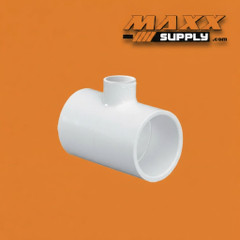

Tee, Slip x Slip x Slip PVC Schedule 40 10" x 10" x 3" (401-623)
$544.03
The 10" x 10" x 3" Schedule 40 White PVC Reducing Tee (401-623, Slip x Slip x Slip) is a large-diameter thermoplastic reducing tee fitting manufactured to ASTM D2466 in Schedule 40 white PVC — in which both run connections are 10" IPS slip socket ends and the branch connection is a 3" IPS slip socket end, providing a single-body Schedule 40 PVC solution for connecting a 3" IPS socket PVC branch assembly perpendicularly to a 10" Schedule 40 PVC primary run at a branch location where the 10" primary run continues at full diameter through both straight-run ports downstream of the 3" branch connection, without a saddle tap, without field fabrication, without transitioning out of Schedule 40 white PVC construction at the primary main branch point, and without interrupting the 10" primary run's continuity at the branch location. The 401-623 is the correct fitting wherever a 10" Schedule 40 PVC primary main must provide a 3" IPS socket PVC perpendicular branch connection while maintaining the full 10" primary run diameter through both run sockets — where the 3" downstream branch system is permanently bonded socket PVC construction continuing in 3" IPS socket PVC pipe and fittings from the tee's branch socket, where the primary main must continue downstream of the 3" branch at full 10" diameter serving additional primary distribution or transmission demands, and where the branch connection must be a manufactured, rated, NSF-listed, ASTM D2466-compliant Schedule 40 white PVC tee body whose 3" branch socket accepts standard 3" IPS Schedule 40 or Schedule 80 PVC pipe directly in the factory-formed female socket of the tee's branch port. As the most broadly applicable minimal-lateral branch configuration in the Spears 401 series at the 10" run service level — positioned at the 30% branch-to-run ratio where the branch pipe transitions from primary-infrastructure scale to large-bore appurtenance scale, and where the 3" IPS branch serves the broadest range of large-bore appurtenance, zone supply, drain assembly, blowoff assembly, air release valve supply, chemical injection supply, and secondary distribution connection applications of any minimal-lateral branch configuration in the series — the 401-623 appears on more 10" Schedule 40 PVC primary main project BOMs, at more individual branch locations per project, and across more distinct commercial markets and appurtenance application types than any other minimal-lateral reducing tee in the Spears 401 series at the 10" run level.
The 401-623's position within the Spears 401 series all-socket reducing tee line at the 10" run service level is fully defined by the 30% branch-to-run ratio and its placement at the boundary between the near-equal primary-infrastructure-scale configurations above it in the series and the large-bore appurtenance-scale configurations below it. The 401-100 (10"x10"x10" equal tee at 100%) is the anchor equal junction fitting whose all-three-ports-equal geometry serves symmetric and near-symmetric flow division between three equal-diameter primary infrastructure systems. The 401-628 (10"x10"x8" reducing tee at 80%) is the most near-equal reducing tee in the standard Schedule 40 PVC socket fitting line at the 10" run — the configuration where the branch is the most nearly equal to the run diameter, both systems are primary infrastructure scale, and the branch carries a near-primary flow fraction. The 401-623 (10"x10"x3" at 30%) is the first configuration in the 10" run series where the branch pipe size has crossed from primary-infrastructure scale into large-bore appurtenance scale — where the 10" run remains at full primary main diameter while the 3" branch serves not a parallel primary distribution main or large-capacity sector supply but a large-bore appurtenance assembly, a zone supply header, a drain or blowoff structure, an air release valve supply assembly, or a secondary distribution connection whose flow demand has been sized at 3" IPS from the hydraulic analysis. This infrastructure-to-appurtenance transition at the 30% branch-to-run ratio is the most commercially significant boundary in the 10" run Spears 401 series reducing tee line — above it, both run and branch serve primary infrastructure systems; at and below it, the run serves primary infrastructure and the branch serves appurtenance, zone supply, or secondary distribution systems — and the 401-623's position at this boundary, combined with 3" IPS being the most commercially active large-bore appurtenance pipe size in the commercial PVC socket fitting market, establishes the 401-623 as the most broadly applicable fitting at this critical transition point in the series.
The 3" branch socket's downstream application range is the commercial foundation of the 401-623's identity within the Spears 401 series and the primary commercial differentiator from both the near-equal configurations above it and the smaller branch configurations below it in the 10" run series. At 3" IPS socket PVC construction, the downstream branch systems and assemblies served by the 401-623's perpendicular branch socket include: 3" IPS socket PVC zone supply assemblies where the primary distribution main's perpendicular zone supply branch connection is designed as a permanently bonded 3" socket PVC valve and supply continuation — the most commercially prevalent zone supply branch size at 10" primary distribution main service levels where individual zone supply demands have been hydraulically sized at 3" IPS; 3" IPS socket PVC gate valve and ball valve assemblies for primary main blowoff, drain, and isolation service where the valve's primary main connection is socket PVC rather than male NPT threaded — the governing application type distinction between the 401-623 and the 402-623 at this size combination; 3" IPS socket PVC pipe continuation for major drain assembly legs, blowoff assembly discharge pipes, and air release valve supply pipes where the downstream assembly continues in permanently bonded 3" socket PVC pipe and fitting construction from the tee's branch socket; large-capacity combination air release and vacuum breaker valve supply assemblies in 3" IPS socket PVC construction where the air release valve's supply connection accepts 3" IPS socket PVC pipe from the tee's branch socket at primary transmission main high-point air management locations; primary main chemical injection and chemical dosing supply connections in 3" IPS socket PVC construction where high-volume chemical injection assemblies supply treatment chemicals, fertilizer solutions, pH adjustment chemicals, disinfection chemicals, or corrosion inhibitors to the primary main branch at the tee body's perpendicular branch port; secondary distribution supply connections where the 10" primary main supplies a 3" IPS secondary distribution header, recirculation supply branch, or sector fill connection in permanently bonded socket PVC construction from the tee's perpendicular branch port; major flushing and commissioning assembly connections where 3" socket PVC gate valve or ball valve assemblies at primary main dead-end adjacent locations provide the system commissioning flushing, water age management, and distribution system maintenance flushing functions from perpendicular branch positions on the continuing 10" primary run; secondary pump suction supply assemblies where a secondary pump's 3" socket PVC suction supply pipe connects to the 10" primary main's perpendicular branch port with the 10" primary run continuing at full diameter downstream of the branch connection; and primary main high-flow service lateral connections where individual large building service supply laterals continue in 3" IPS socket PVC construction from the tee's perpendicular branch socket at primary distribution main branch locations. This complete range of 3" IPS socket PVC downstream application types — spanning zone supply, blowoff, drain, air release supply, chemical injection, secondary distribution, flushing, pump connections, and service laterals — is broader at the 3" branch size than at any smaller branch configuration in the 10" run series, reflecting 3" IPS socket PVC's position as the most commercially active large-bore appurtenance pipe size in the commercial PVC socket fitting market.
The three most important specification comparisons at the 401-623 are each governed by a different selection criterion, each is non-negotiable at its applicable fitting selection decision point, and each must be resolved before any fitting is purchased for installation at a 10" primary main branch location requiring a 3" appurtenance or zone supply branch assembly. The first and most important comparison is the all-socket branch versus FPT branch selection between the 401-623 and the 402-623 (10"x10"x3" Schedule 40 FPT branch tee in the Spears 402 series) — the fitting that differs from the 401-623 by exactly one characteristic: the branch connection type. The 401-623's 3" branch socket is a slip socket that accepts 3" IPS socket PVC pipe in a permanently bonded solvent cement connection — the correct configuration wherever the 3" downstream branch system continues in socket PVC pipe and fitting construction. The 402-623's 3" branch port is a female pipe thread (FPT) that accepts 3" male NPT threaded components directly — the correct configuration wherever the first downstream component at the branch is an inherently male NPT threaded valve body, air release valve inlet, pump connection, chemical injection assembly, or other 3" male NPT threaded appurtenance component. This selection between the 401-623 socket branch and the 402-623 FPT branch is determined entirely by the downstream 3" branch component's connection interface type — socket PVC pipe insertion for the 401-623, male NPT threaded for the 402-623 — and must be confirmed by inspecting the downstream component's connection interface before purchasing either fitting. At the 3" branch size, the range of applications distributed between socket PVC and male NPT threaded downstream components is broader than at almost any other branch size in the commercial PVC fitting market — socket PVC gate valves and ball valves, socket PVC pipe continuations, and socket PVC air release valve supply assemblies all use the 401-623, while threaded gate valve bodies, threaded ball valves, threaded air release valve inlets, and threaded chemical injection assemblies with male NPT connections use the 402-623 — making the socket-versus-FPT confirmation the most practically consequential specification decision at this size combination and the one most susceptible to error if assumed rather than confirmed.
The second critical comparison is the perpendicular reducing tee versus inline reducer coupling selection between the 401-623 and the 829-623 (10"x3" Schedule 80 PVC reducer coupling in the Spears 829 series) — the fitting that differs from the 401-623 by both its structural role and its schedule. The 401-623 is a three-port perpendicular reducing tee with two 10" run sockets and one 3" perpendicular branch socket — the 10" primary run continues at full diameter through both run ports downstream of the 3" branch connection, and the 3" branch exits at 90 degrees to the run axis. The 829-623 is a two-port inline reducer coupling with a 10" large-end socket and a 3" small-end socket — there is no continuing 10" run port, the entire primary main flow path transitions inline from the 10" socket to the 3" socket at the coupling body, and the fitting serves terminal end-of-run, major drain, blowoff, air release valve supply, and chemical injection supply connections where the 10" primary main terminates at the fitting rather than continuing downstream. The selection between the 401-623 and the 829-623 at any 10" primary main location requiring a 3" connection is determined by the single most important structural question in primary main branch assembly design: does the 10" primary main continue downstream of the 3" connection point? Where the answer is yes — where the primary main continues to serve additional downstream service areas beyond the 3" branch location — the 401-623 is correct and the 829-623 cannot be substituted. Where the answer is no — where the primary main terminates at the 3" connection and the entire end-of-run flow transitions to the 3" downstream assembly — the 829-623 reducer coupling is correct and the 401-623's continuing run ports serve no useful function. Additionally, the 401-623 is Schedule 40 white PVC while the 829-623 is Schedule 80 gray PVC — where the primary main system standard mandates Schedule 80 gray PVC throughout, the 401-623's Schedule 40 white PVC construction is not the correct material class at the primary main fitting, and the Schedule 80 counterpart tee configuration or the 829-623 reducer coupling (for terminal end-of-run applications) is the correct specification. These structural role and schedule differences together make the 401-623 versus 829-623 comparison the second most consequential fitting specification decision at the 10"x3" primary main service level and must be resolved from both the primary main continuation requirement and the schedule requirement before either fitting is purchased.
The third critical comparison is the branch size selection within the Spears 401 series at the 10" run — specifically the selection between the 401-623 (3" branch at 30%) and the 401-628 (8" branch at 80%) as the two most commercially active reducing tee configurations in the 10" run series after the 401-100 anchor equal tee. The 401-628's 80% near-equal branch serves applications where the downstream branch system is a near-equal primary distribution infrastructure system — where the branch carries a near-primary flow fraction and both the run and branch are at primary infrastructure pipe scale. The 401-623's 30% branch serves applications where the downstream branch system is a large-bore appurtenance or secondary distribution system — where the branch carries a significantly smaller flow fraction than the continuing 10" run and the branch serves a zone supply, drain, blowoff, air release, chemical injection, or secondary distribution function rather than a parallel primary distribution system. Between the 401-628 and the 401-623, the branch-to-run ratio drops from 80% to 30% — a substantial jump that corresponds to the infrastructure-to-appurtenance transition boundary established above, and buyers who are working from an incomplete hydraulic analysis that has established a 3" branch demand and a 10" continuing run must verify that the hydraulic design's downstream demand justifies a 3" branch before specifying the 401-623 over the 401-628: if the downstream branch demand has been determined by flow calculation to require 3" IPS supply capacity, the 401-623 is correct; if the downstream branch demand requires near-equal 8" supply capacity, the 401-628 is correct; and if the demand falls between these sizes, the intervening Spears 401 series configurations at 6", 4", and other branch sizes must be consulted against the hydraulic design's branch demand analysis before the correct branch size is confirmed.
The 401-623's hydraulic behavior at the 30% branch-to-run ratio establishes the hydraulic accounting requirements appropriate to this minimal-lateral configuration. At 30%, the 3" branch carries a low fraction of the 10" primary run's design flow under normal branch service conditions — the 10" primary run's hydraulic dominance over the 3" branch is at its most pronounced of any configuration above the 401-623 in the 10" run reducing tee series, and the tee junction's effect on the primary run's velocity, pressure, and flow profile during normal primary distribution operation when the branch valve is closed or at low-service conditions is effectively negligible. During zone supply service events, blowoff operations, air release valve cycling, or chemical injection at peak dose rates when the 3" branch valve is partially or fully open, the 3" branch's 30% flow fraction withdraws a limited but hydraulically meaningful fraction of the primary run's available pressure and flow at the junction location — a fraction requiring explicit confirmation against the downstream 3" branch assembly's minimum supply pressure requirement at the branch's design service flow, while simultaneously confirming that the primary run's residual downstream pressure remains above minimum distribution system requirements at the most remote downstream service point under the combined primary distribution and branch service event flow conditions. The branch junction pressure loss at the 401-623 under these branch service conditions must be included in the primary system's hydraulic model — the tee body's flow resistance at the perpendicular branch junction under the specific flow division proportion between the continuing 10" run and the 3" perpendicular branch must be characterized and confirmed against both the primary run's downstream pressure requirements and the branch's supply pressure requirements before the fitting is finalized in the primary system design. In primary main systems with multiple 401-623 tee bodies at different branch locations along the same 10" primary run — a common configuration in large commercial irrigation primary transmission main layouts where the appurtenance schedule includes multiple zone supply tees, multiple air release tee branches, and multiple drain and blowoff tee branches of 3" IPS socket PVC construction along the same primary run route — the cumulative effect of all tee junction pressure losses on the primary run's pressure profile must be modeled in the primary system's hydraulic analysis as a complete assembly rather than individually at each tee location.
The assembly requirements at the 401-623 reflect the pronounced size asymmetry between its two 10" run sockets and its single 3" branch socket — the run connections requiring the full large-diameter Schedule 40 PVC assembly discipline established at every 10" Schedule 40 socket fitting in this catalog, and the branch connection requiring the assembly standards appropriate for 3" IPS Schedule 40 or Schedule 80 PVC pipe. All three socket connections require heavy-body solvent cement rated for Schedule 40 PVC at the applicable socket size — the two 10" run sockets with their large bonding surface areas requiring the pre-planned assembly sequencing, complete circumferential coverage, and working time management established across all 10" Schedule 40 socket fitting documentation in this catalog, and the 3" branch socket with its substantially smaller bonding surface area and correspondingly shorter working time. The complete assembly sequence must be planned with all three pipe ends positioned and accessible before any cement application begins at any socket — the branch port's 90-degree orientation relative to the run axis must be confirmed against the piping layout drawing by dry-fit before any cement is applied, because the branch socket's angular orientation commits the downstream 3" branch assembly's spatial routing direction relative to the primary run simultaneously with the run socket cement joints, and this orientation cannot be adjusted without full joint destruction at all three sockets after cement application. At the 401-623's 30% branch-to-run size differential — where the 3" branch socket is substantially smaller than both 10" run sockets — the branch socket's visual and tactile distinction from the run sockets during assembly is the most reliable field indicator of the fitting's correct orientation in the primary run, and the installer must confirm both that the branch socket's 90-degree angular direction corresponds to the intended downstream 3" assembly routing direction before any cement application begins. Apply complete circumferential heavy-body cement coverage at all three socket connections within the available working time, comply fully with cure time requirements before any system pressurization, and deburr and bevel all three pipe ends — both 10" run pipe ends and the 3" branch pipe end — before cementing to ensure consistent insertion depths and complete circumferential bond lines at every socket connection.
Engineered concrete thrust block or mechanical joint restraint is required at the 401-623's perpendicular branch port at buried installations — the 90-degree perpendicular branch direction change produces an unbalanced hydraulic thrust force in the branch direction proportional to the branch pipe's operating pressure and 3" cross-sectional area, requiring the same engineered thrust restraint design applied at direction change elbows in the same primary main system. At the 30% branch-to-run ratio, the 3" branch port's thrust force magnitude is proportional to the 3" pipe cross-sectional area and the operating pressure at the branch location — substantially smaller in absolute magnitude than the thrust forces at the 10" run direction change elbows in the same primary main system, but not negligible at the 10" primary main service pressure level and requiring a site-specific engineered thrust block design that accounts for the soil bearing conditions, operating pressure, and 3" branch pipe cross-sectional area at each buried 401-623 installation location. No thrust restraint is required at the 401-623's two 10" run ports — the run ports are inline connections producing no angular thrust force component in the run direction, and thrust restraint at the run connections is addressed through the primary run's pipe anchoring and support design rather than through thrust blocks at the tee body. The run port thrust restraint framework established at the 401-100 page — no concrete thrust blocks required at inline run ports, thrust restraint only at the perpendicular branch port — applies identically at the 401-623.
The schedule selection at the 401-623 — Schedule 40 over the Schedule 80 counterpart at the 10"x3" all-socket reducing tee configuration — follows the engineering framework established across all 10" Schedule 40 specialty fitting pages in this catalog. Schedule 40 is the correct specification where the system's design operating pressure, surge allowance, and engineering safety margin requirements fall within the Schedule 40 pressure ceiling at the 10" fitting size, where the system specification does not mandate Schedule 80 gray PVC throughout, and where the design engineer has confirmed that Schedule 40 wall thickness satisfies all engineering requirements at the primary main reducing tee branch location. Where the system requires Schedule 80 wall thickness, gray material class identification, or the higher pressure ceiling that Schedule 80 provides at large-diameter primary main reducing tee fittings, the Schedule 80 counterpart at the 10"x10"x3" reducing tee configuration is the correct specification — at pump stations, high-pressure primary mains, and well field primary headers where primary main operating pressures approach or exceed the Schedule 40 pressure ceiling at the 10" fitting size, the schedule selection must be confirmed with explicit attention to the tee body's loading under primary run operating conditions before Schedule 40 material class is finalized at the primary main reducing tee branch location.
Schedule 40 white PVC construction provides the chemical resistance, NSF certification, and structural capability appropriate for large-diameter primary main reducing tee branch service within the Schedule 40 pressure and wall thickness envelope. PVC Type 1 Grade 1 construction with cell classification 12454 per ASTM D1784 delivers broad chemical resistance across water treatment chemicals, process water service, industrial utility water, and the full range of non-solvent process fluids appropriate for Schedule 40 PVC primary main service at all three socket connections. The white color provides the permanent, inspectable Schedule 40 material class identification at the primary main branch location — confirming the installed material class for inspectors, maintenance engineers, and facility managers at the primary run branch connection point and distinguishing the installed fitting from gray Schedule 80 components in the same primary main system. The 3" branch socket is compatible with both Schedule 40 and Schedule 80 3" IPS PVC pipe — the schedule of the 3" branch pipe is selected based on the downstream assembly's own design requirements rather than constrained by the 401-623's socket geometry, and both pipe schedules insert fully into the 3" slip socket at the tee's branch port.
NSF 61 certification lists this fitting for potable water contact, and NSF 14 covers compliance with applicable plastics piping material standards — making it the correct Schedule 40 PVC all-socket reducing tee for municipal water distribution systems, large potable water pump station primary headers, large commercial irrigation primary mains, and large commercial and institutional water supply primary mains where NSF-listed materials are required at every fitting in the primary distribution system including reducing tee bodies at primary main zone supply, drain, blowoff, air release valve supply, chemical injection, and secondary distribution branch locations. ASTM D2466 governs Schedule 40 PVC socket fittings and defines the manufacturing, dimensional, and pressure performance requirements the 401-623 is produced to. Verify manufacturer pressure rating documentation for the specific fitting configuration before final system specification — at the 10"x10"x3" reducing tee configuration, the governing pressure rating is determined by the 10" run port size and the fitting's tested performance at this large-diameter minimal-lateral reducing tee geometry, and must be confirmed against the manufacturer's published pressure-temperature rating table for SKU 401-623 before installation in systems at or near the fitting's rated pressure ceiling.
Key Features:
- Schedule 40 white PVC reducing tee — 10" x 10" run (slip socket) x 3" branch (slip socket), all socket (slip) ends; Spears 401 series Schedule 40 PVC socket fittings
- Most broadly applicable minimal-lateral branch reducing tee in the Spears 401 series at the 10" run level — 3" IPS is the most commercially active large-bore appurtenance pipe size; the widest range of large-bore appurtenance, zone supply, drain, blowoff, air release valve supply, chemical injection, secondary distribution, and service lateral downstream assemblies in permanently bonded socket PVC construction is available at the 3" IPS branch size
- 3" branch at 30% of 10" run diameter — minimal lateral ratio; 10" primary run most hydraulically dominant at normal distribution flow; branch flow fraction meaningful at peak zone supply, blowoff, flushing, and air release events; hydraulic confirmation required at peak branch service conditions; 10" primary run continues at full diameter through both run ports
- Infrastructure-to-appurtenance boundary position — 401-623 is the first configuration in the 10" run Spears 401 series where the branch transitions from primary infrastructure scale to large-bore appurtenance scale; above this configuration in the series (401-628 at 80%), both run and branch are primary infrastructure systems; at the 401-623 and below, the run is primary infrastructure and the branch is appurtenance, zone supply, or secondary distribution scale
- First critical comparison — all-socket versus FPT branch: 401-623 where downstream 3" branch assembly continues in socket PVC pipe and fitting construction; 402-623 (10"x10"x3" FPT branch tee) where downstream 3" branch component is inherently male NPT threaded; downstream component's connection interface type determines which fitting is correct — confirm before purchasing; at 3" branch size, both socket PVC and male NPT 3" downstream components are in broad commercial use; socket-versus-FPT confirmation has highest practical significance at 3" branch size
- Second critical comparison — perpendicular reducing tee versus inline reducer coupling: 401-623 where 10" primary run continues downstream of the 3" branch and the branch exits perpendicularly; 829-623 (10"x3" Schedule 80 reducer coupling) where 10" primary main terminates inline at the 3" connection and the entire end-of-run flow transitions to the 3" downstream assembly; primary main continuation requirement determines which fitting is correct; 401-623 also Schedule 40 white PVC while 829-623 is Schedule 80 gray PVC — schedule requirement applies simultaneously
- Third critical comparison — branch size selection within Spears 401 series at 10" run: 401-628 (8" branch at 80%) where downstream branch serves near-equal primary distribution infrastructure system at near-primary flow fraction; 401-623 (3" branch at 30%) where downstream branch serves large-bore appurtenance, zone supply, drain, blowoff, or secondary distribution system at substantially lower flow fraction; branch pipe size confirmed from hydraulic design's downstream demand analysis before specifying either configuration
- Thrust restraint required at buried 3" branch port — 90-degree perpendicular branch produces unbalanced hydraulic thrust force in branch direction; engineered concrete thrust block or mechanical joint restraint required at buried installations; bearing area calculated site-specifically from soil conditions, operating pressure, and 3" branch pipe cross-sectional area; no thrust restraint required at either 10" run port — inline run connections produce no angular thrust force
- Branch socket orientation committed at run socket cement application — 3" branch socket's 90-degree angular direction relative to the 10" run axis is fixed when run socket cement joints are made; confirm branch orientation against piping layout and downstream 3" assembly routing before cementing any socket; the 3" branch socket's size asymmetry from the 10" run sockets is the most reliable visual orientation aid during field assembly — use it to confirm branch direction before cement application
- Both 10" run socket connections require full large-diameter heavy-body cement assembly discipline; 3" branch socket requires standard 3" IPS assembly discipline; plan complete three-socket assembly sequence with all pipe ends positioned before any cement application begins; full cure time compliance before pressurization
- 3" branch socket accepts Schedule 40 and Schedule 80 3" IPS PVC pipe — downstream branch pipe schedule selected from downstream assembly design requirements
- Schedule 40 vs. Schedule 80 selection: Schedule 40 correct where system pressure, surge, and safety margin requirements fall within Schedule 40 pressure ceiling; verify against Schedule 80 counterpart and 829-623 inline reducer coupling before final specification
- Manufactured to ASTM D2466 — governing standard for Schedule 40 PVC socket fittings
- NSF 61 certified for potable water contact; NSF 14 listed
- Run socket connections compatible with Schedule 40 and Schedule 80 IPS 10" pipe; branch socket compatible with Schedule 40 and Schedule 80 IPS 3" pipe
- White color — standard Schedule 40 material class identification at the primary main reducing tee branch location
- Cell classification PVC 12454 per ASTM D1784
- Heavy-body solvent cement required at all three socket connections; full cure time compliance mandatory before pressurization
- Pressure rating: verify against manufacturer pressure-temperature table for SKU 401-623
Specifications:
| Attribute | Value |
|---|---|
| SKU | 401-623 |
| Fitting Type | Reducing Tee |
| Series | Spears 401 Schedule 40 PVC Socket Fittings |
| Run Size | 10" x 10" |
| Branch Size | 3" |
| Branch-to-Run Ratio | 30% |
| Branch Angle | 90 Degrees to Run Axis |
| End Connections | Slip x Slip x Slip (All Socket) |
| Connection Method — Run | Solvent Cement (IPS), both run sockets |
| Connection Method — Branch | Solvent Cement (IPS), 3" branch socket |
| Compatible Pipe — Run | 10" IPS Schedule 40 or Schedule 80 PVC |
| Compatible Pipe — Branch | 3" IPS Schedule 40 or Schedule 80 PVC |
| Thrust Restraint — Branch Port | Required at buried installations — engineered concrete thrust block or mechanical restraint; site-specific design |
| Thrust Restraint — Run Ports | Not required — inline run connections produce no angular thrust force |
| Schedule | Schedule 40 |
| Material | PVC (Polyvinyl Chloride) Type 1, Grade 1 |
| Cell Classification | 12454 per ASTM D1784 |
| Color | White |
| Manufacturing Standard | ASTM D2466 |
| Potable Water Certification | NSF/ANSI 61 |
| Plastics Standard Certification | NSF 14 |
| Max Service Temperature | 140°F (60°C) |
| Pressure Rating | Verify with manufacturer pressure-temperature rating table for SKU 401-623 |
Industries & Applications:
- Municipal Water Distribution — Primary Transmission and Distribution Main Zone Supply Branches, Air Release Valve Supply Connections, Drain and Blowoff Assembly Branches, Chemical Injection Supply Branches, Flushing Assembly Branches, and Secondary Distribution Connections on 10" Schedule 40 Primary Mains — The 10" x 10" x 3" Schedule 40 all-socket reducing tee is the most broadly applicable minimal-lateral branch reducing tee on 10" municipal water transmission and primary distribution mains in Schedule 40 PVC systems — specified at every 3" IPS socket PVC branch assembly location along the primary main route where the hydraulic design, appurtenance schedule, or distribution system design has established a 3" IPS socket PVC branch assembly as the primary main branch fitting and the primary run must continue downstream of the branch connection; zone supply branch connections where the 10" primary distribution main provides perpendicular zone supply branches to commercial, institutional, or residential service zones through 3" IPS socket PVC valve and supply continuation assemblies that connect to the primary distribution main through the 401-623's branch socket — the most common zone supply branch configuration at 10" primary distribution main service levels where individual zone supply demands have been hydraulically sized at 3" IPS socket PVC supply capacity from the distribution system's demand analysis and the zone supply valve assembly is in permanently bonded socket PVC construction rather than male NPT threaded construction; primary transmission main high-point large-capacity combination air release and vacuum breaker valve supply branches where 3" IPS socket PVC air release valve supply assemblies connect perpendicularly to the 10" primary transmission main through the 401-623's branch socket while the primary transmission main continues downstream at full 10" diameter — the standard air release valve supply branch configuration at transmission main service levels where the air release station's supply assembly is in permanently bonded 3" socket PVC construction from the tee branch socket to the combination air valve inlet; primary main major low-point drain assembly branches where the 10" primary main requires perpendicular low-point drain connections in 3" IPS socket PVC construction at drain structure locations along the primary main route — the 401-623 providing the tee body at each drain assembly branch where the 3" socket PVC drain valve and discharge pipe assembly connects perpendicularly to the continuing 10" primary run; primary transmission main end-of-main and major blowoff assembly branches where the 10" primary transmission main requires perpendicular blowoff valve assemblies in 3" IPS socket PVC construction at low-point, end-of-main, and distribution boundary blowoff stations — the 401-623 providing the tee body at each blowoff station where the 3" socket PVC blowoff valve and discharge assembly connects perpendicularly to the continuing 10" primary run; primary distribution main chemical injection and fluoridation supply branches where chemical injection assemblies in 3" IPS socket PVC construction supply fluoridation chemicals, disinfection chemicals, pH adjustment reagents, and corrosion inhibitor chemicals through perpendicular 3" socket PVC branch connections from the 10" primary distribution main; primary main flushing and water age management assembly branches where 3" IPS socket PVC flushing valve assemblies at primary main near-dead-end locations, distribution boundary points, and unidirectional flushing program station locations connect perpendicularly to the continuing 10" primary run through the 401-623's branch socket; and primary main large service lateral branches where individual large building or campus service supply laterals continue in 3" IPS socket PVC construction from the 401-623's perpendicular branch socket at primary distribution main service branch locations; NSF 61 listing confirms potable water fitness at every municipal distribution primary main 3" socket branch connection; the design flow through the 3" branch socket at zone supply service, blowoff operations, and peak flushing events must be confirmed against the primary main's available pressure at the 401-623 branch location and the primary run's minimum residual downstream pressure at the most remote simultaneous service point; engineered thrust block design at each buried 401-623 branch port is mandatory and must be calculated site-specifically from soil bearing conditions, system operating pressure, and 3" branch pipe cross-sectional area
- Water Treatment Plant — Primary Header Zone Supply Branches, Air Release Valve Supply Connections, Drain Assembly Branches, Chemical Dosing Supply Branches, and Equipment Supply Connections on 10" Schedule 40 Primary Distribution Headers — Installed at 3" IPS socket PVC branch assembly locations on 10" primary distribution headers in municipal and industrial water treatment plants where the primary header must continue downstream of the 3" branch connection — filter gallery primary header zone supply branches where 3" IPS socket PVC supply assemblies connect perpendicularly to the 10" primary header and supply individual filter gallery process sections, parallel filter treatment units, or gallery equipment supply zones while the primary header continues downstream at full 10" diameter; plant service water primary header air release valve supply branches where 3" IPS socket PVC air release valve supply assemblies connect perpendicularly to the 10" primary service water header at high-point branch locations throughout the treatment facility's service water distribution network; clearwell supply header drain assembly branches where 3" IPS socket PVC drain valve assemblies connect perpendicularly to the 10" primary supply header at low-point drain branch locations for primary header drainage during process isolation and maintenance; backwash primary supply header drain and flush assembly branches where 3" IPS socket PVC drain valve and flush assembly branches connect perpendicularly to the 10" primary backwash supply header at drain structure locations; primary distribution header chemical dosing supply branches where coagulant, disinfectant, pH adjustment, fluoride, and corrosion inhibitor chemical dosing assemblies in 3" IPS socket PVC construction connect perpendicularly to the 10" primary distribution header at chemical injection branch points while the primary header continues downstream to additional process sections and distribution zones; primary distribution header individual equipment supply branches where 3" IPS socket PVC supply assemblies connect perpendicularly to the 10" primary header and supply individual process equipment, secondary pump suction assemblies, and major equipment cooling supply connections at treatment facility equipment branch locations; and primary distribution header secondary pump suction supply branches where 3" IPS socket PVC secondary pump suction supply assemblies connect perpendicularly to the continuing 10" primary distribution header through the 401-623's branch socket; NSF 61 listing confirms potable water fitness at every water treatment plant primary header 3" socket branch connection
- Pump Station — Primary Header Zone Supply Branches, Air Release Valve Supply Connections, Chemical Injection Supply Branches, Drain Assembly Branches, and Secondary Pump Supply Connections on 10" Schedule 40 Primary Headers — Used at 3" IPS socket PVC branch assembly locations on 10" primary pump station suction and discharge headers where the primary header continues downstream of the 3" branch connection — pump station primary discharge header zone supply branches where 3" IPS socket PVC zone supply assemblies connect perpendicularly to the 10" primary discharge header and supply individual service zones, pressure district transmission systems, or downstream distribution connections from the pump station's primary discharge header while the header continues downstream at full 10" diameter to additional distribution zones; pump station primary discharge header high-point air release valve supply branches where 3" IPS socket PVC combination air release and vacuum breaker valve supply assemblies connect perpendicularly to the 10" primary discharge header at high-point header branch locations for primary discharge header air management after pump startup events while the header continues downstream; pump station primary suction and discharge header drain assembly branches where 3" IPS socket PVC drain valve assemblies connect perpendicularly to the 10" primary headers at low-point drain branch locations for primary header drainage during pump station maintenance isolation while the header continues downstream to additional pump unit connections; pump station primary discharge header chemical injection supply branches where treatment chemical dosing assemblies — chlorination supply, pH adjustment chemical supply, corrosion inhibitor injection, surge relief supply — in 3" IPS socket PVC construction connect perpendicularly to the 10" primary discharge header at chemical injection branch points while the header continues downstream to the transmission main departure; pump station primary header blowoff assembly branches where 3" IPS socket PVC blowoff valve assemblies connect perpendicularly to the 10" primary header at major blowoff branch locations while the header continues downstream to additional pump station distribution points; and secondary and standby pump suction supply branches where 3" IPS socket PVC secondary pump suction supply assemblies connect perpendicularly to the continuing 10" primary suction header through the 401-623's branch socket; at pump stations where primary headers operate at full system pressure including shut-off head and surge, Schedule 40 pressure ceiling confirmation at the 401-623 installation location is required before Schedule 40 material class is finalized at the pump station primary header branch location
- Large Commercial & Agricultural Irrigation — Primary Transmission Main Zone Supply Branches, Air Release Valve Supply Connections, Chemical Injection Supply Branches, Drain and Blowoff Assembly Branches, and Flushing Assemblies on 10" Schedule 40 Primary Mains — Specified at 3" IPS socket PVC branch assembly locations on 10" primary irrigation transmission mains at major golf course and resort irrigation systems, large-acreage agricultural operations, and regional landscape irrigation projects — the 401-623 is the most broadly specified minimal-lateral reducing tee at irrigation primary transmission main branch locations because 3" IPS socket PVC is the standard branch pipe size across the broadest range of irrigation zone supply, air release valve supply, chemical injection, and blowoff assembly applications in the large commercial irrigation primary main market; irrigation primary transmission main zone supply branches where 3" IPS socket PVC zone supply valve and supply header assemblies connect perpendicularly to the 10" primary transmission main through the 401-623's branch socket and supply individual irrigation sectors, management zones, and major irrigation blocks while the primary transmission main continues downstream at full 10" diameter to additional zone supply branch locations — the 401-623 is typically the most common reducing tee in the irrigation primary transmission main's zone supply appurtenance schedule because 3" IPS socket PVC is the standard zone supply branch size at 10" irrigation primary transmission main service levels where individual sector supply demands have been hydraulically sized at the 3" IPS supply capacity level; irrigation primary transmission main high-point combination air release and vacuum breaker valve supply branches where 3" IPS socket PVC combination air valve supply assemblies connect perpendicularly to the 10" primary transmission main at each high-point summit along the primary transmission route — at large commercial irrigation systems with extended primary transmission main routes traversing undulating terrain, the succession of 401-623 tee bodies at high-point air release branch stations along the primary transmission route generates multiple 401-623 units in the primary transmission main BOM, each providing the continuing 10" run through the run ports and the perpendicular 3" socket branch to the air valve supply assembly at its respective summit location; irrigation pump station primary discharge main chemical injection supply branches where fertilizer injection assemblies, soil amendment chemical supply connections, pH adjustment chemical injection assemblies, and chlorine injection supply assemblies in 3" IPS socket PVC construction connect perpendicularly to the 10" primary discharge main through the 401-623's branch socket while the primary discharge main continues downstream to additional transmission main zones; irrigation primary transmission main blowoff assembly branches where 3" IPS socket PVC blowoff valve and discharge assemblies connect perpendicularly to the 10" primary transmission main at low-point blowoff branch stations while the primary transmission main continues downstream to additional service areas; irrigation primary transmission main flushing and commissioning assembly branches where 3" IPS socket PVC flushing valve assemblies at near-dead-end, distribution boundary, and unidirectional flushing program station locations connect perpendicularly to the continuing 10" primary transmission main through the 401-623's branch socket; and primary transmission main drain assembly branches where 3" IPS socket PVC drain valve assemblies connect perpendicularly to the 10" primary transmission main at drain structure branch locations while the primary transmission main continues downstream; the 401-623 typically appears in the highest quantity per irrigation primary transmission main project BOM of any reducing tee in the Spears 401 series at the 10" run level because the irrigation primary transmission main's appurtenance schedule — multiple zone supply tee branches, multiple high-point air release tee branches, chemical injection tee branches, and blowoff tee branches in 3" IPS socket PVC construction — generates the highest per-project count of 3" branch tee bodies along the primary transmission main route
- Industrial Process Piping — Primary Header Zone Supply Branches, Air Release Valve Supply Connections, Chemical Treatment Supply Branches, Drain Assembly Branches, and Secondary Equipment Supply Connections on 10" Schedule 40 Primary Headers — Used at 3" IPS socket PVC branch assembly locations on 10" process water primary headers, cooling water primary distribution trunks, and plant utility water primary mains in manufacturing plants, chemical processing facilities, petrochemical support facilities, and heavy industrial environments where the primary header continues downstream of the 3" branch connection — process water primary header zone supply branches where 3" IPS socket PVC supply assemblies connect perpendicularly to the 10" primary process water header and supply individual process sections, equipment cooling supply zones, and parallel process supply branches while the primary header continues downstream at full 10" diameter to additional process section supply branch locations; cooling water primary distribution trunk zone supply and equipment supply branches where 3" IPS socket PVC cooling water supply assemblies connect perpendicularly to the 10" primary cooling water trunk and supply individual heat exchanger banks, cooling equipment zones, and process section cooling supply systems while the primary trunk continues downstream to additional equipment supply branch locations; plant utility water primary main drain assembly branches where 3" IPS socket PVC drain valve assemblies connect perpendicularly to the 10" primary utility water main at low-point drain branch locations for primary header drainage while the primary main continues downstream; primary process water header high-point air release valve supply branches where 3" IPS socket PVC combination air release valve supply assemblies connect perpendicularly to the 10" primary process water header at high-point branch locations for primary header air management; primary process water header chemical treatment supply branches where corrosion inhibitor injection assemblies, biocide injection assemblies, scale inhibitor supply connections, and pH adjustment chemical injection assemblies in 3" IPS socket PVC construction connect perpendicularly to the 10" primary process water header at chemical treatment injection branch points while the header continues downstream; cooling water primary distribution trunk blowoff assembly branches where 3" IPS socket PVC blowoff valve assemblies connect perpendicularly to the 10" primary cooling water trunk at major blowoff branch locations while the trunk continues downstream to additional distribution zones; and standby and backup process pump suction supply branches where 3" IPS socket PVC secondary pump suction supply assemblies connect perpendicularly to the continuing 10" primary process water header through the 401-623's branch socket; Schedule 40 white PVC construction satisfies the material specification at primary process header 3" socket branch locations where Schedule 40 is the system material standard and all operating pressure, surge, and safety margin requirements fall within the Schedule 40 pressure ceiling at the 10" reducing tee service size
- Municipal Well Field — Primary Collection and Distribution Header Zone Supply Branches, Air Release Valve Supply Connections, Chemical Injection Supply Branches, Drain Assembly Branches, and Secondary Supply Connections on 10" Schedule 40 Primary Headers — Installed at 3" IPS socket PVC branch assembly locations on 10" primary well field collection and distribution headers where the primary header continues downstream of the 3" branch connection — primary distribution header zone supply branches where 3" IPS socket PVC supply assemblies connect perpendicularly to the 10" primary distribution header and supply individual service zones, pressure districts, and sector transmission systems while the primary header continues downstream at full 10" diameter to additional service zone branch locations; primary distribution header high-point combination air release and vacuum breaker valve supply branches where 3" IPS socket PVC combination air valve supply assemblies connect perpendicularly to the 10" primary distribution header at high-point branch locations throughout the well field primary distribution network; pump station primary discharge header chemical treatment injection supply branches where chlorination supply assemblies, fluoridation supply assemblies, pH adjustment chemical injection assemblies, and corrosion inhibitor injection assemblies in 3" IPS socket PVC construction connect perpendicularly to the 10" primary distribution header at chemical injection branch points while the header continues downstream to additional service zones; primary collection and distribution header drain assembly branches where 3" IPS socket PVC drain valve assemblies connect perpendicularly to the 10" primary header at low-point drain branch locations for primary header drainage while the header continues downstream to additional collection or distribution junction points; primary distribution header blowoff assembly branches where 3" IPS socket PVC blowoff valve assemblies at major blowoff branch stations connect perpendicularly to the continuing 10" primary distribution header through the 401-623's branch socket while the distribution header continues downstream; and primary distribution header secondary pump suction supply branches where 3" IPS socket PVC secondary and standby pump suction supply assemblies connect perpendicularly to the continuing 10" primary distribution header through the 401-623's branch socket at emergency and standby pump suction branch locations; at well field primary headers where pump operating pressures including shut-off head and surge must be confirmed within the Schedule 40 pressure ceiling at the 10" reducing tee service size, Schedule 40 material class confirmation is required for every 401-623 installation location in the well field primary distribution system
- Water & Wastewater Treatment — Primary Process Header Zone Supply Branches, Air Release Valve Supply Connections, Chemical Dosing Supply Branches, Drain Assembly Branches, and Process Equipment Supply Connections on 10" Schedule 40 Primary Process Headers — Specified at 3" IPS socket PVC branch assembly locations on 10" primary process distribution headers in industrial wastewater treatment, water reclamation, and large-scale industrial water management facilities where the primary process header continues downstream of the 3" branch connection — primary influent header zone supply branches where 3" IPS socket PVC supply assemblies connect perpendicularly to the 10" primary influent header and supply individual treatment trains, parallel process units, and process section supply branches while the primary header continues downstream at full 10" diameter; primary effluent distribution header zone supply branches where 3" IPS socket PVC effluent distribution assemblies connect perpendicularly to the 10" primary effluent header and supply individual reclaimed water use zones, downstream treatment process connections, and effluent management systems while the primary header continues downstream; primary process distribution header high-point air release valve supply branches where 3" IPS socket PVC combination air release valve supply assemblies connect perpendicularly to the 10" primary process header at high-point branch locations for primary header air management; primary chemical distribution header zone supply and dosing branches where chemical dosing assemblies in 3" IPS socket PVC construction connect perpendicularly to the 10" primary chemical distribution header and supply individual dosing point assemblies, chemical supply stations, and process unit chemical supply branches while the primary header continues downstream; aeration system primary supply header zone supply branches where 3" IPS socket PVC aeration supply branches connect perpendicularly to the 10" primary aeration supply header and supply individual aeration zone supply assemblies while the primary header continues downstream to additional aeration zones; primary disinfection header chemical injection supply branches where disinfection chemical dosing assemblies in 3" IPS socket PVC construction connect perpendicularly to the 10" primary disinfection header at dosing injection branch points while the header continues downstream; and primary process distribution header individual equipment supply branches where 3" IPS socket PVC supply assemblies connect perpendicularly to the 10" primary header and supply individual treatment process equipment, secondary pump suction assemblies, and process unit service supply connections; Schedule 40 PVC handles chemical service, process fluid conditions, and primary header operating pressures at 3" socket branch locations in treatment environments where Schedule 40 satisfies the system material specification; NSF 61 listing confirms potable and process water fitness at every 3" socket branch connection in the primary treatment distribution system
- HVAC & Large Commercial Mechanical Systems — Primary Distribution Main Zone Supply Branches, Air Release Valve Supply Connections, Chemical Treatment Supply Branches, Drain Assembly Branches, and System Management Connections on 10" Schedule 40 Primary Distribution Mains — Used at 3" IPS socket PVC branch assembly locations on 10" primary chilled water distribution mains, condenser water primary trunks, and large-capacity hydronic heating and cooling primary distribution mains in Schedule 40 PVC systems at large commercial campus, institutional, and industrial mechanical systems where the primary distribution main continues downstream of the 3" branch connection — campus primary chilled water distribution main zone supply branches where 3" IPS socket PVC zone supply assemblies connect perpendicularly to the 10" primary chilled water distribution main and supply individual campus buildings, mechanical rooms, and sector air handling unit supply headers while the primary distribution main continues downstream at full 10" diameter to additional campus service branch locations; primary condenser water distribution trunk zone supply and equipment supply branches where 3" IPS socket PVC condenser water supply assemblies connect perpendicularly to the 10" primary condenser water trunk and supply individual cooling tower circuits, condenser water equipment zones, and parallel condenser water supply systems while the primary trunk continues downstream to additional zone supply branch locations; primary distribution main high-point air release valve supply branches where 3" IPS socket PVC combination air release valve supply assemblies connect perpendicularly to the 10" primary distribution main at high-point branch locations throughout the campus primary distribution network for primary loop air management; primary distribution main chemical treatment supply branches where cooling tower water treatment chemical dosing assemblies, chilled water corrosion inhibitor supply connections, and glycol makeup supply assemblies in 3" IPS socket PVC construction connect perpendicularly to the 10" primary distribution main at chemical treatment branch points while the primary main continues downstream to additional treatment injection zones; primary distribution main drain assembly branches where 3" IPS socket PVC drain valve assemblies connect perpendicularly to the 10" primary distribution main at low-point drain branch locations for primary loop drainage while the primary main continues downstream; and primary distribution main secondary and supplemental circulation pump suction supply branches where 3" IPS socket PVC secondary pump suction supply assemblies connect perpendicularly to the continuing 10" primary distribution main through the 401-623's branch socket at secondary pump branch locations; Schedule 40 PVC construction satisfies the material specification at primary distribution main 3" socket branch locations in large commercial mechanical systems where Schedule 40 is the system material standard
- Aquaculture & Large-Scale Water Management Infrastructure — Installed at 3" IPS socket PVC branch assembly locations on 10" primary water supply, recirculation, or distribution mains at the largest commercial aquaculture facilities, regional hatchery systems, and large recirculating aquaculture systems (RAS) where the primary main continues downstream of the 3" branch connection — primary recirculation main zone supply branches where 3" IPS socket PVC zone supply assemblies connect perpendicularly to the 10" primary recirculation main and supply individual production halls, tank system supply headers, and recirculation treatment train supply assemblies while the primary recirculation main continues downstream at full 10" diameter to additional production section supply branch locations; primary supply main high-point combination air release and vacuum breaker valve supply branches where 3" IPS socket PVC combination air valve supply assemblies connect perpendicularly to the 10" primary supply or recirculation main at high-point branch locations throughout the facility's primary supply distribution network for pump startup air management and pressure transient protection; primary supply main chemical treatment supply branches where water quality treatment chemical injection assemblies — sodium bicarbonate supply, salt solution supply, carbon dioxide injection, sodium thiosulfate supply, proprietary water conditioner supply, and pH adjustment chemical injection assemblies — in 3" IPS socket PVC construction connect perpendicularly to the 10" primary supply main at chemical dosing branch points while the primary main continues downstream to additional production section supply zones; primary recirculation main zone supply and production section supply branches where 3" IPS socket PVC production section recirculation supply assemblies connect perpendicularly to the 10" primary recirculation main and supply individual tank banks, production section recirculation headers, and recirculation treatment supply connections while the primary recirculation main continues downstream to additional production sections; primary supply main drain assembly branches where 3" IPS socket PVC drain valve assemblies connect perpendicularly to the 10" primary supply main at low-point drain branch locations for primary supply main drainage while the primary main continues downstream; primary recirculation main secondary circulation pump suction supply branches where 3" IPS socket PVC secondary and emergency recirculation pump suction supply assemblies connect perpendicularly to the continuing 10" primary recirculation main through the 401-623's branch socket; and primary supply main flushing and water exchange assembly branches where 3" IPS socket PVC flushing valve assemblies at major distribution branch boundaries connect perpendicularly to the continuing 10" primary supply main for water exchange management and primary main maintenance flushing operations; Schedule 40 PVC handles continuous water contact, treatment chemical exposure, and primary main operating pressures at 3" socket branch locations in commercial aquaculture infrastructure; NSF 61 listing confirms potable and process water fitness at every 3" socket branch connection in the primary aquaculture distribution system
(No reviews yet)

Write a Review

Tee, Slip x Slip x Slip PVC Schedule 40 10" x 10" x 3" (401-623)
The 10" x 10" x 3" Schedule 40 White PVC Reducing Tee (401-623, Slip x Slip x Slip) is a large-diameter thermoplastic reducing tee fitting manufactured to ASTM D2466 in Schedule 40 white PVC — in which both run connections are 10" IPS slip socket ends and the branch connection is a 3" IPS slip socket end, providing a single-body Schedule 40 PVC solution for connecting a 3" IPS socket PVC branch assembly perpendicularly to a 10" Schedule 40 PVC primary run at a branch location where the 10" primary run continues at full diameter through both straight-run ports downstream of the 3" branch connection, without a saddle tap, without field fabrication, without transitioning out of Schedule 40 white PVC construction at the primary main branch point, and without interrupting the 10" primary run's continuity at the branch location. The 401-623 is the correct fitting wherever a 10" Schedule 40 PVC primary main must provide a 3" IPS socket PVC perpendicular branch connection while maintaining the full 10" primary run diameter through both run sockets — where the 3" downstream branch system is permanently bonded socket PVC construction continuing in 3" IPS socket PVC pipe and fittings from the tee's branch socket, where the primary main must continue downstream of the 3" branch at full 10" diameter serving additional primary distribution or transmission demands, and where the branch connection must be a manufactured, rated, NSF-listed, ASTM D2466-compliant Schedule 40 white PVC tee body whose 3" branch socket accepts standard 3" IPS Schedule 40 or Schedule 80 PVC pipe directly in the factory-formed female socket of the tee's branch port. As the most broadly applicable minimal-lateral branch configuration in the Spears 401 series at the 10" run service level — positioned at the 30% branch-to-run ratio where the branch pipe transitions from primary-infrastructure scale to large-bore appurtenance scale, and where the 3" IPS branch serves the broadest range of large-bore appurtenance, zone supply, drain assembly, blowoff assembly, air release valve supply, chemical injection supply, and secondary distribution connection applications of any minimal-lateral branch configuration in the series — the 401-623 appears on more 10" Schedule 40 PVC primary main project BOMs, at more individual branch locations per project, and across more distinct commercial markets and appurtenance application types than any other minimal-lateral reducing tee in the Spears 401 series at the 10" run level.
The 401-623's position within the Spears 401 series all-socket reducing tee line at the 10" run service level is fully defined by the 30% branch-to-run ratio and its placement at the boundary between the near-equal primary-infrastructure-scale configurations above it in the series and the large-bore appurtenance-scale configurations below it. The 401-100 (10"x10"x10" equal tee at 100%) is the anchor equal junction fitting whose all-three-ports-equal geometry serves symmetric and near-symmetric flow division between three equal-diameter primary infrastructure systems. The 401-628 (10"x10"x8" reducing tee at 80%) is the most near-equal reducing tee in the standard Schedule 40 PVC socket fitting line at the 10" run — the configuration where the branch is the most nearly equal to the run diameter, both systems are primary infrastructure scale, and the branch carries a near-primary flow fraction. The 401-623 (10"x10"x3" at 30%) is the first configuration in the 10" run series where the branch pipe size has crossed from primary-infrastructure scale into large-bore appurtenance scale — where the 10" run remains at full primary main diameter while the 3" branch serves not a parallel primary distribution main or large-capacity sector supply but a large-bore appurtenance assembly, a zone supply header, a drain or blowoff structure, an air release valve supply assembly, or a secondary distribution connection whose flow demand has been sized at 3" IPS from the hydraulic analysis. This infrastructure-to-appurtenance transition at the 30% branch-to-run ratio is the most commercially significant boundary in the 10" run Spears 401 series reducing tee line — above it, both run and branch serve primary infrastructure systems; at and below it, the run serves primary infrastructure and the branch serves appurtenance, zone supply, or secondary distribution systems — and the 401-623's position at this boundary, combined with 3" IPS being the most commercially active large-bore appurtenance pipe size in the commercial PVC socket fitting market, establishes the 401-623 as the most broadly applicable fitting at this critical transition point in the series.
The 3" branch socket's downstream application range is the commercial foundation of the 401-623's identity within the Spears 401 series and the primary commercial differentiator from both the near-equal configurations above it and the smaller branch configurations below it in the 10" run series. At 3" IPS socket PVC construction, the downstream branch systems and assemblies served by the 401-623's perpendicular branch socket include: 3" IPS socket PVC zone supply assemblies where the primary distribution main's perpendicular zone supply branch connection is designed as a permanently bonded 3" socket PVC valve and supply continuation — the most commercially prevalent zone supply branch size at 10" primary distribution main service levels where individual zone supply demands have been hydraulically sized at 3" IPS; 3" IPS socket PVC gate valve and ball valve assemblies for primary main blowoff, drain, and isolation service where the valve's primary main connection is socket PVC rather than male NPT threaded — the governing application type distinction between the 401-623 and the 402-623 at this size combination; 3" IPS socket PVC pipe continuation for major drain assembly legs, blowoff assembly discharge pipes, and air release valve supply pipes where the downstream assembly continues in permanently bonded 3" socket PVC pipe and fitting construction from the tee's branch socket; large-capacity combination air release and vacuum breaker valve supply assemblies in 3" IPS socket PVC construction where the air release valve's supply connection accepts 3" IPS socket PVC pipe from the tee's branch socket at primary transmission main high-point air management locations; primary main chemical injection and chemical dosing supply connections in 3" IPS socket PVC construction where high-volume chemical injection assemblies supply treatment chemicals, fertilizer solutions, pH adjustment chemicals, disinfection chemicals, or corrosion inhibitors to the primary main branch at the tee body's perpendicular branch port; secondary distribution supply connections where the 10" primary main supplies a 3" IPS secondary distribution header, recirculation supply branch, or sector fill connection in permanently bonded socket PVC construction from the tee's perpendicular branch port; major flushing and commissioning assembly connections where 3" socket PVC gate valve or ball valve assemblies at primary main dead-end adjacent locations provide the system commissioning flushing, water age management, and distribution system maintenance flushing functions from perpendicular branch positions on the continuing 10" primary run; secondary pump suction supply assemblies where a secondary pump's 3" socket PVC suction supply pipe connects to the 10" primary main's perpendicular branch port with the 10" primary run continuing at full diameter downstream of the branch connection; and primary main high-flow service lateral connections where individual large building service supply laterals continue in 3" IPS socket PVC construction from the tee's perpendicular branch socket at primary distribution main branch locations. This complete range of 3" IPS socket PVC downstream application types — spanning zone supply, blowoff, drain, air release supply, chemical injection, secondary distribution, flushing, pump connections, and service laterals — is broader at the 3" branch size than at any smaller branch configuration in the 10" run series, reflecting 3" IPS socket PVC's position as the most commercially active large-bore appurtenance pipe size in the commercial PVC socket fitting market.
The three most important specification comparisons at the 401-623 are each governed by a different selection criterion, each is non-negotiable at its applicable fitting selection decision point, and each must be resolved before any fitting is purchased for installation at a 10" primary main branch location requiring a 3" appurtenance or zone supply branch assembly. The first and most important comparison is the all-socket branch versus FPT branch selection between the 401-623 and the 402-623 (10"x10"x3" Schedule 40 FPT branch tee in the Spears 402 series) — the fitting that differs from the 401-623 by exactly one characteristic: the branch connection type. The 401-623's 3" branch socket is a slip socket that accepts 3" IPS socket PVC pipe in a permanently bonded solvent cement connection — the correct configuration wherever the 3" downstream branch system continues in socket PVC pipe and fitting construction. The 402-623's 3" branch port is a female pipe thread (FPT) that accepts 3" male NPT threaded components directly — the correct configuration wherever the first downstream component at the branch is an inherently male NPT threaded valve body, air release valve inlet, pump connection, chemical injection assembly, or other 3" male NPT threaded appurtenance component. This selection between the 401-623 socket branch and the 402-623 FPT branch is determined entirely by the downstream 3" branch component's connection interface type — socket PVC pipe insertion for the 401-623, male NPT threaded for the 402-623 — and must be confirmed by inspecting the downstream component's connection interface before purchasing either fitting. At the 3" branch size, the range of applications distributed between socket PVC and male NPT threaded downstream components is broader than at almost any other branch size in the commercial PVC fitting market — socket PVC gate valves and ball valves, socket PVC pipe continuations, and socket PVC air release valve supply assemblies all use the 401-623, while threaded gate valve bodies, threaded ball valves, threaded air release valve inlets, and threaded chemical injection assemblies with male NPT connections use the 402-623 — making the socket-versus-FPT confirmation the most practically consequential specification decision at this size combination and the one most susceptible to error if assumed rather than confirmed.
The second critical comparison is the perpendicular reducing tee versus inline reducer coupling selection between the 401-623 and the 829-623 (10"x3" Schedule 80 PVC reducer coupling in the Spears 829 series) — the fitting that differs from the 401-623 by both its structural role and its schedule. The 401-623 is a three-port perpendicular reducing tee with two 10" run sockets and one 3" perpendicular branch socket — the 10" primary run continues at full diameter through both run ports downstream of the 3" branch connection, and the 3" branch exits at 90 degrees to the run axis. The 829-623 is a two-port inline reducer coupling with a 10" large-end socket and a 3" small-end socket — there is no continuing 10" run port, the entire primary main flow path transitions inline from the 10" socket to the 3" socket at the coupling body, and the fitting serves terminal end-of-run, major drain, blowoff, air release valve supply, and chemical injection supply connections where the 10" primary main terminates at the fitting rather than continuing downstream. The selection between the 401-623 and the 829-623 at any 10" primary main location requiring a 3" connection is determined by the single most important structural question in primary main branch assembly design: does the 10" primary main continue downstream of the 3" connection point? Where the answer is yes — where the primary main continues to serve additional downstream service areas beyond the 3" branch location — the 401-623 is correct and the 829-623 cannot be substituted. Where the answer is no — where the primary main terminates at the 3" connection and the entire end-of-run flow transitions to the 3" downstream assembly — the 829-623 reducer coupling is correct and the 401-623's continuing run ports serve no useful function. Additionally, the 401-623 is Schedule 40 white PVC while the 829-623 is Schedule 80 gray PVC — where the primary main system standard mandates Schedule 80 gray PVC throughout, the 401-623's Schedule 40 white PVC construction is not the correct material class at the primary main fitting, and the Schedule 80 counterpart tee configuration or the 829-623 reducer coupling (for terminal end-of-run applications) is the correct specification. These structural role and schedule differences together make the 401-623 versus 829-623 comparison the second most consequential fitting specification decision at the 10"x3" primary main service level and must be resolved from both the primary main continuation requirement and the schedule requirement before either fitting is purchased.
The third critical comparison is the branch size selection within the Spears 401 series at the 10" run — specifically the selection between the 401-623 (3" branch at 30%) and the 401-628 (8" branch at 80%) as the two most commercially active reducing tee configurations in the 10" run series after the 401-100 anchor equal tee. The 401-628's 80% near-equal branch serves applications where the downstream branch system is a near-equal primary distribution infrastructure system — where the branch carries a near-primary flow fraction and both the run and branch are at primary infrastructure pipe scale. The 401-623's 30% branch serves applications where the downstream branch system is a large-bore appurtenance or secondary distribution system — where the branch carries a significantly smaller flow fraction than the continuing 10" run and the branch serves a zone supply, drain, blowoff, air release, chemical injection, or secondary distribution function rather than a parallel primary distribution system. Between the 401-628 and the 401-623, the branch-to-run ratio drops from 80% to 30% — a substantial jump that corresponds to the infrastructure-to-appurtenance transition boundary established above, and buyers who are working from an incomplete hydraulic analysis that has established a 3" branch demand and a 10" continuing run must verify that the hydraulic design's downstream demand justifies a 3" branch before specifying the 401-623 over the 401-628: if the downstream branch demand has been determined by flow calculation to require 3" IPS supply capacity, the 401-623 is correct; if the downstream branch demand requires near-equal 8" supply capacity, the 401-628 is correct; and if the demand falls between these sizes, the intervening Spears 401 series configurations at 6", 4", and other branch sizes must be consulted against the hydraulic design's branch demand analysis before the correct branch size is confirmed.
The 401-623's hydraulic behavior at the 30% branch-to-run ratio establishes the hydraulic accounting requirements appropriate to this minimal-lateral configuration. At 30%, the 3" branch carries a low fraction of the 10" primary run's design flow under normal branch service conditions — the 10" primary run's hydraulic dominance over the 3" branch is at its most pronounced of any configuration above the 401-623 in the 10" run reducing tee series, and the tee junction's effect on the primary run's velocity, pressure, and flow profile during normal primary distribution operation when the branch valve is closed or at low-service conditions is effectively negligible. During zone supply service events, blowoff operations, air release valve cycling, or chemical injection at peak dose rates when the 3" branch valve is partially or fully open, the 3" branch's 30% flow fraction withdraws a limited but hydraulically meaningful fraction of the primary run's available pressure and flow at the junction location — a fraction requiring explicit confirmation against the downstream 3" branch assembly's minimum supply pressure requirement at the branch's design service flow, while simultaneously confirming that the primary run's residual downstream pressure remains above minimum distribution system requirements at the most remote downstream service point under the combined primary distribution and branch service event flow conditions. The branch junction pressure loss at the 401-623 under these branch service conditions must be included in the primary system's hydraulic model — the tee body's flow resistance at the perpendicular branch junction under the specific flow division proportion between the continuing 10" run and the 3" perpendicular branch must be characterized and confirmed against both the primary run's downstream pressure requirements and the branch's supply pressure requirements before the fitting is finalized in the primary system design. In primary main systems with multiple 401-623 tee bodies at different branch locations along the same 10" primary run — a common configuration in large commercial irrigation primary transmission main layouts where the appurtenance schedule includes multiple zone supply tees, multiple air release tee branches, and multiple drain and blowoff tee branches of 3" IPS socket PVC construction along the same primary run route — the cumulative effect of all tee junction pressure losses on the primary run's pressure profile must be modeled in the primary system's hydraulic analysis as a complete assembly rather than individually at each tee location.
The assembly requirements at the 401-623 reflect the pronounced size asymmetry between its two 10" run sockets and its single 3" branch socket — the run connections requiring the full large-diameter Schedule 40 PVC assembly discipline established at every 10" Schedule 40 socket fitting in this catalog, and the branch connection requiring the assembly standards appropriate for 3" IPS Schedule 40 or Schedule 80 PVC pipe. All three socket connections require heavy-body solvent cement rated for Schedule 40 PVC at the applicable socket size — the two 10" run sockets with their large bonding surface areas requiring the pre-planned assembly sequencing, complete circumferential coverage, and working time management established across all 10" Schedule 40 socket fitting documentation in this catalog, and the 3" branch socket with its substantially smaller bonding surface area and correspondingly shorter working time. The complete assembly sequence must be planned with all three pipe ends positioned and accessible before any cement application begins at any socket — the branch port's 90-degree orientation relative to the run axis must be confirmed against the piping layout drawing by dry-fit before any cement is applied, because the branch socket's angular orientation commits the downstream 3" branch assembly's spatial routing direction relative to the primary run simultaneously with the run socket cement joints, and this orientation cannot be adjusted without full joint destruction at all three sockets after cement application. At the 401-623's 30% branch-to-run size differential — where the 3" branch socket is substantially smaller than both 10" run sockets — the branch socket's visual and tactile distinction from the run sockets during assembly is the most reliable field indicator of the fitting's correct orientation in the primary run, and the installer must confirm both that the branch socket's 90-degree angular direction corresponds to the intended downstream 3" assembly routing direction before any cement application begins. Apply complete circumferential heavy-body cement coverage at all three socket connections within the available working time, comply fully with cure time requirements before any system pressurization, and deburr and bevel all three pipe ends — both 10" run pipe ends and the 3" branch pipe end — before cementing to ensure consistent insertion depths and complete circumferential bond lines at every socket connection.
Engineered concrete thrust block or mechanical joint restraint is required at the 401-623's perpendicular branch port at buried installations — the 90-degree perpendicular branch direction change produces an unbalanced hydraulic thrust force in the branch direction proportional to the branch pipe's operating pressure and 3" cross-sectional area, requiring the same engineered thrust restraint design applied at direction change elbows in the same primary main system. At the 30% branch-to-run ratio, the 3" branch port's thrust force magnitude is proportional to the 3" pipe cross-sectional area and the operating pressure at the branch location — substantially smaller in absolute magnitude than the thrust forces at the 10" run direction change elbows in the same primary main system, but not negligible at the 10" primary main service pressure level and requiring a site-specific engineered thrust block design that accounts for the soil bearing conditions, operating pressure, and 3" branch pipe cross-sectional area at each buried 401-623 installation location. No thrust restraint is required at the 401-623's two 10" run ports — the run ports are inline connections producing no angular thrust force component in the run direction, and thrust restraint at the run connections is addressed through the primary run's pipe anchoring and support design rather than through thrust blocks at the tee body. The run port thrust restraint framework established at the 401-100 page — no concrete thrust blocks required at inline run ports, thrust restraint only at the perpendicular branch port — applies identically at the 401-623.
The schedule selection at the 401-623 — Schedule 40 over the Schedule 80 counterpart at the 10"x3" all-socket reducing tee configuration — follows the engineering framework established across all 10" Schedule 40 specialty fitting pages in this catalog. Schedule 40 is the correct specification where the system's design operating pressure, surge allowance, and engineering safety margin requirements fall within the Schedule 40 pressure ceiling at the 10" fitting size, where the system specification does not mandate Schedule 80 gray PVC throughout, and where the design engineer has confirmed that Schedule 40 wall thickness satisfies all engineering requirements at the primary main reducing tee branch location. Where the system requires Schedule 80 wall thickness, gray material class identification, or the higher pressure ceiling that Schedule 80 provides at large-diameter primary main reducing tee fittings, the Schedule 80 counterpart at the 10"x10"x3" reducing tee configuration is the correct specification — at pump stations, high-pressure primary mains, and well field primary headers where primary main operating pressures approach or exceed the Schedule 40 pressure ceiling at the 10" fitting size, the schedule selection must be confirmed with explicit attention to the tee body's loading under primary run operating conditions before Schedule 40 material class is finalized at the primary main reducing tee branch location.
Schedule 40 white PVC construction provides the chemical resistance, NSF certification, and structural capability appropriate for large-diameter primary main reducing tee branch service within the Schedule 40 pressure and wall thickness envelope. PVC Type 1 Grade 1 construction with cell classification 12454 per ASTM D1784 delivers broad chemical resistance across water treatment chemicals, process water service, industrial utility water, and the full range of non-solvent process fluids appropriate for Schedule 40 PVC primary main service at all three socket connections. The white color provides the permanent, inspectable Schedule 40 material class identification at the primary main branch location — confirming the installed material class for inspectors, maintenance engineers, and facility managers at the primary run branch connection point and distinguishing the installed fitting from gray Schedule 80 components in the same primary main system. The 3" branch socket is compatible with both Schedule 40 and Schedule 80 3" IPS PVC pipe — the schedule of the 3" branch pipe is selected based on the downstream assembly's own design requirements rather than constrained by the 401-623's socket geometry, and both pipe schedules insert fully into the 3" slip socket at the tee's branch port.
NSF 61 certification lists this fitting for potable water contact, and NSF 14 covers compliance with applicable plastics piping material standards — making it the correct Schedule 40 PVC all-socket reducing tee for municipal water distribution systems, large potable water pump station primary headers, large commercial irrigation primary mains, and large commercial and institutional water supply primary mains where NSF-listed materials are required at every fitting in the primary distribution system including reducing tee bodies at primary main zone supply, drain, blowoff, air release valve supply, chemical injection, and secondary distribution branch locations. ASTM D2466 governs Schedule 40 PVC socket fittings and defines the manufacturing, dimensional, and pressure performance requirements the 401-623 is produced to. Verify manufacturer pressure rating documentation for the specific fitting configuration before final system specification — at the 10"x10"x3" reducing tee configuration, the governing pressure rating is determined by the 10" run port size and the fitting's tested performance at this large-diameter minimal-lateral reducing tee geometry, and must be confirmed against the manufacturer's published pressure-temperature rating table for SKU 401-623 before installation in systems at or near the fitting's rated pressure ceiling.
Key Features:
- Schedule 40 white PVC reducing tee — 10" x 10" run (slip socket) x 3" branch (slip socket), all socket (slip) ends; Spears 401 series Schedule 40 PVC socket fittings
- Most broadly applicable minimal-lateral branch reducing tee in the Spears 401 series at the 10" run level — 3" IPS is the most commercially active large-bore appurtenance pipe size; the widest range of large-bore appurtenance, zone supply, drain, blowoff, air release valve supply, chemical injection, secondary distribution, and service lateral downstream assemblies in permanently bonded socket PVC construction is available at the 3" IPS branch size
- 3" branch at 30% of 10" run diameter — minimal lateral ratio; 10" primary run most hydraulically dominant at normal distribution flow; branch flow fraction meaningful at peak zone supply, blowoff, flushing, and air release events; hydraulic confirmation required at peak branch service conditions; 10" primary run continues at full diameter through both run ports
- Infrastructure-to-appurtenance boundary position — 401-623 is the first configuration in the 10" run Spears 401 series where the branch transitions from primary infrastructure scale to large-bore appurtenance scale; above this configuration in the series (401-628 at 80%), both run and branch are primary infrastructure systems; at the 401-623 and below, the run is primary infrastructure and the branch is appurtenance, zone supply, or secondary distribution scale
- First critical comparison — all-socket versus FPT branch: 401-623 where downstream 3" branch assembly continues in socket PVC pipe and fitting construction; 402-623 (10"x10"x3" FPT branch tee) where downstream 3" branch component is inherently male NPT threaded; downstream component's connection interface type determines which fitting is correct — confirm before purchasing; at 3" branch size, both socket PVC and male NPT 3" downstream components are in broad commercial use; socket-versus-FPT confirmation has highest practical significance at 3" branch size
- Second critical comparison — perpendicular reducing tee versus inline reducer coupling: 401-623 where 10" primary run continues downstream of the 3" branch and the branch exits perpendicularly; 829-623 (10"x3" Schedule 80 reducer coupling) where 10" primary main terminates inline at the 3" connection and the entire end-of-run flow transitions to the 3" downstream assembly; primary main continuation requirement determines which fitting is correct; 401-623 also Schedule 40 white PVC while 829-623 is Schedule 80 gray PVC — schedule requirement applies simultaneously
- Third critical comparison — branch size selection within Spears 401 series at 10" run: 401-628 (8" branch at 80%) where downstream branch serves near-equal primary distribution infrastructure system at near-primary flow fraction; 401-623 (3" branch at 30%) where downstream branch serves large-bore appurtenance, zone supply, drain, blowoff, or secondary distribution system at substantially lower flow fraction; branch pipe size confirmed from hydraulic design's downstream demand analysis before specifying either configuration
- Thrust restraint required at buried 3" branch port — 90-degree perpendicular branch produces unbalanced hydraulic thrust force in branch direction; engineered concrete thrust block or mechanical joint restraint required at buried installations; bearing area calculated site-specifically from soil conditions, operating pressure, and 3" branch pipe cross-sectional area; no thrust restraint required at either 10" run port — inline run connections produce no angular thrust force
- Branch socket orientation committed at run socket cement application — 3" branch socket's 90-degree angular direction relative to the 10" run axis is fixed when run socket cement joints are made; confirm branch orientation against piping layout and downstream 3" assembly routing before cementing any socket; the 3" branch socket's size asymmetry from the 10" run sockets is the most reliable visual orientation aid during field assembly — use it to confirm branch direction before cement application
- Both 10" run socket connections require full large-diameter heavy-body cement assembly discipline; 3" branch socket requires standard 3" IPS assembly discipline; plan complete three-socket assembly sequence with all pipe ends positioned before any cement application begins; full cure time compliance before pressurization
- 3" branch socket accepts Schedule 40 and Schedule 80 3" IPS PVC pipe — downstream branch pipe schedule selected from downstream assembly design requirements
- Schedule 40 vs. Schedule 80 selection: Schedule 40 correct where system pressure, surge, and safety margin requirements fall within Schedule 40 pressure ceiling; verify against Schedule 80 counterpart and 829-623 inline reducer coupling before final specification
- Manufactured to ASTM D2466 — governing standard for Schedule 40 PVC socket fittings
- NSF 61 certified for potable water contact; NSF 14 listed
- Run socket connections compatible with Schedule 40 and Schedule 80 IPS 10" pipe; branch socket compatible with Schedule 40 and Schedule 80 IPS 3" pipe
- White color — standard Schedule 40 material class identification at the primary main reducing tee branch location
- Cell classification PVC 12454 per ASTM D1784
- Heavy-body solvent cement required at all three socket connections; full cure time compliance mandatory before pressurization
- Pressure rating: verify against manufacturer pressure-temperature table for SKU 401-623
Specifications:
| Attribute | Value |
|---|---|
| SKU | 401-623 |
| Fitting Type | Reducing Tee |
| Series | Spears 401 Schedule 40 PVC Socket Fittings |
| Run Size | 10" x 10" |
| Branch Size | 3" |
| Branch-to-Run Ratio | 30% |
| Branch Angle | 90 Degrees to Run Axis |
| End Connections | Slip x Slip x Slip (All Socket) |
| Connection Method — Run | Solvent Cement (IPS), both run sockets |
| Connection Method — Branch | Solvent Cement (IPS), 3" branch socket |
| Compatible Pipe — Run | 10" IPS Schedule 40 or Schedule 80 PVC |
| Compatible Pipe — Branch | 3" IPS Schedule 40 or Schedule 80 PVC |
| Thrust Restraint — Branch Port | Required at buried installations — engineered concrete thrust block or mechanical restraint; site-specific design |
| Thrust Restraint — Run Ports | Not required — inline run connections produce no angular thrust force |
| Schedule | Schedule 40 |
| Material | PVC (Polyvinyl Chloride) Type 1, Grade 1 |
| Cell Classification | 12454 per ASTM D1784 |
| Color | White |
| Manufacturing Standard | ASTM D2466 |
| Potable Water Certification | NSF/ANSI 61 |
| Plastics Standard Certification | NSF 14 |
| Max Service Temperature | 140°F (60°C) |
| Pressure Rating | Verify with manufacturer pressure-temperature rating table for SKU 401-623 |
Industries & Applications:
- Municipal Water Distribution — Primary Transmission and Distribution Main Zone Supply Branches, Air Release Valve Supply Connections, Drain and Blowoff Assembly Branches, Chemical Injection Supply Branches, Flushing Assembly Branches, and Secondary Distribution Connections on 10" Schedule 40 Primary Mains — The 10" x 10" x 3" Schedule 40 all-socket reducing tee is the most broadly applicable minimal-lateral branch reducing tee on 10" municipal water transmission and primary distribution mains in Schedule 40 PVC systems — specified at every 3" IPS socket PVC branch assembly location along the primary main route where the hydraulic design, appurtenance schedule, or distribution system design has established a 3" IPS socket PVC branch assembly as the primary main branch fitting and the primary run must continue downstream of the branch connection; zone supply branch connections where the 10" primary distribution main provides perpendicular zone supply branches to commercial, institutional, or residential service zones through 3" IPS socket PVC valve and supply continuation assemblies that connect to the primary distribution main through the 401-623's branch socket — the most common zone supply branch configuration at 10" primary distribution main service levels where individual zone supply demands have been hydraulically sized at 3" IPS socket PVC supply capacity from the distribution system's demand analysis and the zone supply valve assembly is in permanently bonded socket PVC construction rather than male NPT threaded construction; primary transmission main high-point large-capacity combination air release and vacuum breaker valve supply branches where 3" IPS socket PVC air release valve supply assemblies connect perpendicularly to the 10" primary transmission main through the 401-623's branch socket while the primary transmission main continues downstream at full 10" diameter — the standard air release valve supply branch configuration at transmission main service levels where the air release station's supply assembly is in permanently bonded 3" socket PVC construction from the tee branch socket to the combination air valve inlet; primary main major low-point drain assembly branches where the 10" primary main requires perpendicular low-point drain connections in 3" IPS socket PVC construction at drain structure locations along the primary main route — the 401-623 providing the tee body at each drain assembly branch where the 3" socket PVC drain valve and discharge pipe assembly connects perpendicularly to the continuing 10" primary run; primary transmission main end-of-main and major blowoff assembly branches where the 10" primary transmission main requires perpendicular blowoff valve assemblies in 3" IPS socket PVC construction at low-point, end-of-main, and distribution boundary blowoff stations — the 401-623 providing the tee body at each blowoff station where the 3" socket PVC blowoff valve and discharge assembly connects perpendicularly to the continuing 10" primary run; primary distribution main chemical injection and fluoridation supply branches where chemical injection assemblies in 3" IPS socket PVC construction supply fluoridation chemicals, disinfection chemicals, pH adjustment reagents, and corrosion inhibitor chemicals through perpendicular 3" socket PVC branch connections from the 10" primary distribution main; primary main flushing and water age management assembly branches where 3" IPS socket PVC flushing valve assemblies at primary main near-dead-end locations, distribution boundary points, and unidirectional flushing program station locations connect perpendicularly to the continuing 10" primary run through the 401-623's branch socket; and primary main large service lateral branches where individual large building or campus service supply laterals continue in 3" IPS socket PVC construction from the 401-623's perpendicular branch socket at primary distribution main service branch locations; NSF 61 listing confirms potable water fitness at every municipal distribution primary main 3" socket branch connection; the design flow through the 3" branch socket at zone supply service, blowoff operations, and peak flushing events must be confirmed against the primary main's available pressure at the 401-623 branch location and the primary run's minimum residual downstream pressure at the most remote simultaneous service point; engineered thrust block design at each buried 401-623 branch port is mandatory and must be calculated site-specifically from soil bearing conditions, system operating pressure, and 3" branch pipe cross-sectional area
- Water Treatment Plant — Primary Header Zone Supply Branches, Air Release Valve Supply Connections, Drain Assembly Branches, Chemical Dosing Supply Branches, and Equipment Supply Connections on 10" Schedule 40 Primary Distribution Headers — Installed at 3" IPS socket PVC branch assembly locations on 10" primary distribution headers in municipal and industrial water treatment plants where the primary header must continue downstream of the 3" branch connection — filter gallery primary header zone supply branches where 3" IPS socket PVC supply assemblies connect perpendicularly to the 10" primary header and supply individual filter gallery process sections, parallel filter treatment units, or gallery equipment supply zones while the primary header continues downstream at full 10" diameter; plant service water primary header air release valve supply branches where 3" IPS socket PVC air release valve supply assemblies connect perpendicularly to the 10" primary service water header at high-point branch locations throughout the treatment facility's service water distribution network; clearwell supply header drain assembly branches where 3" IPS socket PVC drain valve assemblies connect perpendicularly to the 10" primary supply header at low-point drain branch locations for primary header drainage during process isolation and maintenance; backwash primary supply header drain and flush assembly branches where 3" IPS socket PVC drain valve and flush assembly branches connect perpendicularly to the 10" primary backwash supply header at drain structure locations; primary distribution header chemical dosing supply branches where coagulant, disinfectant, pH adjustment, fluoride, and corrosion inhibitor chemical dosing assemblies in 3" IPS socket PVC construction connect perpendicularly to the 10" primary distribution header at chemical injection branch points while the primary header continues downstream to additional process sections and distribution zones; primary distribution header individual equipment supply branches where 3" IPS socket PVC supply assemblies connect perpendicularly to the 10" primary header and supply individual process equipment, secondary pump suction assemblies, and major equipment cooling supply connections at treatment facility equipment branch locations; and primary distribution header secondary pump suction supply branches where 3" IPS socket PVC secondary pump suction supply assemblies connect perpendicularly to the continuing 10" primary distribution header through the 401-623's branch socket; NSF 61 listing confirms potable water fitness at every water treatment plant primary header 3" socket branch connection
- Pump Station — Primary Header Zone Supply Branches, Air Release Valve Supply Connections, Chemical Injection Supply Branches, Drain Assembly Branches, and Secondary Pump Supply Connections on 10" Schedule 40 Primary Headers — Used at 3" IPS socket PVC branch assembly locations on 10" primary pump station suction and discharge headers where the primary header continues downstream of the 3" branch connection — pump station primary discharge header zone supply branches where 3" IPS socket PVC zone supply assemblies connect perpendicularly to the 10" primary discharge header and supply individual service zones, pressure district transmission systems, or downstream distribution connections from the pump station's primary discharge header while the header continues downstream at full 10" diameter to additional distribution zones; pump station primary discharge header high-point air release valve supply branches where 3" IPS socket PVC combination air release and vacuum breaker valve supply assemblies connect perpendicularly to the 10" primary discharge header at high-point header branch locations for primary discharge header air management after pump startup events while the header continues downstream; pump station primary suction and discharge header drain assembly branches where 3" IPS socket PVC drain valve assemblies connect perpendicularly to the 10" primary headers at low-point drain branch locations for primary header drainage during pump station maintenance isolation while the header continues downstream to additional pump unit connections; pump station primary discharge header chemical injection supply branches where treatment chemical dosing assemblies — chlorination supply, pH adjustment chemical supply, corrosion inhibitor injection, surge relief supply — in 3" IPS socket PVC construction connect perpendicularly to the 10" primary discharge header at chemical injection branch points while the header continues downstream to the transmission main departure; pump station primary header blowoff assembly branches where 3" IPS socket PVC blowoff valve assemblies connect perpendicularly to the 10" primary header at major blowoff branch locations while the header continues downstream to additional pump station distribution points; and secondary and standby pump suction supply branches where 3" IPS socket PVC secondary pump suction supply assemblies connect perpendicularly to the continuing 10" primary suction header through the 401-623's branch socket; at pump stations where primary headers operate at full system pressure including shut-off head and surge, Schedule 40 pressure ceiling confirmation at the 401-623 installation location is required before Schedule 40 material class is finalized at the pump station primary header branch location
- Large Commercial & Agricultural Irrigation — Primary Transmission Main Zone Supply Branches, Air Release Valve Supply Connections, Chemical Injection Supply Branches, Drain and Blowoff Assembly Branches, and Flushing Assemblies on 10" Schedule 40 Primary Mains — Specified at 3" IPS socket PVC branch assembly locations on 10" primary irrigation transmission mains at major golf course and resort irrigation systems, large-acreage agricultural operations, and regional landscape irrigation projects — the 401-623 is the most broadly specified minimal-lateral reducing tee at irrigation primary transmission main branch locations because 3" IPS socket PVC is the standard branch pipe size across the broadest range of irrigation zone supply, air release valve supply, chemical injection, and blowoff assembly applications in the large commercial irrigation primary main market; irrigation primary transmission main zone supply branches where 3" IPS socket PVC zone supply valve and supply header assemblies connect perpendicularly to the 10" primary transmission main through the 401-623's branch socket and supply individual irrigation sectors, management zones, and major irrigation blocks while the primary transmission main continues downstream at full 10" diameter to additional zone supply branch locations — the 401-623 is typically the most common reducing tee in the irrigation primary transmission main's zone supply appurtenance schedule because 3" IPS socket PVC is the standard zone supply branch size at 10" irrigation primary transmission main service levels where individual sector supply demands have been hydraulically sized at the 3" IPS supply capacity level; irrigation primary transmission main high-point combination air release and vacuum breaker valve supply branches where 3" IPS socket PVC combination air valve supply assemblies connect perpendicularly to the 10" primary transmission main at each high-point summit along the primary transmission route — at large commercial irrigation systems with extended primary transmission main routes traversing undulating terrain, the succession of 401-623 tee bodies at high-point air release branch stations along the primary transmission route generates multiple 401-623 units in the primary transmission main BOM, each providing the continuing 10" run through the run ports and the perpendicular 3" socket branch to the air valve supply assembly at its respective summit location; irrigation pump station primary discharge main chemical injection supply branches where fertilizer injection assemblies, soil amendment chemical supply connections, pH adjustment chemical injection assemblies, and chlorine injection supply assemblies in 3" IPS socket PVC construction connect perpendicularly to the 10" primary discharge main through the 401-623's branch socket while the primary discharge main continues downstream to additional transmission main zones; irrigation primary transmission main blowoff assembly branches where 3" IPS socket PVC blowoff valve and discharge assemblies connect perpendicularly to the 10" primary transmission main at low-point blowoff branch stations while the primary transmission main continues downstream to additional service areas; irrigation primary transmission main flushing and commissioning assembly branches where 3" IPS socket PVC flushing valve assemblies at near-dead-end, distribution boundary, and unidirectional flushing program station locations connect perpendicularly to the continuing 10" primary transmission main through the 401-623's branch socket; and primary transmission main drain assembly branches where 3" IPS socket PVC drain valve assemblies connect perpendicularly to the 10" primary transmission main at drain structure branch locations while the primary transmission main continues downstream; the 401-623 typically appears in the highest quantity per irrigation primary transmission main project BOM of any reducing tee in the Spears 401 series at the 10" run level because the irrigation primary transmission main's appurtenance schedule — multiple zone supply tee branches, multiple high-point air release tee branches, chemical injection tee branches, and blowoff tee branches in 3" IPS socket PVC construction — generates the highest per-project count of 3" branch tee bodies along the primary transmission main route
- Industrial Process Piping — Primary Header Zone Supply Branches, Air Release Valve Supply Connections, Chemical Treatment Supply Branches, Drain Assembly Branches, and Secondary Equipment Supply Connections on 10" Schedule 40 Primary Headers — Used at 3" IPS socket PVC branch assembly locations on 10" process water primary headers, cooling water primary distribution trunks, and plant utility water primary mains in manufacturing plants, chemical processing facilities, petrochemical support facilities, and heavy industrial environments where the primary header continues downstream of the 3" branch connection — process water primary header zone supply branches where 3" IPS socket PVC supply assemblies connect perpendicularly to the 10" primary process water header and supply individual process sections, equipment cooling supply zones, and parallel process supply branches while the primary header continues downstream at full 10" diameter to additional process section supply branch locations; cooling water primary distribution trunk zone supply and equipment supply branches where 3" IPS socket PVC cooling water supply assemblies connect perpendicularly to the 10" primary cooling water trunk and supply individual heat exchanger banks, cooling equipment zones, and process section cooling supply systems while the primary trunk continues downstream to additional equipment supply branch locations; plant utility water primary main drain assembly branches where 3" IPS socket PVC drain valve assemblies connect perpendicularly to the 10" primary utility water main at low-point drain branch locations for primary header drainage while the primary main continues downstream; primary process water header high-point air release valve supply branches where 3" IPS socket PVC combination air release valve supply assemblies connect perpendicularly to the 10" primary process water header at high-point branch locations for primary header air management; primary process water header chemical treatment supply branches where corrosion inhibitor injection assemblies, biocide injection assemblies, scale inhibitor supply connections, and pH adjustment chemical injection assemblies in 3" IPS socket PVC construction connect perpendicularly to the 10" primary process water header at chemical treatment injection branch points while the header continues downstream; cooling water primary distribution trunk blowoff assembly branches where 3" IPS socket PVC blowoff valve assemblies connect perpendicularly to the 10" primary cooling water trunk at major blowoff branch locations while the trunk continues downstream to additional distribution zones; and standby and backup process pump suction supply branches where 3" IPS socket PVC secondary pump suction supply assemblies connect perpendicularly to the continuing 10" primary process water header through the 401-623's branch socket; Schedule 40 white PVC construction satisfies the material specification at primary process header 3" socket branch locations where Schedule 40 is the system material standard and all operating pressure, surge, and safety margin requirements fall within the Schedule 40 pressure ceiling at the 10" reducing tee service size
- Municipal Well Field — Primary Collection and Distribution Header Zone Supply Branches, Air Release Valve Supply Connections, Chemical Injection Supply Branches, Drain Assembly Branches, and Secondary Supply Connections on 10" Schedule 40 Primary Headers — Installed at 3" IPS socket PVC branch assembly locations on 10" primary well field collection and distribution headers where the primary header continues downstream of the 3" branch connection — primary distribution header zone supply branches where 3" IPS socket PVC supply assemblies connect perpendicularly to the 10" primary distribution header and supply individual service zones, pressure districts, and sector transmission systems while the primary header continues downstream at full 10" diameter to additional service zone branch locations; primary distribution header high-point combination air release and vacuum breaker valve supply branches where 3" IPS socket PVC combination air valve supply assemblies connect perpendicularly to the 10" primary distribution header at high-point branch locations throughout the well field primary distribution network; pump station primary discharge header chemical treatment injection supply branches where chlorination supply assemblies, fluoridation supply assemblies, pH adjustment chemical injection assemblies, and corrosion inhibitor injection assemblies in 3" IPS socket PVC construction connect perpendicularly to the 10" primary distribution header at chemical injection branch points while the header continues downstream to additional service zones; primary collection and distribution header drain assembly branches where 3" IPS socket PVC drain valve assemblies connect perpendicularly to the 10" primary header at low-point drain branch locations for primary header drainage while the header continues downstream to additional collection or distribution junction points; primary distribution header blowoff assembly branches where 3" IPS socket PVC blowoff valve assemblies at major blowoff branch stations connect perpendicularly to the continuing 10" primary distribution header through the 401-623's branch socket while the distribution header continues downstream; and primary distribution header secondary pump suction supply branches where 3" IPS socket PVC secondary and standby pump suction supply assemblies connect perpendicularly to the continuing 10" primary distribution header through the 401-623's branch socket at emergency and standby pump suction branch locations; at well field primary headers where pump operating pressures including shut-off head and surge must be confirmed within the Schedule 40 pressure ceiling at the 10" reducing tee service size, Schedule 40 material class confirmation is required for every 401-623 installation location in the well field primary distribution system
- Water & Wastewater Treatment — Primary Process Header Zone Supply Branches, Air Release Valve Supply Connections, Chemical Dosing Supply Branches, Drain Assembly Branches, and Process Equipment Supply Connections on 10" Schedule 40 Primary Process Headers — Specified at 3" IPS socket PVC branch assembly locations on 10" primary process distribution headers in industrial wastewater treatment, water reclamation, and large-scale industrial water management facilities where the primary process header continues downstream of the 3" branch connection — primary influent header zone supply branches where 3" IPS socket PVC supply assemblies connect perpendicularly to the 10" primary influent header and supply individual treatment trains, parallel process units, and process section supply branches while the primary header continues downstream at full 10" diameter; primary effluent distribution header zone supply branches where 3" IPS socket PVC effluent distribution assemblies connect perpendicularly to the 10" primary effluent header and supply individual reclaimed water use zones, downstream treatment process connections, and effluent management systems while the primary header continues downstream; primary process distribution header high-point air release valve supply branches where 3" IPS socket PVC combination air release valve supply assemblies connect perpendicularly to the 10" primary process header at high-point branch locations for primary header air management; primary chemical distribution header zone supply and dosing branches where chemical dosing assemblies in 3" IPS socket PVC construction connect perpendicularly to the 10" primary chemical distribution header and supply individual dosing point assemblies, chemical supply stations, and process unit chemical supply branches while the primary header continues downstream; aeration system primary supply header zone supply branches where 3" IPS socket PVC aeration supply branches connect perpendicularly to the 10" primary aeration supply header and supply individual aeration zone supply assemblies while the primary header continues downstream to additional aeration zones; primary disinfection header chemical injection supply branches where disinfection chemical dosing assemblies in 3" IPS socket PVC construction connect perpendicularly to the 10" primary disinfection header at dosing injection branch points while the header continues downstream; and primary process distribution header individual equipment supply branches where 3" IPS socket PVC supply assemblies connect perpendicularly to the 10" primary header and supply individual treatment process equipment, secondary pump suction assemblies, and process unit service supply connections; Schedule 40 PVC handles chemical service, process fluid conditions, and primary header operating pressures at 3" socket branch locations in treatment environments where Schedule 40 satisfies the system material specification; NSF 61 listing confirms potable and process water fitness at every 3" socket branch connection in the primary treatment distribution system
- HVAC & Large Commercial Mechanical Systems — Primary Distribution Main Zone Supply Branches, Air Release Valve Supply Connections, Chemical Treatment Supply Branches, Drain Assembly Branches, and System Management Connections on 10" Schedule 40 Primary Distribution Mains — Used at 3" IPS socket PVC branch assembly locations on 10" primary chilled water distribution mains, condenser water primary trunks, and large-capacity hydronic heating and cooling primary distribution mains in Schedule 40 PVC systems at large commercial campus, institutional, and industrial mechanical systems where the primary distribution main continues downstream of the 3" branch connection — campus primary chilled water distribution main zone supply branches where 3" IPS socket PVC zone supply assemblies connect perpendicularly to the 10" primary chilled water distribution main and supply individual campus buildings, mechanical rooms, and sector air handling unit supply headers while the primary distribution main continues downstream at full 10" diameter to additional campus service branch locations; primary condenser water distribution trunk zone supply and equipment supply branches where 3" IPS socket PVC condenser water supply assemblies connect perpendicularly to the 10" primary condenser water trunk and supply individual cooling tower circuits, condenser water equipment zones, and parallel condenser water supply systems while the primary trunk continues downstream to additional zone supply branch locations; primary distribution main high-point air release valve supply branches where 3" IPS socket PVC combination air release valve supply assemblies connect perpendicularly to the 10" primary distribution main at high-point branch locations throughout the campus primary distribution network for primary loop air management; primary distribution main chemical treatment supply branches where cooling tower water treatment chemical dosing assemblies, chilled water corrosion inhibitor supply connections, and glycol makeup supply assemblies in 3" IPS socket PVC construction connect perpendicularly to the 10" primary distribution main at chemical treatment branch points while the primary main continues downstream to additional treatment injection zones; primary distribution main drain assembly branches where 3" IPS socket PVC drain valve assemblies connect perpendicularly to the 10" primary distribution main at low-point drain branch locations for primary loop drainage while the primary main continues downstream; and primary distribution main secondary and supplemental circulation pump suction supply branches where 3" IPS socket PVC secondary pump suction supply assemblies connect perpendicularly to the continuing 10" primary distribution main through the 401-623's branch socket at secondary pump branch locations; Schedule 40 PVC construction satisfies the material specification at primary distribution main 3" socket branch locations in large commercial mechanical systems where Schedule 40 is the system material standard
- Aquaculture & Large-Scale Water Management Infrastructure — Installed at 3" IPS socket PVC branch assembly locations on 10" primary water supply, recirculation, or distribution mains at the largest commercial aquaculture facilities, regional hatchery systems, and large recirculating aquaculture systems (RAS) where the primary main continues downstream of the 3" branch connection — primary recirculation main zone supply branches where 3" IPS socket PVC zone supply assemblies connect perpendicularly to the 10" primary recirculation main and supply individual production halls, tank system supply headers, and recirculation treatment train supply assemblies while the primary recirculation main continues downstream at full 10" diameter to additional production section supply branch locations; primary supply main high-point combination air release and vacuum breaker valve supply branches where 3" IPS socket PVC combination air valve supply assemblies connect perpendicularly to the 10" primary supply or recirculation main at high-point branch locations throughout the facility's primary supply distribution network for pump startup air management and pressure transient protection; primary supply main chemical treatment supply branches where water quality treatment chemical injection assemblies — sodium bicarbonate supply, salt solution supply, carbon dioxide injection, sodium thiosulfate supply, proprietary water conditioner supply, and pH adjustment chemical injection assemblies — in 3" IPS socket PVC construction connect perpendicularly to the 10" primary supply main at chemical dosing branch points while the primary main continues downstream to additional production section supply zones; primary recirculation main zone supply and production section supply branches where 3" IPS socket PVC production section recirculation supply assemblies connect perpendicularly to the 10" primary recirculation main and supply individual tank banks, production section recirculation headers, and recirculation treatment supply connections while the primary recirculation main continues downstream to additional production sections; primary supply main drain assembly branches where 3" IPS socket PVC drain valve assemblies connect perpendicularly to the 10" primary supply main at low-point drain branch locations for primary supply main drainage while the primary main continues downstream; primary recirculation main secondary circulation pump suction supply branches where 3" IPS socket PVC secondary and emergency recirculation pump suction supply assemblies connect perpendicularly to the continuing 10" primary recirculation main through the 401-623's branch socket; and primary supply main flushing and water exchange assembly branches where 3" IPS socket PVC flushing valve assemblies at major distribution branch boundaries connect perpendicularly to the continuing 10" primary supply main for water exchange management and primary main maintenance flushing operations; Schedule 40 PVC handles continuous water contact, treatment chemical exposure, and primary main operating pressures at 3" socket branch locations in commercial aquaculture infrastructure; NSF 61 listing confirms potable and process water fitness at every 3" socket branch connection in the primary aquaculture distribution system
- Part #:
- 401-623
- Product Family:
- Sch 40 PVC
- Carton Qty:
- 1
- Pallet Qty:
- 6
- Size:
- 10"