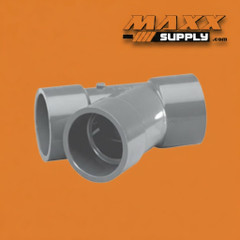


Wye PVC Schedule 80 8" x 4" (875-582)
$418.68
Blue Monster 76037 1-Step PVC Cement Clear (32OZ)
The 8" x 8" x 4" Schedule 80 Gray PVC Wye (875-582, Slip x Slip x Slip) is a large-diameter, heavy-wall specialty branch fitting manufactured to ASTM D2467 in Schedule 80 gray PVC — a wye configuration in which the two run connections are 8" and the branch connection is 4", with the 4" branch port oriented at a 45-degree angle to the 8" run axis rather than the 90-degree perpendicular branch geometry of the standard reducing tee series. The 875-582 provides a single-body Schedule 80 PVC solution for taking a 4" angled lateral branch connection off an 8" primary transmission or distribution main — maintaining the full 8" primary run flow path through both run ports while providing the hydraulically superior, lower-pressure-loss, lower-turbulence branch entry geometry of the 45-degree wye configuration for the 4" branch that the perpendicular reducing tee cannot replicate at any branch size or run size in the standard Schedule 80 PVC socket fitting line. The 875-582 is the geometric midpoint configuration of the Spears 875 series Schedule 80 PVC wye line at the 8" run size — the fitting where the 4" branch at exactly 50% of the 8" run diameter positions the wye at the hydraulic boundary between the true lateral service tap role of the smaller-branch configurations and the near-equal flow division role of the larger-branch configuration, and where the 4" IPS branch pipe size connects the 8" primary main to the single most commercially active mid-scale pipe diameter in the commercial PVC distribution, zone supply, equipment supply, and process piping market. The 875-582 is the correct fitting wherever a 12" Schedule 80 PVC primary main must supply a 4" angled lateral branch through the 45-degree wye geometry's superior hydraulic performance — wherever the system's hydraulic design, branch flow characteristics, or operational requirements establish the 45-degree angled branch entry as the preferred or required specification over the perpendicular tee branch at the 4" service size on the 8" primary main.
The wye fitting's hydraulic advantage over the reducing tee at the branch connection is the central specification fact that drives every application where the 875-582 is the preferred or required fitting over the Schedule 80 reducing tee at the 8" x 4" size combination — and at the 50% geometric midpoint ratio, these advantages are measurably more pronounced and operationally more consequential than at the smaller-branch wye configurations in the same series. In a standard reducing tee at the 8" x 4" size, the 4" branch port is oriented perpendicular to the 8" primary run axis, and a substantial fraction of the primary run flow must undergo a 90-degree direction change at the branch entry. At the 50% branch-to-run ratio, the 4" branch carries exactly half the primary run flow's cross-sectional capacity — a flow fraction that is meaningfully larger than the minimal fractions at the 875-578 (25%) and 875-580 (37.5%), and that generates a correspondingly larger flow separation zone at the inner radius of the perpendicular branch entry, more turbulence throughout the 90-degree entry throat, a higher pressure loss coefficient at the branch junction, a more pronounced velocity profile distortion in the 4" branch pipe downstream of the junction, and a larger unbalanced hydraulic thrust force at the tee body directed laterally at the branch entry — effects that scale with branch flow fraction and that are meaningfully more significant at the 50% midpoint ratio than at the two smaller-branch wye configurations in the 875 series at the 8" run. In the wye configuration, the 4" branch port is oriented at 45 degrees to the primary run axis, and the moderate flow fraction diverting into the 4" branch undergoes only a 45-degree direction change — substantially reducing the flow separation zone, reducing the turbulence and pressure loss coefficient at the branch entry, producing a more uniform velocity profile in the 4" branch pipe downstream of the junction, and reducing the unbalanced lateral force on the fitting body at the branch entry. The wye geometry's hydraulic and structural advantages over the tee geometry at the 875-582's 50% ratio are quantifiable, consistent, and operationally consequential across the full range of flow conditions the fitting serves — and they are more significant at the 50% midpoint than at either the 25% or 37.5% smaller-branch configurations in the Spears 875 series, reflecting the scaling relationship between branch flow fraction and the magnitude of the wye's performance advantage over the perpendicular tee at equivalent size combinations.
The 875-582 occupies a specific and precisely defined position in the Spears 875 series hydraulic progression at the 8" run size. The series advances from the 25% minimal lateral of the 875-578 through the 37.5% modest lateral of the 875-580 to the 50% geometric midpoint of the 875-582 and then to the 75% near-equal configuration of the 875-585 — a progression where both the wye's specification rationale relative to the tee and the downstream system's infrastructure scale increase at each step. At the 50% midpoint, the 875-582 sits precisely where the branch transitions from a service tap that draws a relatively modest fraction of the primary flow to a moderate lateral that draws exactly half the primary run flow's cross-sectional capacity and requires explicit accounting in the primary system's hydraulic analysis. Unlike the 875-578 and 875-580 where the branch flow fraction is small enough that its effect on the continuing 8" primary run can be treated as minor, the 875-582's 50% ratio means the 4" branch withdraws a flow fraction that is large enough to affect the continuing 8" primary run's residual velocity and pressure in a hydraulically meaningful way — a junction where the system engineer must account for both the 4" branch's supply pressure and the continuing 8" primary run's residual pressure after the 50% branch withdrawal in the primary system's hydraulic analysis. This hydraulic accounting requirement distinguishes the 875-582 from the smaller-branch wye configurations in the series and is the hydraulic design signal that positions the 875-582 as a moderate lateral fitting rather than a simple service tap at the 8" primary main level.
The 4" IPS branch pipe size positions the downstream connection at the most commercially active mid-scale pipe diameter in the commercial PVC distribution market — the branch size that connects the 8" primary main to the broadest possible range of downstream mid-commercial distribution and service applications across every industry the 875-582 serves. At 4" IPS, the downstream branch system serves the most diverse range of application contexts of any branch size in the Spears 875 series at the 8" run: the most common commercial irrigation zone supply and sub-main pipe size connecting 8" primary transmission mains to individual irrigation zones, valve manifolds, and control valve stations; the most common commercial pool and aquatics facility primary recirculation pipe size connecting 8" primary supply mains to pool pump systems and filter equipment; the most common commercial and light industrial service lateral size for mid-scale building service connections from 8" primary distribution mains; the most common HVAC branch supply pipe size for mid-scale building zone supply connections from 8" large-campus primary distribution headers; the most common industrial process equipment section supply pipe size connecting 8" process primary headers to mid-scale equipment sections and production areas; the most common zone supply header size in municipal secondary distribution systems connecting 8" primary mains to mid-scale residential and commercial service areas; and a widely used pump station branch connection size at discharge header lateral connections, chemical injection supply branches, and instrument supply manifold connections. The breadth of 4" IPS downstream application contexts means that the 875-582 serves the most diverse range of mid-commercial system types and branch service scenarios of any configuration in the Spears 875 series at the 8" run size — a moderate lateral wye that appears at zone supply lateral connections, major service branches, equipment supply headers, secondary distribution connections, and process section supply points across every industry and application category in the commercial Schedule 80 PVC market simultaneously. This application breadth, combined with the wye geometry's more pronounced hydraulic advantage at the 50% midpoint ratio relative to the smaller-branch configurations, and the 4" IPS size's dominant position in the commercial mid-scale PVC distribution market, makes the 875-582 the most broadly applicable and most commercially active configuration in the Spears 875 series Schedule 80 wye line at the 8" run size — the geometric and commercial midpoint fitting that connects more primary main installations to more downstream mid-commercial systems than any other branch size in the 875 series at this run diameter.
The 875-582 also reflects the wye geometry's structural loading advantage at the geometric midpoint of the Spears 875 series at the 8" run, where the 50% branch flow fraction produces a meaningfully larger branch entry lateral force on the fitting body than the smaller-branch configurations but a smaller force than the near-equal 875-585. In a standard reducing tee at the 8" x 4" size, the 90-degree branch port subjects the fitting body to a direct lateral thrust force at the branch entry whose magnitude at the 50% flow fraction is substantially larger than at the 875-578 (25%) and 875-580 (37.5%) — a lateral force that the tee body and the cemented socket joints at both run ports must absorb under sustained primary main operating conditions. In the wye configuration, the 45-degree branch orientation distributes this momentum change force between the primary run direction and the perpendicular direction, reducing the lateral component that the fitting body and socket joints must absorb. At the 50% branch flow fraction on an 8" primary main, the wye geometry's force distribution advantage over the perpendicular tee is more consequential than at the smaller-branch configurations — the absolute magnitude of the branch entry force at 50% is large enough that the angular distribution provided by the wye geometry represents a meaningful structural service life advantage over the tee alternative, accumulating across the installation's full operating life as reduced asymmetric lateral stress on the fitting body and cemented socket joints under sustained primary main service pressure conditions.
Schedule 80 gray PVC construction is the correct and only material specification for this fitting across every application where the 8" x 8" x 4" wye configuration is required in a Schedule 80 piping system. The Schedule 80 wall thickness applied uniformly through the complete wye body — across both 8" run ports, through the full angled branch body, and at the 4" branch socket — provides the structural integrity and pressure performance required at the geometric midpoint branch connection on an 8" primary main where the 50% flow fraction produces the moderate-to-substantial combined pressure loading and branch entry force that Schedule 80 construction is specified to handle throughout the fitting's service life. The gray color provides the permanent, inspectable Schedule 80 material class identification at the primary main angled branch connection — confirming the installed material class for inspectors, maintenance engineers, and facility managers at the wye branch takeoff location in the 8" primary system. PVC Type 1 Grade 1 construction with cell classification 12454 per ASTM D1784 provides broad chemical resistance across water treatment chemicals, process water service, industrial utility water, and the full range of non-solvent process fluids appropriate for Schedule 80 PVC primary main service. All three socket connections solvent cement directly onto standard IPS Schedule 40 or Schedule 80 PVC pipe of the corresponding nominal sizes — 8" IPS schedule pipe on both run ports and 4" IPS schedule pipe on the branch port. At the 8" run socket connections, heavy-body solvent cement is mandatory, pre-planned assembly with both 8" pipe ends accessible and positioned before any cement application begins is essential, and full cure time compliance before system pressurization is non-negotiable. The 4" branch socket connection requires the same heavy-body cement and full cure time compliance as the 8" run sockets — the branch socket on a large-diameter primary main fitting carries the full system operating pressure at the branch port regardless of the branch pipe size relative to the run, and joint integrity at the 4" wye branch socket is as operationally critical as at the 8" run connections under primary main service pressure conditions; at the 875-582's 50% branch-to-run ratio, the 4" branch socket on the 8" primary main wye body is a hydraulically active connection carrying a substantial flow fraction whose pressure loading on the branch socket joint must be respected with the same cement application rigor as the 8" run connections. The 45-degree branch orientation of the wye geometry must be confirmed in the installation layout before any cement is applied — the 4" branch pipe's routing direction at 45 degrees to the primary 8" run axis must be verified against the system's piping layout drawing and the downstream 4" branch pipe routing clearances before the fitting is cemented into the 8" primary main run, because the wye branch angle is fixed at 45 degrees and cannot be adjusted after cement application has begun; plan all pipe routing, support locations, and downstream 4" branch system alignment clearances before beginning cement assembly on the 875-582.
NSF 61 certification lists this fitting for potable water contact, and NSF 14 covers compliance with applicable plastics piping material standards — making it the correct primary main wye branch fitting for municipal water treatment and distribution systems, large potable water pump station primary headers, and large commercial and institutional water supply primary mains where NSF-listed materials are required at every fitting in the primary distribution system. ASTM D2467 governs Schedule 80 PVC socket fittings and defines the manufacturing, dimensional, and pressure performance requirements the 875-582 is produced to. Verify manufacturer pressure rating documentation for the specific fitting configuration before final system specification — at the 8" x 8" x 4" Schedule 80 PVC wye configuration, the governing pressure rating is determined by the largest port size (8") and the fitting's tested performance at this geometric midpoint wye geometry under primary main service conditions, and must be confirmed against the manufacturer's published pressure-temperature rating table for SKU 875-582 before installation in systems at or near the fitting's rated pressure ceiling.
Key Features:
- Schedule 80 gray PVC wye — 8" x 8" run x 4" branch, all socket (slip) ends; Spears 875 series Schedule 80 PVC wye
- Geometric midpoint configuration in the Spears 875 series at the 8" run — 4" branch at exactly 50% of 8" run diameter; hydraulic boundary between true lateral service tap and near-equal flow division character
- Wye geometry advantages over perpendicular tee are meaningfully more pronounced at the 50% midpoint ratio than at the 875-578 (25%) and 875-580 (37.5%) configurations — lower turbulence, reduced pressure loss coefficient, shorter equivalent length, and lower lateral fitting body loading scale with branch flow fraction and reach their most commercially significant levels within the lower half of the 875 series at the 8" run at this midpoint configuration
- 4" IPS branch — most commercially active mid-scale pipe size in the commercial PVC distribution market; widest downstream application breadth of any branch size in the Spears 875 series at the 8" run; connects 8" primary infrastructure to the broadest range of mid-commercial zone supply, equipment supply, and service distribution systems
- Geometric midpoint branch flow fraction — 4" branch at 50% requires explicit hydraulic accounting of both the continuing 8" primary run residual pressure and the 4" branch supply pressure in the primary system design; more hydraulically consequential than the smaller-branch wye configurations at 25% and 37.5%
- Most broadly applicable and most commercially active configuration in the Spears 875 series Schedule 80 wye line at the 8" run — broadest downstream application context coverage of any branch size in the series at this run diameter
- Manufactured to ASTM D2467 — governing standard for Schedule 80 PVC socket fittings
- NSF 61 certified for potable water contact; NSF 14 listed
- Solvent cement socket connections compatible with Schedule 40 and Schedule 80 IPS pipe at both run and branch sizes
- Gray color — universal Schedule 80 material class identification
- 45-degree branch angle is fixed — confirm 4" branch pipe routing direction, alignment, and clearances in layout before cementing; wye orientation cannot be adjusted after cement application begins
- Cell classification PVC 12454 per ASTM D1784
- Heavy-body solvent cement required at all three socket connections including the 4" branch; full cure time compliance mandatory before pressurization
- Pressure rating: verify against manufacturer pressure-temperature table for SKU 875-582
Specifications:
| Attribute | Value |
|---|---|
| SKU | 875-582 |
| Fitting Type | Wye (Y-Fitting) |
| Series | Spears 875 Schedule 80 PVC Wye |
| Run Size | 8" x 8" |
| Branch Size | 4" |
| Branch-to-Run Ratio | 50% |
| Branch Angle | 45 Degrees to Run Axis |
| End Connections | Slip x Slip x Slip (All Socket) |
| Connection Method | Solvent Cement (IPS) |
| Compatible Pipe — Run | 8" IPS Schedule 40 or Schedule 80 PVC |
| Compatible Pipe — Branch | 4" IPS Schedule 40 or Schedule 80 PVC |
| Schedule | Schedule 80 |
| Material | PVC (Polyvinyl Chloride) Type 1, Grade 1 |
| Cell Classification | 12454 per ASTM D1784 |
| Color | Gray |
| Manufacturing Standard | ASTM D2467 |
| Potable Water Certification | NSF/ANSI 61 |
| Plastics Standard Certification | NSF 14 |
| Max Service Temperature | 140°F (60°C) |
| Pressure Rating | Verify with manufacturer pressure-temperature rating table for SKU 875-582 |
Industries & Applications:
- Pump Station — Moderate Lateral 4" Branch Connections on 8" Primary Discharge and Suction Headers at the Midpoint Wye Configuration — The 8" x 8" x 4" Schedule 80 PVC wye is specified at pump station primary header 4" branch connection points where the 45-degree wye geometry's hydraulic and structural advantages over the perpendicular reducing tee are most commercially significant within the lower half of the Spears 875 series at the 8" run — pump station primary discharge headers providing 4" socket wye branch connections to zone supply laterals, secondary distribution connections, chemical injection supply branches, bypass valve assemblies, and instrument supply manifold connections where the 4" branch carries a substantial 50% flow fraction and the wye geometry's lower pressure loss coefficient at the midpoint ratio preserves meaningfully more available discharge pressure in the 4" branch supply system than the perpendicular tee would at the same operating conditions; primary discharge headers providing 4" socket wye branches to pressure relief valve inlet branches and bypass valve connections where the wye geometry's more uniform branch velocity profile supports more accurate static pressure signal at the relief valve sensing port and more consistent bypass flow performance relative to the distorted branch velocity profile of a perpendicular tee; suction header 4" branch connections to pump unit suction laterals where the wye geometry's reduced turbulence at the moderate 50% flow fraction decreases flow-induced pressure pulsation and velocity distortion at the pump unit suction port — a pump protection benefit that is more consequential at the 50% midpoint flow fraction than at the smaller-branch wye configurations where the suction branch flow fraction is smaller; and pump station manifold primary headers providing 4" socket wye branches to parallel distribution connections at pump station output manifolds where the 4" IPS branch pipe size serves the broadest range of manifold branch connection types and the wye geometry's lower pressure loss preserves the most available manifold supply pressure across all parallel 4" distribution branches simultaneously; the 875-582's wye geometry advantages over the perpendicular tee are more pronounced at the 50% midpoint ratio than at the 875-578 and 875-580 because the 50% flow fraction amplifies every unit of pressure loss, turbulence reduction, and structural loading advantage that the 45-degree geometry provides relative to the 90-degree perpendicular tee at the same pump station operating conditions
- Municipal Water Distribution — Midpoint 4" Zone Supply and Major Service Lateral Connections on 8" Primary Mains — Installed at 4" IPS lateral branch connection points on 8" municipal water transmission and primary distribution mains in Schedule 80 PVC systems where the hydraulic design has established 4" as the correct branch pipe size and the system engineer has specified wye geometry to minimize pressure loss and turbulence at the moderate 50% branch-to-run ratio — major zone supply lateral connections supplying 4" socket Schedule 80 PVC zone distribution headers serving mid-scale residential and commercial service areas where the zone's combined peak demand is correctly sized at 4" IPS and the lower wye branch entry pressure loss directly improves the available supply pressure at the downstream zone header relative to the perpendicular tee; 8" primary main lateral connections where the 4" branch's 50% flow fraction makes the wye geometry's shorter equivalent length most consequential to the primary system's available pressure budget — the 875-582's lower pressure loss at the 50% branch-to-run ratio delivers a larger per-fitting pressure preservation benefit than the smaller-branch wye configurations in the same series; primary main 4" service lateral connections to large commercial properties, municipal facilities, and light industrial buildings where the service lateral pipe sizing has been established at 4" IPS and the wye geometry provides a more uniform velocity profile in the 4" service lateral pipe immediately downstream of the primary main junction — benefiting large commercial water meter accuracy and backflow preventer performance at 4" service connections; and municipal 8" primary main near-equal flow distribution points where the 50% branch fraction means the primary main must continue to supply downstream areas at a meaningfully reduced flow fraction after the 4" branch withdrawal, requiring explicit hydraulic confirmation of the continuing 8" primary run's residual pressure in the primary system's hydraulic design; NSF 61 listing confirms potable water fitness at every municipal water distribution wye branch connection
- Water Treatment Plant — Midpoint 4" Branch Connections on 8" Primary Process and Distribution Headers — Used at 4" IPS lateral branch connection points on 8" primary distribution headers in municipal and industrial water treatment plants where the 45-degree wye geometry's hydraulic advantages at the midpoint 50% branch-to-run ratio provide measurably superior branch entry performance over the perpendicular tee — clearwell supply and distribution primary headers providing 4" socket wye branches to zone distribution connections supplying major treatment process sections where the 50% branch flow fraction makes the wye geometry's lower turbulence and more uniform branch velocity profile most consequential to downstream instrument accuracy and process equipment performance; filter influent and effluent primary headers providing 4" socket wye branches to individual filter supply and return connections where the per-filter flow rate at the midpoint ratio requires the wye geometry's most favorable pressure loss performance to maintain adequate filtration pressure differential across all filters served by the primary header; backwash primary supply headers providing 4" socket wye branches to individual filter backwash connections where the high instantaneous backwash flow at the 50% fraction makes the wye geometry's structural loading advantage over the tee more consequential to fitting body and socket joint service life than at the smaller-branch configurations; chemical injection and dosing primary supply headers providing 4" socket wye branches to secondary chemical distribution systems where the wye's more uniform branch velocity profile supports more consistent chemical concentration downstream of the injection point; and plant service water primary headers providing 4" socket wye branches to major equipment sections where the 50% midpoint flow fraction requires the wye geometry's lower pressure loss to preserve adequate service water supply pressure in both the continuing 8" primary run and the 4" equipment section supply branch; NSF 61 listing confirms potable water fitness at every water treatment plant primary distribution wye branch connection in Schedule 80 PVC systems
- Large Commercial & Agricultural Irrigation — Midpoint 4" Zone Supply and Sector Lateral Connections on 8" Primary Transmission Mains — Specified at 4" IPS lateral branch takeoff points on 8" primary irrigation transmission mains at the largest commercial irrigation systems — major golf course and resort irrigation systems, large-acreage agricultural operations, and regional landscape and municipal park irrigation projects where the irrigation hydraulic design has established 4" IPS as the correct branch pipe size for zone supply lateral or sector sub-main connections and the system engineer has specified wye geometry to minimize branch entry pressure loss at the midpoint 50% branch-to-run ratio; at large commercial irrigation systems where 8" primary transmission mains serve entire irrigated properties or major property sections and 4" IPS is the standard zone supply lateral and sector sub-main pipe size serving individual irrigation zones and valve manifolds, the 875-582 is specified at the most hydraulically sensitive zone supply lateral connections — those where the 4" branch carries a 50% flow fraction large enough that the wye geometry's lower pressure loss at the branch entry delivers a measurable improvement in available zone supply pressure at the downstream valve manifold relative to the perpendicular tee; the accumulated pressure loss at multiple 4" zone supply lateral connections along an 8" primary main is reduced at each 875-582 installation relative to the perpendicular tee alternative — and at the 50% midpoint flow fraction, this per-fitting pressure loss reduction is larger than at the 875-578 and 875-580, making the 875-582 the most pressure-efficient 4" lateral branch specification available in the Schedule 80 PVC socket wye line at the 8" run; the wye geometry's reduced turbulence at the 4" zone supply branch entry under peak irrigation demand flow conditions also reduces the hydraulic noise and velocity instability in the 4" zone supply lateral pipe at high-velocity pump discharge conditions — a benefit to downstream solenoid valve operation, hydraulic control valve performance, and zone pipe longevity that accumulates across the irrigation system's full service life; the 45-degree branch orientation must be confirmed in the irrigation system's piping layout drawing before cementing — the 4" branch pipe's 45-degree exit direction from the primary main must align with the downstream zone supply lateral routing and the valve manifold's inlet orientation before the 875-582 is cemented into the 8" primary main
- Industrial Process Piping — Midpoint 4" Equipment Section Supply and Zone Distribution Branch Connections on 8" Primary Headers — Specified at 4" IPS lateral branch connection points on 8" process water primary headers, cooling water primary distribution trunks, and plant utility water primary mains in manufacturing plants, chemical processing facilities, petrochemical support facilities, and heavy industrial environments where the process engineer has specified wye geometry at the midpoint 4" branch connection to minimize pressure loss and turbulence at the branch entry — 8" primary process water headers providing 4" socket wye branches to mid-scale process equipment cooling sections where the 50% flow fraction makes the wye geometry's lower pressure loss coefficient most consequential to maintaining adequate cooling water supply pressure at the downstream equipment section; cooling water primary distribution trunks providing 4" socket wye branches to heat exchanger battery supply headers where the midpoint flow fraction and the wye geometry's more uniform downstream velocity profile improve heat exchanger performance consistency relative to the distorted velocity profile that the perpendicular tee branch would produce at the same flow conditions; plant utility water primary mains providing 4" socket wye branches to major production area utility water distribution headers where the 50% branch flow fraction requires the wye geometry's lower pressure loss to preserve adequate utility water supply pressure in both the continuing 8" primary run and the 4" production area supply branch; and primary headers at 4" flow measurement installations where the wye geometry's more uniform downstream velocity profile supports improved magnetic flow meter, turbine meter, or vortex flow meter measurement accuracy at instruments installed in the 4" branch pipe within the straight pipe run distances from the primary header connection — a benefit that is more significant at the 50% midpoint flow fraction than at the smaller-branch wye configurations because the larger branch flow volume amplifies every unit of velocity profile uniformity improvement provided by the wye geometry over the perpendicular tee; the 875-582's wye geometry advantages are most worth the specification investment at industrial process primary headers where the 4" branch flow measurement accuracy, chemical dosing consistency, and equipment supply pressure are explicit process performance parameters that the hydraulic design accounts for at the branch connection level
- Municipal Well Field — Midpoint 4" Collection and Distribution Branch Connections on 8" Primary Headers — Used at 4" IPS lateral branch connections on 8" primary well field collection or distribution headers in municipal and commercial well field installations where the 50% midpoint branch-to-run ratio and the wye geometry's midpoint-scale hydraulic advantages apply — primary collection headers providing 4" socket wye branches to individual well pump or well cluster sub-collection connections where the per-well or per-cluster output at the 50% flow fraction is hydraulically significant enough that the wye geometry's lower turbulence at the branch entry reduces collection junction noise and pressure pulsation under high well pump output conditions; primary distribution headers providing 4" socket wye branches to major zone transmission laterals where the 4" zone lateral carries a 50% flow fraction of the primary distribution header requiring explicit hydraulic accounting of the continuing 8" primary run's residual pressure and the 4" zone lateral's supply pressure after the midpoint branch withdrawal; pump station primary discharge headers at well field pump stations providing 4" socket wye branches to major distribution connections where the wye geometry's lower pressure loss at the 50% flow fraction preserves more available discharge pressure for both the continuing primary run and the 4" major distribution branch; and primary collection and distribution headers at well head structures and booster pump stations where compact 4" wye branch connections to secondary supply and distribution systems require the wye geometry's angular branch orientation for routing clearances in the constrained dimensional envelopes of well head and booster pump structures; Schedule 80 construction handles the high well pump operating pressures, shut-off head, and surge conditions at well field primary header 4" branch connections where the 50% midpoint flow fraction makes the structural loading at the branch junction more significant than at the smaller-branch wye configurations
- Water & Wastewater Treatment — Midpoint 4" Lateral Branch Connections on 8" Primary Process Distribution Headers — Installed at 4" IPS lateral branch connection points on 8" primary process distribution headers in industrial wastewater treatment, water reclamation, and large-scale industrial water management facilities where the midpoint 50% branch-to-run ratio and the wye geometry's more pronounced hydraulic advantages at this ratio apply — primary influent distribution headers providing 4" socket wye branches to individual treatment zone feed connections where the per-zone influent flow fraction at 50% makes the wye geometry's lower turbulence at the branch entry more consequential to treatment performance uniformity across parallel treatment zones; primary effluent distribution headers providing 4" socket wye branches to major disposal or reuse distribution laterals where the midpoint flow fraction requires full hydraulic accounting of the continuing primary run's residual pressure and the 4" lateral's supply pressure in the facility's hydraulic design; aeration system primary supply headers providing 4" socket wye branches to individual aeration zone supply connections where the wye geometry's reduced turbulence at the 50% flow fraction supports more uniform aeration distribution and reduces air entrainment complications at the midpoint-scale branch entry; polymer and chemical metering system primary supply headers providing 4" socket wye branches to secondary distribution connections where the wye geometry's more uniform branch velocity profile improves chemical dosing consistency downstream of the metering point at the 50% flow fraction; and primary process distribution headers at analytical instrument supply manifold branch connections where the wye geometry's more uniform downstream velocity profile at the midpoint ratio improves the accuracy and stability of flow meters, pressure transmitters, and water quality instruments installed in the 4" branch supply pipe at the primary header connection level; Schedule 80 PVC construction handles continuous chemical exposure, high-pressure primary header service, and the moderate-to-substantial structural loading of 50% midpoint branch flow conditions at the 8" primary process header level
- HVAC & Large Commercial Mechanical Systems — Midpoint 4" Zone Supply and Building Loop Branch Connections on 8" Primary Distribution Mains — Specified at 4" IPS lateral branch supply connections on 8" primary chilled water distribution mains, condenser water primary trunks, and large-capacity hydronic heating and cooling primary distribution headers in Schedule 80 PVC systems at large commercial campus, institutional, and industrial mechanical systems where the midpoint 50% branch-to-run ratio positions the 875-582 at the primary distribution main's most hydraulically sensitive 4" zone supply branch connections — primary HVAC distribution headers providing 4" socket wye branches to building loop supply connections for mid-scale buildings or building sections whose peak chilled or condenser water demand represents a 50% flow fraction of the 8" primary distribution header and where the wye geometry's lower branch entry pressure loss directly improves the building loop supply pressure available to terminal equipment; campus primary distribution mains providing 4" socket wye branches to major building sector supply connections where the 50% flow fraction makes the wye geometry's shorter equivalent length most consequential to campus system hydraulic balance — the 875-582's pressure loss reduction at the midpoint ratio is larger per fitting than at either the 875-578 or 875-580 and directly benefits the available pressure at both the continuing 8" primary run and the 4" building sector supply branch; primary distribution trunks providing 4" socket wye branches to campus chilled water sub-loop supply connections where the midpoint flow fraction and the wye geometry's more uniform branch velocity profile improve differential pressure transmitter accuracy and system balancing precision at the primary distribution branch connection level; and air release and combination air vacuum valve supply branch connections at 4" IPS where the wye geometry's lower turbulence reduces air entrainment at the branch entry and provides a more stable static pressure signal to the air release valve sensing port under full primary distribution flow conditions; Schedule 80 PVC construction satisfies the pressure and material class specification requirements at 8" primary HVAC distribution wye branch connections where Schedule 80 is the system-wide material standard
- Aquaculture & Large-Scale Water Management Infrastructure — Used at 4" IPS lateral branch connections on 8" primary water supply, recirculation, or distribution headers at the largest commercial aquaculture facilities, regional hatchery systems, and large recirculating aquaculture systems (RAS) where the midpoint 50% branch-to-run ratio and the wye geometry's most practically significant hydraulic advantages within the lower half of the 875 series apply at production-critical primary distribution branch connections — primary recirculation headers providing 4" socket wye branches to individual production section recirculation supply connections where the 50% flow fraction at the branch entry requires the wye geometry's most favorable turbulence and pressure loss characteristics to maintain adequate recirculation pressure and flow uniformity in both the continuing 8" primary run and the 4" production section supply branch; primary treatment supply headers providing 4" socket wye branches to individual filter train supply connections where the midpoint branch flow fraction and the wye geometry's more uniform downstream velocity profile support more consistent filtration loading across parallel filter trains in the RAS water treatment system; primary aeration and oxygenation supply headers providing 4" socket wye branches to individual aeration section supply connections where the wye geometry's lower turbulence at the 50% flow fraction reduces dissolved oxygen stripping at the branch entry and supports more uniform dissolved oxygen distribution in the 4" aeration supply branch downstream of the primary header junction; and primary disinfection and water conditioning headers providing 4" socket wye branches to individual parallel conditioning path supply connections where the midpoint flow division between the continuing primary run and the 4" conditioning branch requires the wye geometry's most favorable pressure loss and turbulence characteristics to maintain consistent water quality treatment performance across parallel conditioning sections serving different production areas; NSF 61 listing confirms fitness for potable and process water contact at every wye branch connection in the primary aquaculture distribution system; Schedule 80 PVC construction handles continuous water contact, treatment chemical exposure, and the moderate-to-substantial structural loading of 50% midpoint branch flow conditions at the 8" primary aquaculture distribution level
(No reviews yet)

Write a Review

Wye PVC Schedule 80 8" x 4" (875-582)
Blue Monster 76037 1-Step PVC Cement Clear (32OZ)
The 8" x 8" x 4" Schedule 80 Gray PVC Wye (875-582, Slip x Slip x Slip) is a large-diameter, heavy-wall specialty branch fitting manufactured to ASTM D2467 in Schedule 80 gray PVC — a wye configuration in which the two run connections are 8" and the branch connection is 4", with the 4" branch port oriented at a 45-degree angle to the 8" run axis rather than the 90-degree perpendicular branch geometry of the standard reducing tee series. The 875-582 provides a single-body Schedule 80 PVC solution for taking a 4" angled lateral branch connection off an 8" primary transmission or distribution main — maintaining the full 8" primary run flow path through both run ports while providing the hydraulically superior, lower-pressure-loss, lower-turbulence branch entry geometry of the 45-degree wye configuration for the 4" branch that the perpendicular reducing tee cannot replicate at any branch size or run size in the standard Schedule 80 PVC socket fitting line. The 875-582 is the geometric midpoint configuration of the Spears 875 series Schedule 80 PVC wye line at the 8" run size — the fitting where the 4" branch at exactly 50% of the 8" run diameter positions the wye at the hydraulic boundary between the true lateral service tap role of the smaller-branch configurations and the near-equal flow division role of the larger-branch configuration, and where the 4" IPS branch pipe size connects the 8" primary main to the single most commercially active mid-scale pipe diameter in the commercial PVC distribution, zone supply, equipment supply, and process piping market. The 875-582 is the correct fitting wherever a 12" Schedule 80 PVC primary main must supply a 4" angled lateral branch through the 45-degree wye geometry's superior hydraulic performance — wherever the system's hydraulic design, branch flow characteristics, or operational requirements establish the 45-degree angled branch entry as the preferred or required specification over the perpendicular tee branch at the 4" service size on the 8" primary main.
The wye fitting's hydraulic advantage over the reducing tee at the branch connection is the central specification fact that drives every application where the 875-582 is the preferred or required fitting over the Schedule 80 reducing tee at the 8" x 4" size combination — and at the 50% geometric midpoint ratio, these advantages are measurably more pronounced and operationally more consequential than at the smaller-branch wye configurations in the same series. In a standard reducing tee at the 8" x 4" size, the 4" branch port is oriented perpendicular to the 8" primary run axis, and a substantial fraction of the primary run flow must undergo a 90-degree direction change at the branch entry. At the 50% branch-to-run ratio, the 4" branch carries exactly half the primary run flow's cross-sectional capacity — a flow fraction that is meaningfully larger than the minimal fractions at the 875-578 (25%) and 875-580 (37.5%), and that generates a correspondingly larger flow separation zone at the inner radius of the perpendicular branch entry, more turbulence throughout the 90-degree entry throat, a higher pressure loss coefficient at the branch junction, a more pronounced velocity profile distortion in the 4" branch pipe downstream of the junction, and a larger unbalanced hydraulic thrust force at the tee body directed laterally at the branch entry — effects that scale with branch flow fraction and that are meaningfully more significant at the 50% midpoint ratio than at the two smaller-branch wye configurations in the 875 series at the 8" run. In the wye configuration, the 4" branch port is oriented at 45 degrees to the primary run axis, and the moderate flow fraction diverting into the 4" branch undergoes only a 45-degree direction change — substantially reducing the flow separation zone, reducing the turbulence and pressure loss coefficient at the branch entry, producing a more uniform velocity profile in the 4" branch pipe downstream of the junction, and reducing the unbalanced lateral force on the fitting body at the branch entry. The wye geometry's hydraulic and structural advantages over the tee geometry at the 875-582's 50% ratio are quantifiable, consistent, and operationally consequential across the full range of flow conditions the fitting serves — and they are more significant at the 50% midpoint than at either the 25% or 37.5% smaller-branch configurations in the Spears 875 series, reflecting the scaling relationship between branch flow fraction and the magnitude of the wye's performance advantage over the perpendicular tee at equivalent size combinations.
The 875-582 occupies a specific and precisely defined position in the Spears 875 series hydraulic progression at the 8" run size. The series advances from the 25% minimal lateral of the 875-578 through the 37.5% modest lateral of the 875-580 to the 50% geometric midpoint of the 875-582 and then to the 75% near-equal configuration of the 875-585 — a progression where both the wye's specification rationale relative to the tee and the downstream system's infrastructure scale increase at each step. At the 50% midpoint, the 875-582 sits precisely where the branch transitions from a service tap that draws a relatively modest fraction of the primary flow to a moderate lateral that draws exactly half the primary run flow's cross-sectional capacity and requires explicit accounting in the primary system's hydraulic analysis. Unlike the 875-578 and 875-580 where the branch flow fraction is small enough that its effect on the continuing 8" primary run can be treated as minor, the 875-582's 50% ratio means the 4" branch withdraws a flow fraction that is large enough to affect the continuing 8" primary run's residual velocity and pressure in a hydraulically meaningful way — a junction where the system engineer must account for both the 4" branch's supply pressure and the continuing 8" primary run's residual pressure after the 50% branch withdrawal in the primary system's hydraulic analysis. This hydraulic accounting requirement distinguishes the 875-582 from the smaller-branch wye configurations in the series and is the hydraulic design signal that positions the 875-582 as a moderate lateral fitting rather than a simple service tap at the 8" primary main level.
The 4" IPS branch pipe size positions the downstream connection at the most commercially active mid-scale pipe diameter in the commercial PVC distribution market — the branch size that connects the 8" primary main to the broadest possible range of downstream mid-commercial distribution and service applications across every industry the 875-582 serves. At 4" IPS, the downstream branch system serves the most diverse range of application contexts of any branch size in the Spears 875 series at the 8" run: the most common commercial irrigation zone supply and sub-main pipe size connecting 8" primary transmission mains to individual irrigation zones, valve manifolds, and control valve stations; the most common commercial pool and aquatics facility primary recirculation pipe size connecting 8" primary supply mains to pool pump systems and filter equipment; the most common commercial and light industrial service lateral size for mid-scale building service connections from 8" primary distribution mains; the most common HVAC branch supply pipe size for mid-scale building zone supply connections from 8" large-campus primary distribution headers; the most common industrial process equipment section supply pipe size connecting 8" process primary headers to mid-scale equipment sections and production areas; the most common zone supply header size in municipal secondary distribution systems connecting 8" primary mains to mid-scale residential and commercial service areas; and a widely used pump station branch connection size at discharge header lateral connections, chemical injection supply branches, and instrument supply manifold connections. The breadth of 4" IPS downstream application contexts means that the 875-582 serves the most diverse range of mid-commercial system types and branch service scenarios of any configuration in the Spears 875 series at the 8" run size — a moderate lateral wye that appears at zone supply lateral connections, major service branches, equipment supply headers, secondary distribution connections, and process section supply points across every industry and application category in the commercial Schedule 80 PVC market simultaneously. This application breadth, combined with the wye geometry's more pronounced hydraulic advantage at the 50% midpoint ratio relative to the smaller-branch configurations, and the 4" IPS size's dominant position in the commercial mid-scale PVC distribution market, makes the 875-582 the most broadly applicable and most commercially active configuration in the Spears 875 series Schedule 80 wye line at the 8" run size — the geometric and commercial midpoint fitting that connects more primary main installations to more downstream mid-commercial systems than any other branch size in the 875 series at this run diameter.
The 875-582 also reflects the wye geometry's structural loading advantage at the geometric midpoint of the Spears 875 series at the 8" run, where the 50% branch flow fraction produces a meaningfully larger branch entry lateral force on the fitting body than the smaller-branch configurations but a smaller force than the near-equal 875-585. In a standard reducing tee at the 8" x 4" size, the 90-degree branch port subjects the fitting body to a direct lateral thrust force at the branch entry whose magnitude at the 50% flow fraction is substantially larger than at the 875-578 (25%) and 875-580 (37.5%) — a lateral force that the tee body and the cemented socket joints at both run ports must absorb under sustained primary main operating conditions. In the wye configuration, the 45-degree branch orientation distributes this momentum change force between the primary run direction and the perpendicular direction, reducing the lateral component that the fitting body and socket joints must absorb. At the 50% branch flow fraction on an 8" primary main, the wye geometry's force distribution advantage over the perpendicular tee is more consequential than at the smaller-branch configurations — the absolute magnitude of the branch entry force at 50% is large enough that the angular distribution provided by the wye geometry represents a meaningful structural service life advantage over the tee alternative, accumulating across the installation's full operating life as reduced asymmetric lateral stress on the fitting body and cemented socket joints under sustained primary main service pressure conditions.
Schedule 80 gray PVC construction is the correct and only material specification for this fitting across every application where the 8" x 8" x 4" wye configuration is required in a Schedule 80 piping system. The Schedule 80 wall thickness applied uniformly through the complete wye body — across both 8" run ports, through the full angled branch body, and at the 4" branch socket — provides the structural integrity and pressure performance required at the geometric midpoint branch connection on an 8" primary main where the 50% flow fraction produces the moderate-to-substantial combined pressure loading and branch entry force that Schedule 80 construction is specified to handle throughout the fitting's service life. The gray color provides the permanent, inspectable Schedule 80 material class identification at the primary main angled branch connection — confirming the installed material class for inspectors, maintenance engineers, and facility managers at the wye branch takeoff location in the 8" primary system. PVC Type 1 Grade 1 construction with cell classification 12454 per ASTM D1784 provides broad chemical resistance across water treatment chemicals, process water service, industrial utility water, and the full range of non-solvent process fluids appropriate for Schedule 80 PVC primary main service. All three socket connections solvent cement directly onto standard IPS Schedule 40 or Schedule 80 PVC pipe of the corresponding nominal sizes — 8" IPS schedule pipe on both run ports and 4" IPS schedule pipe on the branch port. At the 8" run socket connections, heavy-body solvent cement is mandatory, pre-planned assembly with both 8" pipe ends accessible and positioned before any cement application begins is essential, and full cure time compliance before system pressurization is non-negotiable. The 4" branch socket connection requires the same heavy-body cement and full cure time compliance as the 8" run sockets — the branch socket on a large-diameter primary main fitting carries the full system operating pressure at the branch port regardless of the branch pipe size relative to the run, and joint integrity at the 4" wye branch socket is as operationally critical as at the 8" run connections under primary main service pressure conditions; at the 875-582's 50% branch-to-run ratio, the 4" branch socket on the 8" primary main wye body is a hydraulically active connection carrying a substantial flow fraction whose pressure loading on the branch socket joint must be respected with the same cement application rigor as the 8" run connections. The 45-degree branch orientation of the wye geometry must be confirmed in the installation layout before any cement is applied — the 4" branch pipe's routing direction at 45 degrees to the primary 8" run axis must be verified against the system's piping layout drawing and the downstream 4" branch pipe routing clearances before the fitting is cemented into the 8" primary main run, because the wye branch angle is fixed at 45 degrees and cannot be adjusted after cement application has begun; plan all pipe routing, support locations, and downstream 4" branch system alignment clearances before beginning cement assembly on the 875-582.
NSF 61 certification lists this fitting for potable water contact, and NSF 14 covers compliance with applicable plastics piping material standards — making it the correct primary main wye branch fitting for municipal water treatment and distribution systems, large potable water pump station primary headers, and large commercial and institutional water supply primary mains where NSF-listed materials are required at every fitting in the primary distribution system. ASTM D2467 governs Schedule 80 PVC socket fittings and defines the manufacturing, dimensional, and pressure performance requirements the 875-582 is produced to. Verify manufacturer pressure rating documentation for the specific fitting configuration before final system specification — at the 8" x 8" x 4" Schedule 80 PVC wye configuration, the governing pressure rating is determined by the largest port size (8") and the fitting's tested performance at this geometric midpoint wye geometry under primary main service conditions, and must be confirmed against the manufacturer's published pressure-temperature rating table for SKU 875-582 before installation in systems at or near the fitting's rated pressure ceiling.
Key Features:
- Schedule 80 gray PVC wye — 8" x 8" run x 4" branch, all socket (slip) ends; Spears 875 series Schedule 80 PVC wye
- Geometric midpoint configuration in the Spears 875 series at the 8" run — 4" branch at exactly 50% of 8" run diameter; hydraulic boundary between true lateral service tap and near-equal flow division character
- Wye geometry advantages over perpendicular tee are meaningfully more pronounced at the 50% midpoint ratio than at the 875-578 (25%) and 875-580 (37.5%) configurations — lower turbulence, reduced pressure loss coefficient, shorter equivalent length, and lower lateral fitting body loading scale with branch flow fraction and reach their most commercially significant levels within the lower half of the 875 series at the 8" run at this midpoint configuration
- 4" IPS branch — most commercially active mid-scale pipe size in the commercial PVC distribution market; widest downstream application breadth of any branch size in the Spears 875 series at the 8" run; connects 8" primary infrastructure to the broadest range of mid-commercial zone supply, equipment supply, and service distribution systems
- Geometric midpoint branch flow fraction — 4" branch at 50% requires explicit hydraulic accounting of both the continuing 8" primary run residual pressure and the 4" branch supply pressure in the primary system design; more hydraulically consequential than the smaller-branch wye configurations at 25% and 37.5%
- Most broadly applicable and most commercially active configuration in the Spears 875 series Schedule 80 wye line at the 8" run — broadest downstream application context coverage of any branch size in the series at this run diameter
- Manufactured to ASTM D2467 — governing standard for Schedule 80 PVC socket fittings
- NSF 61 certified for potable water contact; NSF 14 listed
- Solvent cement socket connections compatible with Schedule 40 and Schedule 80 IPS pipe at both run and branch sizes
- Gray color — universal Schedule 80 material class identification
- 45-degree branch angle is fixed — confirm 4" branch pipe routing direction, alignment, and clearances in layout before cementing; wye orientation cannot be adjusted after cement application begins
- Cell classification PVC 12454 per ASTM D1784
- Heavy-body solvent cement required at all three socket connections including the 4" branch; full cure time compliance mandatory before pressurization
- Pressure rating: verify against manufacturer pressure-temperature table for SKU 875-582
Specifications:
| Attribute | Value |
|---|---|
| SKU | 875-582 |
| Fitting Type | Wye (Y-Fitting) |
| Series | Spears 875 Schedule 80 PVC Wye |
| Run Size | 8" x 8" |
| Branch Size | 4" |
| Branch-to-Run Ratio | 50% |
| Branch Angle | 45 Degrees to Run Axis |
| End Connections | Slip x Slip x Slip (All Socket) |
| Connection Method | Solvent Cement (IPS) |
| Compatible Pipe — Run | 8" IPS Schedule 40 or Schedule 80 PVC |
| Compatible Pipe — Branch | 4" IPS Schedule 40 or Schedule 80 PVC |
| Schedule | Schedule 80 |
| Material | PVC (Polyvinyl Chloride) Type 1, Grade 1 |
| Cell Classification | 12454 per ASTM D1784 |
| Color | Gray |
| Manufacturing Standard | ASTM D2467 |
| Potable Water Certification | NSF/ANSI 61 |
| Plastics Standard Certification | NSF 14 |
| Max Service Temperature | 140°F (60°C) |
| Pressure Rating | Verify with manufacturer pressure-temperature rating table for SKU 875-582 |
Industries & Applications:
- Pump Station — Moderate Lateral 4" Branch Connections on 8" Primary Discharge and Suction Headers at the Midpoint Wye Configuration — The 8" x 8" x 4" Schedule 80 PVC wye is specified at pump station primary header 4" branch connection points where the 45-degree wye geometry's hydraulic and structural advantages over the perpendicular reducing tee are most commercially significant within the lower half of the Spears 875 series at the 8" run — pump station primary discharge headers providing 4" socket wye branch connections to zone supply laterals, secondary distribution connections, chemical injection supply branches, bypass valve assemblies, and instrument supply manifold connections where the 4" branch carries a substantial 50% flow fraction and the wye geometry's lower pressure loss coefficient at the midpoint ratio preserves meaningfully more available discharge pressure in the 4" branch supply system than the perpendicular tee would at the same operating conditions; primary discharge headers providing 4" socket wye branches to pressure relief valve inlet branches and bypass valve connections where the wye geometry's more uniform branch velocity profile supports more accurate static pressure signal at the relief valve sensing port and more consistent bypass flow performance relative to the distorted branch velocity profile of a perpendicular tee; suction header 4" branch connections to pump unit suction laterals where the wye geometry's reduced turbulence at the moderate 50% flow fraction decreases flow-induced pressure pulsation and velocity distortion at the pump unit suction port — a pump protection benefit that is more consequential at the 50% midpoint flow fraction than at the smaller-branch wye configurations where the suction branch flow fraction is smaller; and pump station manifold primary headers providing 4" socket wye branches to parallel distribution connections at pump station output manifolds where the 4" IPS branch pipe size serves the broadest range of manifold branch connection types and the wye geometry's lower pressure loss preserves the most available manifold supply pressure across all parallel 4" distribution branches simultaneously; the 875-582's wye geometry advantages over the perpendicular tee are more pronounced at the 50% midpoint ratio than at the 875-578 and 875-580 because the 50% flow fraction amplifies every unit of pressure loss, turbulence reduction, and structural loading advantage that the 45-degree geometry provides relative to the 90-degree perpendicular tee at the same pump station operating conditions
- Municipal Water Distribution — Midpoint 4" Zone Supply and Major Service Lateral Connections on 8" Primary Mains — Installed at 4" IPS lateral branch connection points on 8" municipal water transmission and primary distribution mains in Schedule 80 PVC systems where the hydraulic design has established 4" as the correct branch pipe size and the system engineer has specified wye geometry to minimize pressure loss and turbulence at the moderate 50% branch-to-run ratio — major zone supply lateral connections supplying 4" socket Schedule 80 PVC zone distribution headers serving mid-scale residential and commercial service areas where the zone's combined peak demand is correctly sized at 4" IPS and the lower wye branch entry pressure loss directly improves the available supply pressure at the downstream zone header relative to the perpendicular tee; 8" primary main lateral connections where the 4" branch's 50% flow fraction makes the wye geometry's shorter equivalent length most consequential to the primary system's available pressure budget — the 875-582's lower pressure loss at the 50% branch-to-run ratio delivers a larger per-fitting pressure preservation benefit than the smaller-branch wye configurations in the same series; primary main 4" service lateral connections to large commercial properties, municipal facilities, and light industrial buildings where the service lateral pipe sizing has been established at 4" IPS and the wye geometry provides a more uniform velocity profile in the 4" service lateral pipe immediately downstream of the primary main junction — benefiting large commercial water meter accuracy and backflow preventer performance at 4" service connections; and municipal 8" primary main near-equal flow distribution points where the 50% branch fraction means the primary main must continue to supply downstream areas at a meaningfully reduced flow fraction after the 4" branch withdrawal, requiring explicit hydraulic confirmation of the continuing 8" primary run's residual pressure in the primary system's hydraulic design; NSF 61 listing confirms potable water fitness at every municipal water distribution wye branch connection
- Water Treatment Plant — Midpoint 4" Branch Connections on 8" Primary Process and Distribution Headers — Used at 4" IPS lateral branch connection points on 8" primary distribution headers in municipal and industrial water treatment plants where the 45-degree wye geometry's hydraulic advantages at the midpoint 50% branch-to-run ratio provide measurably superior branch entry performance over the perpendicular tee — clearwell supply and distribution primary headers providing 4" socket wye branches to zone distribution connections supplying major treatment process sections where the 50% branch flow fraction makes the wye geometry's lower turbulence and more uniform branch velocity profile most consequential to downstream instrument accuracy and process equipment performance; filter influent and effluent primary headers providing 4" socket wye branches to individual filter supply and return connections where the per-filter flow rate at the midpoint ratio requires the wye geometry's most favorable pressure loss performance to maintain adequate filtration pressure differential across all filters served by the primary header; backwash primary supply headers providing 4" socket wye branches to individual filter backwash connections where the high instantaneous backwash flow at the 50% fraction makes the wye geometry's structural loading advantage over the tee more consequential to fitting body and socket joint service life than at the smaller-branch configurations; chemical injection and dosing primary supply headers providing 4" socket wye branches to secondary chemical distribution systems where the wye's more uniform branch velocity profile supports more consistent chemical concentration downstream of the injection point; and plant service water primary headers providing 4" socket wye branches to major equipment sections where the 50% midpoint flow fraction requires the wye geometry's lower pressure loss to preserve adequate service water supply pressure in both the continuing 8" primary run and the 4" equipment section supply branch; NSF 61 listing confirms potable water fitness at every water treatment plant primary distribution wye branch connection in Schedule 80 PVC systems
- Large Commercial & Agricultural Irrigation — Midpoint 4" Zone Supply and Sector Lateral Connections on 8" Primary Transmission Mains — Specified at 4" IPS lateral branch takeoff points on 8" primary irrigation transmission mains at the largest commercial irrigation systems — major golf course and resort irrigation systems, large-acreage agricultural operations, and regional landscape and municipal park irrigation projects where the irrigation hydraulic design has established 4" IPS as the correct branch pipe size for zone supply lateral or sector sub-main connections and the system engineer has specified wye geometry to minimize branch entry pressure loss at the midpoint 50% branch-to-run ratio; at large commercial irrigation systems where 8" primary transmission mains serve entire irrigated properties or major property sections and 4" IPS is the standard zone supply lateral and sector sub-main pipe size serving individual irrigation zones and valve manifolds, the 875-582 is specified at the most hydraulically sensitive zone supply lateral connections — those where the 4" branch carries a 50% flow fraction large enough that the wye geometry's lower pressure loss at the branch entry delivers a measurable improvement in available zone supply pressure at the downstream valve manifold relative to the perpendicular tee; the accumulated pressure loss at multiple 4" zone supply lateral connections along an 8" primary main is reduced at each 875-582 installation relative to the perpendicular tee alternative — and at the 50% midpoint flow fraction, this per-fitting pressure loss reduction is larger than at the 875-578 and 875-580, making the 875-582 the most pressure-efficient 4" lateral branch specification available in the Schedule 80 PVC socket wye line at the 8" run; the wye geometry's reduced turbulence at the 4" zone supply branch entry under peak irrigation demand flow conditions also reduces the hydraulic noise and velocity instability in the 4" zone supply lateral pipe at high-velocity pump discharge conditions — a benefit to downstream solenoid valve operation, hydraulic control valve performance, and zone pipe longevity that accumulates across the irrigation system's full service life; the 45-degree branch orientation must be confirmed in the irrigation system's piping layout drawing before cementing — the 4" branch pipe's 45-degree exit direction from the primary main must align with the downstream zone supply lateral routing and the valve manifold's inlet orientation before the 875-582 is cemented into the 8" primary main
- Industrial Process Piping — Midpoint 4" Equipment Section Supply and Zone Distribution Branch Connections on 8" Primary Headers — Specified at 4" IPS lateral branch connection points on 8" process water primary headers, cooling water primary distribution trunks, and plant utility water primary mains in manufacturing plants, chemical processing facilities, petrochemical support facilities, and heavy industrial environments where the process engineer has specified wye geometry at the midpoint 4" branch connection to minimize pressure loss and turbulence at the branch entry — 8" primary process water headers providing 4" socket wye branches to mid-scale process equipment cooling sections where the 50% flow fraction makes the wye geometry's lower pressure loss coefficient most consequential to maintaining adequate cooling water supply pressure at the downstream equipment section; cooling water primary distribution trunks providing 4" socket wye branches to heat exchanger battery supply headers where the midpoint flow fraction and the wye geometry's more uniform downstream velocity profile improve heat exchanger performance consistency relative to the distorted velocity profile that the perpendicular tee branch would produce at the same flow conditions; plant utility water primary mains providing 4" socket wye branches to major production area utility water distribution headers where the 50% branch flow fraction requires the wye geometry's lower pressure loss to preserve adequate utility water supply pressure in both the continuing 8" primary run and the 4" production area supply branch; and primary headers at 4" flow measurement installations where the wye geometry's more uniform downstream velocity profile supports improved magnetic flow meter, turbine meter, or vortex flow meter measurement accuracy at instruments installed in the 4" branch pipe within the straight pipe run distances from the primary header connection — a benefit that is more significant at the 50% midpoint flow fraction than at the smaller-branch wye configurations because the larger branch flow volume amplifies every unit of velocity profile uniformity improvement provided by the wye geometry over the perpendicular tee; the 875-582's wye geometry advantages are most worth the specification investment at industrial process primary headers where the 4" branch flow measurement accuracy, chemical dosing consistency, and equipment supply pressure are explicit process performance parameters that the hydraulic design accounts for at the branch connection level
- Municipal Well Field — Midpoint 4" Collection and Distribution Branch Connections on 8" Primary Headers — Used at 4" IPS lateral branch connections on 8" primary well field collection or distribution headers in municipal and commercial well field installations where the 50% midpoint branch-to-run ratio and the wye geometry's midpoint-scale hydraulic advantages apply — primary collection headers providing 4" socket wye branches to individual well pump or well cluster sub-collection connections where the per-well or per-cluster output at the 50% flow fraction is hydraulically significant enough that the wye geometry's lower turbulence at the branch entry reduces collection junction noise and pressure pulsation under high well pump output conditions; primary distribution headers providing 4" socket wye branches to major zone transmission laterals where the 4" zone lateral carries a 50% flow fraction of the primary distribution header requiring explicit hydraulic accounting of the continuing 8" primary run's residual pressure and the 4" zone lateral's supply pressure after the midpoint branch withdrawal; pump station primary discharge headers at well field pump stations providing 4" socket wye branches to major distribution connections where the wye geometry's lower pressure loss at the 50% flow fraction preserves more available discharge pressure for both the continuing primary run and the 4" major distribution branch; and primary collection and distribution headers at well head structures and booster pump stations where compact 4" wye branch connections to secondary supply and distribution systems require the wye geometry's angular branch orientation for routing clearances in the constrained dimensional envelopes of well head and booster pump structures; Schedule 80 construction handles the high well pump operating pressures, shut-off head, and surge conditions at well field primary header 4" branch connections where the 50% midpoint flow fraction makes the structural loading at the branch junction more significant than at the smaller-branch wye configurations
- Water & Wastewater Treatment — Midpoint 4" Lateral Branch Connections on 8" Primary Process Distribution Headers — Installed at 4" IPS lateral branch connection points on 8" primary process distribution headers in industrial wastewater treatment, water reclamation, and large-scale industrial water management facilities where the midpoint 50% branch-to-run ratio and the wye geometry's more pronounced hydraulic advantages at this ratio apply — primary influent distribution headers providing 4" socket wye branches to individual treatment zone feed connections where the per-zone influent flow fraction at 50% makes the wye geometry's lower turbulence at the branch entry more consequential to treatment performance uniformity across parallel treatment zones; primary effluent distribution headers providing 4" socket wye branches to major disposal or reuse distribution laterals where the midpoint flow fraction requires full hydraulic accounting of the continuing primary run's residual pressure and the 4" lateral's supply pressure in the facility's hydraulic design; aeration system primary supply headers providing 4" socket wye branches to individual aeration zone supply connections where the wye geometry's reduced turbulence at the 50% flow fraction supports more uniform aeration distribution and reduces air entrainment complications at the midpoint-scale branch entry; polymer and chemical metering system primary supply headers providing 4" socket wye branches to secondary distribution connections where the wye geometry's more uniform branch velocity profile improves chemical dosing consistency downstream of the metering point at the 50% flow fraction; and primary process distribution headers at analytical instrument supply manifold branch connections where the wye geometry's more uniform downstream velocity profile at the midpoint ratio improves the accuracy and stability of flow meters, pressure transmitters, and water quality instruments installed in the 4" branch supply pipe at the primary header connection level; Schedule 80 PVC construction handles continuous chemical exposure, high-pressure primary header service, and the moderate-to-substantial structural loading of 50% midpoint branch flow conditions at the 8" primary process header level
- HVAC & Large Commercial Mechanical Systems — Midpoint 4" Zone Supply and Building Loop Branch Connections on 8" Primary Distribution Mains — Specified at 4" IPS lateral branch supply connections on 8" primary chilled water distribution mains, condenser water primary trunks, and large-capacity hydronic heating and cooling primary distribution headers in Schedule 80 PVC systems at large commercial campus, institutional, and industrial mechanical systems where the midpoint 50% branch-to-run ratio positions the 875-582 at the primary distribution main's most hydraulically sensitive 4" zone supply branch connections — primary HVAC distribution headers providing 4" socket wye branches to building loop supply connections for mid-scale buildings or building sections whose peak chilled or condenser water demand represents a 50% flow fraction of the 8" primary distribution header and where the wye geometry's lower branch entry pressure loss directly improves the building loop supply pressure available to terminal equipment; campus primary distribution mains providing 4" socket wye branches to major building sector supply connections where the 50% flow fraction makes the wye geometry's shorter equivalent length most consequential to campus system hydraulic balance — the 875-582's pressure loss reduction at the midpoint ratio is larger per fitting than at either the 875-578 or 875-580 and directly benefits the available pressure at both the continuing 8" primary run and the 4" building sector supply branch; primary distribution trunks providing 4" socket wye branches to campus chilled water sub-loop supply connections where the midpoint flow fraction and the wye geometry's more uniform branch velocity profile improve differential pressure transmitter accuracy and system balancing precision at the primary distribution branch connection level; and air release and combination air vacuum valve supply branch connections at 4" IPS where the wye geometry's lower turbulence reduces air entrainment at the branch entry and provides a more stable static pressure signal to the air release valve sensing port under full primary distribution flow conditions; Schedule 80 PVC construction satisfies the pressure and material class specification requirements at 8" primary HVAC distribution wye branch connections where Schedule 80 is the system-wide material standard
- Aquaculture & Large-Scale Water Management Infrastructure — Used at 4" IPS lateral branch connections on 8" primary water supply, recirculation, or distribution headers at the largest commercial aquaculture facilities, regional hatchery systems, and large recirculating aquaculture systems (RAS) where the midpoint 50% branch-to-run ratio and the wye geometry's most practically significant hydraulic advantages within the lower half of the 875 series apply at production-critical primary distribution branch connections — primary recirculation headers providing 4" socket wye branches to individual production section recirculation supply connections where the 50% flow fraction at the branch entry requires the wye geometry's most favorable turbulence and pressure loss characteristics to maintain adequate recirculation pressure and flow uniformity in both the continuing 8" primary run and the 4" production section supply branch; primary treatment supply headers providing 4" socket wye branches to individual filter train supply connections where the midpoint branch flow fraction and the wye geometry's more uniform downstream velocity profile support more consistent filtration loading across parallel filter trains in the RAS water treatment system; primary aeration and oxygenation supply headers providing 4" socket wye branches to individual aeration section supply connections where the wye geometry's lower turbulence at the 50% flow fraction reduces dissolved oxygen stripping at the branch entry and supports more uniform dissolved oxygen distribution in the 4" aeration supply branch downstream of the primary header junction; and primary disinfection and water conditioning headers providing 4" socket wye branches to individual parallel conditioning path supply connections where the midpoint flow division between the continuing primary run and the 4" conditioning branch requires the wye geometry's most favorable pressure loss and turbulence characteristics to maintain consistent water quality treatment performance across parallel conditioning sections serving different production areas; NSF 61 listing confirms fitness for potable and process water contact at every wye branch connection in the primary aquaculture distribution system; Schedule 80 PVC construction handles continuous water contact, treatment chemical exposure, and the moderate-to-substantial structural loading of 50% midpoint branch flow conditions at the 8" primary aquaculture distribution level
- Part #:
- 875-582
- Product Family:
- Sch 80 PVC
- Carton Qty:
- 1
- Pallet Qty:
- 24
- Size:
- 85"