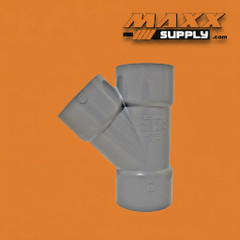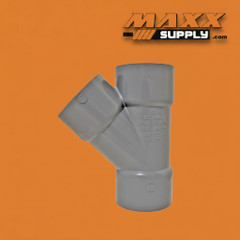
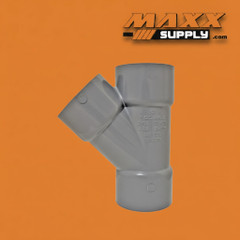

Wye, Slip x Slip x Slip 4" x 3" (9875-422)
$248.41
Blue Monster 76037 1-Step PVC Cement Clear (32OZ)
The 4" x 3" Schedule 40 White PVC Reducing Wye (9875-422, Slip x Slip x Slip) is a medium-bore thermoplastic reducing branch junction fitting manufactured to ASTM D2466 in Schedule 40 white PVC — a three-port fitting in which both run connections are 4" IPS slip socket ends and the branch connection is a 3" IPS slip socket end exiting at 45 degrees to the run axis, providing a single-body Schedule 40 PVC solution for connecting a 3" IPS socket PVC branch assembly to a 4" Schedule 40 PVC primary run at a branch junction location where the 4" primary run continues at full diameter through both straight-run ports downstream of the 3" branch connection and the 3" branch exits at 45 degrees to the run axis rather than at the 90-degree perpendicular angle of a standard reducing tee, without a saddle tap, without field fabrication, without transitioning out of Schedule 40 white PVC construction at the branch junction, and without the higher hydraulic minor loss at the branch junction that the 90-degree perpendicular branch geometry of the reducing tee produces at the same nominal size combination. The 9875-422 is the correct fitting wherever a 4" Schedule 40 PVC primary run must provide a 3" IPS socket PVC branch connection while maintaining the full 4" primary run diameter through both run sockets — where the 3" downstream branch assembly is permanently bonded socket PVC construction continuing in 3" IPS socket PVC pipe and fittings from the wye's branch socket, where the primary run must continue downstream of the 3" branch at full 4" diameter, where the branch connection must be a manufactured, rated, NSF-listed, ASTM D2466-compliant Schedule 40 white PVC wye body with a 45-degree branch socket whose 3" slip socket accepts standard 3" IPS Schedule 40 or Schedule 80 PVC pipe directly, and where the 45-degree branch angle provides a hydraulic, geometric, or gravity-flow advantage over the 90-degree perpendicular branch angle of the Spears 401 series reducing tee at the same 4"x3" size combination. The 9875-422 is the near-equal-branch reducing wye of the 4" Schedule 40 PVC socket fitting ecosystem — the reducing wye configuration with the largest branch-to-run ratio and the lowest velocity increase in the Spears 9875 series at the 4" run level, with the 3" branch socket at 75% of the 4" run diameter producing a cross-sectional area ratio of approximately 56% and a velocity increase of approximately 1.78x at constant full-branch-flow passage through the wye body's branch socket.
The 9875-422's commercial identity is defined by two characteristics operating simultaneously: its structural role as a three-port branch junction fitting with a continuing 4" run, which it shares with the Spears 401 series reducing tees at the same size combination, and its 45-degree branch angle, which distinguishes it from every reducing tee in this catalog at any size combination and establishes the specific hydraulic, geometric, and gravity-flow advantages that govern when the 9875-422 is specified in preference to the 4"x4"x3" reducing tee. The 9875-422 does not reduce the run pipe size: both run sockets are 4" IPS, the primary run continues at full 4" diameter through both run ports of the wye body, and no velocity increase occurs at the run ports. The 9875-422 does not transition the primary run inline from one pipe size to another: it is not a reducer coupling and its run axis is not interrupted by a size change at the wye body. The 9875-422 does not adapt another fitting's socket: it is an independent three-port fitting body in the primary run, connected between upstream and downstream 4" IPS pipe sections with the 3" branch socket available as the 45-degree branch pipe connection. What distinguishes the 9875-422 from the 4"x4"x3" Schedule 40 reducing tee is the 45-degree branch exit angle — every hydraulic consequence, every geometric consequence, and every installation consequence applicable to the 9875-422 that differs from the reducing tee at the same size combination flows directly from this single angular distinction.
The 45-degree branch angle's hydraulic consequence at the wye branch junction — lower hydraulic minor loss than a 90-degree tee branch at the same nominal size, branch flow rate, and primary run velocity — is the primary technical advantage that governs the 9875-422's specification in preference to the 4"x4"x3" reducing tee at hydraulically sensitive branch junction locations. At a 90-degree tee branch, the primary run flow must divide between the continuing run and the perpendicular branch with an abrupt 90-degree direction change at the branch exit — producing significant flow separation, turbulence, and secondary flow patterns at the branch junction that contribute to the relatively high hydraulic minor loss coefficient of the 90-degree tee branch compared to any less abrupt branch angle geometry. At the 9875-422's 45-degree branch angle, the dividing flow transitions from the primary run to the branch with a less abrupt 45-degree direction change — reducing flow separation at the branch entry, producing a smoother velocity profile transition at the branch junction, and generating lower turbulent energy dissipation at the branch exit compared to the 90-degree tee. The resulting minor loss coefficient at the 9875-422's 45-degree branch is meaningfully lower than at the 4"x4"x3" reducing tee's 90-degree branch — a distinction that is commercially significant in four application contexts: pressurized irrigation systems where the cumulative minor losses at all branch junctions along an extended lateral supply run contribute to the lateral's available pressure head budget at the farthest zone supply point; pump suction manifold assemblies where low suction-side minor losses at branch entries are critical to preserving available NPSH at the pump impeller inlet; high-flow process piping branch junctions where the absolute hydraulic minor loss at the branch junction in high-flow systems represents a meaningful fraction of the system's available head budget; and gravity drainage and gravity sewer collection systems where smooth flow division at branch junctions promotes drainage continuity and reduces the risk of flow obstruction accumulation at branch junction turbulence zones.
The 9875-422's 45-degree branch angle also produces a distinctive thrust force geometry at buried installations that differs from the 90-degree reducing tee's perpendicular branch thrust force in its direction and thrust block orientation requirements, though not in its magnitude. At the 4"x4"x3" reducing tee's 90-degree branch port, the unbalanced hydraulic pressure force at the branch exits perpendicular to the run axis — directed at 90 degrees to the primary run, requiring the thrust block bearing surface to resist a force component perpendicular to the run within the trench geometry. At the 9875-422's 45-degree branch port, the unbalanced hydraulic pressure force at the branch exits at 45 degrees to the run axis — directed along the branch pipe's axis at 45 degrees to the primary run, requiring the thrust block bearing surface to be oriented perpendicular to the 45-degree branch axis rather than perpendicular to the run. The resultant branch thrust force magnitude at the 9875-422's 45-degree branch is the product of the system operating pressure and the 3" IPS branch pipe's cross-sectional area — the same P × A_branch calculation that applies at a 90-degree tee branch of the same 3" branch pipe size and the same operating pressure — and is therefore equal in magnitude to the thrust force at a 4"x4"x3" reducing tee's branch port at the same operating pressure. The critical difference from the reducing tee's thrust block is the direction of the bearing requirement: the 9875-422's 45-degree branch thrust force has both a component perpendicular to the run axis (P × A_branch × sin(45°) ≈ 0.707 × P × A_branch) and a component along the run axis (P × A_branch × cos(45°) ≈ 0.707 × P × A_branch), requiring a thrust block bearing surface oriented at 45 degrees to the run axis — perpendicular to the branch pipe axis — that resists both the perpendicular and run-axis thrust components simultaneously. The primary system engineer must confirm that the 45-degree branch thrust block bearing surface can be constructed perpendicular to the 45-degree branch direction with adequate bearing area in the available trench geometry at each buried 9875-422 installation, that the thrust block bearing area is calculated from P × A_branch at the 3" IPS cross-sectional area and the system's full anticipated operating pressure including surge transient, and that undisturbed soil is available in the bearing direction (at 45 degrees to the trench's run-axis orientation) to provide the required thrust resistance. No thrust restraint is required at either 4" run port of the 9875-422 — the run ports are inline connections at the wye's run axis producing no angular thrust force component in the run direction, consistent with the no-run-port-thrust characteristic of all branch junction fittings documented in this catalog.
The Spears 9875 series Schedule 40 PVC wye fittings at the 4" run level include both equal and reducing configurations — the equal wye (4"x4"x4", all three sockets equal 4" IPS) and reducing configurations with smaller branch socket sizes, of which the 9875-422 (4"x4"x3") is the near-equal-branch configuration with the largest branch-to-run ratio and the lowest velocity increase in the reducing configuration range at the 4" run level. The 9875-422's 3" branch at 75% of the 4" run diameter and ~1.78x velocity increase at constant full-branch-flow passage through the branch socket places it at the transition between the near-equal branch scale and the large-bore appurtenance branch scale at the 4" run level — the branch size where the 3" IPS downstream assembly is large enough to serve genuine secondary lateral supply, large zone supply, and large-capacity appurtenance supply functions while remaining at the secondary and lateral distribution scale rather than the primary infrastructure scale. The ~1.78x velocity increase at the 3" branch socket confirms that the full 4" primary run design flow cannot pass through the 3" branch at standard primary run design velocities — the 9875-422 is a branch junction fitting whose 3" branch carries only the confirmed design service flow fraction of the 4" primary run's total flow, not a full-flow inline transition from 4" to 3" IPS. At a standard 4" primary run design velocity of 4 feet per second, a hypothetical full-flow passage through the 3" branch socket would produce a branch velocity of approximately 7.1 feet per second — approaching the upper boundary of standard design velocity limits for 3" IPS PVC pipe in lateral supply service and confirming that the 9875-422's 3" branch is sized for lateral supply fractions of the 4" primary run's total flow rather than the primary run's full throughput. The governing pre-specification step at the 9875-422 is explicit confirmation that the downstream 3" branch assembly's design service flow — the confirmed peak demand of the downstream irrigation zone, the confirmed pump suction or discharge branch flow, the confirmed drainage lateral collection flow, or the confirmed process equipment supply demand — produces a downstream 3" branch velocity within standard design limits for 3" IPS PVC pipe under the branch's peak service conditions. The 4" primary run continues to carry the remaining primary run flow at its design velocity through both run sockets downstream of the 9875-422 branch junction.
The most commercially important specification comparison at the 9875-422 is the wye versus reducing tee selection — the selection between the 9875-422 and the 4"x4"x3" Schedule 40 all-socket reducing tee in the Spears 401 series at the same 4"x3" run-and-branch size combination. Both the 9875-422 and the 4"x4"x3" reducing tee provide a 3" IPS socket PVC branch connection on a continuing 4" IPS primary run in Schedule 40 white PVC construction — the structural role, the run size, the branch size, and the material are all identical between the two fittings. The sole functional difference is the branch exit angle: the 9875-422 exits at 45 degrees, the reducing tee exits at 90 degrees. This angular difference produces every practical consequence that distinguishes the two fittings in the field — the lower hydraulic minor loss at the 9875-422's 45-degree branch junction, the 45-degree directional requirement for the 9875-422's downstream branch assembly routing away from the primary run (versus the 90-degree perpendicular requirement at the tee), the differently oriented thrust block requirement at the 9875-422's buried branch port (at 45 degrees to the run versus perpendicular to the run at the tee), and the 9875-422's advantage in gravity drainage and gravity sewer collection applications where the 45-degree branch entry promotes smooth flow contribution from the collecting lateral into the primary collection run. The selection between the 9875-422 and the 4"x4"x3" reducing tee is governed by four criteria that must be evaluated at each individual branch junction location in the piping layout: the hydraulic minor loss budget for the primary run system at that branch junction (favoring 9875-422 where minor loss reduction is required); the available routing space for the 45-degree branch departure angle versus the 90-degree branch departure at the branch location (the 9875-422's 45-degree branch requires routing space in the run-axis direction as well as perpendicular to the run, while the reducing tee's perpendicular branch requires space only perpendicular to the run); the gravity-flow or drainage character of the service (strongly favoring 9875-422 in all gravity drainage, gravity sewer, and gravity collection applications); and the downstream branch assembly's available routing space and preferred departure direction relative to the primary run (confirming that a 45-degree branch departure serves the downstream assembly's layout). Where the routing space at the branch junction cannot accommodate the 9875-422's 45-degree branch footprint along the run axis — at branch locations where the available space in the run direction between the 9875-422 body and an adjacent structural element, trench obstruction, or piping boundary is insufficient for the elbow-to-branch alignment the 45-degree wye requires — the 4"x4"x3" reducing tee's perpendicular branch may be the only geometrically viable configuration regardless of the hydraulic preference for the wye. Buyers must confirm the downstream branch assembly's routing direction and available space in the run-axis direction at the branch location from the piping layout drawing before specifying the 9875-422 over the 4"x4"x3" reducing tee, because the 45-degree branch departure direction is committed at the wye body and cannot be field-modified to 90 degrees after cement application.
The 9875-422 is additionally distinguished from the Spears 402 series 4"x4"x3" Schedule 40 FPT branch tee — which has a 3" FPT branch accepting 3" male NPT threaded components at the 90-degree perpendicular branch rather than a 3" slip socket accepting socket PVC pipe — and from any wye configuration with a 3" FPT branch rather than a 3" slip socket. The 9875-422's 3" slip branch socket is the correct specification wherever the downstream 3" branch assembly continues in permanently bonded socket PVC pipe and fitting construction from the wye's branch socket. A wye or tee configuration with a 3" FPT branch port is correct wherever the first downstream component at the branch is an inherently 3" male NPT threaded component — a threaded valve body, a threaded pump connection, or a threaded appurtenance assembly with a 3" male NPT interface. At the 4"x3" run-and-branch combination in the medium-bore irrigation, process piping, and drainage markets, the downstream branch assembly predominantly continues in socket PVC pipe construction from the branch junction fitting's socket rather than threading a male NPT component directly into the branch — making the 9875-422's slip branch socket the predominant correct specification at 3" IPS socket PVC branch assembly locations on 4" primary runs where the 45-degree wye angle is specified. Confirm the downstream branch component's connection interface type from the component manufacturer's specification before purchasing any branch junction fitting at a 4"x3" branch location.
The 9875-422 is further distinguished from the 4"x3" Schedule 80 PVC flush-style reducing bushing (Spears 837 series) and the 4"x3" Schedule 80 inline reducer coupling (Spears 829 series) by its three-port branch junction structural role. The 9875-422 has two 4" run sockets and one 3" branch socket — the 4" primary run continues through both run ports and the 3" branch exits the wye body at 45 degrees; the fitting is a branch junction body, not a socket adapter and not an inline reducer coupling. The 4"x3" inline reducer coupling has two sockets in the run axis with no continuing run — the entire primary run flow transitions inline from the 4" large-end socket to the 3" small-end socket with no perpendicular branch. The 4"x3" reducing bushing inserts into a receiving fitting's 4" socket and adapts it to accept 3" pipe. None of these alternatives serve the same function as the 9875-422 at a 4" primary run branch location requiring a 3" IPS socket PVC 45-degree branch connection with a continuing 4" run.
The 9875-422's 45-degree branch angle makes it the standard fitting specification in gravity drainage and gravity sewer collection systems at the 4" collection main and 3" lateral scale — the application category where the wye's advantages over the reducing tee are most universally recognized and where the 45-degree branch angle's smooth flow contribution geometry provides the greatest practical benefit. In gravity drainage systems where the 4" collection main carries drainage flow by gravity at sub-atmospheric pressure and the 3" lateral branches contribute collected drainage flow to the main, the 9875-422's 45-degree branch angle orients the lateral's flow contribution in a direction more closely aligned with the main's downstream flow direction — reducing the turbulence, flow reversal, and hydraulic jump potential that the 90-degree perpendicular entry of a reducing tee would create at the lateral junction under full gravity-flow drainage conditions. This smooth flow contribution geometry at the 9875-422's 45-degree branch junction promotes unobstructed drainage flow continuity at the collection main lateral entry points and reduces the risk of debris accumulation, sediment deposition, and flow blockage at the branch junction that the 90-degree reducing tee's abrupt perpendicular branch entry can promote in gravity drainage service. The 9875-422 is consequently the preferred branch junction fitting specification in Schedule 40 PVC gravity drainage collection systems, agricultural subsurface drainage collection systems, stormwater collection laterals, and site drainage secondary collection mains at the 4" collection main and 3" lateral scale wherever the smooth lateral flow contribution geometry of the 45-degree wye is valued over the more compact perpendicular footprint of the reducing tee.
In pressurized irrigation systems — the highest-volume market category for the 4"x3" Schedule 40 PVC wye at the Maxx-Supply commercial contractor customer level — the 9875-422 is specified at lateral supply branch junction locations on 4" IPS primary run supply laterals where the downstream 3" branch assembly serves a large irrigation zone supply header, a major drip lateral sub-main supply connection, a large-capacity filter station connection, or a chemical injection supply assembly in 3" IPS socket PVC construction, and where the lateral supply system's hydraulic design specifically requires or benefits from the lower minor loss coefficient of the 45-degree wye branch junction over the 90-degree reducing tee's branch. In irrigation systems with multiple branch junction fittings along an extended 4" IPS lateral supply run — a common configuration in drip irrigation systems with multiple zone supply header connections, in large-acreage agricultural irrigation laterals with multiple field block supply branches, and in large landscape irrigation distribution systems with multiple zone supply connections along the primary lateral — the cumulative minor loss reduction from specifying the 9875-422 at high-flow branch junction locations rather than the 4"x4"x3" reducing tee contributes to the lateral supply run's available pressure head at the most remote zone supply branch, and the primary system designer's evaluation of wye versus tee at individual branch locations should include explicit minor loss comparison in the lateral hydraulic analysis at the design stage rather than defaulting to the reducing tee at all branch locations without hydraulic evaluation. The 9875-422 is most commonly specified in irrigation systems at branch locations identified in the lateral hydraulic analysis as pressure-head-critical — branch locations near the end of an extended lateral where the available pressure head margin at the terminal zone supply point is tight and minor loss reduction at upstream branch junctions contributes to maintaining the minimum required pressure at the terminal service point.
At pump suction and discharge manifold assemblies — the application category where the wye fitting's lower suction-side minor loss coefficient provides the most operationally critical advantage — the 9875-422 is specified at 3" IPS socket PVC branch entry points on 4" IPS primary suction or discharge manifolds where the smooth 45-degree branch entry geometry reduces the suction-side minor loss at the pump suction manifold's branch entry points and preserves available net positive suction head (NPSH) at the pump impeller inlet. In irrigation pump station assemblies, process pump suction manifolds, and booster pump suction supply headers at the 4" manifold and 3" branch supply scale, the pump's available NPSH budget — the difference between the available absolute pressure at the pump suction flange and the fluid's vapor pressure at the operating temperature — is a critical design constraint that is sensitive to every suction-side minor loss including the minor loss at each branch junction in the suction manifold. At suction-side branch entry locations where the pump's NPSH margin is tight and the minor loss at the branch junction is hydraulically material to the available NPSH, the 9875-422's lower minor loss at the 45-degree branch entry relative to the 4"x4"x3" reducing tee's 90-degree branch entry is a meaningful specification advantage — specifying the 9875-422 over the reducing tee at suction manifold branch entries contributes directly to preserving available NPSH and reducing the risk of cavitation at the pump impeller. On the discharge side of pump assemblies, the lower minor loss at the 9875-422's 45-degree branch reduces the pump's required total dynamic head at the branch junction, contributing to operating efficiency at design flow.
The assembly requirements at the 9875-422 reflect the three socket connections — two equal 4" IPS run sockets and one 3" IPS branch socket at 45 degrees to the run axis — and the critical importance of the 45-degree branch socket's directional orientation confirmation before cement application, which at the wye fitting type applies in two planes simultaneously: the plane containing the wye's run axis and branch axis (confirming the 45-degree branch is pointing in the correct departure direction relative to the downstream branch assembly's layout) and the rotational orientation of the wye body about the run axis (confirming that the 45-degree branch socket faces the correct side of the primary run's routing plane — upward, downward, or laterally — as specified by the piping layout drawing). Both 4" run socket connections require heavy-body solvent cement rated for 4" IPS Schedule 40 or Schedule 80 PVC pipe, applied with complete circumferential coverage at both 4" bonding surfaces within the available working time. The 3" branch socket requires heavy-body solvent cement rated for 3" IPS Schedule 40 or Schedule 80 PVC pipe — a smaller bonding surface than either 4" run socket, with shorter working time and lower cement volume requirements relative to the run sockets. The assembly sequence must be planned with all three pipe ends positioned and accessible before cement application begins at any socket — the upstream 4" run pipe end, the downstream 4" run pipe end, and the 3" branch pipe end all confirmed in position by dry-fit against the piping layout drawing before any solvent cement is applied. The 45-degree branch socket's departure direction — both its departure plane and its rotational orientation about the run axis — must be confirmed by dry-fit and reference-marked before cement application because the 45-degree branch direction is fixed permanently at the moment of cement application and any angular error in the branch socket's orientation produces a permanent misalignment in the downstream 3" branch assembly's routing. In gravity drainage installations where the 9875-422's branch socket must be oriented to receive gravity flow from the 3" lateral branch into the 4" collection run — with the branch socket facing upslope, upstream, and elevated relative to the run's downstream direction — the branch socket's orientation in all three spatial dimensions must be confirmed from the drainage system's grade plan, invert elevations, and collection main alignment drawings before cement is applied at any socket. Apply complete circumferential heavy-body cement coverage at all three socket connections within the available working time for each respective socket size, comply fully with cure time requirements before any system pressurization or gravity-flow service, and deburr and bevel all three pipe ends — both 4" run pipe ends and the 3" branch pipe end — before cementing to ensure consistent insertion depths and complete circumferential bond lines at all three socket connections.
The schedule selection at the 9875-422 — Schedule 40 over the Schedule 80 counterpart at the 4"x4"x3" wye configuration — follows the engineering framework established across all Schedule 40 specialty fitting documentation in this catalog. Schedule 40 is the correct specification where the system's design operating pressure, surge allowance, and engineering safety margin requirements fall within the Schedule 40 pressure ceiling at the 4" fitting size, where the system specification does not mandate Schedule 80 gray PVC throughout, and where the design engineer has confirmed that Schedule 40 wall thickness satisfies all engineering requirements at the 4" primary run branch location. In irrigation lateral supply, gravity drainage, and process piping branch junction applications at the 4"x3" wye size combination, Schedule 40 is the predominant correct specification for systems operating within the Schedule 40 pressure ceiling — including the majority of low-to-moderate-pressure irrigation lateral systems, atmospheric-pressure and low-pressure drainage systems, and moderate-pressure process piping systems. Where the system requires Schedule 80 wall thickness, gray material class identification, or the higher pressure ceiling Schedule 80 provides at the 4" wye fitting size — including higher-pressure pump discharge manifold assemblies, industrial process piping systems mandating Schedule 80 throughout, and any application where surge transient pressure at the 4" wye branch location exceeds the Schedule 40 pressure ceiling — the Schedule 80 counterpart at the 4"x4"x3" wye configuration is the correct specification.
Schedule 40 white PVC construction provides the chemical resistance, NSF certification, and structural capability appropriate for medium-bore irrigation lateral, drainage collection, pump manifold, and process piping branch junction wye service within the Schedule 40 pressure and wall thickness envelope. PVC Type 1 Grade 1 construction with cell classification 12454 per ASTM D1784 delivers broad chemical resistance across irrigation water, drainage water, process water service, water treatment chemicals, and the full range of non-solvent process fluids appropriate for Schedule 40 PVC service at all three socket connections. The 3" branch socket is compatible with both Schedule 40 and Schedule 80 3" IPS PVC pipe — the schedule of the 3" downstream branch pipe is selected based on the downstream assembly's own design requirements. NSF 61 certification lists this fitting for potable water contact, and NSF 14 covers compliance with applicable plastics piping material standards. ASTM D2466 governs Schedule 40 PVC socket fittings and defines the manufacturing, dimensional, and pressure performance requirements the 9875-422 is produced to. Verify manufacturer pressure rating documentation for the specific fitting configuration before final system specification — at the 4"x4"x3" wye configuration, the governing pressure rating must be confirmed against the manufacturer's published pressure-temperature rating table for SKU 9875-422 before installation in systems at or near the fitting's rated pressure ceiling.
Key Features:
- Schedule 40 white PVC reducing wye — 4" run (slip socket) x 4" run (slip socket) x 3" branch (slip socket, 45-degree exit); Spears 9875 series Schedule 40 PVC socket wyes
- 45-degree branch angle — the defining characteristic distinguishing the 9875-422 from the 4"x4"x3" Schedule 40 reducing tee (Spears 401 series) at the same size combination; lower hydraulic minor loss coefficient at the branch junction; smoother flow division geometry; preferred over the reducing tee in gravity drainage collection systems, pump suction manifold branch entries, hydraulically sensitive pressurized branch junctions, and all applications where the 45-degree branch angle provides routing or hydraulic advantages
- 3" branch socket at 75% of 4" run diameter — ~56% cross-sectional area ratio; ~1.78x velocity increase at constant full-branch-flow passage; near-equal-branch reducing wye at the 4" run level; 3" branch design service flow confirmed within 3" IPS PVC velocity limits at peak branch service before specifying; full 4" primary run design flow cannot pass through 3" branch at standard primary run design velocities
- 4" primary run continues at full diameter through both run sockets — the 9875-422 is a branch junction fitting with two equal 4" run ports; the primary run continues downstream of the 3" branch at full 4" diameter; NOT an inline reducer coupling; NOT a full-flow inline 4"-to-3" size transition fitting
- Primary comparison — wye versus reducing tee: 9875-422 (45-degree branch, lower minor loss, smooth flow contribution geometry) where hydraulic minor loss reduction, gravity drainage continuity, pump suction NPSH preservation, or 45-degree branch routing governs the specification; 4"x4"x3" Schedule 40 reducing tee (Spears 401 series, 90-degree branch, more compact perpendicular footprint) where space constraints, perpendicular branch routing, or standard branch junction specification governs; selection criteria: hydraulic minor loss budget, available routing space in run-axis direction at branch location, gravity-flow or pressure-service character, downstream branch assembly departure direction; confirm from piping layout drawing before specifying
- Branch socket orientation committed at cement application — 45-degree branch socket orientation confirmed in two planes before cement: (1) departure plane of 45-degree branch relative to downstream branch assembly's layout direction; (2) rotational orientation of wye body about run axis confirming branch socket faces correct side of run (upward, downward, laterally); dry-fit against piping layout drawing and apply reference marks before cement at any socket; angular error in either plane produces permanent branch assembly routing misalignment
- Branch thrust force at buried installations — resultant force: P × A_branch directed at 45 degrees to run axis along the branch pipe axis; same magnitude as 90-degree tee branch at same 3" pipe size and operating pressure (P × A_branch) but directed at 45 degrees rather than perpendicular; thrust block bearing surface oriented perpendicular to 45-degree branch pipe axis (at 45 degrees to trench run-axis orientation); resists both run-axis and perpendicular-axis thrust components simultaneously; thrust block bearing area calculated from P × A_branch at 3" IPS cross-sectional area and full anticipated operating pressure including surge transient at each buried installation; undisturbed soil availability in the 45-degree bearing direction must be confirmed at each buried installation; no thrust restraint required at either 4" run socket
- Gravity drainage advantage — 45-degree branch entry angle orients lateral flow contribution in a direction more aligned with the collection main's downstream flow; reduces turbulence, flow reversal, and hydraulic jump potential at the lateral entry compared to 90-degree reducing tee; preferred specification in Schedule 40 PVC gravity drainage collection mains, agricultural subsurface drainage systems, and stormwater lateral collection systems where smooth lateral flow contribution promotes drainage continuity and reduces blockage risk at branch junctions
- Pump suction manifold advantage — 45-degree branch entry reduces suction-side minor loss at branch supply entries to 4" IPS pump suction manifolds; preserves available NPSH at pump impeller inlet relative to 90-degree reducing tee branch entry; specified at suction-side branch entry locations where pump NPSH margin is tight and branch junction minor loss is hydraulically material to available NPSH
- Secondary comparison — slip branch socket versus FPT branch wye: 9875-422 where downstream 3" branch assembly continues in socket PVC pipe and fitting construction; FPT branch wye where downstream 3" branch component is inherently 3" male NPT threaded; at 3" branch size on 4" irrigation laterals, process piping, and drainage collection mains, socket PVC pipe continuation is the predominant downstream construction — 9875-422 is the predominant correct specification; confirm from downstream component manufacturer specification before purchasing either configuration
- Three socket connections require individually staged cement assembly — both 4" run sockets and 3" branch socket; plan complete three-socket assembly sequence with all pipe ends positioned and branch socket orientation dry-fit confirmed before cement application begins at any socket; both 4" run sockets require heavy-body cement at 4" IPS working time; 3" branch socket requires heavy-body cement at 3" IPS working time; full cure time compliance before pressurization or gravity-flow service
- 3" branch socket accepts Schedule 40 and Schedule 80 3" IPS PVC pipe
- Schedule 40 vs. Schedule 80 selection: Schedule 40 correct where system pressure, surge, and safety margin requirements fall within Schedule 40 pressure ceiling at the 4" wye fitting size; predominant correct specification in irrigation lateral supply, gravity drainage, and moderate-pressure process piping applications; Schedule 80 counterpart correct where higher pressure, gray material class identification, or system-wide Schedule 80 specification applies
- Manufactured to ASTM D2466 — governing standard for Schedule 40 PVC socket fittings
- NSF 61 certified for potable water contact; NSF 14 listed
- Both run sockets compatible with Schedule 40 and Schedule 80 IPS 4" pipe; branch socket compatible with Schedule 40 and Schedule 80 IPS 3" pipe
- White color — standard Schedule 40 material class identification at the branch junction location
- Cell classification PVC 12454 per ASTM D1784
- Heavy-body solvent cement required at all three socket connections; full cure time compliance mandatory before pressurization or gravity-flow service
- Pressure rating: verify against manufacturer pressure-temperature table for SKU 9875-422
Specifications:
| Attribute | Value |
|---|---|
| SKU | 9875-422 |
| Fitting Type | Wye (Reducing Wye — Asymmetric Y, Single Branch) |
| Series | Spears 9875 Schedule 40 PVC Socket Wyes |
| Run Size | 4" x 4" (Both run sockets equal 4" IPS) |
| Branch Size | 3" |
| Branch Angle | 45 Degrees to Run Axis |
| Branch-to-Run Ratio | 75% (3" is 75% of 4" run diameter) |
| Cross-Sectional Area Ratio | ~56% (3" pipe area is ~56% of 4" pipe area) |
| Velocity Increase at Constant Full-Branch-Flow | ~1.78x |
| End Connections | Slip x Slip x Slip (All Socket) |
| Connection Method — Run Sockets | Solvent Cement (IPS) — both 4" run sockets |
| Connection Method — Branch Socket | Solvent Cement (IPS) — 3" branch socket, 45-degree exit |
| Compatible Pipe — Run | 4" IPS Schedule 40 or Schedule 80 PVC |
| Compatible Pipe — Branch | 3" IPS Schedule 40 or Schedule 80 PVC |
| Branch Socket Orientation | Two-plane confirmation required before cement — departure plane and rotational orientation about run axis |
| Application Role | Reducing wye branch junction — 4" primary run continues at full diameter through both run ports; 3" branch exits at 45 degrees for irrigation lateral supply, gravity drainage collection, pump suction manifold, process piping branch supply, and appurtenance branch connections in 3" IPS socket PVC construction |
| Hydraulic Advantage vs. Reducing Tee | Lower minor loss coefficient at 45-degree branch junction vs. 90-degree tee branch at same size and flow |
| Gravity Drainage Advantage | 45-degree branch entry promotes smooth lateral flow contribution to collection main; reduces turbulence and blockage risk at branch junction vs. perpendicular tee branch |
| Thrust Restraint — Branch Port | Required at buried installations — bearing surface perpendicular to 45-degree branch pipe axis; thrust force P × A_branch at 3" IPS cross-sectional area directed at 45° to run; site-specific engineering calculation required |
| Thrust Restraint — Run Ports | Not required |
| Schedule | Schedule 40 |
| Material | PVC (Polyvinyl Chloride) Type 1, Grade 1 |
| Cell Classification | 12454 per ASTM D1784 |
| Color | White |
| Manufacturing Standard | ASTM D2466 |
| Potable Water Certification | NSF/ANSI 61 |
| Plastics Standard Certification | NSF 14 |
| Max Service Temperature | 140°F (60°C) |
| Pressure Rating | Verify with manufacturer pressure-temperature rating table for SKU 9875-422 |
Industries & Applications:
- Commercial & Agricultural Irrigation — 45-Degree Branch Connections for Large Zone Supply Headers, Drip Irrigation Sub-Main Supply, Chemical Injection Supply, Filter Station Supply, and Major Lateral Supply Branches on 4" Schedule 40 PVC Primary Laterals and Distribution Mains — The 4" x 3" Schedule 40 PVC reducing wye is specified at 3" IPS socket PVC branch assembly locations on 4" Schedule 40 PVC irrigation primary laterals and distribution mains where the 45-degree branch angle's lower hydraulic minor loss coefficient and smoother flow division geometry are preferred over the 90-degree reducing tee's perpendicular branch — the most commercially prevalent application category for the 9875-422 at the Maxx-Supply commercial irrigation contractor customer level; zone supply header branch connections where the 4" IPS primary lateral provides 3" IPS socket PVC supply to large irrigation zone supply assemblies — valve, filter, pressure regulator, and zone supply header assemblies in 3" IPS socket PVC construction — at branch junction locations where the lateral's hydraulic analysis identifies the branch junction minor loss as a contributing factor in the available pressure head budget at downstream service points, with the 9875-422's lower minor loss coefficient at the 45-degree branch preserving more available pressure head for downstream zones relative to the 4"x4"x3" reducing tee at the same branch location; drip irrigation sub-main supply branch connections where the 4" IPS supply lateral delivers 3" IPS socket PVC supply to drip irrigation sub-main assemblies at multiple branch locations along the lateral run, with the 9875-422 specified at hydraulically critical branch locations where the lateral's pressure head budget is tight and minor loss reduction at individual branch junctions contributes meaningfully to maintaining minimum required pressure at the terminal sub-main supply branch; chemical injection supply branch connections where the 4" IPS irrigation main provides 3" IPS socket PVC supply to chemical injection station assemblies — fertilizer injection, soil amendment injection, pH adjustment, and water treatment chemical injection stations in 3" IPS socket PVC construction — at branch locations where smooth 45-degree flow division promotes unobstructed chemical supply delivery; filter station supply branch connections where the 4" IPS primary lateral provides 3" IPS socket PVC supply to disc filter stations, screen filter stations, and sand media filter stations in 3" IPS socket PVC construction at filter station branch locations where the 45-degree branch reduces the suction-side pressure drop at the filter station inlet; pump station primary discharge lateral 3" IPS branch connections where the 4" IPS primary discharge lateral provides 3" IPS socket PVC supply branches to major zone supply headers and sub-main supply systems at the pump station's discharge lateral branch locations; and field boundary block supply branch connections where the 4" IPS distribution lateral provides 3" IPS socket PVC supply to large agricultural field block supply headers and drip irrigation block sub-mains at field boundary branch junctions, with the 9875-422 preferred at branch junctions identified in the system hydraulic analysis as minor-loss-sensitive locations requiring the lower branch junction loss of the 45-degree wye geometry; the 9875-422 is specified alongside the 4"x4"x3" reducing tee in the same large irrigation system BOM at different branch locations — the 9875-422 at hydraulically critical branch junctions where minor loss reduction is required and the routing space accommodates the 45-degree branch footprint, and the reducing tee at branch junctions where perpendicular branch departure, space constraints, or standard specification governs
- Gravity Drainage & Stormwater Collection — 45-Degree Lateral Branch Connections on 4" Schedule 40 PVC Gravity Drainage Collection Mains and Stormwater Secondary Collection Mains — Specified as the standard branch junction fitting in 4" Schedule 40 PVC gravity drainage collection systems where smooth lateral flow contribution at branch junctions is required for drainage continuity — the application category where the 9875-422's 45-degree branch angle advantage over the 90-degree reducing tee is most universally recognized and most universally specified; subsurface agricultural drainage collection main lateral branch connections where the 4" IPS collection main receives 3" IPS lateral drainage contributions from field drainage laterals through the 9875-422's 45-degree branch socket, with the 45-degree entry angle orienting the lateral's drainage flow contribution in a direction more aligned with the collection main's downstream gravity flow direction — reducing turbulence, flow reversal, and potential sediment deposition at the lateral entry junction relative to a 90-degree reducing tee entry at the same collection main location; site drainage secondary collection main lateral connections where the 4" IPS secondary collection main receives 3" IPS lateral contributions from site drainage inlets, swale drainage outlets, and paved surface drainage assemblies, with the 9875-422 providing smoother flow contribution geometry at each lateral entry than the perpendicular tee configuration; landscape and turf drainage collection main lateral connections where the 4" IPS drainage collection main serves as the primary collection trunk for landscape drainage laterals in golf course drainage systems, sports field drainage systems, and large landscape drainage networks, with the 9875-422 specified at lateral entry points along the collection trunk to maintain smooth gravity flow continuity through the collection main; stormwater secondary collection main lateral connections where the 4" IPS stormwater collection main receives 3" IPS lateral contributions from catch basin outlets, area drain connections, and stormwater inlet connections, with the 9875-422's 45-degree lateral entry reducing the turbulence and hydraulic jump potential that the 90-degree perpendicular entry creates at high-flow storm event collection main lateral junctions; commercial site drainage collection main connections where the 4" IPS collection main serves commercial parking area drainage, building perimeter drainage, and paved surface drainage collection in 3" IPS lateral connections, with the 9875-422 providing smooth lateral contribution geometry at each connection point; the 9875-422 branch socket orientation in gravity drainage installations requires three-dimensional confirmation — the branch socket must be oriented to receive gravity flow from the elevated lateral (facing upslope and upstream relative to the collection main's gravity flow direction) at the confirmed lateral invert elevation above the collection main's flow line — before cement is applied at any socket; NSF 61 listing confirms potable water fitness at every drainage collection installation where NSF-listed materials are required throughout the drainage system
- Pump Station & Pump System Manifolds — 45-Degree Branch Supply Connections at Pump Suction Manifolds, Pump Discharge Headers, and Manifold Supply Branches on 4" Schedule 40 PVC Pump Assembly Headers — Used at 3" IPS socket PVC branch entry and branch supply locations on 4" Schedule 40 PVC pump suction and discharge manifold assemblies where the 45-degree wye branch angle's lower suction-side minor loss coefficient provides NPSH-critical advantages at pump suction manifold branch entries — the most operationally significant application of the 9875-422 in pump system design at the 4" manifold and 3" branch supply scale; irrigation pump station 4" IPS primary suction manifold 3" IPS branch supply connections where the 9875-422 is installed at suction supply branch entry points on the pump station's primary suction manifold, with the 45-degree branch entry geometry reducing the suction-side minor loss at each supply branch entry and preserving available NPSH at the pump impeller inlet relative to 90-degree reducing tee branch entries at the same suction manifold locations — specified at suction manifold branch entries where the pump's available NPSH margin is identified as tight in the pump system's NPSH analysis and suction-side minor loss reduction at branch entries is required to maintain the minimum required NPSH above the pump's NPSH_required at the design operating point; irrigation pump station 4" IPS primary discharge header 3" IPS branch supply connections where the 9875-422 is installed at discharge header branch supply points serving large zone supply headers and major sub-main supply assemblies, with the 45-degree branch reducing the discharge-side minor loss at each branch supply point and contributing to the pump's operating efficiency at design flow; booster pump station 4" IPS primary manifold 3" IPS branch connections where the 9875-422 provides 3" IPS socket PVC branch connections to booster pump discharge supply assemblies and secondary pump suction supply assemblies in the increasing orientation; municipal well pump station 4" IPS primary discharge header 3" IPS branch supply connections where the 9875-422 is installed at discharge header branch supply points in the pump station's primary discharge header distribution assembly; and process pump suction manifold 3" IPS branch supply entries where the 9875-422 provides smooth 45-degree branch supply entry geometry at 3" IPS socket PVC supply connections to process pump suction manifold assemblies in industrial and water treatment pump stations; the thrust block at the 9875-422's branch port in buried pump station piping must be designed for the 45-degree branch resultant force direction and the pump station's full design pressure including shut-off head — the pump station operating pressure including shut-off head must be confirmed within the Schedule 40 pressure ceiling at the 4" wye fitting before Schedule 40 material class is finalized at the pump station piping
- Water Treatment Plant — 45-Degree Branch Connections at Primary Distribution Header Zone Supply Branches, Chemical Dosing Supply Branches, Instrument Supply Branches, and Sample Connection Branches on 4" Schedule 40 PVC Distribution Headers — Installed at 3" IPS socket PVC branch connection locations on 4" Schedule 40 PVC primary distribution headers in municipal and industrial water treatment plant piping where the 45-degree wye branch angle's lower minor loss coefficient and smooth branch flow division geometry are preferred over the reducing tee at hydraulically sensitive branch junction locations — filter gallery 4" IPS distribution header 3" IPS zone supply branch connections where the 9875-422 provides 3" IPS socket PVC zone supply branches to major filter gallery process zone supply assemblies and large parallel process unit supply headers, with the 45-degree branch preserving available distribution header pressure at downstream zone supply branches through reduced branch junction minor loss; plant service water distribution header 3" IPS branch supply connections where the 9875-422 provides 3" IPS socket PVC branch supply to plant service water zone supply assemblies and large facility service connections; primary distribution header 3" IPS chemical dosing supply branch connections where the 9875-422 provides 3" IPS socket PVC branch supply connections to chemical dosing assembly supply lines at primary chemical injection station locations; and primary distribution header 3" IPS instrument supply and sample connection branches where the 9875-422 provides 3" IPS socket PVC branch connections to instrument supply assemblies and process sample connection assemblies at distribution header monitoring and control locations; NSF 61 listing confirms potable water fitness at every water treatment plant distribution header branch connection
- Municipal Water Distribution — 45-Degree Branch Connections at Secondary Distribution Header Supply Branches, Large Zone Supply Branches, and Service Connection Branches on 4" Schedule 40 PVC Secondary Distribution Mains — Specified at 3" IPS socket PVC branch connection locations on 4" Schedule 40 PVC secondary distribution mains in municipal water distribution systems where the 45-degree wye branch angle is preferred — secondary distribution main 3" IPS large zone supply branch connections where the 9875-422 provides 3" IPS socket PVC perpendicular supply to major service zone supply assemblies and large commercial service connections; secondary distribution main 3" IPS branch connections to large service meter assemblies and commercial service line supply assemblies where the 45-degree wye entry direction accommodates the service connection routing's departure direction from the secondary distribution main; and secondary distribution header 3" IPS sub-lateral supply branch connections where the 9875-422 provides 3" IPS socket PVC branch supply to sub-lateral distribution headers serving downstream service zones; NSF 61 listing confirms potable water fitness at every municipal distribution secondary main branch connection
- Industrial Process Piping — 45-Degree Branch Connections at Process Supply Header Zone Supply Branches, Equipment Supply Branches, Cooling Water Distribution Branches, and Chemical Injection Supply Branches on 4" Schedule 40 PVC Process Headers — Used at 3" IPS socket PVC branch connection locations on 4" Schedule 40 PVC primary process headers in manufacturing plants, chemical processing facilities, and industrial environments where the 45-degree branch angle's lower minor loss coefficient is hydraulically beneficial — process water supply header 3" IPS zone supply branch connections where the 9875-422 provides 3" IPS socket PVC branch supply to major process zone supply assemblies and large process equipment supply connections; cooling water distribution header 3" IPS branch connections where the 9875-422 provides 3" IPS socket PVC branch supply to cooling equipment supply assemblies and process equipment cooling connections; plant utility water supply header 3" IPS branch connections where the 9875-422 provides 3" IPS socket PVC branch supply to plant utility water zone supply assemblies; and process supply header 3" IPS chemical injection and treatment chemical supply branch connections where the 9875-422 provides 3" IPS socket PVC supply connections to chemical injection and treatment chemical supply assemblies at primary process chemical treatment locations; Schedule 40 white PVC construction satisfies the material specification at process header branch junction locations where Schedule 40 is the system material standard
- Municipal Well Field & Water Supply Infrastructure — 45-Degree Branch Connections at Distribution Header Zone Supply Branches, Chemical Injection Supply Branches, and Service Connection Branches on 4" Schedule 40 PVC Distribution Headers — Installed at 3" IPS socket PVC branch connection locations on 4" Schedule 40 PVC distribution headers in municipal well field and water supply infrastructure where the 45-degree wye branch is preferred — primary distribution header 3" IPS zone supply branch connections where the 9875-422 provides 3" IPS socket PVC supply to major service zone supply assemblies and large service connection headers; distribution header 3" IPS chemical injection supply branch connections where the 9875-422 provides 3" IPS socket PVC supply connections to chlorination supply assemblies, fluoridation supply assemblies, pH adjustment chemical supply assemblies, and water treatment chemical injection station supply connections in the well field's primary distribution chemical treatment network; and distribution header 3" IPS sub-lateral supply branch connections where the 9875-422 provides 3" IPS socket PVC supply to downstream sub-lateral distribution headers; NSF 61 listing confirms potable water fitness at every well field distribution header branch connection installation
- HVAC & Large Commercial Mechanical Systems — 45-Degree Branch Connections at Chilled Water Distribution Branch Supply, Condenser Water Zone Supply Branches, Make-Up Water Supply Branches, and Chemical Treatment Supply Branches on 4" Schedule 40 PVC Distribution Headers — Used at 3" IPS socket PVC branch connection locations on 4" Schedule 40 PVC primary chilled water distribution headers, condenser water distribution headers, and large-capacity hydronic distribution headers in commercial campus and institutional mechanical systems where the 45-degree wye branch angle's lower minor loss coefficient contributes to the distribution system's available pressure head at downstream service points — campus chilled water distribution header 3" IPS zone supply branch connections where the 9875-422 provides 3" IPS socket PVC supply to building cluster chilled water zone supply assemblies and campus sector mechanical room supply connections; condenser water distribution header 3" IPS equipment supply branch connections where the 9875-422 provides 3" IPS socket PVC supply to cooling tower circuit supply assemblies and large condenser water equipment supply connections; make-up water supply header 3" IPS branch connections where the 9875-422 provides 3" IPS socket PVC supply to make-up water zone supply assemblies and major make-up water service connections; and primary distribution header 3" IPS chemical treatment supply branch connections where the 9875-422 provides 3" IPS socket PVC supply connections to cooling water treatment chemical supply assemblies and glycol supply connections at primary distribution header chemical treatment stations
- Aquaculture & Large-Scale Water Management Infrastructure — Installed at 3" IPS socket PVC branch connection locations on 4" Schedule 40 PVC primary supply and recirculation distribution mains in commercial aquaculture facilities, hatchery systems, and recirculating aquaculture systems (RAS) where the 45-degree wye branch angle provides hydraulic or gravity-flow advantages at branch junction locations — primary recirculation main 3" IPS zone supply branch connections where the 9875-422 provides 3" IPS socket PVC supply to major recirculation zone supply assemblies and large production area recirculation distribution connections; primary supply main 3" IPS lateral supply branch connections where the 9875-422 provides 3" IPS socket PVC supply to hatchery incubation hall lateral supply assemblies, rearing hall zone supply headers, and production area supply distribution systems; primary supply main 3" IPS chemical treatment supply branch connections where the 9875-422 provides 3" IPS socket PVC supply to water quality treatment chemical supply assemblies — sodium bicarbonate supply, salt solution supply, carbon dioxide injection supply, and primary water conditioner supply connections in 3" IPS socket PVC construction; recirculation pump suction manifold 3" IPS branch supply entries where the 9875-422 provides smooth 45-degree branch supply entry geometry at recirculation pump suction manifold supply connections, preserving available NPSH at recirculation pump impeller inlets; and facility drainage collection main lateral connections where the 9875-422 provides 3" IPS gravity drainage lateral branch connections to the 4" facility drainage collection main with 45-degree smooth flow contribution geometry at each lateral entry; NSF 61 listing confirms fitness for every branch connection in the primary aquaculture supply and recirculation distribution system; Schedule 40 PVC handles continuous water contact, treatment chemical exposure, and aquaculture facility operating pressures at wye branch junction locations
(No reviews yet)

Write a Review

Wye, Slip x Slip x Slip 4" x 3" (9875-422)
Blue Monster 76037 1-Step PVC Cement Clear (32OZ)
The 4" x 3" Schedule 40 White PVC Reducing Wye (9875-422, Slip x Slip x Slip) is a medium-bore thermoplastic reducing branch junction fitting manufactured to ASTM D2466 in Schedule 40 white PVC — a three-port fitting in which both run connections are 4" IPS slip socket ends and the branch connection is a 3" IPS slip socket end exiting at 45 degrees to the run axis, providing a single-body Schedule 40 PVC solution for connecting a 3" IPS socket PVC branch assembly to a 4" Schedule 40 PVC primary run at a branch junction location where the 4" primary run continues at full diameter through both straight-run ports downstream of the 3" branch connection and the 3" branch exits at 45 degrees to the run axis rather than at the 90-degree perpendicular angle of a standard reducing tee, without a saddle tap, without field fabrication, without transitioning out of Schedule 40 white PVC construction at the branch junction, and without the higher hydraulic minor loss at the branch junction that the 90-degree perpendicular branch geometry of the reducing tee produces at the same nominal size combination. The 9875-422 is the correct fitting wherever a 4" Schedule 40 PVC primary run must provide a 3" IPS socket PVC branch connection while maintaining the full 4" primary run diameter through both run sockets — where the 3" downstream branch assembly is permanently bonded socket PVC construction continuing in 3" IPS socket PVC pipe and fittings from the wye's branch socket, where the primary run must continue downstream of the 3" branch at full 4" diameter, where the branch connection must be a manufactured, rated, NSF-listed, ASTM D2466-compliant Schedule 40 white PVC wye body with a 45-degree branch socket whose 3" slip socket accepts standard 3" IPS Schedule 40 or Schedule 80 PVC pipe directly, and where the 45-degree branch angle provides a hydraulic, geometric, or gravity-flow advantage over the 90-degree perpendicular branch angle of the Spears 401 series reducing tee at the same 4"x3" size combination. The 9875-422 is the near-equal-branch reducing wye of the 4" Schedule 40 PVC socket fitting ecosystem — the reducing wye configuration with the largest branch-to-run ratio and the lowest velocity increase in the Spears 9875 series at the 4" run level, with the 3" branch socket at 75% of the 4" run diameter producing a cross-sectional area ratio of approximately 56% and a velocity increase of approximately 1.78x at constant full-branch-flow passage through the wye body's branch socket.
The 9875-422's commercial identity is defined by two characteristics operating simultaneously: its structural role as a three-port branch junction fitting with a continuing 4" run, which it shares with the Spears 401 series reducing tees at the same size combination, and its 45-degree branch angle, which distinguishes it from every reducing tee in this catalog at any size combination and establishes the specific hydraulic, geometric, and gravity-flow advantages that govern when the 9875-422 is specified in preference to the 4"x4"x3" reducing tee. The 9875-422 does not reduce the run pipe size: both run sockets are 4" IPS, the primary run continues at full 4" diameter through both run ports of the wye body, and no velocity increase occurs at the run ports. The 9875-422 does not transition the primary run inline from one pipe size to another: it is not a reducer coupling and its run axis is not interrupted by a size change at the wye body. The 9875-422 does not adapt another fitting's socket: it is an independent three-port fitting body in the primary run, connected between upstream and downstream 4" IPS pipe sections with the 3" branch socket available as the 45-degree branch pipe connection. What distinguishes the 9875-422 from the 4"x4"x3" Schedule 40 reducing tee is the 45-degree branch exit angle — every hydraulic consequence, every geometric consequence, and every installation consequence applicable to the 9875-422 that differs from the reducing tee at the same size combination flows directly from this single angular distinction.
The 45-degree branch angle's hydraulic consequence at the wye branch junction — lower hydraulic minor loss than a 90-degree tee branch at the same nominal size, branch flow rate, and primary run velocity — is the primary technical advantage that governs the 9875-422's specification in preference to the 4"x4"x3" reducing tee at hydraulically sensitive branch junction locations. At a 90-degree tee branch, the primary run flow must divide between the continuing run and the perpendicular branch with an abrupt 90-degree direction change at the branch exit — producing significant flow separation, turbulence, and secondary flow patterns at the branch junction that contribute to the relatively high hydraulic minor loss coefficient of the 90-degree tee branch compared to any less abrupt branch angle geometry. At the 9875-422's 45-degree branch angle, the dividing flow transitions from the primary run to the branch with a less abrupt 45-degree direction change — reducing flow separation at the branch entry, producing a smoother velocity profile transition at the branch junction, and generating lower turbulent energy dissipation at the branch exit compared to the 90-degree tee. The resulting minor loss coefficient at the 9875-422's 45-degree branch is meaningfully lower than at the 4"x4"x3" reducing tee's 90-degree branch — a distinction that is commercially significant in four application contexts: pressurized irrigation systems where the cumulative minor losses at all branch junctions along an extended lateral supply run contribute to the lateral's available pressure head budget at the farthest zone supply point; pump suction manifold assemblies where low suction-side minor losses at branch entries are critical to preserving available NPSH at the pump impeller inlet; high-flow process piping branch junctions where the absolute hydraulic minor loss at the branch junction in high-flow systems represents a meaningful fraction of the system's available head budget; and gravity drainage and gravity sewer collection systems where smooth flow division at branch junctions promotes drainage continuity and reduces the risk of flow obstruction accumulation at branch junction turbulence zones.
The 9875-422's 45-degree branch angle also produces a distinctive thrust force geometry at buried installations that differs from the 90-degree reducing tee's perpendicular branch thrust force in its direction and thrust block orientation requirements, though not in its magnitude. At the 4"x4"x3" reducing tee's 90-degree branch port, the unbalanced hydraulic pressure force at the branch exits perpendicular to the run axis — directed at 90 degrees to the primary run, requiring the thrust block bearing surface to resist a force component perpendicular to the run within the trench geometry. At the 9875-422's 45-degree branch port, the unbalanced hydraulic pressure force at the branch exits at 45 degrees to the run axis — directed along the branch pipe's axis at 45 degrees to the primary run, requiring the thrust block bearing surface to be oriented perpendicular to the 45-degree branch axis rather than perpendicular to the run. The resultant branch thrust force magnitude at the 9875-422's 45-degree branch is the product of the system operating pressure and the 3" IPS branch pipe's cross-sectional area — the same P × A_branch calculation that applies at a 90-degree tee branch of the same 3" branch pipe size and the same operating pressure — and is therefore equal in magnitude to the thrust force at a 4"x4"x3" reducing tee's branch port at the same operating pressure. The critical difference from the reducing tee's thrust block is the direction of the bearing requirement: the 9875-422's 45-degree branch thrust force has both a component perpendicular to the run axis (P × A_branch × sin(45°) ≈ 0.707 × P × A_branch) and a component along the run axis (P × A_branch × cos(45°) ≈ 0.707 × P × A_branch), requiring a thrust block bearing surface oriented at 45 degrees to the run axis — perpendicular to the branch pipe axis — that resists both the perpendicular and run-axis thrust components simultaneously. The primary system engineer must confirm that the 45-degree branch thrust block bearing surface can be constructed perpendicular to the 45-degree branch direction with adequate bearing area in the available trench geometry at each buried 9875-422 installation, that the thrust block bearing area is calculated from P × A_branch at the 3" IPS cross-sectional area and the system's full anticipated operating pressure including surge transient, and that undisturbed soil is available in the bearing direction (at 45 degrees to the trench's run-axis orientation) to provide the required thrust resistance. No thrust restraint is required at either 4" run port of the 9875-422 — the run ports are inline connections at the wye's run axis producing no angular thrust force component in the run direction, consistent with the no-run-port-thrust characteristic of all branch junction fittings documented in this catalog.
The Spears 9875 series Schedule 40 PVC wye fittings at the 4" run level include both equal and reducing configurations — the equal wye (4"x4"x4", all three sockets equal 4" IPS) and reducing configurations with smaller branch socket sizes, of which the 9875-422 (4"x4"x3") is the near-equal-branch configuration with the largest branch-to-run ratio and the lowest velocity increase in the reducing configuration range at the 4" run level. The 9875-422's 3" branch at 75% of the 4" run diameter and ~1.78x velocity increase at constant full-branch-flow passage through the branch socket places it at the transition between the near-equal branch scale and the large-bore appurtenance branch scale at the 4" run level — the branch size where the 3" IPS downstream assembly is large enough to serve genuine secondary lateral supply, large zone supply, and large-capacity appurtenance supply functions while remaining at the secondary and lateral distribution scale rather than the primary infrastructure scale. The ~1.78x velocity increase at the 3" branch socket confirms that the full 4" primary run design flow cannot pass through the 3" branch at standard primary run design velocities — the 9875-422 is a branch junction fitting whose 3" branch carries only the confirmed design service flow fraction of the 4" primary run's total flow, not a full-flow inline transition from 4" to 3" IPS. At a standard 4" primary run design velocity of 4 feet per second, a hypothetical full-flow passage through the 3" branch socket would produce a branch velocity of approximately 7.1 feet per second — approaching the upper boundary of standard design velocity limits for 3" IPS PVC pipe in lateral supply service and confirming that the 9875-422's 3" branch is sized for lateral supply fractions of the 4" primary run's total flow rather than the primary run's full throughput. The governing pre-specification step at the 9875-422 is explicit confirmation that the downstream 3" branch assembly's design service flow — the confirmed peak demand of the downstream irrigation zone, the confirmed pump suction or discharge branch flow, the confirmed drainage lateral collection flow, or the confirmed process equipment supply demand — produces a downstream 3" branch velocity within standard design limits for 3" IPS PVC pipe under the branch's peak service conditions. The 4" primary run continues to carry the remaining primary run flow at its design velocity through both run sockets downstream of the 9875-422 branch junction.
The most commercially important specification comparison at the 9875-422 is the wye versus reducing tee selection — the selection between the 9875-422 and the 4"x4"x3" Schedule 40 all-socket reducing tee in the Spears 401 series at the same 4"x3" run-and-branch size combination. Both the 9875-422 and the 4"x4"x3" reducing tee provide a 3" IPS socket PVC branch connection on a continuing 4" IPS primary run in Schedule 40 white PVC construction — the structural role, the run size, the branch size, and the material are all identical between the two fittings. The sole functional difference is the branch exit angle: the 9875-422 exits at 45 degrees, the reducing tee exits at 90 degrees. This angular difference produces every practical consequence that distinguishes the two fittings in the field — the lower hydraulic minor loss at the 9875-422's 45-degree branch junction, the 45-degree directional requirement for the 9875-422's downstream branch assembly routing away from the primary run (versus the 90-degree perpendicular requirement at the tee), the differently oriented thrust block requirement at the 9875-422's buried branch port (at 45 degrees to the run versus perpendicular to the run at the tee), and the 9875-422's advantage in gravity drainage and gravity sewer collection applications where the 45-degree branch entry promotes smooth flow contribution from the collecting lateral into the primary collection run. The selection between the 9875-422 and the 4"x4"x3" reducing tee is governed by four criteria that must be evaluated at each individual branch junction location in the piping layout: the hydraulic minor loss budget for the primary run system at that branch junction (favoring 9875-422 where minor loss reduction is required); the available routing space for the 45-degree branch departure angle versus the 90-degree branch departure at the branch location (the 9875-422's 45-degree branch requires routing space in the run-axis direction as well as perpendicular to the run, while the reducing tee's perpendicular branch requires space only perpendicular to the run); the gravity-flow or drainage character of the service (strongly favoring 9875-422 in all gravity drainage, gravity sewer, and gravity collection applications); and the downstream branch assembly's available routing space and preferred departure direction relative to the primary run (confirming that a 45-degree branch departure serves the downstream assembly's layout). Where the routing space at the branch junction cannot accommodate the 9875-422's 45-degree branch footprint along the run axis — at branch locations where the available space in the run direction between the 9875-422 body and an adjacent structural element, trench obstruction, or piping boundary is insufficient for the elbow-to-branch alignment the 45-degree wye requires — the 4"x4"x3" reducing tee's perpendicular branch may be the only geometrically viable configuration regardless of the hydraulic preference for the wye. Buyers must confirm the downstream branch assembly's routing direction and available space in the run-axis direction at the branch location from the piping layout drawing before specifying the 9875-422 over the 4"x4"x3" reducing tee, because the 45-degree branch departure direction is committed at the wye body and cannot be field-modified to 90 degrees after cement application.
The 9875-422 is additionally distinguished from the Spears 402 series 4"x4"x3" Schedule 40 FPT branch tee — which has a 3" FPT branch accepting 3" male NPT threaded components at the 90-degree perpendicular branch rather than a 3" slip socket accepting socket PVC pipe — and from any wye configuration with a 3" FPT branch rather than a 3" slip socket. The 9875-422's 3" slip branch socket is the correct specification wherever the downstream 3" branch assembly continues in permanently bonded socket PVC pipe and fitting construction from the wye's branch socket. A wye or tee configuration with a 3" FPT branch port is correct wherever the first downstream component at the branch is an inherently 3" male NPT threaded component — a threaded valve body, a threaded pump connection, or a threaded appurtenance assembly with a 3" male NPT interface. At the 4"x3" run-and-branch combination in the medium-bore irrigation, process piping, and drainage markets, the downstream branch assembly predominantly continues in socket PVC pipe construction from the branch junction fitting's socket rather than threading a male NPT component directly into the branch — making the 9875-422's slip branch socket the predominant correct specification at 3" IPS socket PVC branch assembly locations on 4" primary runs where the 45-degree wye angle is specified. Confirm the downstream branch component's connection interface type from the component manufacturer's specification before purchasing any branch junction fitting at a 4"x3" branch location.
The 9875-422 is further distinguished from the 4"x3" Schedule 80 PVC flush-style reducing bushing (Spears 837 series) and the 4"x3" Schedule 80 inline reducer coupling (Spears 829 series) by its three-port branch junction structural role. The 9875-422 has two 4" run sockets and one 3" branch socket — the 4" primary run continues through both run ports and the 3" branch exits the wye body at 45 degrees; the fitting is a branch junction body, not a socket adapter and not an inline reducer coupling. The 4"x3" inline reducer coupling has two sockets in the run axis with no continuing run — the entire primary run flow transitions inline from the 4" large-end socket to the 3" small-end socket with no perpendicular branch. The 4"x3" reducing bushing inserts into a receiving fitting's 4" socket and adapts it to accept 3" pipe. None of these alternatives serve the same function as the 9875-422 at a 4" primary run branch location requiring a 3" IPS socket PVC 45-degree branch connection with a continuing 4" run.
The 9875-422's 45-degree branch angle makes it the standard fitting specification in gravity drainage and gravity sewer collection systems at the 4" collection main and 3" lateral scale — the application category where the wye's advantages over the reducing tee are most universally recognized and where the 45-degree branch angle's smooth flow contribution geometry provides the greatest practical benefit. In gravity drainage systems where the 4" collection main carries drainage flow by gravity at sub-atmospheric pressure and the 3" lateral branches contribute collected drainage flow to the main, the 9875-422's 45-degree branch angle orients the lateral's flow contribution in a direction more closely aligned with the main's downstream flow direction — reducing the turbulence, flow reversal, and hydraulic jump potential that the 90-degree perpendicular entry of a reducing tee would create at the lateral junction under full gravity-flow drainage conditions. This smooth flow contribution geometry at the 9875-422's 45-degree branch junction promotes unobstructed drainage flow continuity at the collection main lateral entry points and reduces the risk of debris accumulation, sediment deposition, and flow blockage at the branch junction that the 90-degree reducing tee's abrupt perpendicular branch entry can promote in gravity drainage service. The 9875-422 is consequently the preferred branch junction fitting specification in Schedule 40 PVC gravity drainage collection systems, agricultural subsurface drainage collection systems, stormwater collection laterals, and site drainage secondary collection mains at the 4" collection main and 3" lateral scale wherever the smooth lateral flow contribution geometry of the 45-degree wye is valued over the more compact perpendicular footprint of the reducing tee.
In pressurized irrigation systems — the highest-volume market category for the 4"x3" Schedule 40 PVC wye at the Maxx-Supply commercial contractor customer level — the 9875-422 is specified at lateral supply branch junction locations on 4" IPS primary run supply laterals where the downstream 3" branch assembly serves a large irrigation zone supply header, a major drip lateral sub-main supply connection, a large-capacity filter station connection, or a chemical injection supply assembly in 3" IPS socket PVC construction, and where the lateral supply system's hydraulic design specifically requires or benefits from the lower minor loss coefficient of the 45-degree wye branch junction over the 90-degree reducing tee's branch. In irrigation systems with multiple branch junction fittings along an extended 4" IPS lateral supply run — a common configuration in drip irrigation systems with multiple zone supply header connections, in large-acreage agricultural irrigation laterals with multiple field block supply branches, and in large landscape irrigation distribution systems with multiple zone supply connections along the primary lateral — the cumulative minor loss reduction from specifying the 9875-422 at high-flow branch junction locations rather than the 4"x4"x3" reducing tee contributes to the lateral supply run's available pressure head at the most remote zone supply branch, and the primary system designer's evaluation of wye versus tee at individual branch locations should include explicit minor loss comparison in the lateral hydraulic analysis at the design stage rather than defaulting to the reducing tee at all branch locations without hydraulic evaluation. The 9875-422 is most commonly specified in irrigation systems at branch locations identified in the lateral hydraulic analysis as pressure-head-critical — branch locations near the end of an extended lateral where the available pressure head margin at the terminal zone supply point is tight and minor loss reduction at upstream branch junctions contributes to maintaining the minimum required pressure at the terminal service point.
At pump suction and discharge manifold assemblies — the application category where the wye fitting's lower suction-side minor loss coefficient provides the most operationally critical advantage — the 9875-422 is specified at 3" IPS socket PVC branch entry points on 4" IPS primary suction or discharge manifolds where the smooth 45-degree branch entry geometry reduces the suction-side minor loss at the pump suction manifold's branch entry points and preserves available net positive suction head (NPSH) at the pump impeller inlet. In irrigation pump station assemblies, process pump suction manifolds, and booster pump suction supply headers at the 4" manifold and 3" branch supply scale, the pump's available NPSH budget — the difference between the available absolute pressure at the pump suction flange and the fluid's vapor pressure at the operating temperature — is a critical design constraint that is sensitive to every suction-side minor loss including the minor loss at each branch junction in the suction manifold. At suction-side branch entry locations where the pump's NPSH margin is tight and the minor loss at the branch junction is hydraulically material to the available NPSH, the 9875-422's lower minor loss at the 45-degree branch entry relative to the 4"x4"x3" reducing tee's 90-degree branch entry is a meaningful specification advantage — specifying the 9875-422 over the reducing tee at suction manifold branch entries contributes directly to preserving available NPSH and reducing the risk of cavitation at the pump impeller. On the discharge side of pump assemblies, the lower minor loss at the 9875-422's 45-degree branch reduces the pump's required total dynamic head at the branch junction, contributing to operating efficiency at design flow.
The assembly requirements at the 9875-422 reflect the three socket connections — two equal 4" IPS run sockets and one 3" IPS branch socket at 45 degrees to the run axis — and the critical importance of the 45-degree branch socket's directional orientation confirmation before cement application, which at the wye fitting type applies in two planes simultaneously: the plane containing the wye's run axis and branch axis (confirming the 45-degree branch is pointing in the correct departure direction relative to the downstream branch assembly's layout) and the rotational orientation of the wye body about the run axis (confirming that the 45-degree branch socket faces the correct side of the primary run's routing plane — upward, downward, or laterally — as specified by the piping layout drawing). Both 4" run socket connections require heavy-body solvent cement rated for 4" IPS Schedule 40 or Schedule 80 PVC pipe, applied with complete circumferential coverage at both 4" bonding surfaces within the available working time. The 3" branch socket requires heavy-body solvent cement rated for 3" IPS Schedule 40 or Schedule 80 PVC pipe — a smaller bonding surface than either 4" run socket, with shorter working time and lower cement volume requirements relative to the run sockets. The assembly sequence must be planned with all three pipe ends positioned and accessible before cement application begins at any socket — the upstream 4" run pipe end, the downstream 4" run pipe end, and the 3" branch pipe end all confirmed in position by dry-fit against the piping layout drawing before any solvent cement is applied. The 45-degree branch socket's departure direction — both its departure plane and its rotational orientation about the run axis — must be confirmed by dry-fit and reference-marked before cement application because the 45-degree branch direction is fixed permanently at the moment of cement application and any angular error in the branch socket's orientation produces a permanent misalignment in the downstream 3" branch assembly's routing. In gravity drainage installations where the 9875-422's branch socket must be oriented to receive gravity flow from the 3" lateral branch into the 4" collection run — with the branch socket facing upslope, upstream, and elevated relative to the run's downstream direction — the branch socket's orientation in all three spatial dimensions must be confirmed from the drainage system's grade plan, invert elevations, and collection main alignment drawings before cement is applied at any socket. Apply complete circumferential heavy-body cement coverage at all three socket connections within the available working time for each respective socket size, comply fully with cure time requirements before any system pressurization or gravity-flow service, and deburr and bevel all three pipe ends — both 4" run pipe ends and the 3" branch pipe end — before cementing to ensure consistent insertion depths and complete circumferential bond lines at all three socket connections.
The schedule selection at the 9875-422 — Schedule 40 over the Schedule 80 counterpart at the 4"x4"x3" wye configuration — follows the engineering framework established across all Schedule 40 specialty fitting documentation in this catalog. Schedule 40 is the correct specification where the system's design operating pressure, surge allowance, and engineering safety margin requirements fall within the Schedule 40 pressure ceiling at the 4" fitting size, where the system specification does not mandate Schedule 80 gray PVC throughout, and where the design engineer has confirmed that Schedule 40 wall thickness satisfies all engineering requirements at the 4" primary run branch location. In irrigation lateral supply, gravity drainage, and process piping branch junction applications at the 4"x3" wye size combination, Schedule 40 is the predominant correct specification for systems operating within the Schedule 40 pressure ceiling — including the majority of low-to-moderate-pressure irrigation lateral systems, atmospheric-pressure and low-pressure drainage systems, and moderate-pressure process piping systems. Where the system requires Schedule 80 wall thickness, gray material class identification, or the higher pressure ceiling Schedule 80 provides at the 4" wye fitting size — including higher-pressure pump discharge manifold assemblies, industrial process piping systems mandating Schedule 80 throughout, and any application where surge transient pressure at the 4" wye branch location exceeds the Schedule 40 pressure ceiling — the Schedule 80 counterpart at the 4"x4"x3" wye configuration is the correct specification.
Schedule 40 white PVC construction provides the chemical resistance, NSF certification, and structural capability appropriate for medium-bore irrigation lateral, drainage collection, pump manifold, and process piping branch junction wye service within the Schedule 40 pressure and wall thickness envelope. PVC Type 1 Grade 1 construction with cell classification 12454 per ASTM D1784 delivers broad chemical resistance across irrigation water, drainage water, process water service, water treatment chemicals, and the full range of non-solvent process fluids appropriate for Schedule 40 PVC service at all three socket connections. The 3" branch socket is compatible with both Schedule 40 and Schedule 80 3" IPS PVC pipe — the schedule of the 3" downstream branch pipe is selected based on the downstream assembly's own design requirements. NSF 61 certification lists this fitting for potable water contact, and NSF 14 covers compliance with applicable plastics piping material standards. ASTM D2466 governs Schedule 40 PVC socket fittings and defines the manufacturing, dimensional, and pressure performance requirements the 9875-422 is produced to. Verify manufacturer pressure rating documentation for the specific fitting configuration before final system specification — at the 4"x4"x3" wye configuration, the governing pressure rating must be confirmed against the manufacturer's published pressure-temperature rating table for SKU 9875-422 before installation in systems at or near the fitting's rated pressure ceiling.
Key Features:
- Schedule 40 white PVC reducing wye — 4" run (slip socket) x 4" run (slip socket) x 3" branch (slip socket, 45-degree exit); Spears 9875 series Schedule 40 PVC socket wyes
- 45-degree branch angle — the defining characteristic distinguishing the 9875-422 from the 4"x4"x3" Schedule 40 reducing tee (Spears 401 series) at the same size combination; lower hydraulic minor loss coefficient at the branch junction; smoother flow division geometry; preferred over the reducing tee in gravity drainage collection systems, pump suction manifold branch entries, hydraulically sensitive pressurized branch junctions, and all applications where the 45-degree branch angle provides routing or hydraulic advantages
- 3" branch socket at 75% of 4" run diameter — ~56% cross-sectional area ratio; ~1.78x velocity increase at constant full-branch-flow passage; near-equal-branch reducing wye at the 4" run level; 3" branch design service flow confirmed within 3" IPS PVC velocity limits at peak branch service before specifying; full 4" primary run design flow cannot pass through 3" branch at standard primary run design velocities
- 4" primary run continues at full diameter through both run sockets — the 9875-422 is a branch junction fitting with two equal 4" run ports; the primary run continues downstream of the 3" branch at full 4" diameter; NOT an inline reducer coupling; NOT a full-flow inline 4"-to-3" size transition fitting
- Primary comparison — wye versus reducing tee: 9875-422 (45-degree branch, lower minor loss, smooth flow contribution geometry) where hydraulic minor loss reduction, gravity drainage continuity, pump suction NPSH preservation, or 45-degree branch routing governs the specification; 4"x4"x3" Schedule 40 reducing tee (Spears 401 series, 90-degree branch, more compact perpendicular footprint) where space constraints, perpendicular branch routing, or standard branch junction specification governs; selection criteria: hydraulic minor loss budget, available routing space in run-axis direction at branch location, gravity-flow or pressure-service character, downstream branch assembly departure direction; confirm from piping layout drawing before specifying
- Branch socket orientation committed at cement application — 45-degree branch socket orientation confirmed in two planes before cement: (1) departure plane of 45-degree branch relative to downstream branch assembly's layout direction; (2) rotational orientation of wye body about run axis confirming branch socket faces correct side of run (upward, downward, laterally); dry-fit against piping layout drawing and apply reference marks before cement at any socket; angular error in either plane produces permanent branch assembly routing misalignment
- Branch thrust force at buried installations — resultant force: P × A_branch directed at 45 degrees to run axis along the branch pipe axis; same magnitude as 90-degree tee branch at same 3" pipe size and operating pressure (P × A_branch) but directed at 45 degrees rather than perpendicular; thrust block bearing surface oriented perpendicular to 45-degree branch pipe axis (at 45 degrees to trench run-axis orientation); resists both run-axis and perpendicular-axis thrust components simultaneously; thrust block bearing area calculated from P × A_branch at 3" IPS cross-sectional area and full anticipated operating pressure including surge transient at each buried installation; undisturbed soil availability in the 45-degree bearing direction must be confirmed at each buried installation; no thrust restraint required at either 4" run socket
- Gravity drainage advantage — 45-degree branch entry angle orients lateral flow contribution in a direction more aligned with the collection main's downstream flow; reduces turbulence, flow reversal, and hydraulic jump potential at the lateral entry compared to 90-degree reducing tee; preferred specification in Schedule 40 PVC gravity drainage collection mains, agricultural subsurface drainage systems, and stormwater lateral collection systems where smooth lateral flow contribution promotes drainage continuity and reduces blockage risk at branch junctions
- Pump suction manifold advantage — 45-degree branch entry reduces suction-side minor loss at branch supply entries to 4" IPS pump suction manifolds; preserves available NPSH at pump impeller inlet relative to 90-degree reducing tee branch entry; specified at suction-side branch entry locations where pump NPSH margin is tight and branch junction minor loss is hydraulically material to available NPSH
- Secondary comparison — slip branch socket versus FPT branch wye: 9875-422 where downstream 3" branch assembly continues in socket PVC pipe and fitting construction; FPT branch wye where downstream 3" branch component is inherently 3" male NPT threaded; at 3" branch size on 4" irrigation laterals, process piping, and drainage collection mains, socket PVC pipe continuation is the predominant downstream construction — 9875-422 is the predominant correct specification; confirm from downstream component manufacturer specification before purchasing either configuration
- Three socket connections require individually staged cement assembly — both 4" run sockets and 3" branch socket; plan complete three-socket assembly sequence with all pipe ends positioned and branch socket orientation dry-fit confirmed before cement application begins at any socket; both 4" run sockets require heavy-body cement at 4" IPS working time; 3" branch socket requires heavy-body cement at 3" IPS working time; full cure time compliance before pressurization or gravity-flow service
- 3" branch socket accepts Schedule 40 and Schedule 80 3" IPS PVC pipe
- Schedule 40 vs. Schedule 80 selection: Schedule 40 correct where system pressure, surge, and safety margin requirements fall within Schedule 40 pressure ceiling at the 4" wye fitting size; predominant correct specification in irrigation lateral supply, gravity drainage, and moderate-pressure process piping applications; Schedule 80 counterpart correct where higher pressure, gray material class identification, or system-wide Schedule 80 specification applies
- Manufactured to ASTM D2466 — governing standard for Schedule 40 PVC socket fittings
- NSF 61 certified for potable water contact; NSF 14 listed
- Both run sockets compatible with Schedule 40 and Schedule 80 IPS 4" pipe; branch socket compatible with Schedule 40 and Schedule 80 IPS 3" pipe
- White color — standard Schedule 40 material class identification at the branch junction location
- Cell classification PVC 12454 per ASTM D1784
- Heavy-body solvent cement required at all three socket connections; full cure time compliance mandatory before pressurization or gravity-flow service
- Pressure rating: verify against manufacturer pressure-temperature table for SKU 9875-422
Specifications:
| Attribute | Value |
|---|---|
| SKU | 9875-422 |
| Fitting Type | Wye (Reducing Wye — Asymmetric Y, Single Branch) |
| Series | Spears 9875 Schedule 40 PVC Socket Wyes |
| Run Size | 4" x 4" (Both run sockets equal 4" IPS) |
| Branch Size | 3" |
| Branch Angle | 45 Degrees to Run Axis |
| Branch-to-Run Ratio | 75% (3" is 75% of 4" run diameter) |
| Cross-Sectional Area Ratio | ~56% (3" pipe area is ~56% of 4" pipe area) |
| Velocity Increase at Constant Full-Branch-Flow | ~1.78x |
| End Connections | Slip x Slip x Slip (All Socket) |
| Connection Method — Run Sockets | Solvent Cement (IPS) — both 4" run sockets |
| Connection Method — Branch Socket | Solvent Cement (IPS) — 3" branch socket, 45-degree exit |
| Compatible Pipe — Run | 4" IPS Schedule 40 or Schedule 80 PVC |
| Compatible Pipe — Branch | 3" IPS Schedule 40 or Schedule 80 PVC |
| Branch Socket Orientation | Two-plane confirmation required before cement — departure plane and rotational orientation about run axis |
| Application Role | Reducing wye branch junction — 4" primary run continues at full diameter through both run ports; 3" branch exits at 45 degrees for irrigation lateral supply, gravity drainage collection, pump suction manifold, process piping branch supply, and appurtenance branch connections in 3" IPS socket PVC construction |
| Hydraulic Advantage vs. Reducing Tee | Lower minor loss coefficient at 45-degree branch junction vs. 90-degree tee branch at same size and flow |
| Gravity Drainage Advantage | 45-degree branch entry promotes smooth lateral flow contribution to collection main; reduces turbulence and blockage risk at branch junction vs. perpendicular tee branch |
| Thrust Restraint — Branch Port | Required at buried installations — bearing surface perpendicular to 45-degree branch pipe axis; thrust force P × A_branch at 3" IPS cross-sectional area directed at 45° to run; site-specific engineering calculation required |
| Thrust Restraint — Run Ports | Not required |
| Schedule | Schedule 40 |
| Material | PVC (Polyvinyl Chloride) Type 1, Grade 1 |
| Cell Classification | 12454 per ASTM D1784 |
| Color | White |
| Manufacturing Standard | ASTM D2466 |
| Potable Water Certification | NSF/ANSI 61 |
| Plastics Standard Certification | NSF 14 |
| Max Service Temperature | 140°F (60°C) |
| Pressure Rating | Verify with manufacturer pressure-temperature rating table for SKU 9875-422 |
Industries & Applications:
- Commercial & Agricultural Irrigation — 45-Degree Branch Connections for Large Zone Supply Headers, Drip Irrigation Sub-Main Supply, Chemical Injection Supply, Filter Station Supply, and Major Lateral Supply Branches on 4" Schedule 40 PVC Primary Laterals and Distribution Mains — The 4" x 3" Schedule 40 PVC reducing wye is specified at 3" IPS socket PVC branch assembly locations on 4" Schedule 40 PVC irrigation primary laterals and distribution mains where the 45-degree branch angle's lower hydraulic minor loss coefficient and smoother flow division geometry are preferred over the 90-degree reducing tee's perpendicular branch — the most commercially prevalent application category for the 9875-422 at the Maxx-Supply commercial irrigation contractor customer level; zone supply header branch connections where the 4" IPS primary lateral provides 3" IPS socket PVC supply to large irrigation zone supply assemblies — valve, filter, pressure regulator, and zone supply header assemblies in 3" IPS socket PVC construction — at branch junction locations where the lateral's hydraulic analysis identifies the branch junction minor loss as a contributing factor in the available pressure head budget at downstream service points, with the 9875-422's lower minor loss coefficient at the 45-degree branch preserving more available pressure head for downstream zones relative to the 4"x4"x3" reducing tee at the same branch location; drip irrigation sub-main supply branch connections where the 4" IPS supply lateral delivers 3" IPS socket PVC supply to drip irrigation sub-main assemblies at multiple branch locations along the lateral run, with the 9875-422 specified at hydraulically critical branch locations where the lateral's pressure head budget is tight and minor loss reduction at individual branch junctions contributes meaningfully to maintaining minimum required pressure at the terminal sub-main supply branch; chemical injection supply branch connections where the 4" IPS irrigation main provides 3" IPS socket PVC supply to chemical injection station assemblies — fertilizer injection, soil amendment injection, pH adjustment, and water treatment chemical injection stations in 3" IPS socket PVC construction — at branch locations where smooth 45-degree flow division promotes unobstructed chemical supply delivery; filter station supply branch connections where the 4" IPS primary lateral provides 3" IPS socket PVC supply to disc filter stations, screen filter stations, and sand media filter stations in 3" IPS socket PVC construction at filter station branch locations where the 45-degree branch reduces the suction-side pressure drop at the filter station inlet; pump station primary discharge lateral 3" IPS branch connections where the 4" IPS primary discharge lateral provides 3" IPS socket PVC supply branches to major zone supply headers and sub-main supply systems at the pump station's discharge lateral branch locations; and field boundary block supply branch connections where the 4" IPS distribution lateral provides 3" IPS socket PVC supply to large agricultural field block supply headers and drip irrigation block sub-mains at field boundary branch junctions, with the 9875-422 preferred at branch junctions identified in the system hydraulic analysis as minor-loss-sensitive locations requiring the lower branch junction loss of the 45-degree wye geometry; the 9875-422 is specified alongside the 4"x4"x3" reducing tee in the same large irrigation system BOM at different branch locations — the 9875-422 at hydraulically critical branch junctions where minor loss reduction is required and the routing space accommodates the 45-degree branch footprint, and the reducing tee at branch junctions where perpendicular branch departure, space constraints, or standard specification governs
- Gravity Drainage & Stormwater Collection — 45-Degree Lateral Branch Connections on 4" Schedule 40 PVC Gravity Drainage Collection Mains and Stormwater Secondary Collection Mains — Specified as the standard branch junction fitting in 4" Schedule 40 PVC gravity drainage collection systems where smooth lateral flow contribution at branch junctions is required for drainage continuity — the application category where the 9875-422's 45-degree branch angle advantage over the 90-degree reducing tee is most universally recognized and most universally specified; subsurface agricultural drainage collection main lateral branch connections where the 4" IPS collection main receives 3" IPS lateral drainage contributions from field drainage laterals through the 9875-422's 45-degree branch socket, with the 45-degree entry angle orienting the lateral's drainage flow contribution in a direction more aligned with the collection main's downstream gravity flow direction — reducing turbulence, flow reversal, and potential sediment deposition at the lateral entry junction relative to a 90-degree reducing tee entry at the same collection main location; site drainage secondary collection main lateral connections where the 4" IPS secondary collection main receives 3" IPS lateral contributions from site drainage inlets, swale drainage outlets, and paved surface drainage assemblies, with the 9875-422 providing smoother flow contribution geometry at each lateral entry than the perpendicular tee configuration; landscape and turf drainage collection main lateral connections where the 4" IPS drainage collection main serves as the primary collection trunk for landscape drainage laterals in golf course drainage systems, sports field drainage systems, and large landscape drainage networks, with the 9875-422 specified at lateral entry points along the collection trunk to maintain smooth gravity flow continuity through the collection main; stormwater secondary collection main lateral connections where the 4" IPS stormwater collection main receives 3" IPS lateral contributions from catch basin outlets, area drain connections, and stormwater inlet connections, with the 9875-422's 45-degree lateral entry reducing the turbulence and hydraulic jump potential that the 90-degree perpendicular entry creates at high-flow storm event collection main lateral junctions; commercial site drainage collection main connections where the 4" IPS collection main serves commercial parking area drainage, building perimeter drainage, and paved surface drainage collection in 3" IPS lateral connections, with the 9875-422 providing smooth lateral contribution geometry at each connection point; the 9875-422 branch socket orientation in gravity drainage installations requires three-dimensional confirmation — the branch socket must be oriented to receive gravity flow from the elevated lateral (facing upslope and upstream relative to the collection main's gravity flow direction) at the confirmed lateral invert elevation above the collection main's flow line — before cement is applied at any socket; NSF 61 listing confirms potable water fitness at every drainage collection installation where NSF-listed materials are required throughout the drainage system
- Pump Station & Pump System Manifolds — 45-Degree Branch Supply Connections at Pump Suction Manifolds, Pump Discharge Headers, and Manifold Supply Branches on 4" Schedule 40 PVC Pump Assembly Headers — Used at 3" IPS socket PVC branch entry and branch supply locations on 4" Schedule 40 PVC pump suction and discharge manifold assemblies where the 45-degree wye branch angle's lower suction-side minor loss coefficient provides NPSH-critical advantages at pump suction manifold branch entries — the most operationally significant application of the 9875-422 in pump system design at the 4" manifold and 3" branch supply scale; irrigation pump station 4" IPS primary suction manifold 3" IPS branch supply connections where the 9875-422 is installed at suction supply branch entry points on the pump station's primary suction manifold, with the 45-degree branch entry geometry reducing the suction-side minor loss at each supply branch entry and preserving available NPSH at the pump impeller inlet relative to 90-degree reducing tee branch entries at the same suction manifold locations — specified at suction manifold branch entries where the pump's available NPSH margin is identified as tight in the pump system's NPSH analysis and suction-side minor loss reduction at branch entries is required to maintain the minimum required NPSH above the pump's NPSH_required at the design operating point; irrigation pump station 4" IPS primary discharge header 3" IPS branch supply connections where the 9875-422 is installed at discharge header branch supply points serving large zone supply headers and major sub-main supply assemblies, with the 45-degree branch reducing the discharge-side minor loss at each branch supply point and contributing to the pump's operating efficiency at design flow; booster pump station 4" IPS primary manifold 3" IPS branch connections where the 9875-422 provides 3" IPS socket PVC branch connections to booster pump discharge supply assemblies and secondary pump suction supply assemblies in the increasing orientation; municipal well pump station 4" IPS primary discharge header 3" IPS branch supply connections where the 9875-422 is installed at discharge header branch supply points in the pump station's primary discharge header distribution assembly; and process pump suction manifold 3" IPS branch supply entries where the 9875-422 provides smooth 45-degree branch supply entry geometry at 3" IPS socket PVC supply connections to process pump suction manifold assemblies in industrial and water treatment pump stations; the thrust block at the 9875-422's branch port in buried pump station piping must be designed for the 45-degree branch resultant force direction and the pump station's full design pressure including shut-off head — the pump station operating pressure including shut-off head must be confirmed within the Schedule 40 pressure ceiling at the 4" wye fitting before Schedule 40 material class is finalized at the pump station piping
- Water Treatment Plant — 45-Degree Branch Connections at Primary Distribution Header Zone Supply Branches, Chemical Dosing Supply Branches, Instrument Supply Branches, and Sample Connection Branches on 4" Schedule 40 PVC Distribution Headers — Installed at 3" IPS socket PVC branch connection locations on 4" Schedule 40 PVC primary distribution headers in municipal and industrial water treatment plant piping where the 45-degree wye branch angle's lower minor loss coefficient and smooth branch flow division geometry are preferred over the reducing tee at hydraulically sensitive branch junction locations — filter gallery 4" IPS distribution header 3" IPS zone supply branch connections where the 9875-422 provides 3" IPS socket PVC zone supply branches to major filter gallery process zone supply assemblies and large parallel process unit supply headers, with the 45-degree branch preserving available distribution header pressure at downstream zone supply branches through reduced branch junction minor loss; plant service water distribution header 3" IPS branch supply connections where the 9875-422 provides 3" IPS socket PVC branch supply to plant service water zone supply assemblies and large facility service connections; primary distribution header 3" IPS chemical dosing supply branch connections where the 9875-422 provides 3" IPS socket PVC branch supply connections to chemical dosing assembly supply lines at primary chemical injection station locations; and primary distribution header 3" IPS instrument supply and sample connection branches where the 9875-422 provides 3" IPS socket PVC branch connections to instrument supply assemblies and process sample connection assemblies at distribution header monitoring and control locations; NSF 61 listing confirms potable water fitness at every water treatment plant distribution header branch connection
- Municipal Water Distribution — 45-Degree Branch Connections at Secondary Distribution Header Supply Branches, Large Zone Supply Branches, and Service Connection Branches on 4" Schedule 40 PVC Secondary Distribution Mains — Specified at 3" IPS socket PVC branch connection locations on 4" Schedule 40 PVC secondary distribution mains in municipal water distribution systems where the 45-degree wye branch angle is preferred — secondary distribution main 3" IPS large zone supply branch connections where the 9875-422 provides 3" IPS socket PVC perpendicular supply to major service zone supply assemblies and large commercial service connections; secondary distribution main 3" IPS branch connections to large service meter assemblies and commercial service line supply assemblies where the 45-degree wye entry direction accommodates the service connection routing's departure direction from the secondary distribution main; and secondary distribution header 3" IPS sub-lateral supply branch connections where the 9875-422 provides 3" IPS socket PVC branch supply to sub-lateral distribution headers serving downstream service zones; NSF 61 listing confirms potable water fitness at every municipal distribution secondary main branch connection
- Industrial Process Piping — 45-Degree Branch Connections at Process Supply Header Zone Supply Branches, Equipment Supply Branches, Cooling Water Distribution Branches, and Chemical Injection Supply Branches on 4" Schedule 40 PVC Process Headers — Used at 3" IPS socket PVC branch connection locations on 4" Schedule 40 PVC primary process headers in manufacturing plants, chemical processing facilities, and industrial environments where the 45-degree branch angle's lower minor loss coefficient is hydraulically beneficial — process water supply header 3" IPS zone supply branch connections where the 9875-422 provides 3" IPS socket PVC branch supply to major process zone supply assemblies and large process equipment supply connections; cooling water distribution header 3" IPS branch connections where the 9875-422 provides 3" IPS socket PVC branch supply to cooling equipment supply assemblies and process equipment cooling connections; plant utility water supply header 3" IPS branch connections where the 9875-422 provides 3" IPS socket PVC branch supply to plant utility water zone supply assemblies; and process supply header 3" IPS chemical injection and treatment chemical supply branch connections where the 9875-422 provides 3" IPS socket PVC supply connections to chemical injection and treatment chemical supply assemblies at primary process chemical treatment locations; Schedule 40 white PVC construction satisfies the material specification at process header branch junction locations where Schedule 40 is the system material standard
- Municipal Well Field & Water Supply Infrastructure — 45-Degree Branch Connections at Distribution Header Zone Supply Branches, Chemical Injection Supply Branches, and Service Connection Branches on 4" Schedule 40 PVC Distribution Headers — Installed at 3" IPS socket PVC branch connection locations on 4" Schedule 40 PVC distribution headers in municipal well field and water supply infrastructure where the 45-degree wye branch is preferred — primary distribution header 3" IPS zone supply branch connections where the 9875-422 provides 3" IPS socket PVC supply to major service zone supply assemblies and large service connection headers; distribution header 3" IPS chemical injection supply branch connections where the 9875-422 provides 3" IPS socket PVC supply connections to chlorination supply assemblies, fluoridation supply assemblies, pH adjustment chemical supply assemblies, and water treatment chemical injection station supply connections in the well field's primary distribution chemical treatment network; and distribution header 3" IPS sub-lateral supply branch connections where the 9875-422 provides 3" IPS socket PVC supply to downstream sub-lateral distribution headers; NSF 61 listing confirms potable water fitness at every well field distribution header branch connection installation
- HVAC & Large Commercial Mechanical Systems — 45-Degree Branch Connections at Chilled Water Distribution Branch Supply, Condenser Water Zone Supply Branches, Make-Up Water Supply Branches, and Chemical Treatment Supply Branches on 4" Schedule 40 PVC Distribution Headers — Used at 3" IPS socket PVC branch connection locations on 4" Schedule 40 PVC primary chilled water distribution headers, condenser water distribution headers, and large-capacity hydronic distribution headers in commercial campus and institutional mechanical systems where the 45-degree wye branch angle's lower minor loss coefficient contributes to the distribution system's available pressure head at downstream service points — campus chilled water distribution header 3" IPS zone supply branch connections where the 9875-422 provides 3" IPS socket PVC supply to building cluster chilled water zone supply assemblies and campus sector mechanical room supply connections; condenser water distribution header 3" IPS equipment supply branch connections where the 9875-422 provides 3" IPS socket PVC supply to cooling tower circuit supply assemblies and large condenser water equipment supply connections; make-up water supply header 3" IPS branch connections where the 9875-422 provides 3" IPS socket PVC supply to make-up water zone supply assemblies and major make-up water service connections; and primary distribution header 3" IPS chemical treatment supply branch connections where the 9875-422 provides 3" IPS socket PVC supply connections to cooling water treatment chemical supply assemblies and glycol supply connections at primary distribution header chemical treatment stations
- Aquaculture & Large-Scale Water Management Infrastructure — Installed at 3" IPS socket PVC branch connection locations on 4" Schedule 40 PVC primary supply and recirculation distribution mains in commercial aquaculture facilities, hatchery systems, and recirculating aquaculture systems (RAS) where the 45-degree wye branch angle provides hydraulic or gravity-flow advantages at branch junction locations — primary recirculation main 3" IPS zone supply branch connections where the 9875-422 provides 3" IPS socket PVC supply to major recirculation zone supply assemblies and large production area recirculation distribution connections; primary supply main 3" IPS lateral supply branch connections where the 9875-422 provides 3" IPS socket PVC supply to hatchery incubation hall lateral supply assemblies, rearing hall zone supply headers, and production area supply distribution systems; primary supply main 3" IPS chemical treatment supply branch connections where the 9875-422 provides 3" IPS socket PVC supply to water quality treatment chemical supply assemblies — sodium bicarbonate supply, salt solution supply, carbon dioxide injection supply, and primary water conditioner supply connections in 3" IPS socket PVC construction; recirculation pump suction manifold 3" IPS branch supply entries where the 9875-422 provides smooth 45-degree branch supply entry geometry at recirculation pump suction manifold supply connections, preserving available NPSH at recirculation pump impeller inlets; and facility drainage collection main lateral connections where the 9875-422 provides 3" IPS gravity drainage lateral branch connections to the 4" facility drainage collection main with 45-degree smooth flow contribution geometry at each lateral entry; NSF 61 listing confirms fitness for every branch connection in the primary aquaculture supply and recirculation distribution system; Schedule 40 PVC handles continuous water contact, treatment chemical exposure, and aquaculture facility operating pressures at wye branch junction locations
- Part #:
- 9875-422
- Product Family:
- Sch 80 CPVC
- Size:
- 4"