
1st Jun 2026
Male PVC Adapter Uses, Types & Installation
Male PVC adapters play an important role in piping systems, as they bridge two different connection methods, including solvent-welded PVC pipe and threaded components. Contractors, facility managers and DIY homeowners rely on these fittings to create secure, serviceable connections across plumbing, irrigation, and industrial setups.
When a system requires both permanent joints and removable connections, a properly selected PVC male adapter delivers that flexibility without compromising performance. Knowing the answers to “What is a male PVC adapter and how does it function?” and how to install it correctly helps prevent leaks, cracked fittings, and costly downtime.
Standards such as ASTM D1784 also ensure consistent material quality, which directly impacts strength and longevity. Whether you work with Schedule 40 PVC in residential systems or Schedule 80 PVC in high-pressure environments, choosing the correct adapter and installing it with precision determines how well the entire system performs over time.
WHAT IS A MALE PVC ADAPTER?
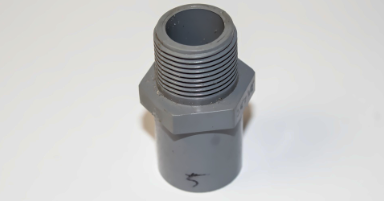
A male adapter connects a smooth PVC pipe to a threaded component. One end features a slip socket that accepts PVC pipe and bonds through solvent welding. The other end has male pipe threads (MPT), which screws into female threaded fittings on valves, pumps, and filters.
This design creates a transition point between permanent and removable connections. Installers glue the slip side to the PVC pipe, forming a sealed joint, while the threaded side allows disassembly for maintenance or replacement. Most PVC adapters use either Schedule 40 PVC or Schedule 80 PVC manufactured to ASTM D1784 material standards for strength and chemical resistance.
HOW MALE PVC ADAPTERS DIFFER FROM FEMALE ADAPTERS
A male adapter threads outward and fits into female threaded fittings. A female adapter works in reverse and accepts a male-threaded component. The difference affects installation and application.
Use male adapters when connecting directly into equipment ports or fittings that already feature internal threads. Use a female adapter when the external component has male threads. Thread compatibility matters, as mismatched threads often cause leaks or cracking.
Many installers prefer male adapters when connecting PVC pipe to pumps or filters because those components commonly include female threaded inlets.
COMMON USES FOR MALE PVC ADAPTERS
Male adapters support a wide range of systems that require threaded transitions, including:
- Irrigation systems and sprinkler assemblies where valves and manifolds require threaded connections
- Pool and spa plumbing that connects pumps, heaters, and filtration units
- Pump and filtration systems in residential and commercial settings
- Residential plumbing systems that combine rigid PVC pipe with threaded fixtures
- Industrial fluid handling and water treatment applications where maintenance access remains essential
These applications depend on pressure fittings that maintain integrity under flow and pressure fluctuations.
TYPES OF MALE PVC ADAPTERS
Different systems require different types of PVC fittings, and male adapters vary accordingly. Types of PVC adapters include:
- Schedule 40 PVC Male Adapters: Designed for standard pressure systems and commonly used in residential and light commercial applications. Browse options like Schedule 40 male adapters.
- Schedule 80 PVC Male Adapters: Built with thicker walls for higher pressure and more demanding environments. Explore Schedule 80 male adapters.
- Slip x MPT Configurations: The most common format, combining a solvent-weld socket with a male pipe thread.
- Pressure-Rated versus DWV Fittings: Pressure fittings handle pressurized systems, while you use DWV fittings for drains, waste, and vent applications.
Wall thickness differences between Schedule 40 PVC and Schedule 80 PVC directly affect pressure tolerance and durability.
HOW TO INSTALL A MALE PVC ADAPTER
Proper installation determines whether a system performs reliably or fails prematurely. Steps to install a male PVC adapter include:
- Cut the PVC pipe square and clean.
- Deburr the edge using a flap wheel or mounted wheel to remove sharp edges that can disrupt sealing.
- Dry-fit all pipe fittings to confirm alignment.
- Apply primer and solvent cement to the slip socket and pipe, then join immediately.
- Wrap PTFE tape or apply approved sealant to the male pipe thread.
- Thread the adapter into the female threaded fittings carefully to avoid cross-threading.
- Tighten snugly by hand, then add a slight turn with a wrench without overtightening.
- Allow proper cure time before pressurizing the system.
Mistakes to avoid include overtightening threaded PVC fittings, applying solvent cement to threaded connections, using incompatible sealants, cross-threading joints, and mixing incompatible materials such as metal and PVC without proper transition fittings.
HOW TO CHOOSE THE RIGHT MALE PVC ADAPTER
Selecting the right PVC male adapter requires attention to several factors, including:
- Match the nominal size of the PVC pipe. Consult a PVC Pipe Size Guide to verify dimensions.
- Choose between Schedule 40 PVC and Schedule 80 PVC based on pressure requirements.
- Evaluate temperature and chemical exposure, especially in industrial systems.
- Confirm compatibility with existing female adapter or female threaded fittings.
- Verify thread type, typically NPT, to ensure a proper seal.
Buyers also need to ensure compatibility with existing PVC pipes and system specifications.
MAINTENANCE AND LONG-TERM PERFORMANCE TIPS
PVC threaded connections last longer when installers and operators take proactive steps, including:
- Inspect joints periodically for leaks or stress cracks.
- Support piping properly to reduce strain on threaded connections.
- Minimize vibration and movement in the system.
- Replace worn or damaged pipe fittings immediately to prevent cascading failures.
Consistent maintenance preserves both performance and safety in pressure systems.
MAKE PVC CONNECTIONS WITH CONFIDENCE
Male adapters provide a reliable transition between solvent-welded PVC pipe and threaded components across residential, commercial and industrial systems. These fittings support flexibility, serviceability, and long-term durability when installed correctly.
Professionals and DIY users benefit from selecting the right materials, following proper installation practices and using high-quality PVC adapters that meet ASTM D1784 standards. Maxx Supply offers a wide selection of PVC fittings designed to meet demanding applications, making it easier to build systems that perform consistently under pressure. Explore the full range of solutions to ensure every connection holds strong.